
HSE-240 · Lesson 4 of 12 · 32 min
Law, standards and program requirements
Respiratory protection is one of the most heavily regulated areas of personal protective equipment. Both countries require employers to provide approved respirators, to run a written program and to cover fit testing, training and maintenance. The details differ. This lesson sets out the legal framework in your country, the standards it references, the elements every program must contain and the special case of voluntary use.
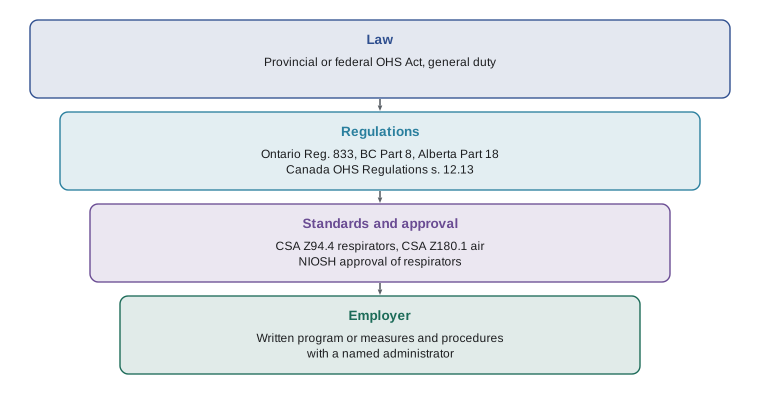
The legal framework
Each province and territory has its own occupational health and safety act and regulations, and federally regulated workplaces follow the Canada Labour Code. All of them impose a general duty on employers to take every reasonable precaution to protect workers, and most contain specific respirator requirements that reference CSA Z94.4, Selection, use and care of respirators. Approval of the respirators themselves almost always relies on the United States National Institute for Occupational Safety and Health (NIOSH), because Canada does not run its own general respirator approval program.
| Jurisdiction | Main respirator provisions | Key points |
|---|---|---|
| Ontario | Regulation 833, respirator sections added by O. Reg. 185/19 (in force 1 January 2020); designated substance regulation O. Reg. 490/09 | Written measures and procedures on selection, care and use; fit testing by qualitative or quantitative methods; training; breathing air to CSA Z180.1. The 2020 change replaced 16 separate respirator codes with consolidated rules. |
| British Columbia | OHS Regulation Part 8, ss. 8.33 to 8.44 | Written respirator program; selection to CSA Z94.4; fit testing at least once a year (s. 8.40), before first use and after changes |
| Alberta | OHS Code Part 18, ss. 245 to 255 | Written code of practice for respiratory protective equipment (s. 245); fit testing to CSA Z94.4 (s. 250); oxygen below 19.5 per cent requires atmosphere-supplying protection |
| Quebec | Regulation respecting occupational health and safety, ss. 45 to 48 | Respiratory protection program to CSA Z94.4; equipment inspected regularly |
| Federal | Canada Occupational Health and Safety Regulations, s. 12.13 | Respirators must be on a NIOSH list and comply with CSA Z94.4; breathing air to CSA Z180.1; use and maintenance to CSA Z94.4 |
Two cautions apply across Canada. First, several regulations still name older editions of CSA Z94.4, such as the 1993 or 2002 editions, while the current edition is CSA Z94.4-18 (reaffirmed in 2023). Inspectors generally expect the edition named in your regulation as a minimum, and many employers follow the current edition as good practice. Second, CSA released a revised draft, CSA Z94.4:25, for public review in 2025; it adds a dedicated section on health care settings. At the time of writing, check CSA Group for whether the revised edition has been published and which edition your regulator expects.
What a written program must contain
Although the wording differs, the required program elements are essentially the same in both countries. The table below lists them. Every later lesson in this course expands on one or more of these elements.
| Program element | What it requires | Lesson |
|---|---|---|
| Hazard assessment and selection | Identify respiratory hazards, estimate exposures and select approved respirators adequate for them | 3, 5, 6, 7 |
| Medical evaluation | Confirm each worker can wear the selected respirator without undue health risk before fit testing and use | 8 |
| Fit testing | Test each tight-fitting respirator on each wearer before use, periodically and after changes | 9 |
| Use procedures | Routine use, seal checks, facial hair, leaving the area, and procedures for emergencies and IDLH atmospheres | 9, 10, 11 |
| Maintenance and care | Cleaning, disinfecting, inspection, storage, repair and discarding | 10 |
| Cartridge and filter change schedules | Data-based replacement for gas and vapour cartridges and criteria for particulate filters | 7 |
| Breathing air quality | Air for supplied-air respirators and SCBA meets the specified grade | 11 |
| Training | Hazards, respirator limits, use, maintenance, emergencies and recognizing medical signs, before use and periodically | 10, 12 |
| Program evaluation | Regular checks that the program is followed and effective, including asking wearers | 12 |
| Records | Hazard assessments, medical clearances, fit tests, training and inspections | 12 |
CSA Z94.4-18 also emphasizes management responsibilities and clarifies the supervisor's role. Supervisors are expected to make sure workers use the respirators selected for them, to watch for problems with fit, comfort and condition, and to support the program administrator. The 2018 edition added guidance on comfort as a factor in selection and fit testing, on interferences such as facial hair, eyewear and dentures, and on bioaerosol exposures.
Approval of respirators
Canadian regulations generally require respirators approved by NIOSH. A NIOSH approval number, in the form TC-84A-xxxx for particulate respirators, appears on the respirator or its packaging, and the approval covers the complete assembly: the facepiece, the specific filters or cartridges and any other components. Mixing parts from different manufacturers voids the approval. During the COVID-19 pandemic Canada developed CSA Z94.4.1:21, a performance standard for filtering respirators intended to support a Canadian certification program aligned with NIOSH requirements. Respirators certified to it are marked with Canadian classes such as CA-N95. Check whether your regulation accepts them for workplace use.
Worked problem
Spotting a voided approval
A crew's half-facepiece respirators are from Manufacturer A. Because the store ran out, the crew buys organic vapour cartridges from Manufacturer B that physically fit the facepieces. Is this acceptable?
Show solution
- NIOSH approval applies to a specific combination of facepiece and cartridges tested together.
- Manufacturer B's cartridges are not part of Manufacturer A's approval, even if they fit.
- The assembly is therefore not approved, and using it would not comply with the regulation.
Answer: No. Use only the cartridges listed in the approval for that facepiece. Stock enough spares to avoid improvising.
Voluntary use
Sometimes workers want to wear a respirator even though the hazard assessment shows it is not required, for example an N95 during dusty sweeping well below the limit, or during allergy season. Voluntary use is generally allowed, but the employer still has responsibilities, because a respirator can create hazards of its own, such as a dirty facepiece or a worker with a heart condition wearing a tight-fitting mask in hot conditions.
Canadian rules on voluntary use are less detailed than OSHA's. CSA Z94.4 expects the employer to make sure voluntarily used respirators do not create a hazard, and many employers apply a simplified version of their program: information on limitations, cleaning and storage, and medical screening for tight-fitting elastomeric respirators. If the hazard assessment later shows the respirator is needed, the use is no longer voluntary and all program elements apply.
Worked problem
Is this use voluntary?
Air sampling in a woodworking shop shows wood dust at 20 per cent of the limit. Two workers ask to wear N95 filtering facepieces, and a third wants to wear his own elastomeric half mask with P100 filters. What does the employer need to do?
Show solution
- Exposure is well below the limit, so respirators are not required by the hazard assessment.
- All three are voluntary users. The employer must make sure the respirators do not create a hazard.
- Give all three information on limitations, use, cleaning and storage. For the elastomeric user, apply medical screening and maintenance procedures, because a tight-fitting reusable respirator carries more physiological and hygiene risk.
- Reassess if exposures increase; if respirators become necessary, the full program applies.
Answer: Provide information to all three and apply medical screening and maintenance procedures for the elastomeric user. Reassess if conditions change.
Responsibilities on multi-employer sites
On construction sites and in contracted maintenance, several employers' workers may share the same atmosphere. Each employer is responsible for its own workers' respiratory protection, but the employer that controls the site, such as the constructor or host employer, must coordinate. A painting contractor's spray mist can expose an electrician working nearby who has no respirator and no idea the exposure exists. Coordination means sharing hazard information, scheduling incompatible work apart, setting up controlled areas with signs, and confirming that each contractor has its own program.
Worked problem
A contractor program gap review
A facility hires a contractor to remove old floor coatings with solvents. The contractor's binder contains a one-page respirator policy saying 'workers will wear respirators as needed', a list of fit test dates from three years ago and purchase receipts for cartridges. What gaps should the host employer raise before work starts?
Show solution
- No hazard assessment or exposure estimate for the specific solvents and task.
- No selection rationale or cartridge change schedule for the solvents.
- No evidence of medical evaluation.
- Fit tests are three years old, older than the interval in CSA Z94.4 practice and the annual requirement in some provinces.
- No training records, maintenance procedures or program administrator named.
Answer: The contractor has respirators but not a program. The host should require a task-specific hazard assessment, selection and change schedule, current fit tests and medical clearances, training records and a named administrator before the work proceeds.
Records
Keep records of hazard assessments and exposure monitoring, respirator selection decisions, medical clearances (with confidential medical details held by the health professional, not the supervisor), fit tests, training, inspections of emergency respirators and breathing air tests. Provincial rules vary on how long records must be kept, and exposure records may be needed decades later for occupational disease claims, so many employers keep them for at least 40 years after employment ends.
Inspections and enforcement
When an inspector visits a workplace where respirators are used, the questions are predictable. Is there a written program, or written measures and procedures as Ontario calls them? Does it name the hazards and the respirators selected for each task, and explain why? Can the employer show medical clearances, current fit tests and training records for each worker on the roster? Are cartridge change schedules written down and followed? Are respirators clean, in good condition and stored properly? Is breathing air tested? Inspectors also talk to workers, and a worker who cannot explain when to change cartridges or how to do a seal check is evidence that training has not worked. Orders typically require the gaps to be fixed by a set date, and stop-work orders are possible where workers are exposed to serious hazards without adequate protection.
Enforcement is not the main reason to run a good program, but inspection questions are a useful self-audit. If you cannot answer one of them quickly with a document or a demonstration, that part of the program probably does not work in practice either.
Worked problem
Preparing for an inspection question
An inspector asks a supervisor to show how the company decided that a half mask with organic vapour cartridges is adequate for the parts-washing task, and how often the cartridges are changed. What documents should the supervisor be able to produce?
Show solution
- The hazard assessment for the task, with exposure monitoring results or a documented estimate.
- The selection calculation: expected concentration divided by the limit, compared with the APF of 10, and a check against the IDLH and cartridge limits.
- The change schedule, with the manufacturer's service life printout and the conditions assumed.
- Fit test, medical clearance and training records for the workers doing the task.
Answer: The assessment, the selection calculation, the change schedule with its data source, and individual worker records. Together they show the decision was deliberate and documented.
Common mistakes
MistakeTreating a box of respirators and a fit test list as a program.
InsteadMaintain a written program covering every required element, with a named administrator.
MistakeMixing facepieces and cartridges from different manufacturers because they fit.
InsteadUse only components listed in the NIOSH approval for that assembly.
MistakeAssuming the current CSA edition is the only one that matters.
InsteadCheck which CSA Z94.4 edition your regulation names, and follow the current edition as good practice.
MistakeIgnoring respirators that workers wear voluntarily.
InsteadMake sure voluntary use does not create a hazard and give the required information.
MistakeLetting supervisors see workers' detailed medical information.
InsteadSupervisors receive only the health professional's clearance and limitations.
MistakeAssuming each contractor's exposures stay within its own work area.
InsteadCoordinate hazards, scheduling and controlled areas on multi-employer sites.
Summary and key terms
- Canadian provinces, territories and the federal government each regulate respirators, mostly referencing CSA Z94.4 and requiring NIOSH-approved respirators.
- Ontario consolidated its respirator rules in Regulation 833 from 1 January 2020; BC requires annual fit testing; Alberta requires a code of practice.
- Every program covers selection, medical evaluation, fit testing, use, maintenance, change schedules, breathing air, training, evaluation and records.
- NIOSH approval covers the complete assembly; mixing components voids it.
- Voluntary use is allowed if the respirator does not create a hazard, with information and, for reusable tight-fitting respirators, medical and maintenance controls.
- Host employers and constructors must coordinate respiratory hazards between contractors.
- Records of assessments, medical clearances, fit tests and training support the program and may be needed decades later.
- CSA Z94.4
- The Canadian standard for the selection, use and care of respirators.
- CSA Z94.4.1
- A Canadian performance standard for filtering respirators, published in 2021.
- 29 CFR 1910.134
- OSHA's Respiratory Protection standard.
- NIOSH approval
- Certification by the US National Institute for Occupational Safety and Health that a complete respirator assembly meets 42 CFR Part 84.
- TC number
- The NIOSH approval number marked on a respirator, such as TC-84A for particulate respirators.
- Voluntary use
- Respirator use that is not required by the hazard assessment or by a regulation.
- Appendix D
- The information sheet in OSHA's standard that must be given to voluntary respirator users.
- Code of practice
- A written set of procedures required by some jurisdictions, such as Alberta, for respirator selection, use and maintenance.
- State plan
- A US state occupational safety and health program approved by OSHA.
- Constructor
- In Ontario, the party with overall responsibility for a construction project, which must coordinate safety between contractors.
Practice problems
Work each problem on paper first, then reveal the answer to check.
Which standard do most Canadian regulations reference for respirator programs?
Show answer
CSA Z94.4, Selection, use and care of respirators.
Who approves respirators used in both Canadian and US workplaces?
Show answer
NIOSH, under 42 CFR Part 84.
List six required program elements.
Show answer
Any six of selection, medical evaluation, fit testing, use procedures, maintenance, change schedules, breathing air, training, evaluation and records.
Why does mixing a facepiece and cartridges from different manufacturers matter?
Show answer
NIOSH approval covers the tested assembly; mixing components voids it.
How often does BC require fit testing?
Show answer
At least once a year, before first use and after changes.
A worker voluntarily wears an elastomeric half mask. What controls are still needed?
Show answer
Information on limitations, plus medical screening and cleaning, storage and maintenance procedures.
What should a supervisor receive from a medical evaluation?
Show answer
Only the clearance and any limitations, not detailed medical information.
Why is coordination needed on a multi-employer site?
Show answer
One contractor's contaminants can expose other workers who have no respirators or information.
What did O. Reg. 185/19 change?
Show answer
It added consolidated respirator requirements to Regulation 833 from 1 January 2020, replacing 16 separate codes.
Why keep exposure records for decades?
Show answer
Occupational diseases appear years later, and records support claims and medical follow-up.
Lesson quiz · 5 questions
Score 60% or more to complete this lesson.
Create a free account to save your progress, take quizzes and earn a certificate.