
HSE-240 · Lesson 10 of 12 · 30 min
Use, maintenance, cleaning and storage
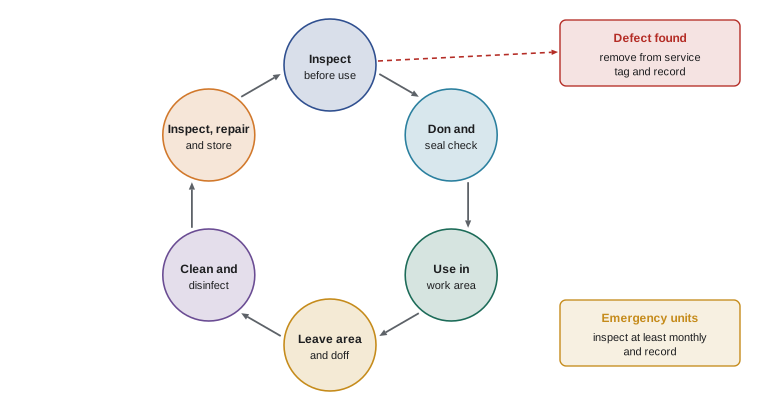
A respirator that was correctly selected and fit-tested can still fail because it was worn wrongly, left dirty, stored crushed in a toolbox or used with a cracked valve. Daily use and care are where most programs succeed or fail, and they are largely in the hands of supervisors and workers. This lesson covers how respirators should be worn and removed, when workers must leave the contaminated area, and how respirators are cleaned, inspected, repaired and stored. It also covers training, which ties the daily practices together.
Wearing a respirator correctly
Every program should have a written donning procedure based on the manufacturer's instructions. The common steps for a tight-fitting elastomeric respirator are: inspect it; position the facepiece over the nose and mouth (or the whole face for a full facepiece); fasten the head harness or straps in the order the manufacturer specifies, starting with the crown straps; tighten the straps evenly without over-tightening; and perform positive and negative pressure seal checks. For filtering facepieces, the metal nose clip must be moulded with both hands to the shape of the nose; pinching it with one hand creates a sharp bend and leaks.
The respirator must stay on for the entire time the worker is in the contaminated atmosphere. Lesson 1 showed how quickly short gaps erode protection. Practices that undermine wear time include pulling the mask down to talk on a radio, wearing the straps over a hard hat brim, letting a filtering facepiece hang around the neck between tasks so that contaminated surfaces touch the inside, and removing the respirator in the work area to drink or wipe sweat.
Workers must be allowed and expected to leave the contaminated area when they need to wash their face or respirator, change filters or cartridges, or when they notice vapour breakthrough, a change in breathing resistance or leakage of the facepiece. CSA Z94.4 sets out these expectations, and the respirator must be repaired or replaced before the worker returns.
Removing a contaminated respirator
Removal, called doffing, matters because the outside of a used respirator is contaminated. Workers should leave the contaminated area first, remove other protective equipment in the planned order, then remove the respirator by the straps without touching the front, and wash their hands. For highly toxic dusts, asbestos and infectious agents, doffing is part of a formal decontamination procedure, often in a designated area, and is covered in HSE-242, HSE-245 and HSE-246.
Worked problem
Planning a doffing sequence
A worker leaves a lead abatement area wearing disposable coveralls with a hood, gloves and a half-mask respirator with P100 filters. In what order should the equipment come off, and why?
Show solution
- In the designated decontamination area, vacuum the coveralls with a HEPA vacuum or wet-wipe visible dust.
- Remove the coveralls by rolling them inside out away from the body, then the gloves, keeping the respirator on so that dust released during removal is not inhaled.
- Remove the respirator last by the straps, without touching the facepiece front, and place it in a bag for cleaning.
- Wash hands and face before eating, drinking or smoking.
Answer: Coveralls and gloves first, respirator last, then wash. Keeping the respirator on until last protects the worker from dust shaken loose during undressing.
Cleaning and disinfecting
Reusable respirators must be cleaned and disinfected regularly. Sweat, skin oils and contaminants on the facepiece cause skin irritation and degrade rubber and silicone, and a dirty respirator worn by a second worker can spread infection. Cleaning should follow the manufacturer's instructions or a recognized procedure.
| Step | What to do |
|---|---|
| 1. Disassemble | Remove filters, cartridges, canisters and, if the manufacturer allows, valves and diaphragms. Discard or set aside filters and cartridges according to the change schedule. |
| 2. Wash | Wash components in warm water (no hotter than about 43 °C) with a mild detergent or the manufacturer's cleaner, using a soft brush. |
| 3. Rinse | Rinse thoroughly in clean, warm running water. |
| 4. Disinfect | If the cleaner does not disinfect, immerse in a disinfectant recommended by the manufacturer for the time specified. |
| 5. Rinse again | Rinse thoroughly to remove disinfectant, which can irritate skin and degrade elastomers. |
| 6. Dry | Air-dry in a clean area or with clean lint-free cloths; avoid heat sources. |
| 7. Reassemble and test | Reassemble, replace damaged parts and perform a functional check. |
CSA Z94.4 expects respirators to be cleaned as often as needed to keep them sanitary, and shared respirators to be cleaned and disinfected before use by another person. Respirators used for fit testing and emergency respirators should be cleaned after each use.
Avoid solvents, alcohol wipes used aggressively, high temperatures and harsh disinfectants unless the manufacturer approves them. They can crack or distort facepieces, harden valves and break down the elastic in straps. Filters and cartridges must never be washed.
Inspection
Respirators are inspected before each use, during cleaning and, for emergency respirators, on a fixed schedule. A good inspection checklist covers every part of the respirator.
| Component | Look for |
|---|---|
| Facepiece | Cracks, tears, holes, distortion, stiffness, loss of shape, dirt |
| Head straps and harness | Loss of elasticity, breaks, worn buckles, missing parts |
| Inhalation and exhalation valves | Missing, curled, torn or dirty valve flaps; damaged valve seats; missing valve covers |
| Filters, cartridges and holders | Correct type for the hazard, approval match, damage, expiry date, change schedule status, threads and gaskets |
| Lens (full facepiece) | Scratches that impair vision, cracks, poor seal at the lens ring |
| PAPR | Battery charge, blower operation, airflow check with the manufacturer's flow indicator, hose condition, belt |
| Supplied-air and SCBA | Hose, couplings, regulator, alarms, cylinder pressure and hydrostatic test date (lesson 11) |
Emergency respirators, such as SCBA kept for rescue and escape respirators, need a documented periodic inspection. CSA Z94.4 and manufacturers generally call for at least monthly inspection of SCBA held for emergency use, with records of the date, inspector and findings.
Worked problem
An SCBA cylinder pressure check
An emergency SCBA cylinder has a rated service pressure of 300 bar. During the monthly inspection, the gauge reads 265 bar. Many programs, following manufacturer guidance, recharge when pressure falls below 90 per cent of the rated pressure. Should the cylinder be recharged?
Show solution
- 90 per cent of 300 bar = 270 bar.
- The gauge reads 265 bar, below 270 bar.
- Recharge the cylinder before returning it to service, record the inspection and check for a slow leak if pressure keeps falling between inspections.
Answer: Yes. The cylinder is below the 90 per cent threshold and must be recharged before it is considered ready for emergency use.
Repairs and parts
Respirators that fail inspection must be removed from service and discarded, repaired or adjusted. Repairs and adjustments must be made only by people appropriately trained, using only the manufacturer's NIOSH-approved parts designed for that respirator. Regulators, reducing valves and alarms on supplied-air respirators and SCBA must be adjusted or repaired only by the manufacturer or a technician trained by the manufacturer. Improvised repairs, such as taping a cracked facepiece or substituting a valve from another brand, void the approval and can create hidden leaks.
Storage
Respirators must be stored so that they are protected from damage, contamination, dust, sunlight, extreme temperatures, excessive moisture and damaging chemicals, and packed or stored so that the facepiece and valves do not become deformed. A clean, sealed bag or container in a locker is typical. Storing a respirator loose in a toolbox, on a dashboard, hanging from a nail in the work area, or with the facepiece folded flat will damage it and contaminate the inside.
Emergency respirators must be stored where they are accessible to the work area, in compartments or covers clearly marked as containing emergency respirators, and in accordance with the manufacturer's instructions. Escape respirators should be located along escape routes and checked so that workers know where they are.
Training
Training is what turns written procedures into everyday practice. It must happen before a worker first uses a respirator, be repeated periodically, and be refreshed when conditions or respirators change or when a worker's behaviour shows they have not retained it.
| Training topic | What workers should be able to do |
|---|---|
| Why the respirator is needed | Explain the hazard and how the respirator protects them |
| Limitations and capabilities | Explain what the respirator does not protect against, such as oxygen deficiency for air-purifying types |
| Fit and use | Explain how poor fit, wear or maintenance reduces protection |
| Donning, seal checks and doffing | Demonstrate the steps correctly |
| Inspection, maintenance and storage | Inspect, clean and store their respirator; identify defects |
| Change schedules | State when filters and cartridges must be changed |
| Emergencies | Explain what to do if the respirator fails or conditions change; use escape respirators |
| Medical signs | Recognize symptoms that limit effective use, such as dizziness or breathlessness, and report them |
| Legal requirements | Describe the general requirements of the program and their rights |
CSA Z94.4-18 expanded the classes of initial and routine training and clarified the supervisor's role. Supervisors need training too, because they enforce use, notice problems and support the program. Many Canadian programs combine refresher training with the periodic fit test.
Worked problem
Investigating a skin rash
Several workers on a night shift develop a rash where their half masks seal. All wear their own respirators, which are stored in an open bin at the end of the shift. Workers say they clean them 'when they look dirty' using whatever wipes are available. What should the supervisor investigate and change?
Show solution
- Check what wipes or chemicals are being used; some disinfectants and solvents irritate skin and must be rinsed off.
- Check how often respirators are cleaned; sweat and contaminants left on the facepiece irritate skin.
- Check storage; an open bin allows contamination and deformation.
- Introduce a written cleaning procedure using the manufacturer's cleaner, with rinsing and drying, and individual sealed storage.
- Refer affected workers to the health professional and consider different facepiece materials, such as silicone, for sensitive skin.
Answer: The rash points to cleaning and storage practices. A written procedure, proper cleaners, rinsing, individual storage and medical referral should resolve it.
Supervising daily practice
Supervisors see respirator practice every day, so their habits set the standard. A few simple routines catch most problems: a quick look at respirators at the start of each shift, a check that cartridges carry the date they were installed, a glance at storage lockers once a week, and attention to workers who keep adjusting or lifting their respirators, which usually signals poor fit, discomfort or heat strain. When a supervisor sees a problem, the response should be immediate and practical: send the worker to clean, refit or replace the respirator before returning, and record anything that points to a program weakness, such as a model that many workers find uncomfortable. Supervisors who wear respirators themselves whenever they enter a respirator area send a stronger message than any poster.
Common mistakes
MistakePulling the respirator down to talk on the radio in the contaminated area.
InsteadKeep the respirator on in the contaminated area; use a respirator compatible with radio communication or step out.
MistakeRemoving the respirator before the coveralls during decontamination.
InsteadRemove the respirator last, after other contaminated equipment.
MistakeWashing filters or cartridges.
InsteadNever wash filters or cartridges; replace them according to the change schedule.
MistakeStoring respirators loose in a toolbox or vehicle.
InsteadStore them clean, in sealed bags or containers, protected from damage, heat and contamination.
MistakeTaping a cracked facepiece or using a valve from another brand.
InsteadRemove damaged respirators from service; repair only with the manufacturer's approved parts by trained people.
MistakeSkipping monthly inspection of emergency SCBA because it has not been used.
InsteadInspect emergency respirators at least monthly and record the results.
Summary and key terms
- Follow a written donning procedure, including seal checks, and keep the respirator on for the whole time in the contaminated atmosphere.
- Workers must be allowed to leave the area to wash, change filters or cartridges, or when they notice breakthrough, resistance changes or leakage.
- Remove contaminated respirators last, by the straps, after leaving the area, and wash hands.
- Clean and disinfect reusable respirators regularly, shared respirators between users, and emergency and fit-test respirators after each use.
- Inspect before each use and during cleaning; inspect emergency respirators at least monthly and record the results.
- Repair only with approved parts by trained people, and store respirators protected from damage and contamination.
- Train workers before use and periodically on hazards, limitations, use, care, change schedules, emergencies and medical signs.
- Donning
- Putting on a respirator or other protective equipment.
- Doffing
- Removing a respirator or other protective equipment, usually in a planned order.
- Decontamination
- The removal of contaminants from workers and equipment before leaving a controlled area.
- Exclusive use
- A respirator issued to only one worker.
- Emergency respirator
- A respirator kept for use in emergencies, rescue or escape.
- Valve flap
- The thin, flexible disc in a respirator valve that controls air direction.
- Hydrostatic test
- A pressure test of a compressed gas cylinder required at set intervals.
- Service pressure
- The rated filling pressure of a compressed air cylinder.
- Retraining
- Repeat training given when conditions change or workers show they have not retained earlier training.
Practice problems
Work each problem on paper first, then reveal the answer to check.
Why must a filtering facepiece nose clip be shaped with both hands?
Show answer
Pinching with one hand creates a sharp bend that leaves gaps and leaks.
Name three situations in which a worker should leave the contaminated area.
Show answer
To wash face or respirator, to change filters or cartridges, or on noticing breakthrough, resistance changes or leakage.
Why is the respirator removed last during decontamination?
Show answer
Removing other contaminated clothing releases dust that would otherwise be inhaled.
List the main steps in cleaning a reusable respirator.
Show answer
Disassemble, wash, rinse, disinfect, rinse again, dry, reassemble and test.
What happens if disinfectant is not rinsed off?
Show answer
It can irritate skin and degrade the facepiece and valves.
Name four things to check on a facepiece and valves.
Show answer
Cracks, distortion, stiffness, dirt, missing or curled valve flaps, damaged valve seats.
A 300 bar SCBA cylinder reads 275 bar. Is it below 90 per cent?
Show answer
No; 90 per cent is 270 bar, so 275 bar is acceptable.
Who may repair SCBA regulators and alarms?
Show answer
Only the manufacturer or a technician trained by the manufacturer.
Give three storage requirements for respirators.
Show answer
Protection from damage, contamination, dust, sunlight, extreme temperatures, moisture and chemicals; no deformation; emergency units accessible and marked.
When is retraining required?
Show answer
When the workplace or respirator changes, when workers show they have not retained training, and periodically.
Lesson quiz · 5 questions
Score 60% or more to complete this lesson.
Create a free account to save your progress, take quizzes and earn a certificate.