
HSE-221 · Lesson 7 of 12 · 25 min
The permit life cycle
A permit is not a single moment of signing. It has a life cycle that starts when someone first identifies the work and ends only when the plant has been returned to operations and the permit is filed. Each stage has its own purpose, its own checks and its own ways of going wrong. This lesson walks through the life cycle stage by stage, using the sequence most sites follow, and shows how the permit's period of validity is managed across shifts.
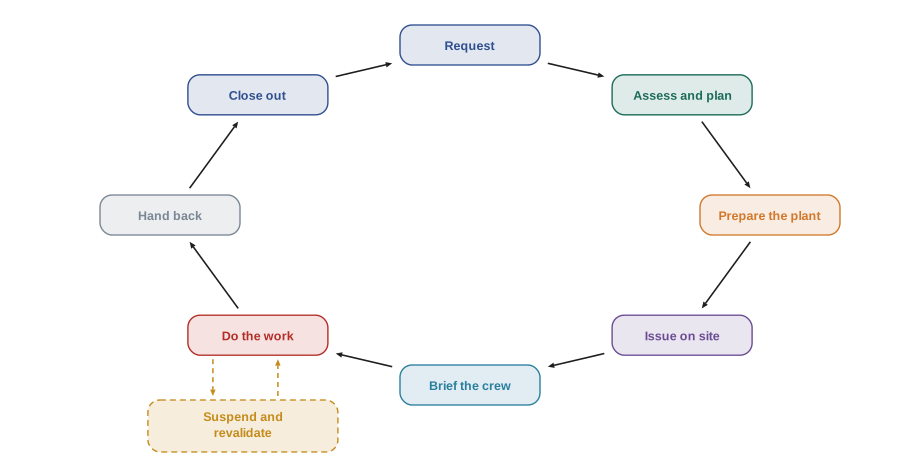
1. Request
The cycle begins when a planner, supervisor or contractor identifies work that needs a permit and submits a request. The request describes the job, the equipment by tag number, the location, the expected start and duration, the number of people and the contractor involved. Good requests arrive early, ideally a day or more before the work for routine maintenance and weeks ahead for shutdown work, so that the area authority can plan isolations and avoid conflicts. Requests that arrive at 7 a.m. for work starting at 7:15 put pressure on everyone to cut corners.
2. Assess and plan
Before a permit can be prepared, the hazards of the specific task must be assessed. Most sites use a job hazard analysis or job safety analysis that breaks the task into steps and identifies the hazards and controls at each step. HSE-223 covers risk assessment methods in detail. For permitted work, the assessment should address the plant state needed (isolated, drained, purged, cooled), the hazards the work itself creates (sparks, dropped objects, line release), the environment (weather, nearby operations, other permits) and emergency arrangements. The output is a list of precautions that will appear on the permit and its certificates.
3. Prepare the plant
Operations now prepares the equipment. This may involve shutting down, isolating, depressurizing, draining, flushing, purging, steaming out, ventilating, cooling and testing. Each isolation is applied by an isolating authority and recorded on an isolation certificate. Gas tests are carried out by an authorized gas tester and recorded. Barriers, signs and drip trays are put in place. This stage can take minutes for a simple job or days for a large vessel. The permit must not be issued until preparation is complete and verified.
4. Issue on site
The issuer and the permit holder meet at the work site for the joint site visit. Together they confirm that the right equipment has been identified, that the isolations on the certificate are in place and verified, that the gas test results are acceptable and current, that the area is safe and that the precautions are adequate. The issuer explains the hazards, the limits of the work and any special conditions. If both are satisfied, both sign the permit, and the issuer records the time of issue and the validity period. The permit, or a copy, is displayed at the work site, and the control room or permit office records it as live.
5. Brief the crew
Before work starts, the permit holder briefs every member of the work party at the job site. This toolbox talk covers the scope of work, the hazards, the precautions, the PPE, emergency arrangements, the limits of the permit and the conditions under which work must stop. Each crew member signs or otherwise acknowledges the permit. Anyone joining the crew later must receive the same briefing before starting.
6. Do the work
The crew carries out the job within the limits of the permit. During the work:
- The permit stays at the work site, visible to anyone who needs to check it.
- Gas tests are repeated at the intervals the permit requires, and after any break, change of conditions or alarm.
- The holder watches for changes in conditions, such as a new smell, a leak, weather or nearby activity, and stops work if conditions change.
- If the scope needs to change, work stops and the permit is reviewed or reissued; the crew never simply carries on.
- Supervisors and issuers make periodic checks to confirm the permit conditions are still being met.
Suspension and revalidation
Many jobs last longer than one shift. When the work stops at the end of a shift, for a break or because of an emergency or alarm, the permit is suspended. The holder makes the site safe, records the state of the work, and signs the suspension section; the issuer accepts the suspension. Before work resumes, the permit is revalidated: the issuer and holder (who may be new people on the next shift) check that the isolations are intact, retest the atmosphere, confirm that nothing has changed, and sign the revalidation. Lesson 10 deals with suspension, handover and long-duration work in detail.
| Stage | Key check | Who signs |
|---|---|---|
| Request | Scope, equipment, timing, contractor | Requester |
| Assess and plan | Job hazard analysis, precautions | Planner, issuer |
| Prepare | Isolations applied and verified, gas tests | Isolating authority, gas tester |
| Issue | Joint site visit, precautions in place | Issuer and holder |
| Brief | Crew understands hazards and limits | Holder and each crew member |
| Work | Conditions maintained, retests done | Holder (and gas tester for retests) |
| Suspend and revalidate | Site safe, isolations intact, retest | Holder and issuer |
| Hand back and close | Work complete, site clean, isolations removed | Holder, issuer, isolating authority |
7. Hand back
When the work is finished, the holder makes sure the crew has left the area, tools and materials have been removed, temporary equipment such as blinds or barriers is accounted for, and the equipment is in a fit state to return to service. The holder signs the handback section to declare that the work is complete and the equipment is ready to return to operations. If the work is not finished but the permit is no longer needed, for example because the job is being stopped, the holder records exactly what state the equipment has been left in.
8. Close out
The issuer inspects the site with the holder, confirms that the work is complete and the site is clean and safe, and accepts the handback. Isolations are then removed in a controlled sequence by the isolating authority, under the isolation certificate, making sure that every person and every lock has been cleared. The equipment is tested or commissioned as needed and returned to operations. The issuer closes the permit, records the time, and the control room or permit office updates its records. Closed permits are kept for a set period for audit and investigation.
Managing validity across shifts
Every permit has a validity period. Sites usually limit permits to one shift, a fixed number of hours, or a maximum number of days with revalidation at each shift change. The aim is to make sure someone who knows the current state of the plant looks at the work at regular intervals. Validity rules must be simple enough that everyone can tell at a glance whether a permit is current.
Worked problem
Is this permit still valid?
A site's rules say a permit may be issued for up to 7 days, must be revalidated at the start of every shift, and a hot work certificate attached to it expires at the end of the shift on which it was issued. Shifts run 06:00 to 18:00 and 18:00 to 06:00. A general permit with a hot work certificate is issued on Monday at 08:30. The night shift revalidates the general permit at 18:20 on Monday. At 21:00 a welder wants to continue grinding. At 07:00 on Tuesday the day crew arrives. Which documents are valid at 21:00 Monday and at 07:00 Tuesday?
Show solution
- At 21:00 Monday the general permit is valid, because it was revalidated at 18:20 at the start of the night shift and is within its 7-day maximum.
- The hot work certificate issued at 08:30 Monday expired at the end of the day shift at 18:00. At 21:00 it is no longer valid, so grinding must not continue until a new hot work certificate is issued, with a fresh gas test and fire watch arrangements.
- At 07:00 Tuesday the general permit has not yet been revalidated for the day shift that began at 06:00. Work must not restart until revalidation is signed.
- Any hot work on Tuesday needs a new hot work certificate issued on the day shift.
Answer: At 21:00 the general permit is valid but the hot work certificate is not; at 07:00 neither may be used until the general permit is revalidated and a new hot work certificate is issued.
Permits are also commonly limited by the number of revalidations, for example a maximum of 14 shifts, after which the job must be reassessed and a new permit issued. This prevents permits from running on for weeks while conditions slowly drift away from those originally assessed.
What happens in an emergency
When an emergency alarm sounds, all permitted work stops. Permits are automatically suspended, and the work party leaves the area by the planned route. Before work resumes, every permit in the affected area must be revalidated, because the emergency may have changed conditions, for example by releasing gas, opening isolations or activating deluge. Some sites require new gas tests for all permits after any alarm in the area, even a false one.
In Canada, emergency procedures for permitted work should align with the site emergency response plan required under provincial OHS rules and, for many facilities, the fire code's fire safety plan (see HSE-105).
Keeping the record
Throughout the life cycle, the permit register keeps track of every permit's status. Whether it is a rack of permits in the control room, a logbook or an electronic system, the register should show at any moment which permits are planned, live, suspended and closed, where each job is, who holds each permit, and which isolations and certificates are linked. The register is used at coordination meetings, at shift handover and by operators before they make any change to the plant. A permit that is live in the field but missing from the register is a serious failure, because others will plan and operate as if the work does not exist.
When the life cycle is cut short
Not every permit runs its full course. A job may be cancelled before issue because priorities change, or stopped partway because the scope turns out to be different from what was planned. A cancelled permit should be marked as cancelled in the register so that no one later assumes the work is still pending. A stopped job should be handed back with an exact record of the state of the equipment, and any isolations should either stay in place under a long-term isolation certificate or be removed through the normal close-out process. Leaving a job half-finished without a clear record is one of the classic ways that hazards are passed silently to the next person.
A simple way to check your understanding of the life cycle is to pick a real permit from your site and trace it through each stage: who requested it, what assessment it was based on, how the plant was prepared, who issued and accepted it, how the crew was briefed, how many times it was suspended and revalidated, and how it was closed. Gaps in that story are gaps in the system.
Common mistakes
MistakeSubmitting permit requests at the last minute.
InsteadRequest permits early so isolations and conflicts can be planned.
MistakeIssuing the permit before the plant is fully prepared.
InsteadIssue only after isolations and tests are complete and verified.
MistakeRestarting work after a break or shift change without revalidation.
InsteadRevalidate every suspended permit before work resumes.
MistakeContinuing hot work on an expired certificate because the main permit is valid.
InsteadCheck the validity of every linked certificate, not just the main permit.
MistakeRemoving isolations before the handback is accepted.
InsteadRemove isolations only after the issuer accepts the handback and all people and locks are cleared.
Summary and key terms
- The permit life cycle runs from request through assessment, preparation, issue, briefing, work, handback and close-out.
- Requests should arrive early enough to plan isolations and avoid conflicts.
- Permits are issued only after the plant is prepared and verified, at a joint site visit.
- Every crew member is briefed and acknowledges the permit before work.
- Permits are suspended at breaks, shift ends and emergencies, and revalidated before work resumes.
- Linked certificates may expire sooner than the main permit.
- Isolations are removed only after handback is accepted and everyone is clear.
- Permit life cycle
- The sequence of stages from request to close-out.
- Validity period
- The time during which a permit or certificate may be used.
- Revalidation
- The check and signature needed before suspended work resumes.
- Suspension
- The formal pause of a permit with the site left safe.
- Handback
- The holder's declaration that work is complete and equipment is ready to return.
- Toolbox talk
- A briefing at the work site before work starts.
- Job hazard analysis
- A step-by-step review of the task to identify hazards and controls.
- Preparation
- Isolating, draining, purging, cleaning and testing plant before work.
- Live permit
- A permit that has been issued and not yet closed.
- Permit register
- The record of all live, suspended and closed permits.
Practice problems
Work each problem on paper first, then reveal the answer to check.
List the main stages of the permit life cycle.
Show answer
Request, assess, prepare, issue, brief, work, suspend and revalidate, hand back, close out.
Why should permit requests be made early?
Show answer
To allow planning of isolations and avoid conflicts with other work.
What must be complete before a permit is issued?
Show answer
Plant preparation, isolations and gas tests, all verified.
What happens to permits when an emergency alarm sounds?
Show answer
All permitted work stops and permits are suspended until revalidated.
Who signs the handback?
Show answer
The permit holder, with acceptance by the issuer.
Why limit the number of revalidations?
Show answer
To force reassessment before conditions drift from those originally assessed.
A hot work certificate expires at shift end but the main permit is valid for 7 days. Can hot work continue next shift?
Show answer
Not without a new hot work certificate.
When are isolations removed?
Show answer
After handback is accepted and all people and locks are cleared.
What should a new crew member do before joining work?
Show answer
Receive the briefing and acknowledge the permit.
Why are closed permits kept?
Show answer
For audits and investigations.
Lesson quiz · 5 questions
Score 60% or more to complete this lesson.
Create a free account to save your progress, take quizzes and earn a certificate.