
HSE-221 · Lesson 5 of 12 · 25 min
Permit types and linked certificates
Once a site has decided which work needs a permit, it has to decide what the permits look like. Some sites use one universal form with sections that are switched on for each hazard. Others use a family of separate permits, each designed for a particular kind of work. Most large sites use a hybrid: a main permit for the job, with certificates attached for specific hazards and precautions. This lesson describes the common permit types, the certificates that link to them, and the information every permit form needs. It builds on the hazard-specific courses (HSE-210 lockout, HSE-211 confined spaces, HSE-212 heights, HSE-214 electrical and HSE-216 hot work) without repeating their technical content.
What every permit must contain
Whatever its type, a permit form should capture the same core information. HSG250 and most company standards list similar contents:
- A unique permit number, so the permit can be tracked, cross-referenced and audited.
- The exact location and the equipment to be worked on, identified by tag number where possible.
- A clear description of the work, specific enough that the issuer and holder agree on what is and is not included.
- The hazards identified, with a reference to the risk assessment or job hazard analysis.
- The precautions required before work starts and during the work, and who is responsible for each.
- References to linked certificates, such as isolation, gas test or confined space entry certificates, and to any other permits in the same area.
- The personal protective equipment required.
- The time and date of issue and the period of validity, including any limits on shifts.
- Signatures of the issuer and the permit holder, and acknowledgement by each member of the work party.
- Sections for suspension, revalidation, handback and close-out, with signatures and times.
A form that leaves out any of these invites misunderstanding. The most common weakness found in permit audits is a vague job description, such as 'repair pump', which gives the issuer no basis for deciding what isolations are needed and gives the holder no limit on what they may do.
Common permit types
General or cold work permit: Used for non-routine work that does not produce heat or sparks but still involves hazards, such as breaking containment, mechanical maintenance on process equipment, scaffolding in operating areas or work on roofs. Some sites call it a cold work permit to distinguish it from hot work. It is often the base permit to which other certificates are attached.
Hot work permit: Covers welding, cutting, grinding, brazing, torch work and other work that can ignite flammable materials. It records gas test results, the protection of combustibles, fire watch requirements and post-work monitoring. HSE-216 covers hot work in detail. Some sites split hot work into two levels: open flame and spark-producing work, and lower-energy work such as using non-certified electrical tools in a classified area.
Confined space entry permit: Required for entry into a space such as a tank, vessel, pit or sewer that meets the legal definition of a confined space or permit-required confined space. It records isolations, atmospheric testing, ventilation, the attendant and the rescue plan. HSE-211 covers the details.
Energized electrical work permit: Used when work must be done on or near exposed energized conductors because de-energizing is not feasible or would create a greater hazard. It records the justification, the shock and arc flash risk assessments, approach boundaries and PPE, following CSA Z462 in Canada or NFPA 70E in the US. Many organizations make these permits hard to obtain on purpose, requiring senior sign-off, so that de-energizing remains the normal choice.
Excavation or ground disturbance permit: Covers digging, trenching, drilling, boring or driving stakes where buried services may exist. It records utility locates, hand-digging zones, protective systems and spoil placement. In Canada, ground disturbance is a defined term in several provinces and in the energy industry, with standards such as the Alberta ground disturbance standard used by many operators.
Work at height permit: Used on some sites for work where fall protection is not already provided, such as roof work, work on unguarded structures or rope access. Others handle height through the general permit with a fall protection plan attached.
Lifting permit or lift plan: Required for critical or complex lifts, often defined by load as a percentage of crane capacity, lifts over live equipment, tandem lifts or lifts of people. The permit links to an engineered lift plan.
Radiation work permit: Covers industrial radiography and other work with ionizing radiation sources, and links to licensing requirements under the Canadian Nuclear Safety Commission in Canada or the Nuclear Regulatory Commission and state agencies in the US.
Override, inhibit or bypass certificate: Records the temporary disabling of a safety system such as fire detection, gas detection, an interlock or a trip, together with the risk assessment, compensating measures and time limit.
| Document | Main purpose | Typical signatories |
|---|---|---|
| General or cold work permit | Authorize non-routine work and record precautions | Issuer, area authority, permit holder |
| Hot work permit or certificate | Control ignition sources | Issuer, gas tester, holder, fire watch |
| Confined space entry permit | Control entry and atmosphere | Entry supervisor, gas tester, attendant |
| Isolation certificate | Record and verify isolations | Isolating authority, issuer |
| Gas test record | Record atmospheric readings | Authorized gas tester |
| Energized work permit | Justify and control live electrical work | Electrical manager, qualified person |
| Override certificate | Control bypass of a safety system | Operations manager, issuer |
Linked certificates
A certificate is a supporting document that records a particular precaution or test in detail. It does not authorize work by itself; it supports a permit. The most important are:
- Isolation certificate: Lists every isolation point, the method (valve closed and locked, spade fitted, breaker racked out and locked, and so on), who applied it, how it was verified and the locks or tags used. Lesson 8 covers isolations and the permit.
- Gas test record: Records the instrument, its bump test or calibration status, the readings for oxygen, flammable gas and specific toxic gases at each test location and depth, the time, and the tester's name. Many permits require repeat tests at set intervals or after breaks.
- Confined space entry certificate: Where the main permit is a general permit, the entry certificate records the entry-specific controls, such as the entrant list, attendant and rescue arrangements.
- Long-term isolation or deferred work certificate: Records equipment that is isolated for a long period, for example while waiting for parts, so that the isolation is not forgotten or removed in error.
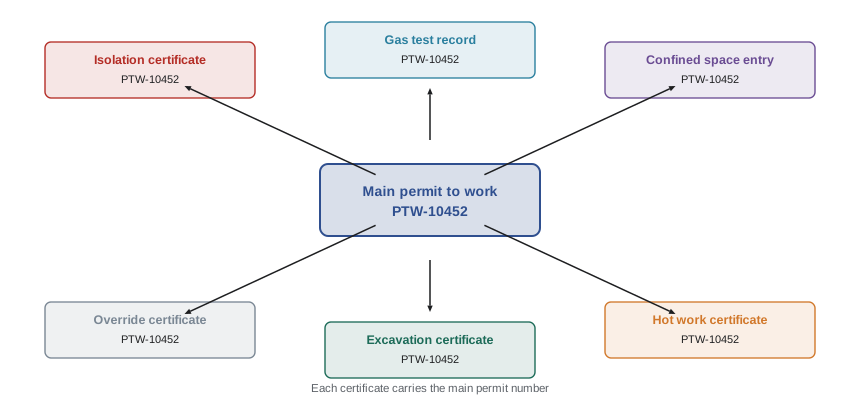
The golden rule is that every certificate carries the number of the permit it supports, and the permit lists every certificate attached to it. When a permit is suspended or closed, the issuer checks the status of each linked certificate. Many serious incidents have involved paperwork that drifted apart, such as an isolation removed under one permit while work continued under another.
Worked problem
Building the paperwork for a heat exchanger repair
A maintenance crew must replace a leaking tube bundle in a heat exchanger that handles light hydrocarbons. The work involves isolating and draining the exchanger, unbolting the channel head, using a gas-powered torque wrench near the open exchanger, cutting two corroded bolts with an angle grinder, and a crane lift of the bundle over an operating pipe rack. Which permit and certificates are needed?
Show solution
- The base document is a general or cold work permit for opening the exchanger, because the work breaks containment.
- An isolation certificate lists the inlet and outlet valve isolations, blinds or spades, drain and vent positions, and any steam tracing isolations, with verification of zero pressure.
- A gas test record shows the exchanger area and opened flanges are free of flammable gas before and during the work.
- Cutting bolts with a grinder is hot work, so a hot work certificate is attached, with combustible protection, a fire watch and continued gas testing.
- The bundle lift over an operating rack is a critical lift, so a lifting permit with an engineered lift plan is attached.
- All certificates carry the main permit number, and the main permit lists all four certificates. If the grinding is done on a different shift, the hot work certificate is issued only after a fresh gas test.
Answer: One general permit with an isolation certificate, a gas test record, a hot work certificate and a lifting permit, all cross-referenced.
One form or many?
Sites debate whether to use one universal permit or separate forms. A single form with hazard sections is easier to train on and makes it harder to miss a hazard, because every section must be considered, even if only to mark it not applicable. Separate forms let each permit focus tightly on one hazard, but a job that involves several hazards can end up with several permits whose holders do not talk to each other. Whichever approach is chosen, the system must ensure that one job has one clear point of control, normally the main permit and its holder.
Design of the form itself
Permit forms are working documents used in difficult conditions, often outdoors, with gloves on and in poor light. Good forms use plain words, a logical order that follows the permit life cycle, check boxes for common precautions with space for job-specific ones, and clear signature blocks with the role printed beside each. Forms should be tested with the people who use them. Human factors research on permit systems has found that long, cluttered forms encourage skimming, while forms that ask the user to write the key hazards in their own words encourage thinking. Electronic permits, covered in Lesson 11, can guide the user through only the sections that apply.
In Canada, forms for specific work must also meet any content requirements in the provincial regulation, such as the items Ontario's confined spaces regulation (O. Reg. 632/05) requires in an entry permit. Sites operating in Quebec should check language requirements under the Charter of the French Language for documents workers must use.
Whatever structure a site chooses, it should also decide how permits and certificates are numbered and stored. Pre-numbered permit books, or numbers assigned automatically by an electronic system, make it possible to account for every permit and to spot missing ones in audits. Many sites keep a copy of each live permit at the work site, a copy in the control room or permit office, and the original with the issuer, and they colour-code copies so that a glance shows which is which.
Retention rules for closed permits and certificates vary. Some are set by law, such as the minimum period for keeping confined space entry permits, and others by company policy, often several years so that records are available for investigations and audits. Whatever the period, the records must be retrievable, complete and linked, so that an investigator can see the whole story of a job.
Common mistakes
MistakeWriting vague job descriptions such as "repair pump".
InsteadDescribe the work precisely, including equipment tags, so scope and isolations are clear.
MistakeTreating a certificate as authority to work.
InsteadCertificates support a permit; only the permit authorizes work.
MistakeLetting certificates and permits drift apart.
InsteadCross-reference every certificate to the main permit and check them all at suspension and close-out.
MistakeIssuing several separate permits for one job with no single point of control.
InsteadUse one main permit and one holder per job, with linked certificates for each hazard.
MistakeDesigning forms without asking the people who use them.
InsteadTest forms with issuers and holders in real conditions and keep them plain and logical.
Summary and key terms
- Every permit needs a number, location, precise job description, hazards, precautions, linked documents, validity, signatures and close-out sections.
- Common types include general, hot work, confined space entry, energized electrical, excavation, height, lifting and radiation permits.
- Certificates record specific precautions and tests; they support but do not replace the permit.
- Isolation certificates and gas test records are the most common linked certificates.
- Every certificate carries the main permit number and the permit lists every certificate.
- One job should have one clear point of control.
- Forms should be plain, logical and tested with users.
- General permit
- A base permit for non-routine work without ignition sources; also called a cold work permit.
- Hot work permit
- A permit controlling welding, cutting, grinding and other ignition sources.
- Energized electrical work permit
- A permit justifying and controlling work on or near live electrical parts.
- Certificate
- A document recording a specific precaution or test that supports a permit.
- Isolation certificate
- A record of each isolation point, method, verification and lock.
- Gas test record
- A record of atmospheric test readings, times, locations and tester.
- Override certificate
- A record controlling the temporary bypass of a safety system.
- Lift plan
- An engineered plan for a critical lift, linked to a lifting permit.
- Cross-referencing
- Recording permit and certificate numbers on each other so they stay linked.
- Point of control
- The single permit and holder that controls all work on a job.
Practice problems
Work each problem on paper first, then reveal the answer to check.
List six items every permit form should contain.
Show answer
Number, location, job description, hazards, precautions, linked documents, validity, signatures, close-out.
What is the most common weakness found in permit audits?
Show answer
Vague job descriptions.
Does a gas test record authorize work?
Show answer
No; it supports a permit.
Why are energized work permits deliberately hard to obtain?
Show answer
To keep de-energizing the normal choice.
What must every certificate carry?
Show answer
The number of the permit it supports.
What does an isolation certificate record?
Show answer
Each isolation point, method, who applied it, verification and locks or tags.
When is a lifting permit typically needed?
Show answer
For critical lifts, such as near capacity, over live plant, tandem lifts or lifting people.
Give one advantage of a single universal permit form.
Show answer
Every hazard section must be considered, so hazards are harder to miss.
What is a long-term isolation certificate for?
Show answer
Keeping track of equipment isolated for a long period so the isolation is not forgotten or removed in error.
Why should forms be tested with users?
Show answer
Forms are used in hard conditions; clutter encourages skimming.
Lesson quiz · 5 questions
Score 60% or more to complete this lesson.
Create a free account to save your progress, take quizzes and earn a certificate.