
HSE-105 · Lesson 4 of 12 · 26 min
Fire codes, fire safety plans and OHS law in Canada
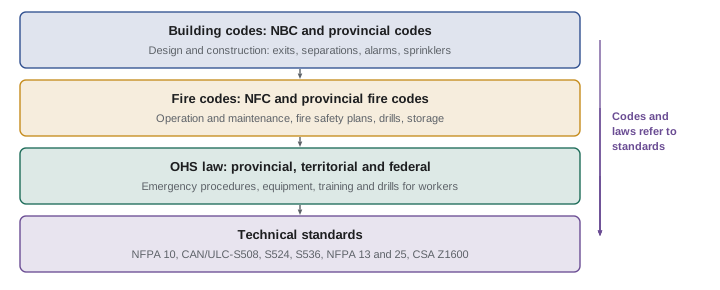
Fire safety at work is governed by several overlapping layers of rules. Building codes set how a building must be designed and built, including its exits, fire separations, alarm and sprinkler systems. Fire codes set how a building must be used, maintained and operated over its life, including storage, housekeeping, maintenance of fire protection systems and fire safety planning. Occupational health and safety laws set what employers must do to protect workers, including emergency plans, training and equipment. Technical standards, mostly developed by bodies such as the National Fire Protection Association (NFPA) and ULC Standards, fill in the detail and are referenced by codes and regulations. This lesson explains how these layers fit together, who enforces them and what they require of employers and workers. It is an overview for awareness: always check the exact edition and wording adopted where you work.
The Canadian framework
In Canada, the national model codes are developed by the Canadian Board for Harmonized Construction Codes and published by the National Research Council (NRC). The National Building Code of Canada (NBC) covers design and construction, and the National Fire Code of Canada (NFC) covers the operation and maintenance of buildings and facilities. The model codes have no legal force on their own: each province and territory adopts them, sometimes with changes, through its own legislation. The 2025 edition of the NFC was published in December 2025; many provinces are still enforcing codes based on the 2020 edition, and adoption timelines vary. Some provinces publish their own codes based on the national models, such as the Ontario Fire Code (O. Reg. 213/07 under the Fire Protection and Prevention Act, 1997), the Quebec Construction Code and Safety Code, the Alberta Fire Code and the British Columbia Fire Code. Municipalities and fire departments enforce the fire code locally, through inspections, orders and, where necessary, prosecution.
Occupational health and safety law in Canada
Each province and territory has its own occupational health and safety act and regulations, and federally regulated workplaces such as banks, airlines and interprovincial transport fall under the Canada Labour Code Part II and the Canada Occupational Health and Safety Regulations. Although wording differs, these laws commonly require employers to assess fire and emergency hazards, prepare written emergency procedures or plans, provide fire protection and firefighting equipment suitable to the hazards, train workers in emergency procedures and in the use of equipment they may be expected to use, conduct drills, and maintain equipment. For example, the federal regulations (Part XVII) require an emergency evacuation plan and fire drills, and many provincial regulations require emergency procedures to be developed in consultation with the joint health and safety committee or representative. Under the general duty clauses, employers must take every reasonable precaution for the protection of workers, which includes fire hazards not addressed by a specific rule.
Fire safety plans under the fire code
The NFC and provincial fire codes require a fire safety plan for many buildings, including those with a fire alarm system, and for certain high-hazard activities and facilities. A fire safety plan typically covers the emergency procedures to be used in case of fire, including sounding the alarm, notifying the fire department, instructing occupants and evacuating; the appointment and organization of designated supervisory staff to carry out fire safety duties; the training of supervisory staff; fire drills; control of fire hazards in the building; maintenance of building facilities provided for the safety of occupants; and alternative measures when fire protection systems are shut down. In Ontario, the Fire Code (Division B, Section 2.8) sets out these requirements, and many fire departments review and approve plans. The plan must be kept in the building, often in a fire safety box near the main entrance, so that responding firefighters can find it. Lesson 8 covers the content of these plans in more detail.
Technical standards
Codes and regulations often reference technical standards rather than writing out every detail. The most important for workplace fire safety include:
| Standard | Subject |
|---|---|
| NFPA 10 | Portable fire extinguishers: selection, placement, inspection, maintenance (2026 edition current) |
| CAN/ULC-S508 | Rating and fire testing of fire extinguishers (Canada) |
| UL 711 / ULC-S508 | Rating and testing of extinguishers (harmonized with Canada) |
| NFPA 13 and NFPA 25 | Installation, then inspection, testing and maintenance of sprinklers |
| NFPA 72 and CAN/ULC-S524, S536 | Fire alarm installation, then inspection and testing |
| NFPA 101 | Life safety and means of egress |
| NFPA 30 | Flammable and combustible liquids |
| NFPA 652 / 660 | Combustible dust |
| NFPA 51B | Hot work |
| CSA Z1600 | Emergency and continuity management (Canada) |
| NFPA 1600 / NFPA 1660 | Emergency, continuity and crisis management (US) |
Standards are updated on regular cycles, typically every three years for NFPA documents, but a code adopts a specific edition. A building inspected under a fire code that references the 2018 edition of NFPA 10 must meet that edition, even if a newer one exists. When in doubt, ask the authority having jurisdiction which edition applies.
Who is responsible
Under the fire code, the owner of a building is generally responsible for compliance, including maintaining fire protection systems and preparing the fire safety plan; owners may delegate tasks to tenants, property managers or contractors, but the responsibility remains. Under occupational health and safety law, the employer is responsible for the safety of its workers, including emergency procedures and training; supervisors must ensure workers follow procedures; and workers must follow safe practices, use equipment as trained and report hazards. In a multi-tenant building, the owner's fire safety plan and each tenant employer's emergency procedures must work together.
Enforcement and consequences
Fire officials can inspect premises, issue inspection orders to correct violations, and in serious cases close buildings or prosecute. Fines for fire code offences can be substantial: under the Ontario Fire Protection and Prevention Act, 1997, individuals face fines up to $50,000 and imprisonment of up to one year, and corporations fines up to $100,000, per offence (amounts change, so check the current Act). Occupational health and safety regulators can issue orders, stop-work orders and tickets and prosecute employers, supervisors and workers. After serious fires, coroners' inquests and fire marshal investigations often lead to recommendations and code changes.
Worked problem
Which rules apply?
A food processing company operates in a single-storey plant with a fire alarm system, deep fryers, a dust-producing flour handling area and 60 employees. Its policy is that employees will use portable extinguishers on small fires. List the main rule sets that apply and what each requires.
Show solution
- Building code: applies to the plant's design and to renovations, setting exits, separations, alarm and sprinkler requirements.
- Fire code: requires the alarm and sprinklers to be maintained and tested, extinguishers to be selected and maintained to the referenced standard, flammable liquids and dusts to be controlled, and, because there is an alarm system, a fire safety plan (Canada) or the applicable fire safety and evacuation plans (US).
- Workplace safety law: requires the employer to assess hazards, prepare emergency procedures or an EAP and FPP, provide extinguishers suited to the hazards (including class K for fryers), and, because employees will use extinguishers, train them on use and hazards at hire and at least annually.
- Standards: NFPA 10 for extinguishers, NFPA 96 for commercial cooking ventilation and suppression, NFPA 652 or 660 for combustible dust, and the alarm and sprinkler standards referenced locally.
Answer: The building code, fire code, workplace safety law and the referenced technical standards all apply, each covering a different part of the fire risk.
Keeping up to date
Codes and standards change after major fires, research and new technologies such as lithium-ion batteries and mass timber construction. Organizations should assign someone to track changes, subscribe to updates from their fire department, regulator and standards bodies, and review procedures when codes change. Industry associations and insurers are useful sources, and insurers often impose requirements beyond the minimum code, such as FM Global data sheets.
Retroactive requirements and existing buildings
Building codes generally apply when a building is built, renovated or changes use; an existing building that met the code when it was built is not usually required to be upgraded each time a new edition is published. Fire codes are different in one important way: they can contain retroactive provisions that apply to existing buildings regardless of when they were built. Examples include requirements to install smoke alarms in residential units, to retrofit sprinklers or alarm systems in certain older high-rise residential or care occupancies after deadly fires, and to keep exit routes and fire separations maintained to the standard originally required. A change of use, such as converting an office floor into a warehouse or a retail space into an assembly hall, usually triggers a review under the building code and may require new exits, separations or fire protection. Renovations should therefore always include a code review, and owners should not assume that grandfathered conditions remain acceptable after changes.
Working with fire inspectors
Fire inspections are an opportunity rather than a threat. Inspectors see many buildings and can explain how requirements apply to unusual situations. A well-prepared site makes the inspection quicker and the outcome better. Before an inspection, gather the fire safety or emergency plan, inspection and maintenance records for alarms, sprinklers, extinguishers and emergency lighting, drill records, hot work permits and any approvals for alternative measures. During the inspection, accompany the inspector, answer questions honestly, note each finding and ask for clarification where a requirement is unclear. Afterwards, correct items promptly, starting with life safety issues such as exits and alarms, keep evidence of correction, and confirm completion with the fire department in writing when required. Disputes about interpretation can usually be resolved through discussion, alternative compliance proposals prepared by a qualified professional, or formal appeal routes available in the fire code legislation.
| Record | Typical retention and purpose |
|---|---|
| Fire alarm inspection and test reports | Kept on site for review; show annual testing and repairs |
| Sprinkler inspection, testing and maintenance records | Kept on site; show weekly, quarterly, annual and five-year tasks |
| Extinguisher tags and service records | Monthly initials on tags; annual service and hydrostatic test dates |
| Emergency lighting test logs | Monthly and annual test results |
| Fire drill records | Date, time, duration, participants and problems found |
| Training records | Who was trained, on what, when and by whom |
| Impairment and hot work records | Dates, areas, precautions and sign-offs |
Insurers and other requirements
Fire codes and safety laws set minimum requirements, but other parties may require more. Property insurers often impose recommendations or conditions after a risk survey, such as additional sprinklers for high-piled storage, protection for lithium-ion battery storage, hot work programs and impairment notification. Large insurers publish engineering standards, such as FM Global property loss prevention data sheets, which are often stricter than codes. Landlords may set requirements in leases, such as restrictions on storage, hot work or modifications. Corporate standards in multinational organizations may also exceed local law. Customers, especially in manufacturing and logistics, may audit suppliers' fire safety as part of their own risk management. A good fire safety program treats the code as the floor and aligns with these additional expectations, documenting which requirement comes from where.
Contractors and shared responsibilities
Contractors working in a building can introduce fire hazards, such as hot work, temporary heaters, flammable products, blocked exits and disabled alarms, and they may not know the building's emergency procedures. Owners and employers should include fire safety in contractor selection and orientation: contractors must follow the hot work permit system, protect fire separations and fire protection equipment, report impairments, keep exits clear and know the alarm signals and assembly points. Construction sites have their own fire safety requirements, often found in a separate part of the fire code dealing with construction and demolition sites, including fire safety plans for the construction site, access for firefighters, temporary standpipes in tall buildings and control of combustible waste. Mass timber and wood-frame buildings under construction are particularly vulnerable before their fire protection is complete, and several large construction-site fires in both countries have prompted stronger rules.
A simple compliance map
Many organizations find it useful to build a compliance map: a table that lists each fire-related requirement that applies to the site, its source (building code, fire code, safety regulation, standard, insurer or lease), the person responsible, the frequency of any recurring task, and where the records are kept. The map makes gaps visible, helps new managers understand their duties and supports audits. It should be reviewed whenever codes change, the building changes or responsibilities move between people or companies. In a multi-tenant building, the owner and tenants can share relevant parts of their maps so that responsibilities at the boundaries, such as shared corridors, alarm systems and assembly points, are clearly assigned.
Common mistakes
MistakeAssuming the newest code edition applies.
InsteadCheck which edition is adopted locally.
MistakeThinking the fire code only matters at construction.
InsteadThe fire code governs operation and maintenance for the building's life.
MistakeTreating the building fire plan and workplace emergency plan as unrelated.
InsteadIntegrate the owner's plan with each employer's procedures.
MistakeBelieving delegation removes the owner's responsibility.
InsteadOwners remain responsible even when tasks are delegated.
MistakeIgnoring hazards with no specific rule.
InsteadGeneral duty provisions still require reasonable precautions.
Summary and key terms
- Building codes govern design and construction; fire codes govern operation and maintenance.
- Model codes become law only when adopted by provinces, states or municipalities.
- Workplace safety law requires emergency plans, equipment, training and drills.
- Technical standards such as NFPA 10 fill in detail; the adopted edition applies.
- Fire codes require fire safety or evacuation plans for many buildings.
- Owners, employers, supervisors and workers each have duties.
- Fire and safety regulators can inspect, order corrections and prosecute.
- Building code
- Rules for designing and constructing buildings.
- Fire code
- Rules for operating and maintaining buildings for fire safety.
- Model code
- Code developed for adoption by governments.
- Authority having jurisdiction
- Body or official that enforces a code or standard.
- Technical standard
- Detailed requirements referenced by codes and regulations.
- Edition
- Specific dated version of a code or standard.
- Fire safety plan
- Document setting out fire emergency procedures and responsibilities.
- General duty
- Broad duty to protect workers from recognized hazards.
- Inspection order
- Official order to correct a fire code violation.
- Owner
- Party generally responsible for fire code compliance.
Practice problems
Work each problem on paper first, then reveal the answer to check.
What is the difference between a building code and a fire code?
Show answer
Building codes cover design and construction; fire codes cover operation and maintenance.
Do model codes have legal force on their own?
Show answer
No, only when adopted by a government.
What standard covers portable extinguishers?
Show answer
NFPA 10.
If a newer edition of a standard exists, which applies?
Show answer
The edition adopted by the local code.
Who is generally responsible for fire code compliance?
Show answer
The building owner.
Name three things workplace safety law commonly requires for emergencies.
Show answer
Emergency plans, equipment, training, drills.
What triggers extinguisher training duties?
Show answer
Employees being expected to use extinguishers.
Where is a fire safety plan often kept?
Show answer
In the building, often near the main entrance.
Why do codes change?
Show answer
After major fires, research and new technologies.
What do insurers sometimes add?
Show answer
Requirements beyond the code minimum.
Lesson quiz · 5 questions
Score 60% or more to complete this lesson.
Create a free account to save your progress, take quizzes and earn a certificate.