
HSE-105 · Lesson 1 of 12 · 27 min
How fires start and behave
Fire is one of the oldest workplace hazards and still one of the most destructive. A fire in a warehouse, a restaurant kitchen, a laboratory, a data centre or an office can kill people in minutes, destroy a business that took decades to build and release smoke and contaminated water into the community. Most workplace fires are preventable, and most deaths in fires are caused not by flames but by smoke and toxic gases, often because people did not recognize the danger early or did not know how to get out. This course gives workers, supervisors and safety representatives a practical understanding of how fires start and spread, how to prevent them, how fire protection systems and portable extinguishers work, and how to respond to fires and other emergencies through planning, evacuation, shelter-in-place, drills and recovery. This first lesson explains the science of fire: what fire needs, how ignition happens, how fires grow and spread through a building, and why smoke is the main killer.
This is an awareness-level course. It supports the fire safety and emergency preparedness duties that employers and building owners have under provincial and territorial fire codes and occupational health and safety law, but it does not replace hands-on training in the use of portable extinguishers, your workplace's fire safety plan or emergency response plan, or the specific training your employer must give you for your building, processes and role. Always follow your site's emergency procedures, the instructions of fire wardens and the fire department, and the law in your province or territory. In an emergency, call 911 or your local emergency number.
The fire triangle and the fire tetrahedron
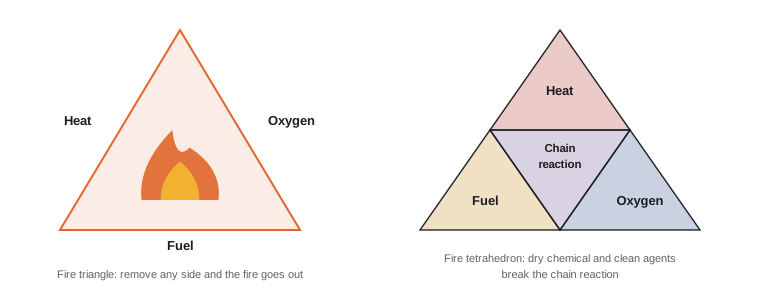
Fire is a rapid chemical reaction, called combustion, in which a fuel combines with oxygen and releases heat and light. For combustion to start and continue, three things must be present together: fuel, oxygen and heat. This is the fire triangle. Remove any one of them and the fire goes out. Modern fire science adds a fourth element: the self-sustaining chemical chain reaction in the flame, in which highly reactive molecular fragments called free radicals keep the reaction going. The four elements together form the fire tetrahedron. Some extinguishing agents, such as dry chemical powders and certain clean agents, work largely by interrupting this chain reaction rather than by cooling or smothering.
- Fuel: anything that can burn, including wood, paper, cardboard, plastics, textiles, flammable liquids, gases, metals in some forms, and dusts.
- Oxygen: normally supplied by the air, which contains about 21 % oxygen. Oxidizing chemicals, such as peroxides, nitrates and pure oxygen from cylinders, can supply oxygen even without air and make fires far more intense.
- Heat: the energy needed to raise the fuel to its ignition temperature, supplied by flames, sparks, hot surfaces, friction, electrical faults or chemical reactions.
- Chain reaction: the self-sustaining cycle of reactions in the flame zone.
Every method of fire prevention and fire fighting works by removing one or more of these elements. Keeping fuels away from ignition sources and storing them properly removes fuel or heat from the equation before a fire can start; water cools burning material below its ignition temperature; foam and carbon dioxide separate the fuel from oxygen; and dry chemicals interrupt the chain reaction.
How ignition happens
Solids and liquids do not burn directly. When they are heated, they give off flammable vapours or gases, and it is these vapours that mix with air and burn. Wood, paper and plastics break down under heat through a process called pyrolysis, releasing flammable gases. Liquids evaporate. Ignition occurs when the vapour concentration in air is within the flammable range and enough energy is supplied. Several properties describe how easily a material ignites:
- Flash point: the lowest temperature at which a liquid gives off enough vapour to form a flammable mixture with air near its surface. Gasoline has a flash point of about −40 °C, so it gives off flammable vapour in almost any weather; diesel fuel's flash point is above about 52 °C, so it is harder to ignite at room temperature but burns fiercely once heated.
- Flammable range: the range of vapour concentrations in air, between the lower flammable limit (LFL) and the upper flammable limit (UFL), within which a mixture can ignite. Below the LFL the mixture is too lean; above the UFL it is too rich. Propane, for example, burns between about 2.1 % and 9.5 % in air.
- Autoignition temperature: the temperature at which a material ignites without a spark or flame, simply from heat. Hot surfaces such as steam pipes, exhaust manifolds and overheated motors can ignite vapours and dusts with low autoignition temperatures.
- Minimum ignition energy: the smallest spark energy that can ignite a mixture. Some vapours and fine dusts can be ignited by static electricity discharges far too small to feel.
| Material | Approximate flash point | Approximate flammable range in air |
|---|---|---|
| Gasoline | −40 °C | 1.4–7.6 % |
| Acetone | −20 °C | 2.5–12.8 % |
| Ethanol | 13 °C | 3.3–19 % |
| Diesel fuel | Above 52 °C | 0.6–7.5 % |
| Propane (gas) | Not applicable (gas) | 2.1–9.5 % |
| Hydrogen (gas) | Not applicable (gas) | 4–75 % |
Safety data sheets (HSE-102) list flash points, flammable limits and autoignition temperatures in section 9, and the hazard classes in section 2 tell you whether a product is a flammable liquid, gas or solid. Knowing these properties explains many fire safety rules: why gasoline must never be used as a cleaning solvent, why containers of flammable liquids must be kept closed, and why sparks from grinding can start fires metres away.
Sources of ignition at work
Ignition sources in workplaces are everywhere, and many fires begin with an ordinary source meeting an unexpected fuel:
- Open flames: torches, burners, candles, pilot lights, matches and lighters, including smoking materials discarded carelessly.
- Hot work: welding, cutting, brazing, soldering and grinding, which throw sparks and molten metal that can travel more than 10 m and smoulder unnoticed for hours (HSE-212 covers hot work permits).
- Electrical sources: overloaded circuits, damaged cords, loose connections, arcing switches, overheated motors and transformers, and lighting fixtures in contact with combustibles.
- Hot surfaces: ovens, dryers, heaters, steam lines, engine exhausts and process equipment.
- Friction and mechanical sparks: slipping belts, seized bearings, grinding wheels and metal striking metal or concrete.
- Static electricity: discharges when liquids are poured or pumped, when powders are moved, or when people walk across insulating floors.
- Chemical reactions: reactive chemicals mixed accidentally, oxidizers contacting organic materials, and self-heating materials such as oily rags, which can heat spontaneously as the oil oxidizes.
- Lithium-ion batteries: damaged, defective or improperly charged batteries can enter thermal runaway, venting flammable gases and burning intensely (Lesson 2).
Stages of fire growth
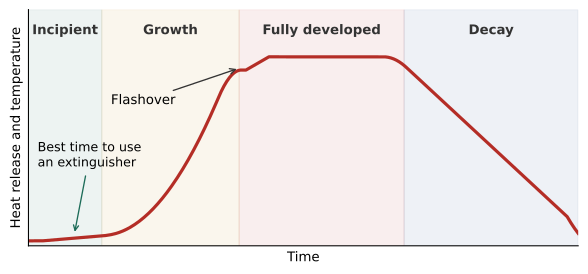
Fire safety engineers describe a typical fire in a room as passing through four stages. In the incipient stage, a small fire burns slowly, producing some smoke but little heat; this is the stage at which a portable extinguisher can be effective and the stage that smoke detectors are designed to catch. In the growth stage, the fire spreads across the fuel and to nearby materials, heat and smoke accumulate in a layer under the ceiling, and temperatures rise rapidly. If the hot smoke layer becomes hot enough, at roughly 500 to 600 °C, the radiant heat it sends down ignites everything combustible in the room almost at once, an event called flashover. After flashover, the fire is fully developed, the room is unsurvivable and the fire threatens neighbouring spaces. Finally, in the decay stage, the fire burns down as fuel or oxygen runs out. A dangerous variation occurs when a fire in a closed room consumes most of the oxygen and then smoulders; if a door is opened suddenly, the inrush of air can cause an explosive ignition of the accumulated gases, called a backdraft.
In modern buildings, the growth stage can be very short. Furniture and contents now contain large amounts of plastics and synthetic foams, which release heat and smoke far faster than traditional materials. Fire service research has shown that rooms furnished with modern contents can reach flashover in a few minutes, compared with much longer times for rooms furnished with older, natural materials. The practical lesson is that the time available to escape is short: people may have only a few minutes from the first signs of fire to untenable conditions.
How fire and smoke spread
Heat moves in three ways, and each contributes to fire spread. Conduction transfers heat through solid materials, such as a steel beam or pipe carrying heat into another room. Convection carries hot gases and smoke upward and outward; hot smoke rises to the ceiling, spreads horizontally, and moves through stairwells, shafts, ducts and gaps around pipes and cables. Radiation transfers heat as infrared energy in straight lines, igniting materials that are not touching the fire and making it impossible to approach a large fire closely. Fires also spread by direct flame contact and by burning debris falling or being carried by air currents.
Buildings are designed to slow this spread. Fire separations and fire-rated walls, floors and doors divide buildings into compartments; fire stopping seals openings around pipes and cables; and self-closing fire doors keep smoke and fire out of exit stairs and corridors. These features only work if they are maintained: a fire door propped open with a wedge, a ceiling tile left out, or a hole cut through a fire-rated wall for a new cable can allow smoke to reach escape routes in seconds. Lesson 3 returns to these everyday issues.
Smoke: the main killer
Most fire deaths are caused by smoke inhalation rather than burns. Smoke contains hot gases, fine particles and toxic products of combustion, including carbon monoxide, which prevents blood from carrying oxygen; hydrogen cyanide, released by burning plastics, foams and textiles and acting very quickly; and irritant gases that damage the airways and eyes. Smoke also blocks vision, so people cannot find exits they know well, and the heat of the smoke layer can burn the airways. Because smoke rises, the air near the floor is often cooler and clearer, which is why people escaping are taught to stay low.
Smoke spreads much faster and farther than flames. In a multi-storey building, smoke can fill stairwells and upper floors well away from the fire, which is one reason why exit stair doors must be kept closed and why elevators must not be used during a fire. Fire alarm systems, sprinklers and smoke control systems (Lesson 5) all aim to detect smoke early, limit its production and keep it out of escape routes.
Worked problem
Applying the fire tetrahedron
A small fire starts in a waste bin of paper in an office. For each of the following responses, identify which element of the fire tetrahedron it removes: (a) placing a metal lid over the bin, (b) spraying water from a water extinguisher, (c) using a dry chemical ABC extinguisher, (d) moving nearby cardboard boxes away from the bin.
Show solution
- (a) A lid cuts off the air supply, removing oxygen (smothering).
- (b) Water absorbs heat as it warms and evaporates, removing heat (cooling) from the burning paper.
- (c) Dry chemical powder mainly interrupts the chemical chain reaction in the flame, and also forms a layer that helps smother Class A fuels.
- (d) Moving combustibles away removes fuel from the path of the fire, limiting its growth.
Answer: Lid: oxygen; water: heat; dry chemical: chain reaction (and some smothering); moving boxes: fuel.
Fire classes
Fires are grouped into classes according to the fuel, because the right extinguishing method depends on what is burning. The classes used in Canada and the United States are:
| Class | Fuel | Examples | Typical extinguishing agents |
|---|---|---|---|
| A | Ordinary combustibles | Wood, paper, cardboard, textiles, many plastics | Water, foam, multipurpose dry chemical |
| B | Flammable liquids and gases | Gasoline, solvents, oils, greases, propane | Foam, carbon dioxide, dry chemical |
| C | Energized electrical equipment | Panels, motors, computers, appliances | Non-conductive agents: carbon dioxide, dry chemical, clean agents |
| D | Combustible metals | Magnesium, titanium, sodium, lithium metal | Special dry powders rated for the metal |
| K | Cooking oils and fats | Deep fryers, commercial kitchens | Wet chemical agents |
Class C refers to the electrical hazard rather than a separate fuel: once the power is shut off, an electrical fire usually becomes a Class A or B fire. Using water on an energized electrical fire risks electric shock, and using water on a cooking oil fire causes violent spattering and fire spread. Lesson 6 explains extinguisher ratings and selection in detail.
Why fire science matters to every worker
Understanding how fires start and behave turns rules into common sense. A worker who knows that vapours, not liquids, burn will keep lids on solvent containers. A supervisor who understands flashover will insist on immediate evacuation rather than heroic attempts to fight a growing fire. A worker who understands smoke will close doors behind them as they leave, know the second exit route, and never re-enter a burning building. The rest of this course builds on these principles: Lessons 2 and 3 apply them to prevention, Lessons 4 to 7 to the laws, systems and equipment that protect buildings, and Lessons 8 to 12 to planning and responding to fires and other emergencies.
Common mistakes
MistakeThinking flames are the main danger in a fire.
InsteadSmoke and toxic gases cause most fire deaths; get out early and stay low.
MistakeAssuming liquids only burn when hot.
InsteadLiquids with low flash points give off flammable vapour at room temperature or below.
MistakeBelieving there is plenty of time to escape.
InsteadModern contents can cause flashover in a few minutes.
MistakePropping fire doors open.
InsteadKeep fire doors closed so compartments slow smoke and fire spread.
MistakeUsing water on every fire.
InsteadMatch the agent to the fire class; water is dangerous on electrical and cooking oil fires.
Summary and key terms
- Fire needs fuel, oxygen, heat and a chemical chain reaction: the fire tetrahedron.
- Solids and liquids burn as vapours; flash point and flammable range describe ignitability.
- Workplace ignition sources include flames, hot work, electricity, hot surfaces, friction, static and reactions.
- Room fires grow through incipient, growth, flashover, fully developed and decay stages.
- Heat spreads by conduction, convection and radiation; compartments slow spread.
- Smoke, carbon monoxide and hydrogen cyanide cause most fire deaths.
- Fire classes A, B, C, D and K guide the choice of extinguishing agent.
- Fire tetrahedron
- Fuel, oxygen, heat and chain reaction needed for fire.
- Combustion
- Rapid reaction of fuel with oxygen releasing heat.
- Flash point
- Lowest temperature at which a liquid forms an ignitable vapour.
- Flammable range
- Vapour concentrations between the lower and upper flammable limits.
- Autoignition temperature
- Temperature at which a material ignites without a spark.
- Pyrolysis
- Breakdown of solids by heat into flammable gases.
- Flashover
- Near-simultaneous ignition of a room's contents.
- Backdraft
- Explosive ignition when air reaches an oxygen-starved fire.
- Fire separation
- Fire-rated construction that limits fire and smoke spread.
- Fire class
- Category of fire by fuel type.
Practice problems
Work each problem on paper first, then reveal the answer to check.
Name the four elements of the fire tetrahedron.
Show answer
Fuel, oxygen, heat and chemical chain reaction.
What actually burns when a liquid fire burns?
Show answer
Its vapour mixed with air.
Define flash point.
Show answer
Lowest temperature at which a liquid gives off ignitable vapour.
Why can oily rags start fires on their own?
Show answer
Oil oxidation generates heat that can build up to ignition.
What is flashover?
Show answer
Almost simultaneous ignition of a room's contents from radiant heat.
Name the three modes of heat transfer.
Show answer
Conduction, convection and radiation.
What causes most fire deaths?
Show answer
Smoke and toxic gases.
Why stay low when escaping smoke?
Show answer
Cooler, clearer air is near the floor.
What class is a deep fryer fire?
Show answer
Class K.
Why is water dangerous on Class C fires?
Show answer
It conducts electricity and risks shock.
Lesson quiz · 5 questions
Score 60% or more to complete this lesson.
Create a free account to save your progress, take quizzes and earn a certificate.