
HSE-105 · Lesson 11 of 12 · 25 min
Drills, training and after-action reviews
A plan that has never been practised is a theory. Drills and exercises turn written procedures into habits, reveal problems while the stakes are low and give people the confidence to act when a real emergency occurs. Training gives people the knowledge and skills for their roles, and after-action reviews turn every drill and every real event into improvements. This lesson covers training needs for different roles, the types of drills and exercises, how to plan, run and evaluate a drill, required frequencies, and how to learn from drills and incidents.
Training needs by role
Emergency training should match what each person is expected to do.
- All workers, at orientation and periodically: the alarm signals and what they mean, how to report an emergency, exits and alternative routes, assembly points, shelter-in-place and lockdown procedures, and whom to follow.
- Workers expected to use extinguishers: fire behaviour and classes, the decision to fight or leave, PASS and hands-on practice, at hire and at least annually.
- Wardens and supervisory staff: their specific duties, sweep and accounting procedures, communication, assisting people who need help, and drill participation.
- Emergency coordinator and deputies: the plan as a whole, decision-making, coordinating with emergency services, and incident command basics.
- First aiders: certified first aid, CPR and AED training, with recertification at the interval set by the provider and regulation, commonly every three years.
- Critical operations staff: shutdown procedures and when to leave.
- Contractors and visitors: a short briefing on alarms, exits and assembly, often at sign-in.
Training records should show who was trained, on what, by whom and when, and should be checked so that no role is left without a trained person.
Types of drills and exercises
Emergency management uses a range of exercises, from discussion to full-scale operation:
| Type | Description | Typical use |
|---|---|---|
| Orientation or seminar | Briefing on the plan and roles | New staff, plan changes |
| Tabletop exercise | Key people talk through a scenario around a table | Testing decisions and coordination |
| Walk-through | Teams walk routes and practise roles without urgency | New buildings, new wardens |
| Drill | Practice of a single procedure, such as evacuation or lockdown | Regular fire and evacuation drills |
| Functional exercise | Simulated event tests several functions, often without moving everyone | Command, communication, accounting |
| Full-scale exercise | Realistic event with emergency services and all functions | High-hazard sites, major plans |
Drills can be announced or unannounced. Announced drills are useful for training and for sites with vulnerable occupants; unannounced drills test real readiness. Drills should vary scenarios and conditions: blocked exits, missing persons, fire at a different location, night shift, during shift change, or with the coordinator absent. A drill that always uses the same exit on a sunny Friday afternoon teaches little.
Required drill frequencies in Canada
The NFC and provincial fire codes require fire drills at intervals set by occupancy and stated in the fire safety plan, commonly at least once a year for most business and industrial occupancies, more often for schools, care facilities and high-rise buildings; for example, many codes require monthly drills in schools during the school year and drills for supervisory staff in care occupancies on each shift. OHS regulations also require emergency drills; for example, the Canada Occupational Health and Safety Regulations require fire drills at least once a year in most federal workplaces. Records of drills, including the date, duration and findings, must be kept.
Planning a drill
A well-planned drill has clear objectives, such as: all occupants evacuate within four minutes; wardens report area status within ten minutes of the alarm; the coordinator receives accounting results and meets the fire department at the main entrance. Plan the scenario, inform the fire department and monitoring company if the alarm will be activated, decide who will observe and where, prepare observer checklists, and arrange for people who need assistance. Consider operational impacts: some processes cannot be stopped without planning, and critical operations staff may practise shutdown separately. For safety, avoid creating real hazards: use simulated smoke only if it is safe, keep stairs clear of obstacles and stop the drill if someone is injured or a real emergency occurs.
Running and observing a drill
Observers should be stationed at key points: at the alarm, at exits and stairs, at the assembly point and with the coordinator. They record times and behaviours, such as when the alarm sounded, when people started to move, when the last person left each area and when accounting was complete. They also note problems: people who did not hear the alarm, used the wrong exit, took elevators, went back for belongings, stood in the way of fire department access, or could not be accounted for; doors that did not close or latch; exits that were obstructed; and wardens who were unsure of their role.
Worked problem
Evaluating a drill
An evacuation drill in a two-storey office of 200 people had an objective of full evacuation within 4 minutes and accounting complete within 10 minutes. Observers recorded: alarm at 0:00; first people moving at 0:45; last person out at 6:10; 12 people used an elevator; the second-floor east warden was absent with no alternate; accounting was complete at 14:30 with 3 people initially unaccounted for, later found at a café across the street. Evaluate the drill and propose improvements.
Show solution
- Evacuation time 6:10 against a 4:00 objective: failed. Pre-movement of 0:45 for the first movers suggests many others started later; brief people that they must leave immediately.
- Elevator use by 12 people: a serious error; reinforce in training and signage that elevators are not used in a fire.
- Absent warden with no alternate: a gap in role assignment; assign and train alternates for every warden position.
- Accounting at 14:30 against 10:00: failed; the 3 people at the café show that people leave the assembly point or skip it, so reinforce reporting and use sign-in or electronic check-in.
- Actions: retrain occupants, add alternates, improve signage, run a follow-up drill within three months and measure again.
Answer: The drill missed both objectives; fix pre-movement, elevator use, warden coverage and accounting, then re-drill.
Debriefs and after-action reviews
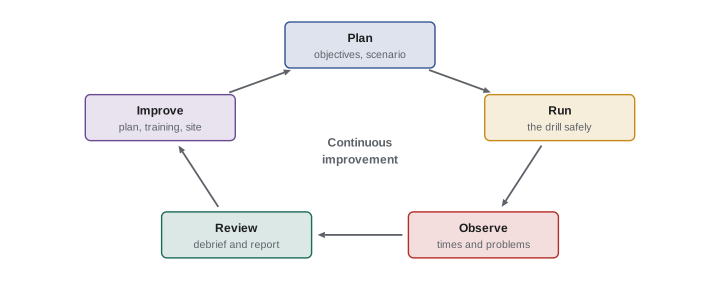
Immediately after a drill or real event, hold a short hot debrief with wardens, coordinators and observers while memories are fresh: what happened, what went well, what went wrong and any immediate safety issues. Within days, prepare an after-action report (AAR) that compares performance with the objectives, identifies root causes of problems rather than blaming individuals, and sets corrective actions with owners and due dates. Track corrective actions to completion through the safety management system (HSE-103), update the plan and training, and verify improvements in the next drill. Share key lessons with workers and the health and safety committee. Real emergencies, including small fires and false alarms, deserve the same review: a false alarm that produced a slow evacuation is valuable data.
False alarms and alarm fatigue
Frequent false or nuisance alarms teach people to ignore alarms. Causes include dust, steam and cooking near smoke detectors, malfunctioning devices, construction work and malicious activation. Organizations should investigate and correct the causes of nuisance alarms, coordinate with contractors to avoid alarms during hot work or dusty work (with proper impairment procedures), and treat every alarm as real. Many fire departments charge fees for repeated false alarms.
Designing a training program
An emergency training program should be designed, not improvised. Start with a training needs analysis that lists each role in the emergency plan, the knowledge and skills it requires, and the people who hold it on each shift. Then choose methods that fit the content: short e-learning or briefings for knowledge such as alarm signals and assembly points; walk-throughs for routes and equipment locations; hands-on practice for extinguishers, evacuation chairs and first aid; and exercises for decision-making by coordinators. Set refresher intervals based on regulations and on how quickly skills fade; skills used rarely, such as operating an evacuation chair, fade fastest. Evaluate training by observing performance in drills, not just by counting attendance.
Adult learning and engagement
Adults learn best when training is relevant, practical and respectful of their experience. Use real examples from the site and the industry, explain why each procedure exists, let people practise and make mistakes in a safe setting, and invite questions and suggestions. Short, frequent sessions are often more effective than long annual ones. Toolbox talks, safety huddles and pre-shift briefings can reinforce key messages, such as the location of a new extinguisher or a change to the assembly point. Workers who help plan and evaluate drills often become strong advocates for emergency preparedness among their colleagues.
Exercises with emergency services
Exercises with fire departments, paramedics and police build relationships and reveal problems that internal drills cannot, such as unclear site access, unfamiliar hazards, incompatible radio systems or confusion about who is in charge. Many fire departments are willing to conduct pre-incident planning visits or to take part in exercises at high-hazard sites, hospitals, schools and large employers. Joint exercises should have shared objectives, be planned well in advance and include a joint debrief. Industrial sites with significant hazards may also take part in community exercises with municipal emergency management, neighbouring facilities and mutual aid organizations, especially where an incident could affect people outside the site.
Measuring preparedness
Organizations can track a few simple indicators to see whether emergency preparedness is improving: the percentage of workers trained in the past year; the percentage of warden and coordinator roles filled with trained people and alternates on every shift; the number of drills held against the plan; evacuation and accounting times compared with objectives; the number of corrective actions open and overdue; and the number of nuisance alarms. Reporting these indicators to management and the health and safety committee keeps preparedness visible between emergencies. A downward trend, such as rising evacuation times or many overdue actions, is an early warning that the program needs attention.
Learning from real events
Every real alarm or emergency, however minor, is an unplanned drill. A burnt-toast alarm that leads to a slow evacuation, a small fire put out with an extinguisher, or a medical emergency where the AED was hard to find all provide evidence about how the plan works under real conditions. Treat them with the same review process: a short debrief, a record of what happened and what was learned, and corrective actions. Organizations can also learn from events elsewhere by reviewing published investigation reports and safety alerts from regulators, fire marshals and industry associations, and asking whether the same thing could happen on their site.
Drill safety and respect for people
Drills must not harm anyone. Plan for people with mobility impairments, pregnancy or health conditions who may need to use an area of refuge or a slower route, and for people for whom loud alarms or simulated emergencies may be distressing, such as those with anxiety or trauma histories. Never use real smoke, real fire or realistic weapons in drills without specialist planning, and never simulate an active attacker without warning and careful design, because such drills have caused real injuries and psychological harm. Stop the drill immediately if a real emergency or injury occurs, and make sure participants know the signal for ending an exercise.
Records and continuous improvement
Keep records of every drill and exercise: the date and time, the scenario, the participants, the observers, the times recorded, the problems found and the corrective actions assigned. Over several years, these records show trends, such as whether evacuation times are falling and whether the same problems recur. Inspectors and auditors will ask for them. More importantly, they show whether the organization is learning: a plan that has been drilled, reviewed and improved repeatedly is far more likely to work when it matters than one that has only been written.
Common mistakes
MistakeRunning the same predictable drill every year.
InsteadVary scenarios, timing, shifts and blocked exits.
MistakeTiming only the evacuation.
InsteadMeasure pre-movement, evacuation and accounting against objectives.
MistakeBlaming individuals for drill failures.
InsteadLook for root causes in training, roles and facilities.
MistakeWriting an after-action report and filing it.
InsteadTrack corrective actions to completion and re-test.
MistakeIgnoring false alarms.
InsteadInvestigate causes and keep people treating every alarm as real.
Summary and key terms
- Training must match what each role is expected to do.
- Exercises range from tabletop discussions to full-scale events.
- Vary drill scenarios and conditions to test real readiness.
- Fire codes and safety laws set minimum drill frequencies and records.
- Plan drills with clear, measurable objectives and observers.
- Debriefs and after-action reports turn drills into improvements.
- Investigate false alarms to prevent alarm fatigue.
- Drill
- Practice of a single emergency procedure.
- Tabletop exercise
- Discussion-based walk-through of a scenario.
- Functional exercise
- Simulated event testing several functions.
- Full-scale exercise
- Realistic exercise involving emergency services.
- Observer
- Person who watches and records drill performance.
- Objective
- Measurable target for a drill.
- Hot debrief
- Short review immediately after an event.
- After-action report
- Written review with findings and corrective actions.
- Corrective action
- Assigned task to fix a problem found.
- Alarm fatigue
- Tendency to ignore alarms after many false alarms.
Practice problems
Work each problem on paper first, then reveal the answer to check.
What emergency training should all workers receive?
Show answer
Alarms, reporting, exits, assembly points, shelter and lockdown procedures.
How often must extinguisher users be trained?
Show answer
At hire and at least annually.
What is a tabletop exercise?
Show answer
Key people discussing a scenario around a table.
Why run unannounced drills?
Show answer
To test real readiness.
Give two ways to vary a drill.
Show answer
Block an exit, run on night shift, remove the coordinator.
Give an example of a drill objective.
Show answer
Full evacuation within four minutes.
Where should observers be placed?
Show answer
At alarms, exits, stairs, assembly point and with the coordinator.
What is a hot debrief?
Show answer
A short review immediately after the event.
What should an after-action report include?
Show answer
Performance against objectives, root causes, corrective actions with owners and dates.
Why do false alarms matter?
Show answer
They teach people to ignore alarms.
Lesson quiz · 5 questions
Score 60% or more to complete this lesson.
Create a free account to save your progress, take quizzes and earn a certificate.