
GCP-190 · Lesson 9 of 12 · 22 min
Practice strategy and timing
▶ Video coming soon A video version of this lesson is on the way.
In the first week of January 2027, when Birchline's stores are quiet after the holiday sales, Farah sets Owen and Jules a timed practice session: fifty-five original questions she has written, ninety minutes, in a closed meeting room with phones left at the door. Owen finishes with twenty minutes to spare and then changes three correct answers to wrong ones. Jules runs out of time with six questions unanswered, having spent almost ten minutes on one question about databases. Their knowledge is similar; their timing is not. "Practice is not just about what you know," Farah says afterwards. "It is about how you spend the ninety minutes." This lesson covers how to practise effectively and how to manage time on the real exam. It describes plans for January 2027, which are still ahead of us as this course is written.
Practise the way you will be tested
Practice works best when it matches the real conditions. That means timed sessions of the same length as the exam, with no notes, no phone and no breaks, and with questions in the same style: short scenarios, multiple choice and multiple select, mixed across all six sections. Untimed study with notes open is useful early on for learning, but it does not prepare you for the pressure of the clock or for switching quickly between topics. Once you have finished the section reviews, at least two full timed sessions before the exam are a good minimum.
Use legitimate practice material. Google offers official sample questions for Cloud Digital Leader on its certification page, along with its own learning path and study guide, and this course provides original questions in every lesson. Avoid exam dumps, which are collections of questions claimed to come from the real exam. Using them breaks Google's exam terms, can lead to a revoked certification, and does not teach you anything you can use at work. Many of them are also simply wrong. If a website promises the real questions, close the tab.
Mixed practice beats blocked practice
When you first learn a topic, it is natural to practise it in a block: ten database questions, then ten security questions. On the exam, though, topics arrive mixed, and part of the skill is recognizing which kind of question you are looking at. Research on learning calls the mixed approach interleaving, and it tends to produce better long-term results even though it feels harder. After the section reviews, Farah gives Owen and Jules only mixed sets, so that each question starts with the step of deciding which section it belongs to.
Spacing helps too. Reviewing a topic again after a few days, then after a week, makes it stick far better than reviewing it many times in one evening. Retrieval practice, which means trying to recall an answer before checking it, beats rereading. Flash cards, practice questions and explaining an idea aloud to someone else are all forms of retrieval. Jules explains one product a night to a patient partner over dinner; Owen uses his index cards on the bus.
Time on the real exam
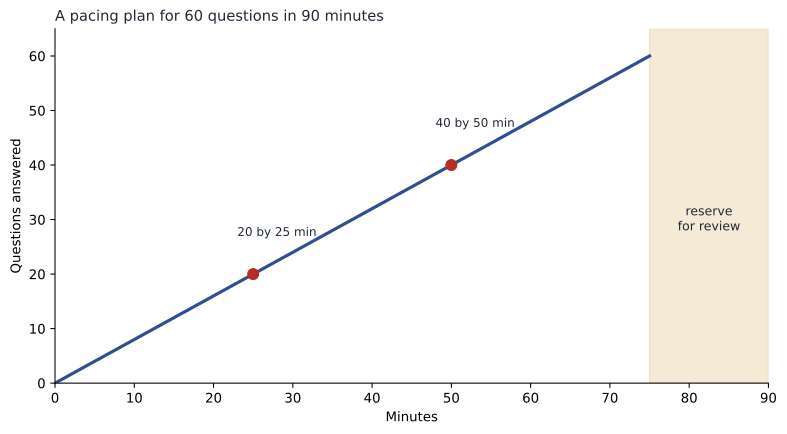
Google's page lists 90 minutes for 50 to 60 questions. If you plan for the larger number, you have 90 seconds per question on average, and some questions will take far less. A simple plan is to aim for an average of about 75 seconds per question on the first pass, which leaves a reserve of around 15 minutes at the end for review. Set checkpoints so you know whether you are on track without doing arithmetic under pressure. If the exam shows 60 questions, aim to have finished about 20 by the 25-minute mark and about 40 by the 50-minute mark, which keeps the reserve intact.
# Checkpoints for a 90-minute exam at a planned 75 seconds per question
total_minutes = 90
for n in (50, 55, 60):
    plan = 75
    checkpoints = [(q, round(q * plan / 60)) for q in (n // 3, 2 * n // 3, n)]
    reserve = total_minutes - round(n * plan / 60)
print(n, "questions:", checkpoints, "reserve", reserve, "minutes")50 questions: [(16, 20), (33, 41), (50, 62)] reserve 28 minutes 55 questions: [(18, 22), (36, 45), (55, 69)] reserve 21 minutes 60 questions: [(20, 25), (40, 50), (60, 75)] reserve 15 minutes
What this code does
For each possible exam length, the program plans 75 seconds per question and works out where the candidate should be after one third, two thirds and all of the questions. It also shows how many minutes would be left over for review. With 60 questions the reserve is 15 minutes, and with 50 it is 28.
The most important timing rule is to cap the time on any one question. If a question is still unclear after about two minutes, choose your best answer, mark it for review if the exam lets you, and move on. One stubborn question is worth the same as one easy question at the end, and running out of time loses several easy marks. That was Jules's problem in the practice session. Next time, Jules sets a personal limit and moves on when it passes.
Answer every question
Unanswered questions cannot score, and we know of no published penalty for a wrong answer on Google's exams, so make sure every question has an answer before time runs out. If you are running short, go through the remaining questions quickly, apply the reading routine from lesson 3 in its fastest form, and choose the best option. In multiple select questions, select exactly the number asked.
When to change an answer
Owen's habit of changing correct answers is common. Studies of test takers suggest that changed answers more often go from wrong to right than from right to wrong, but only when there is a reason for the change. The rule Farah gives Owen is simple: change an answer only if you can name the specific fact or constraint you missed the first time. A vague feeling that another option seems better is not a reason. During review, reread the ask and the constraints of each marked question before looking at your answer again.
| Situation | What to do |
|---|---|
| Question unclear after about two minutes | Choose the best answer, mark it if you can and move on |
| Behind at a checkpoint | Speed up by trusting the reading routine; skip deep rereading |
| Ahead at a checkpoint | Keep the pace; spend the extra time in final review |
| Five minutes left with questions unanswered | Answer every remaining question, even if quickly |
| Tempted to change an answer in review | Change only if you can name the missed fact or constraint |
Reviewing a practice session
The most valuable part of a practice session comes after it. For every wrong answer, and for every right answer you guessed, write down three things in your mistakes log: the section, the reason, and the fix. Reasons usually fall into a few groups: did not know the product or concept, confused two neighbours, misread the ask or a constraint, or ran out of time. Each group needs a different fix. Not knowing a concept means returning to the relevant course lesson. Confusing neighbours means a card or table from lesson 8. Misreading means slowing down and using the routine. Running out of time means practising with checkpoints.
How many practice questions are enough?
There is no magic number, but there are useful signs. You are close to ready when your timed, mixed practice results are steady from one session to the next, when your mistakes are spread thinly rather than clustered in one section, and when most of your remaining errors are close calls you can explain afterwards rather than surprises. A single high score on a set you have seen before is not evidence; a good score on new questions under exam conditions is. Farah asks both candidates to keep a simple chart of their scores on new material, session by session, so they can see the trend rather than react to one result.
Be careful with repeated practice sets. Answering the same questions a second time measures memory of those questions, not understanding of the subject. If you reuse a set, wait at least a week and focus on explaining why each wrong option is wrong, which is still useful. For readiness checks, use questions you have not seen. Google's sample questions, the practice questions in every lesson of this program and questions you write yourself, as described in lesson 10, are all good sources.
Practising multiple select questions
Multiple select questions deserve their own practice, because they test judgement on every option. Treat each option as a separate true or false statement about the scenario. Mark the ones you are sure are true and the ones you are sure are false. If the question asks for two and you have two trues, you are done. If you have only one true, choose the most likely of the uncertain options. If you have three apparent trues, reread the ask: one of them is probably true in general but does not answer the question as asked. On practice sets, track your accuracy on multiple select items separately; if it lags behind your multiple choice accuracy, practise them as a block for a few days before returning to mixed sets.
Practising for the conditions, not only the content
Some of the stress of an exam comes from the conditions rather than the questions. Practise at least once at the same time of day as your booking, in a room like the one you will use, without breaks, so that ninety minutes of concentration feels familiar. Jules does one practice session at the kitchen table at 9 a.m. with the laptop plugged into the router, exactly as planned for the online exam. Owen does one in a quiet room at Birchline's head office after lunch, as close as he can get to testing centre conditions. Neither session is about the score; both are about removing surprises.
Finally, practise recovery. In at least one practice session, deliberately take an unhelpful approach for the first ten minutes, such as reading every question twice in full, so that you fall behind your first checkpoint. Then practise catching up calmly using the time cap and the reading routine. It sounds strange, but it turns a frightening situation into a familiar one. Both Owen and Jules try it once and report that the second half of the session felt far more controlled than they expected. On the real exam, if a slow start happens, they will recognize it and know exactly what to do, rather than spending energy on worry.
Worked problem
Reading a practice result
After her second practice session, a candidate scores 44 out of 55. Her log shows 6 mistakes from confusing neighbouring products, 3 from misreading the ask and 2 from not knowing a concept. What should she do next?
Show solution
- The biggest group is confusing neighbours, so the highest return is in separating pairs, using the methods in lesson 8.
- Misreading comes next, so she should practise the reading routine on a mixed set.
- Two concept gaps are small; she can fix them by revisiting the relevant lessons.
- She should then take one more timed mixed session to check that the fixes worked.
Answer: Focus first on the largest group of mistakes, then the next, and confirm with another timed session.
Owen and Jules plan one more full practice session in mid-January, about a week before Owen's exam, with Farah acting as proctor. Jules will set a two-minute limit per question and Owen will change answers only with a named reason. They agree to compare results in the same meeting room afterwards.
Common mistakes
MistakePractising only with notes open.
InsteadFinish with timed, closed-book, mixed sessions.
MistakeUsing exam dumps.
InsteadThey break exam terms, can cost you the certification and teach nothing reliable.
MistakeSpending ten minutes on one question.
InsteadCap each question at about two minutes, then move on.
MistakeLeaving questions unanswered.
InsteadAnswer every question before time runs out.
MistakeChanging answers on a hunch.
InsteadChange an answer only if you can name the fact or constraint you missed.
Summary and key terms
- Practise under exam conditions: timed, closed book, mixed questions.
- Use Google's sample questions, learning path and original practice questions, never exam dumps.
- Interleaving, spacing and retrieval practice make learning stick.
- Plan about 75 seconds per question with checkpoints and a reserve for review.
- Cap time on any one question and answer every question.
- After practice, log each mistake by section, reason and fix.
- Interleaving
- Practising mixed topics rather than one topic at a time.
- Spacing
- Reviewing material at increasing intervals over days and weeks.
- Retrieval practice
- Recalling an answer from memory before checking it.
- Checkpoint
- A planned point in the exam where you compare progress with time used.
- Exam dump
- A collection of questions claimed to come from a real exam; using one breaks exam terms.
- Mistakes log
- A record of errors with their section, reason and fix.
Practice problems
Work each problem on paper first, then reveal the answer to check.
How long does a first pass take for 60 questions at 75 seconds each?
Show answer
75 minutes, leaving a 15-minute reserve.
Why avoid exam dumps?
Show answer
They break exam terms, risk the certification and are often wrong.
What is interleaving?
Show answer
Practising mixed topics rather than blocks of one topic.
What is a sensible cap on time for one question?
Show answer
About two minutes.
When should you change an answer?
Show answer
Only when you can name the fact or constraint you missed.
What three things go in a mistakes log?
Show answer
The section, the reason and the fix.
What should you do with unanswered questions near the end?
Show answer
Answer every one.
Lesson quiz · 5 questions
Score 60% or more to complete this lesson.
Create a free account to save your progress, take quizzes and earn a certificate.