
FILM-101 · Lesson 7 of 12 · 26 min
Editing II: montage, rhythm and alternatives to continuity
Continuity editing aims to be invisible. But editing can also be visible, expressive and argumentative. Soviet filmmakers of the 1920s treated the cut as a collision that could create new ideas. The French New Wave broke continuity rules to jolt viewers. Other filmmakers have reduced editing almost to nothing, letting long takes unfold in real time. This lesson covers montage in its several senses, the measurement and meaning of rhythm, jump cuts and discontinuity, and the long take. It also introduces average shot length, a simple statistic that lets you compare editing styles across films and eras.
The Kuleshov effect
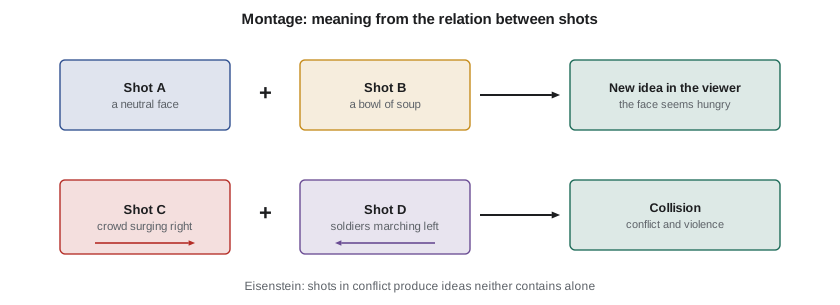
In the years after the Russian Revolution, young Soviet filmmakers studied editing intensively, partly because film stock was scarce and they re-edited existing footage. Lev Kuleshov is credited with experiments showing that viewers interpret a shot according to the shots around it. In the best-known version, the same expressionless close-up of an actor was intercut with different images, such as a bowl of soup, a child in a coffin and a woman on a couch, and viewers reportedly praised the actor's expression of hunger, grief or desire. Historians debate exactly what was filmed, and later experiments have found the effect is real but more modest than legend suggests. The core idea endures: meaning arises from the relation between shots, not only from each shot alone.
Soviet montage
Sergei Eisenstein, the best-known Soviet theorist and director, argued that editing should create conflict between shots, a collision of images that would produce an idea or emotion in the viewer's mind that neither shot contained alone. He described several kinds of montage, including metric (based on shot length), rhythmic (based on movement within shots) and intellectual montage, which joins images to create abstract concepts. In his 1925 film Battleship Potemkin, the famous Odessa Steps sequence uses rapid, conflicting shots of soldiers marching, citizens fleeing and a runaway baby carriage to express the brutality of a massacre, stretching screen time far beyond the real duration of the events.
Other meanings of montage
The word montage is used in several ways, which can confuse beginners.
- In French and in much European usage, montage simply means editing.
- In Soviet film theory, montage means editing that creates meaning through the collision or juxtaposition of shots.
- In Hollywood usage, a montage sequence is a short passage that compresses time or summarizes a process, often set to music: a training montage, a falling-in-love montage, a newspaper-headlines montage. These sequences rely on dissolves, wipes or rapid cuts rather than continuity.
When you use the word, make clear which sense you mean.
Rhythm and shot length
Rhythm comes from the duration of shots, the pattern of those durations, and the movement within shots. Short shots create speed, energy or anxiety; long shots create calm, contemplation or dread. Editors also vary rhythm within a scene, accelerating toward a climax and slowing afterwards. Rhythm interacts with music, dialogue and sound effects; cutting on the beat of a song makes a sequence feel driven by the music.
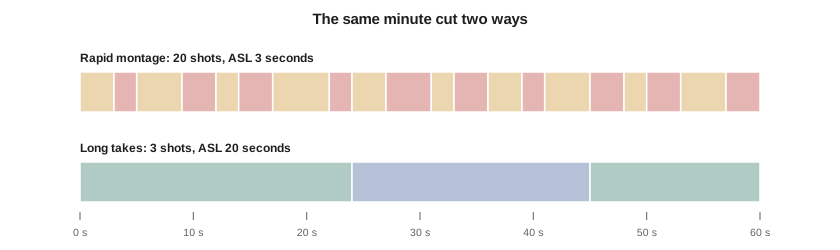
One simple way to describe an editing style is average shot length (ASL), the mean duration of the shots in a film or sequence. Film historians such as Barry Salt and David Bordwell have used ASL to track changes in style. They found that average shot lengths in Hollywood films fell markedly over the second half of the twentieth century: many studio-era films averaged something like eight to eleven seconds per shot, while many films of the 2000s averaged around four seconds or less. Bordwell calls the modern approach intensified continuity: faster cutting, more close-ups and more camera movement, but still following continuity principles.
Worked problem
Calculating average shot length
A described 96-minute feature contains 1,520 shots. A second film of 118 minutes contains 410 shots. Calculate the ASL of each and compare the editing styles.
Show solution
- Convert running times to seconds: 96 minutes \( = 5{,}760 \) seconds; 118 minutes \( = 7{,}080 \) seconds.
- First film ASL: \( 5{,}760 \div 1{,}520 \approx 3.8 \) seconds.
- Second film ASL: \( 7{,}080 \div 410 \approx 17.3 \) seconds.
- Interpret: the first is cut quickly, typical of intensified continuity; the second relies on long takes and slower rhythm.
Answer: The first film averages about 3.8 seconds per shot and the second about 17.3 seconds, so the second uses shots more than four times as long on average, suggesting a contemplative, long-take style.
ASL is a blunt tool. An average can hide huge variation: a film with a few very long takes and many quick cuts might have the same ASL as one with uniform medium-length shots. Some researchers therefore also report the median shot length. Use ASL as a starting point for comparison, not a full description.
| Style | Typical ASL | Characteristic devices | Effect |
|---|---|---|---|
| Classical continuity (studio era) | Roughly 8 to 11 seconds | Establishing shots, shot/reverse-shot, matches on action | Clear, smooth storytelling |
| Intensified continuity (modern) | Roughly 2 to 5 seconds | Rapid cutting, many close-ups, constant camera movement | Energy, urgency, constant engagement |
| Long-take style | Often 15 seconds or more | Extended takes, deep staging, complex camera movement | Real time, observation, immersion |
| Soviet montage | Varies; often rapid in key sequences | Collision of shots, graphic conflict, intellectual montage | Argument, shock, ideas |
Jump cuts and discontinuity
A jump cut is a cut between two shots of the same subject from nearly the same camera position, so that the subject appears to jump abruptly within the frame or time appears to skip. In continuity style, jump cuts are errors to avoid. The French New Wave made them famous as a deliberate technique: Jean-Luc Godard's Breathless (1960) uses jump cuts within scenes, including a car ride in which time skips repeatedly while the background changes. The effect is energetic, self-conscious and modern, reminding viewers they are watching a constructed film.
Today jump cuts are common in music videos, advertising and online video, where they compress talking-head footage and create a brisk rhythm. Other forms of discontinuity include deliberately crossing the 180-degree line, mismatched eyelines, and flash cuts of a frame or two that disrupt time. Discontinuity is not a failure if it is purposeful; analysis asks what effect it creates.
Worked problem
Interpreting a jump cut
In a described documentary-style drama, a young woman is interviewed in a single framing. Her answer is cut into five jump cuts over twenty seconds, so she appears to jolt slightly between sentences. What could the jump cuts be doing?
Show solution
- Identify the device: same subject, nearly the same framing, visible jumps between shots.
- Practical function: compressing a long answer into its key phrases.
- Expressive function: the jolts make the moment feel raw and nervous, as if her thoughts are fragmented.
- Contextual function: the visible editing signals a documentary or online video aesthetic.
Answer: The jump cuts compress her answer while making it feel restless and unpolished, matching her anxiety and placing the film in a documentary or vlog style.
The long take
At the opposite extreme from rapid montage is the long take, a shot that lasts much longer than usual. Long takes give actors room to develop performances, let tension accumulate without the release of a cut, and allow viewers to explore the frame. Combined with deep staging and complex camera movement, they can choreograph entire scenes in one continuous shot. Alfred Hitchcock's Rope (1948) was designed to appear as a few very long takes, with cuts hidden as the camera passes behind objects. More recent films have used digital techniques to stitch shots invisibly so that much of a film appears to be one continuous take.
The French critic André Bazin argued in the 1940s and 1950s that long takes and deep focus respect the continuity of real space and time and leave the viewer free to choose what to look at, in contrast to montage, which imposes meaning. This debate between montage and realism, Eisenstein versus Bazin in simplified form, remains one of the classic arguments of film theory, discussed further in FILM-430.
Editing and meaning across a sequence
When analyzing a sequence's editing, combine the tools from this lesson and the last.
- Map the space: is continuity maintained, and where is it broken?
- Measure rhythm: count shots and time the sequence; note accelerations and pauses.
- Note juxtapositions: what meanings arise from placing particular shots side by side?
- Note transitions: cuts, dissolves, fades, match cuts.
- Relate to sound: how do music and effects shape the cutting?
The National Film Board of Canada has a long tradition of inventive editing in documentary and experimental film. Arthur Lipsett's Very Nice, Very Nice (1961), a short collage of found images and sounds edited in rapid, ironic juxtapositions, was nominated for an Academy Award and influenced filmmakers far beyond Canada.
Editing, music and rhythm in practice
In modern films, editing rhythm is often shaped together with music. Editors may cut to the beat of a song in a montage sequence, or deliberately cut against the beat to create unease. In action sequences, shots may shorten as the music accelerates. In quiet dramas, an editor may let a single shot run through a whole musical phrase so that the image and music breathe together. A useful exercise is to watch a sequence twice: once with the sound on, noting where cuts fall, and once with the sound off, noticing how much of the rhythm you felt came from the music rather than the images.
Rhythm also depends on movement within the frame. A static shot of an empty room feels longer than a shot of the same duration filled with frantic action. Editors therefore judge shot length by feel as well as by the clock, which is one reason average shot length gives only a partial picture of a film's pace.
Finally, remember that discontinuity and continuity can coexist. Many contemporary films follow continuity principles most of the time and break them at key moments, such as a jump cut at a shock or a sudden smash cut from a quiet scene to a loud one. Those breaks gain power precisely because the rest of the film has trained us to expect smoothness.
Common mistakes
MistakeUsing "montage" without saying which sense is meant
InsteadSpecify editing in general, Soviet montage or a Hollywood montage sequence
MistakeTreating ASL as a complete description of style
InsteadUse ASL alongside median shot length and close analysis of variation
MistakeCalling every jump cut a mistake
InsteadAsk what the jump cut does in context; it may be deliberate and expressive
MistakeAssuming long takes are less edited or less designed
InsteadRecognize the planning, choreography and hidden cuts long takes often require
MistakeOverstating the Kuleshov experiment as proven fact in every detail
InsteadPresent it as an influential idea whose original details are debated, with modest experimental support
Summary and key terms
- The Kuleshov effect shows that viewers interpret shots through the shots around them.
- Soviet montage, especially Eisenstein's, uses the collision of shots to create ideas and emotions.
- Montage can mean editing in general, Soviet montage or a Hollywood montage sequence.
- Rhythm comes from shot durations and their patterns; average shot length helps compare styles.
- Hollywood shot lengths shortened markedly over the late twentieth century, producing intensified continuity.
- Jump cuts and other discontinuities can be deliberate, expressive choices.
- Long takes preserve continuous time and space, as Bazin argued, and remain a powerful alternative to cutting.
- Montage
- Editing in general, or editing that creates meaning through juxtaposition, or a sequence compressing time
- Kuleshov effect
- The influence of adjacent shots on how viewers interpret a shot
- Intellectual montage
- Eisenstein's term for juxtaposing images to create an abstract idea
- Montage sequence
- A short passage that compresses time or summarizes a process, often set to music
- Average shot length
- The running time of a film or sequence divided by its number of shots
- Intensified continuity
- Bordwell's term for modern continuity style with faster cutting and more close-ups
- Jump cut
- A cut between similar framings of the same subject that makes it seem to jump
- Long take
- A shot of unusually long duration
- French New Wave
- A movement of young French filmmakers around 1959 to the mid-1960s known for breaking conventions
- Found footage
- Existing film or video material re-edited into a new work
Practice problems
Work each problem on paper first, then reveal the answer to check.
What does the Kuleshov effect suggest?
Show answer
Viewers interpret a shot according to the shots placed around it.
What did Eisenstein believe editing should create?
Show answer
Conflict between shots that produces new ideas or emotions in the viewer.
Give three meanings of the word montage.
Show answer
Editing in general, Soviet montage, and a Hollywood montage sequence.
A 90-minute film has 1,800 shots. What is its ASL?
Show answer
5,400 seconds ÷ 1,800 = 3 seconds.
Why can ASL be misleading?
Show answer
An average can hide wide variation in shot lengths.
What is intensified continuity?
Show answer
Modern continuity style with faster cutting, more close-ups and more camera movement.
Which 1960 film made jump cuts famous?
Show answer
Breathless, directed by Jean-Luc Godard.
What did Bazin value in long takes and deep focus?
Show answer
Respect for continuous space and time and the viewer's freedom to choose where to look.
Name two practical functions of a jump cut.
Show answer
Compressing time and creating a brisk or restless rhythm.
What is found footage editing?
Show answer
Re-editing existing film or video into a new work.
Lesson quiz · 5 questions
Score 60% or more to complete this lesson.
Create a free account to save your progress, take quizzes and earn a certificate.