
FILM-101 · Lesson 5 of 12 · 27 min
Cinematography: framing, shot scale, angle, lens and camera movement
Mise-en-scène is what is placed in front of the camera; cinematography is how the camera records it. Cinematographic choices include how much of the scene the frame includes, from what height and angle we see it, what lens is used and how much is in focus, the shape of the frame itself, and whether and how the camera moves. Each choice affects what we notice, how we relate to characters and how we feel. This lesson gives you the core vocabulary to describe and interpret the camera's work. For the technical craft of exposure, lenses and camera systems, see the cinematography production courses, starting with CINE-101.
The frame and its edges
The frame is the boundary of the image. Everything the filmmaker wants us to see must be inside it, and what lies outside, offscreen space, can be just as important. A character looking or reacting to something offscreen, a sound from beyond the frame, or a hand reaching into the frame all activate offscreen space and make the world feel larger than the image.
Composition within the frame guides attention. Filmmakers use balance and imbalance, lines that lead the eye, and placement relative to the frame edges. A common guideline is the rule of thirds: dividing the frame into a three-by-three grid and placing important elements near the lines or their intersections. Centred, symmetrical compositions feel formal, stable or even unsettling in their perfection; off-centre compositions can feel dynamic or unbalanced. Headroom (space above a head) and lead room (space in the direction a character looks or moves) also affect how comfortable or tense a frame feels. Too little lead room can make a character seem trapped.
Aspect ratio
The aspect ratio is the ratio of the frame's width to its height. It is one of the most basic choices a filmmaker makes, and it has changed throughout film history.
| Ratio | Name or use | Shape |
|---|---|---|
| 1.33:1 (4:3) | Silent era; early television | Nearly square |
| 1.37:1 | Academy ratio, standard for sound films until the 1950s | Nearly square |
| 1.78:1 (16:9) | High-definition television and streaming | Moderately wide |
| 1.85:1 | Common "flat" widescreen for cinema | Wide |
| 2.39:1 | Anamorphic or "scope" widescreen | Very wide |
| 1:1 | Square; occasionally chosen for expressive effect | Square |
Widescreen formats spread in the 1950s as studios competed with television. Wide frames suit landscapes, spectacle and groups; narrower frames can emphasize faces, height or confinement. Some films change aspect ratio for expressive effect, widening the frame at moments of release or switching formats for different time periods.
Worked problem
Comparing frame shapes
Two versions of the same shot are 1920 pixels wide. One is framed at 1.85:1 and the other at 2.39:1. How tall is each image, and what changes for the viewer?
Show solution
- Height equals width divided by the ratio. For 1.85:1: \( 1920 \div 1.85 \approx 1038 \) pixels.
- For 2.39:1: \( 1920 \div 2.39 \approx 803 \) pixels.
- The 2.39:1 image is about 235 pixels shorter, so at the same width it shows less vertical space and more emphasis on horizontal relationships.
Answer: At 1920 pixels wide, the 1.85:1 frame is about 1038 pixels tall and the 2.39:1 frame about 803; the wider shape favours landscapes and side-by-side groupings, while the taller one leaves more room above and below figures.
Shot scale
Shot scale describes how large the subject appears in the frame, conventionally measured against the human figure. The terms are approximate, and different traditions draw the lines slightly differently, but the categories are widely used.
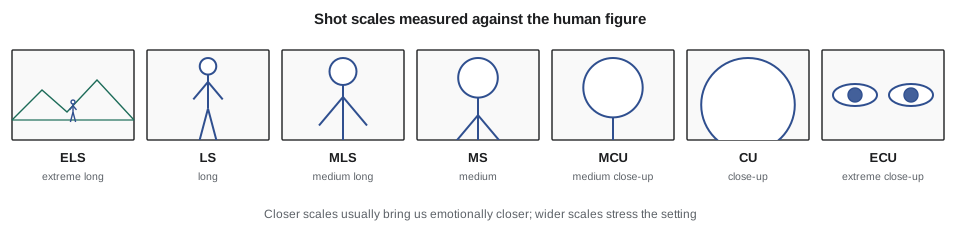
- Extreme long shot (ELS): a figure is tiny or absent; the landscape or setting dominates. Often used as an establishing shot.
- Long shot (LS): the full figure is visible with some surroundings.
- Medium long shot (MLS): the figure from about the knees up, sometimes called the American shot.
- Medium shot (MS): from about the waist up; common for conversations.
- Medium close-up (MCU): from about the chest up.
- Close-up (CU): the head and perhaps the shoulders; emphasizes facial expression or an object.
- Extreme close-up (ECU): a detail such as the eyes, a mouth or a fingertip.
Larger scales generally bring us emotionally closer, while long shots can create objectivity, distance or a sense of the environment's power. A filmmaker who withholds close-ups for a long time can make the first one feel overwhelming.
Camera height and angle
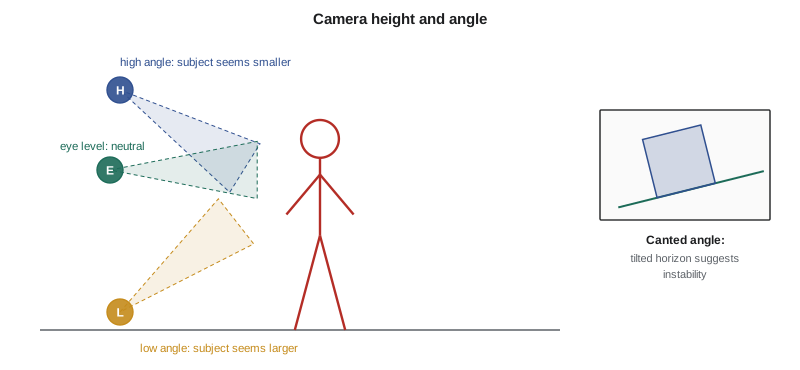
The camera's height and angle relative to the subject affect how we perceive power, vulnerability and orientation.
- Eye-level shots feel neutral and are the norm.
- High-angle shots look down on a subject and can make it seem small, weak or trapped.
- Low-angle shots look up and can make a subject seem large, powerful or threatening.
- Overhead (bird's-eye) shots look straight down, giving a god-like or abstract view.
- Canted (Dutch) angles tilt the horizon, suggesting instability, disorientation or madness.
These associations are tendencies, not codes. A low angle can make a child seem heroic, or simply reflect another character's point of view from the floor. Always check context.
Lenses and depth of field
Lenses change how space looks. Focal length, measured in millimetres, describes how wide or narrow a lens's view is.
- Wide-angle (short focal length) lenses take in a broad view, exaggerate depth so that objects near the lens look large and distant ones small, and can distort faces in close-up.
- Normal lenses approximate ordinary human perception of perspective.
- Telephoto (long focal length) lenses magnify distant subjects and flatten space, making objects at different distances seem stacked together, as in a shot of traffic or a crowd that seems compressed.
- Zoom lenses can change focal length during a shot, which changes magnification without moving the camera.
Depth of field is the range of distances that appear acceptably sharp. Shallow depth of field isolates a subject against a soft background and directs attention; deep focus keeps foreground and background sharp at once, allowing deep staging. Orson Welles and cinematographer Gregg Toland made deep focus famous in Citizen Kane (1941). A rack focus shifts focus during a shot from one plane to another, moving our attention without a cut.
Camera movement
A moving camera can follow action, reveal information, change our relationship to characters or create rhythm.
| Movement | Description | Common effects |
|---|---|---|
| Pan | Camera pivots left or right on a fixed point | Follows action, scans a space, links two subjects |
| Tilt | Camera pivots up or down | Reveals height, follows vertical movement |
| Dolly or tracking shot | Camera moves through space on a dolly, track or vehicle | Follows characters, explores space, pushes in for emphasis |
| Crane or jib shot | Camera rises or descends on an arm | Reveals scale, transitions from intimate to grand |
| Handheld | Camera operated on the shoulder or in the hands | Immediacy, documentary feel, nervous energy |
| Stabilized (gimbal or Steadicam) | Smooth movement while carried | Fluid following through complex spaces |
| Zoom | Lens changes focal length; camera does not move | Sudden emphasis, a sense of being watched |
A slow push-in toward a face usually intensifies attention and emotion. A pull-back can reveal context, isolate a character or provide an ending. Long takes with complex movement, sometimes called oners, show off choreography and immerse the viewer in continuous time; Lesson 7 discusses them as an alternative to editing.
Putting cinematography together
Cinematographic choices combine. A medium shot at eye level with a normal lens and a static camera feels neutral; a close-up from a low angle with a wide lens and a handheld camera feels intense and unstable. Analysis identifies the combination and connects it to the dramatic situation.
Worked problem
Analyzing a described shot
In a described scene, a job applicant waits in a vast corporate lobby. The shot is an extreme long shot from a high angle, with a wide-angle lens, holding for eight seconds before the applicant's name is called offscreen. What do the choices suggest?
Show solution
- Shot scale: the extreme long shot makes the applicant tiny in relation to the building.
- Angle: the high angle looks down on him, suggesting vulnerability.
- Lens: the wide angle exaggerates the depth and emptiness of the lobby.
- Duration and offscreen sound: the long hold and offscreen voice increase a sense of waiting and powerlessness.
Answer: The combination presents the applicant as small and powerless before the institution, so the camera expresses his anxiety and the company's dominance before any dialogue.
Canadian directors have produced some of the most admired images in contemporary film. Denis Villeneuve's collaborations with cinematographers such as Roger Deakins on Sicario (2015), Bradford Young on Arrival (2016) and Greig Fraser on Dune (2021) are known for vast scale, strict compositions and restrained camera movement. The Canadian Society of Cinematographers (CSC) recognizes Canadian camera work each year.
Point-of-view shots and the camera as observer
Cinematography also shapes whose perspective we share. A point-of-view shot places the camera roughly where a character's eyes are, so we see what they see, often framed by shots of the character looking and reacting. An over-the-shoulder shot includes part of one character in the foreground, placing us near their position without fully taking their view. Some films use the camera as a visible observer, with handheld movement and imperfect framing that suggest a documentary crew, while others use smooth, impersonal movement that seems to come from nowhere. A few films are shot almost entirely from one character's optical point of view, which can feel immersive or claustrophobic.
When analyzing a shot, ask whose perspective it represents: a character's, an anonymous observer's, or a deliberately impossible view such as an overhead shot looking straight down. Changes in perspective often mark changes in sympathy or knowledge. A film that has kept us at a distance in long shots and suddenly cuts to a point-of-view shot may be inviting us, for the first time, into a character's experience.
Finally, remember that cinematography is collaborative. The director of photography works with the director, the camera operator, the gaffer who leads the lighting crew and the key grip who handles camera support and rigging. Credits for a striking image may belong to several people.
A simple practice routine is to choose one scene and write a single sentence for each shot naming its scale, angle, lens impression and any movement, then a final sentence explaining how the shots work together. After a few scenes, the vocabulary becomes automatic, and you will begin to notice cinematography in everything from news broadcasts to social media videos.
Common mistakes
MistakeAssuming low angles always mean power
InsteadInterpret angle in context; it may reflect point of view or another purpose
MistakeConfusing a zoom with a dolly shot
InsteadA zoom changes focal length with a fixed camera; a dolly moves the camera through space
MistakeNaming shot scales without saying what they do
InsteadLink scale to emotional distance, attention and story context
MistakeIgnoring offscreen space
InsteadWatch for looks, sounds and movements that point beyond the frame and enlarge the story world
MistakeTreating aspect ratio as a technical default
InsteadAsk why a film uses its frame shape and whether the shape changes
Summary and key terms
- Cinematography covers framing, aspect ratio, shot scale, angle, lens, focus and camera movement.
- The frame selects what we see, and offscreen space can be equally important.
- Aspect ratios range from nearly square to very wide, and changes can be expressive.
- Shot scales from extreme long shot to extreme close-up control emotional distance and attention.
- Camera height and angle shape perceptions of power and stability, always in context.
- Focal length changes perspective, and depth of field directs attention.
- Camera movements such as pans, tilts, tracking shots and handheld work create rhythm, revelation and intimacy.
- Offscreen space
- The parts of the story world beyond the edges of the frame
- Aspect ratio
- The ratio of the frame's width to its height
- Shot scale
- How large the subject appears in the frame, measured against the human figure
- Establishing shot
- A wide shot, often at the start of a scene, that shows where the action takes place
- Canted angle
- A framing in which the horizon is tilted, also called a Dutch angle
- Focal length
- A property of a lens that determines how wide or narrow its view is, measured in millimetres
- Depth of field
- The range of distances that appear acceptably sharp in an image
- Deep focus
- A technique keeping foreground and background in sharp focus at the same time
- Rack focus
- A change of focus during a shot from one plane to another
- Tracking shot
- A shot in which the camera moves through space, usually on a dolly or vehicle
Practice problems
Work each problem on paper first, then reveal the answer to check.
What does the rule of thirds suggest?
Show answer
Placing important elements near the lines or intersections of a three-by-three grid.
What was the Academy ratio?
Show answer
About 1.37:1, the standard ratio for sound films until the 1950s.
How tall is a 2.39:1 frame that is 3840 pixels wide?
Show answer
About 1607 pixels.
Which shot scale shows a figure from about the waist up?
Show answer
A medium shot.
What effect does a high-angle shot often have?
Show answer
It can make a subject seem small, weak or vulnerable.
How does a telephoto lens affect space?
Show answer
It magnifies distant subjects and flattens depth.
What is the difference between a pan and a tracking shot?
Show answer
A pan pivots the camera on a fixed point; a tracking shot moves the camera through space.
What does a rack focus do?
Show answer
It shifts focus from one plane to another during a shot.
What is lead room?
Show answer
Space in the direction a character looks or moves.
Which film made deep focus famous?
Show answer
Citizen Kane (1941), shot by Gregg Toland.
Lesson quiz · 5 questions
Score 60% or more to complete this lesson.
Create a free account to save your progress, take quizzes and earn a certificate.