
FILM-101 · Lesson 3 of 12 · 27 min
Mise-en-scène I: setting, costume, makeup, staging and performance
Mise-en-scène (pronounced roughly "meez-on-SEN") is a French theatre term meaning "putting into the scene." In film studies it refers to everything placed in front of the camera and arranged for it: the setting, props, costumes and makeup, the lighting, and the actors' staging and performances. It is the part of film style most familiar to viewers, because it is what we see. Yet audiences often notice it least, because a well-designed setting or costume feels natural rather than designed. This lesson covers setting, costume, makeup, staging and performance; Lesson 4 covers lighting and colour. Together they show how filmmakers build meaning before the camera even rolls.
Realism and stylization
Mise-en-scène can aim for realism, making the world look and feel like everyday life, or for stylization, making it visibly shaped and expressive. Neither is better. A social-realist drama may shoot on real streets with non-professional actors in their own clothes. A musical or fantasy may build artificial sets with saturated colours and theatrical performances. Realism itself is a set of conventions: what looks "real" changes across eras and cultures. When analyzing mise-en-scène, ask what level of realism the film sets up and how consistently it maintains it.
A classic example of stylization is German Expressionism. The 1920 film The Cabinet of Dr. Caligari used painted sets with slanting walls, jagged windows and shadows painted directly onto the scenery to express a disturbed state of mind. The style influenced horror films and film noir for decades.
Setting
Setting is the place where the action happens, whether a real location or a set built in a studio. Settings do more than provide a background; they can express character, establish mood, carry themes and even act almost as characters themselves.
- Location versus set: shooting on location brings authenticity and texture; studio sets give control over light, sound and space, and allow impossible architecture.
- Production design: the production designer leads the art department, which designs and builds sets, chooses locations and dresses them with furniture and objects (set dressing).
- Props: objects that characters use or that carry meaning. A prop can become a motif, gaining significance each time it reappears.
- Space and scale: a vast empty landscape can isolate a character; a cluttered apartment can suggest a crowded life or a confused mind.
- Digital settings: many modern films combine physical sets with digital extensions or LED volume backgrounds, a technique covered in the cinematography program.
Canadian films often make striking use of landscape. Many Quebec and Prairie films use winter as more than weather: snow can isolate, purify or threaten. Indigenous filmmakers frequently foreground land as a source of identity and memory, so that the setting carries meaning beyond scenery.
Costume and makeup
Costume and makeup tell us about characters' social class, era, occupation, personality and change. A character's costume may shift across the film to mark transformation: a timid office worker who gradually adopts bolder colours and sharper tailoring, for instance. Costume designers work closely with production designers and cinematographers to coordinate palettes and textures.
- Period accuracy: historical films use costume to establish time and place, although designers often adjust historical clothing to modern eyes.
- Character arcs: costume changes signal internal changes.
- Contrast and grouping: matching costumes can link characters; contrasting costumes can set them apart.
- Makeup and hair: from almost invisible "natural" makeup to elaborate prosthetics, ageing makeup and special effects makeup that transforms actors into creatures.
- Representation: costume and makeup choices can reinforce or challenge stereotypes, and historically have been used in harmful ways, such as blackface or "redface" caricatures. Critical viewers notice these choices and their histories.
Staging: figure behaviour and blocking
Staging covers how actors move and are positioned within the setting. Blocking is the planned arrangement of actors' positions and movements during a scene, usually worked out by the director with actors and the cinematographer. Staging guides our attention: viewers tend to look at faces, at movement, at the brightest or most contrasting area of the frame, and at characters who are speaking or being looked at by others.
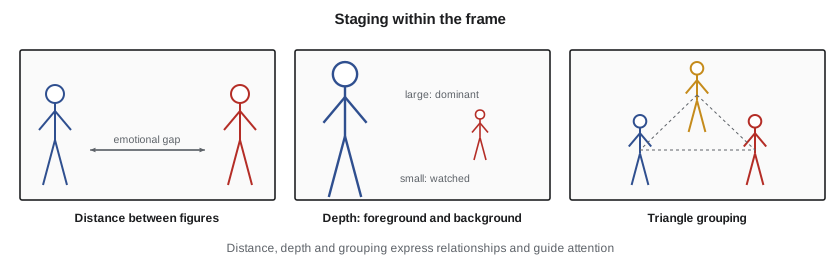
- Distance between figures can express emotional distance or closeness.
- Foreground and background placement creates hierarchy: a character large in the foreground often dominates, while a small figure in the background may seem vulnerable or watched.
- Frontality: a character facing the camera often commands attention more than one seen in profile or from behind.
- Movement: entering the frame, crossing it or leaving it can signal shifts in power or attention.
- Deep staging places significant action at several depths of the frame at once, inviting viewers to scan the image.
Worked problem
Analyzing staging in a described scene
In a described family dinner scene, the father sits at the head of a long table in the foreground, facing the camera. His adult daughter sits at the far end, small in the background, partly hidden by a candlestick. Her brother sits midway, turned toward the father. What does the staging suggest?
Show solution
- Identify hierarchy: the father is large, central and frontal, so he dominates the frame and the scene.
- Identify distance: the daughter is far away and partly blocked, suggesting she is excluded or keeping her distance.
- Identify alignment: the brother's body turns toward the father, aligning him with the father's authority.
- Combine: the staging maps the family's power relations onto space.
Answer: The staging presents the father as the dominant figure, the son as his ally and the daughter as marginalized and partly hidden, so the arrangement of bodies tells us about the family's power structure before anyone speaks.
Performance
Performance includes actors' voices, facial expressions, gestures and movements. Performance styles vary widely.
- Naturalistic acting aims to resemble everyday behaviour, with understated gestures and conversational delivery.
- Stylized or theatrical acting exaggerates expression for comic, melodramatic or artistic effect, as in silent comedy or musicals.
- Method-influenced acting, associated with the Actors Studio in New York, encouraged actors to draw on personal emotional memory, producing intense, interior performances in American films of the 1950s and after.
- Non-professional performers are used in some realist traditions because they bring authenticity.
Film performance is shaped by the other techniques. In a close-up, a tiny movement of the eyes can carry great weight; in a long shot, the whole body must express emotion. Editing can construct a performance by selecting the best moments from many takes. The Soviet filmmaker Lev Kuleshov is credited with an experiment in the 1910s or 1920s suggesting that the same neutral face could seem hungry, grieving or desirous depending on the shot placed next to it, a reminder that viewers read faces in context. Lesson 7 returns to this "Kuleshov effect."
| Element | Questions to ask | Example observations |
|---|---|---|
| Setting | Location or set? What does the space express? | A cramped basement apartment that suggests poverty and confinement |
| Props | Which objects recur or matter? | A broken watch shown three times as a motif of lost time |
| Costume | What does clothing say about class, era, change? | A uniform abandoned in the final scene |
| Makeup and hair | Natural or stylized? Does it change? | Gradual ageing makeup across decades |
| Staging | Who dominates the frame? How far apart are figures? | A character always placed behind doorways |
| Performance | Naturalistic or stylized? Where is attention drawn? | A long, almost silent close-up of a grieving face |
Mise-en-scène across the whole film
Mise-en-scène creates patterns across a film, not only within single shots. A colour linked to danger, a doorway that repeatedly frames a character, or a costume item passed between characters can become a motif. Analysts track such patterns because repetition with variation is one of the main ways films build meaning. Compare how the same setting appears at different points: a house that looks welcoming in daylight in the first act may look threatening at night in the third, signalling change in the characters' situation.
Mise-en-scène, budget and collaboration
Mise-en-scène is the work of many departments: production design, art direction, set decoration, props, costume, hair and makeup, plus the director and actors. Budget shapes what is possible. A low-budget film may use one apartment for most scenes and rely on performance and lighting; a large studio production may build a city. Constraints often encourage inventive solutions. When you analyze a film, recognize that every visible element was chosen, borrowed, built or deliberately left alone.
In Canada, art department, costume and other crew roles on many productions are represented by unions and guilds such as IATSE locals and, in some regions, the Directors Guild of Canada for production designers and art directors. Canadian productions often stand in for other places; Toronto, Vancouver and Montreal regularly double for American and European cities, which makes the art department's job of disguising locations especially visible.
Worked problem
Tracking a costume motif
In a described coming-of-age film, a girl wears a bright red raincoat in the first scene, a faded red sweater in the middle when she is lonely, and a new red jacket she chose herself in the final scene. What might the pattern suggest, and how would you support the claim?
Show solution
- Note the repetition: red appears in her clothing in three key scenes.
- Note the variation: bright and childlike at first, faded in the lonely middle, renewed and chosen by her at the end.
- Link to the narrative arc: the costume tracks her loss of confidence and its recovery on her own terms.
- Gather support: check whether other characters wear red, whether lighting or framing emphasizes the colour, and whether the changes align with turning points.
Answer: The red clothing works as a motif that charts the girl's emotional arc, from childhood confidence through isolation to self-chosen identity; the claim is stronger if the costume changes coincide with turning points and if no other characters share the colour.
A checklist for mise-en-scène analysis
When you sit down with a scene, a short checklist keeps your observations organized. First, describe the space: is it open or closed, cluttered or bare, realistic or stylized, and does it change during the scene? Second, list the objects that matter, especially any that appear elsewhere in the film. Third, note costume and makeup for each important character and any change. Fourth, sketch a quick overhead plan showing where characters stand and how they move, because a simple diagram often reveals patterns of distance and power that are hard to see while watching. Finally, describe the performances: the pace of speech, gestures, stillness and where the actors look. With these notes in hand, you can ask the key question of analysis: how do these choices work together to shape what we understand and feel at this moment of the story?
Common mistakes
MistakeTreating setting as mere background
InsteadAsk how the space expresses character, mood or theme and whether it changes
MistakeAssuming realistic mise-en-scène is undesigned
InsteadRecognize that realism is itself a set of chosen conventions
MistakeDescribing costume without linking it to character or story
InsteadConnect costume choices to class, era, personality and change across the film
MistakeIgnoring where figures stand in the frame
InsteadAnalyze distance, depth, frontality and movement to see how staging guides attention and expresses relationships
MistakeJudging performance only by whether it seems natural
InsteadIdentify the performance style the film uses and how framing and editing shape it
Summary and key terms
- Mise-en-scène is everything placed in front of the camera and arranged for it.
- Films range from realism to stylization, and realism itself is a set of conventions.
- Setting, props and production design express character, mood and theme.
- Costume, makeup and hair signal class, era, personality and transformation.
- Staging and blocking guide attention through distance, depth, frontality and movement.
- Performance styles range from naturalistic to stylized and are shaped by framing and editing.
- Mise-en-scène builds patterns and motifs across the whole film.
- Mise-en-scène
- All elements placed in front of the camera, including setting, costume, lighting, staging and performance
- Production design
- The overall visual design of a film's settings, led by the production designer
- Set dressing
- The furniture and objects placed in a set to make it believable or expressive
- Prop
- An object used by a character or given significance in a scene
- Blocking
- The planned positions and movements of actors in a scene
- Deep staging
- Placing significant action at several depths of the frame at once
- Frontality
- Positioning a figure facing the camera, which tends to draw attention
- Expressionism
- A style that distorts setting, light and performance to express inner states
- Naturalistic acting
- A performance style that resembles everyday behaviour
- Kuleshov effect
- The tendency of viewers to read a face's emotion from the shots placed around it
Practice problems
Work each problem on paper first, then reveal the answer to check.
What does mise-en-scène mean literally?
Show answer
"Putting into the scene."
Name two advantages of shooting on location and two of shooting on a set.
Show answer
Location: authenticity and texture; set: control over light and sound and freedom to build any space.
How can costume express a character arc?
Show answer
Changes in costume across the film can signal changes in the character's status or inner life.
What does deep staging invite viewers to do?
Show answer
Scan the frame and notice action at several depths.
Who usually works out the blocking of a scene?
Show answer
The director with the actors and cinematographer.
Give an example of stylized mise-en-scène.
Show answer
The painted, slanted sets of an Expressionist film.
Why might a filmmaker cast non-professional performers?
Show answer
To bring authenticity in a realist style.
What does a figure placed small in the background often suggest?
Show answer
Vulnerability, exclusion or being watched.
What is a prop motif?
Show answer
An object that recurs and gains meaning through repetition.
Why should viewers notice historical uses of makeup such as blackface?
Show answer
Because such choices carry harmful stereotypes and histories that affect meaning and representation.
Lesson quiz · 5 questions
Score 60% or more to complete this lesson.
Create a free account to save your progress, take quizzes and earn a certificate.