
FAT-230 · Lesson 9 of 12 · 20 min
Notification appliance and voice system testing
A fire alarm system that detects a fire perfectly is useless if nobody hears it. On the third day at Riverlight Tower, Sasha carries a sound level meter from floor to floor while Gerry runs the evacuation message from the fire alarm control centre in the lobby. In a corridor on the fifteenth floor the message is loud and clear. Inside a bedroom of suite 1503, with the door closed, it is barely louder than the air conditioner. 'It used to meet the level,' Gerry says, checking last year's record. 'What changed?' This lesson covers the inspection and testing of horns, strobes, speakers and the voice and two-way communication systems.
Inspecting notification appliances
Each horn, strobe, horn-strobe, speaker and bell is inspected for:
- presence and condition: not missing, damaged, painted over or loose on its box;
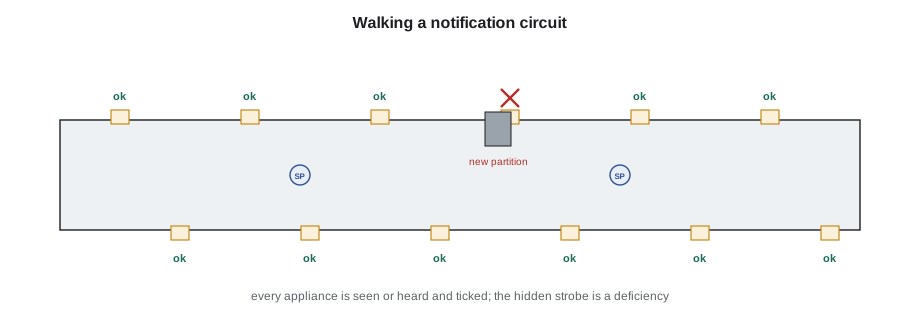
- visibility: strobes not hidden by new partitions, signs, shelving, or decorations; speakers not covered by ceiling tiles or acoustic panels added later;
- settings: candela and sound settings and speaker taps match the record drawings and the design;
- changes in the space: rooms divided, ceilings lowered, carpet or acoustic treatment added, or a quiet office turned into a noisy workshop, any of which can change how loud or visible the signals are.
Functional testing
CAN/ULC-S536 requires each audible and visual signal device to be tested to confirm that it operates. In practice, the technician activates each signal circuit and walks it, confirming that every appliance sounds or flashes. The standard also requires that strobes in the same field of view flash in synchronization, and that the audible pattern is correct: the temporal-three evacuation pattern, and in two-stage systems the distinct alert pattern.
Walking every appliance is slow, so Gerry's crew uses the walk-test feature of the control unit where it allows signal circuits to be activated in short bursts. Two technicians work together: one at the control unit, one on the floor. Strobes are counted as they flash; horns and speakers are listened for. Any appliance that doesn't operate is traced: is the appliance dead, or is the circuit wired wrongly so that the appliances beyond a point are not getting power?
Measuring sound levels
A horn that sounds isn't necessarily loud enough. The sound level is measured with an A-weighted sound level meter at the locations and heights the standard specifies, and compared with the required level above the ambient sound level of the space. Measurements are made in the spaces' normal condition: with doors closed in sleeping rooms, and with the usual equipment running.
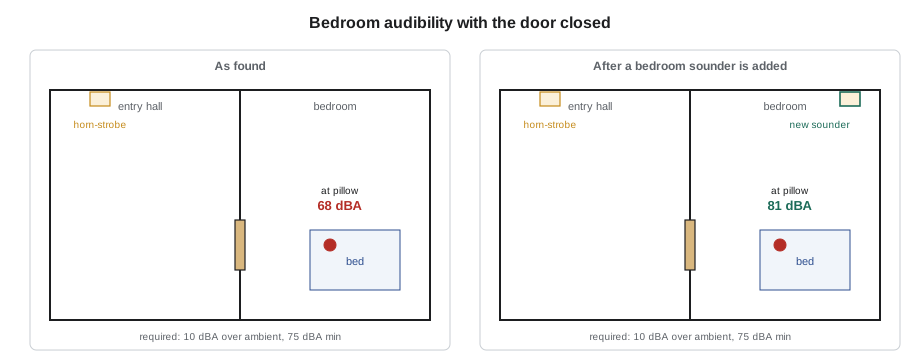
The National Building Code requires the alarm signal to be at least 10 dBA above the ambient sound level, and in sleeping rooms at least 75 dBA, measured at the pillow with the doors closed. Signals must not be so loud that they could harm hearing.
# Audibility check from field measurements (dBA)
above = 10
sleep_min = 75
rooms = [("corridor 15", 46, 84, False), ("suite 1503 living room", 41, 71, False),
         ("suite 1503 bedroom, door closed", 38, 68, True), ("garbage room 15", 58, 80, False)]
for name, ambient, measured, sleeping in rooms:
    need = ambient + above
    if sleeping:
        need = max(need, sleep_min)
print(f"{name:34s} ambient {ambient} need {need} measured {measured} {'OK' if measured >= need else 'LOW'}")corridor 15 ambient 46 need 56 measured 84 OK suite 1503 living room ambient 41 need 51 measured 71 OK suite 1503 bedroom, door closed ambient 38 need 75 measured 68 LOW garbage room 15 ambient 58 need 68 measured 80 OK
The bedroom of suite 1503 fails. Gerry looks at last year's record: the measurement then was 77 dBA. A visit to the suite's entry hall answers the question. The tenant has replaced the suite's hollow-core bedroom door with a heavy solid-core door, and the hall horn-strobe that served the bedroom is now on the other side of a much better sound barrier. The fix isn't the tenant's door; the suite needs a sounder in the bedroom or a louder setting, and that's a design question for Ravi, so the finding goes in the report as a deficiency with a recommendation.
Strobes and visibility
Strobes are checked to confirm they flash, are synchronized, and are visible from everywhere they are meant to serve. A strobe's candela setting is compared with the drawing; a strobe set lower than designed is a deficiency even if it looks bright, because its coverage was calculated for its rated output. Where a space has changed, such as a large room divided into two, the inspection checks that each new room still has a visible signal, and reports any that don't.
Voice evacuation systems
Buildings like Riverlight Tower use voice evacuation: speakers that deliver recorded messages and live announcements, controlled from the fire alarm control centre. Voice systems are tested for more than loudness:
- the pre-recorded messages play correctly, in the right sequence for each zone, with the alert tone and evacuation tone the design calls for;
- live announcements from the microphone reach each zone selected, and override recorded messages as designed;
- speakers are not just loud but intelligible: a message that is loud but garbled by echo or distortion fails;
- the amplifiers are supervised, including the backup amplifier, and switch over on failure;
- each speaker circuit is supervised, and faults are reported.
CAN/ULC-S536 covers voice communication systems, including the tests of messages, live paging, the amplifiers and the speaker circuits. Intelligibility is checked by listening in each area; where measurements are needed, they follow the method the design used.
At Riverlight, Gerry plays each floor's messages, then makes a live announcement on each floor from the control centre while Sasha stands in the corridor and in one suite per floor.
Two-way communication
High buildings also have two-way communication for firefighters: firefighter telephones or radio enhancement systems, or both. Firefighter telephone jacks or handsets are tested at each location, confirming a clear two-way conversation with the control centre and that the control centre shows which location is calling. Stairwell communication for people waiting at an area of refuge, where provided, is tested the same way. Emergency responder radio coverage systems, where installed, are tested by their own specialists, but the fire alarm technician confirms the supervisory signals they send to the fire alarm panel.
# Firefighter telephone test log: every location must give a clear two-way call
locations = [f"stair A floor {n}" for n in range(1, 19)] + [f"stair B floor {n}" for n in range(1, 19)]
results = {loc: "clear" for loc in locations}
results["stair A floor 7"] = "no ring-in at control centre"
results["stair B floor 13"] = "one-way only"
bad = {k: v for k, v in results.items() if v != "clear"}
print("locations tested:", len(results))
for k, v in bad.items():
print("FAIL", k, "-", v)locations tested: 36 FAIL stair A floor 7 - no ring-in at control centre FAIL stair B floor 13 - one-way only
Voltage at the end of the circuit
FAT-130 showed how voltage drop is calculated when a circuit is designed. The inspection can measure it. With the system on battery and all appliances on the circuit sounding, the voltage is measured at the last appliance. It must stay at or above the lowest voltage the appliances are listed for, 16 volts for typical 24-volt appliances. A circuit that met its design voltage when new can fall short later if appliances were added, wiring was damaged, or the batteries feeding it are weak.
# Voltage at the last appliance, on battery, in alarm
min_V = 16.0
circuits = [("RPS-9 NAC 1", 19.2), ("RPS-9 NAC 2", 17.4), ("RPS-14 NAC 1", 15.6), ("panel NAC 3", 20.1)]
for name, v in circuits:
print(f"{name:14s} {v:5.1f} V {'OK' if v >= min_V else 'BELOW 16 V - check load, wiring and batteries'}")RPS-9 NAC 1 19.2 V OK RPS-9 NAC 2 17.4 V OK RPS-14 NAC 1 15.6 V BELOW 16 V - check load, wiring and batteries panel NAC 3 20.1 V OK
One circuit on RPS-14 is low. Gerry checks the circuit's load: two strobes were added in a renovated amenity room without a new calculation. The circuit needs to be split or the added strobes moved to another circuit, and the change goes to Ravi.
Worked problem
Floor 15 at Riverlight
On the fifteenth floor: the corridor measurements pass; one strobe in the amenity room is hidden by a new display screen; the bedroom of suite 1503 measures below the required level with the door closed; the fifteenth-floor live announcement is loud but hard to understand near the elevator lobby, where a new glass wall was installed. What goes in the report?
Show solution
- The hidden strobe: a deficiency, with a recommendation to move the screen or the strobe.
- Suite 1503 bedroom: a deficiency for the owner, with the measurement and the cause, and a recommendation for a design review.
- The elevator lobby intelligibility: a deficiency, noting the new glass wall, and a recommendation for an acoustic or speaker review.
- The corridor passes are recorded with their measured values.
Answer: Measured values go in the report, so next year's inspection can compare.
Amplifiers and backup amplifiers
Voice systems depend on amplifiers, and amplifiers fail. Most voice systems have a backup amplifier that takes over when a primary amplifier fails, and the control unit supervises each amplifier. The test removes or disables a primary amplifier, following the maker's method, and confirms that the trouble is reported, that the backup takes over, and that every speaker circuit the failed amplifier served still plays the message at full level. The amplifiers' battery supply is load-tested like any other, because a voice system in alarm draws far more current than one in standby.
Speaker circuits are supervised for opens, shorts and ground faults, like other circuits, and each fault type is created and confirmed at the control unit. A speaker circuit that has been tapped, with a branch added during a renovation without being wired in and out, may still play the message but leave part of the circuit unsupervised; the inspection finds it when an open on the branch doesn't produce a trouble.
Low-frequency signals and strobes in sleeping areas
Recent editions of the installation standards require a low-frequency audible signal, around 520 Hz, in sleeping areas, because it wakes people more reliably, including people with hearing loss. Sleeping rooms with visual signals for people who are deaf or hard of hearing need high-intensity strobes. The inspection confirms that the appliances installed in sleeping areas are the type the design and the code require, and that replacements over the years, often bought by the building's own staff, haven't swapped in a standard horn or a lower-intensity strobe.
# Check sleeping-area appliances against the design
design = {"suite 1503 bedroom": ("520 Hz sounder", 177), "suite 806 bedroom": ("520 Hz sounder", 177), "suite 1210 bedroom": ("520 Hz sounder", 177)}
found = {"suite 1503 bedroom": ("520 Hz sounder", 177), "suite 806 bedroom": ("standard horn", 177), "suite 1210 bedroom": ("520 Hz sounder", 75)}
for room, (kind, cd) in design.items():
    k2, c2 = found[room]
    ok = (k2 == kind and c2 >= cd)
print(f"{room:20s} design {kind}, {cd} cd found {k2}, {c2} cd {'OK' if ok else 'WRONG TYPE OR SETTING'}")suite 1503 bedroom design 520 Hz sounder, 177 cd found 520 Hz sounder, 177 cd OK suite 806 bedroom design 520 Hz sounder, 177 cd found standard horn, 177 cd WRONG TYPE OR SETTING suite 1210 bedroom design 520 Hz sounder, 177 cd found 520 Hz sounder, 75 cd WRONG TYPE OR SETTING
Recording what was measured
Each audibility measurement, strobe check and voltage reading is recorded with its location, the ambient level, the measured level and the requirement, so that the next inspection can compare. Over several years these records show which spaces have become quieter or louder, which circuits are losing voltage as batteries age, and where renovations have weakened coverage. A report that says only 'audibility OK' throws that history away.
Common mistakes
MistakeTesting only that horns sound, not how loud.
InsteadMeasure where the standard or a change in the space requires it.
MistakeMeasuring bedroom levels with the door open.
InsteadMeasure at the pillow with the door closed.
MistakeTreating a loud voice message as a pass.
InsteadIt must also be intelligible.
MistakeAccepting a strobe set lower than the drawing.
InsteadThe setting must match the design.
MistakeSkipping firefighter phones because they're rarely used.
InsteadTest each location for a clear two-way call.
Summary and key terms
- Inspect appliances for presence, visibility, settings and changes in the space.
- Walk every circuit and confirm each appliance operates and strobes are synchronized.
- Measure sound levels against ambient and the minimums, at the pillow in sleeping rooms.
- Voice systems must be loud and intelligible, with supervised amplifiers and circuits.
- Firefighter communication is tested at every location.
- The voltage at the last appliance must stay above its listed minimum on battery.
- Ambient sound level
- The normal background sound level of a space.
- A-weighting
- A sound level meter filter that approximates human hearing.
- Intelligibility
- How clearly a voice message can be understood.
- Walk test
- Testing devices or appliances one by one while walking the circuit.
- Synchronization
- Strobes and audible patterns operating in step.
- Firefighter telephone
- A two-way phone system between floors and the control centre.
Practice problems
Work each problem on paper first, then reveal the answer to check.
Where is the sound level in a bedroom measured?
Show answer
At the pillow with the door closed.
A strobe is hidden by a new screen. What is it?
Show answer
A deficiency.
What else must a voice message be besides loud?
Show answer
Intelligible.
What is the usual minimum voltage at the last 24 V appliance?
Show answer
16 volts.
Why might a circuit that passed when new now fail its end voltage?
Show answer
Added appliances, damaged wiring or weak batteries.
Lesson quiz · 5 questions
Score 60% or more to complete this lesson.
Create a free account to save your progress, take quizzes and earn a certificate.