
FAT-230 · Lesson 2 of 12 · 20 min
How CAN/ULC-S536 is organized and who must comply
Before Sasha's first full annual inspection, Gerry hands her the company's copy of CAN/ULC-S536 and the service department's procedure binder. 'You'll learn the test methods with your hands,' he says. 'But you need to know where the rules come from, because one day an owner will ask why you're testing something, and the answer is never ‘because Gerry said so’.' This lesson is about that chain: the code that requires the inspection, the standard that describes it, and the people who enforce it.
From the code to the standard
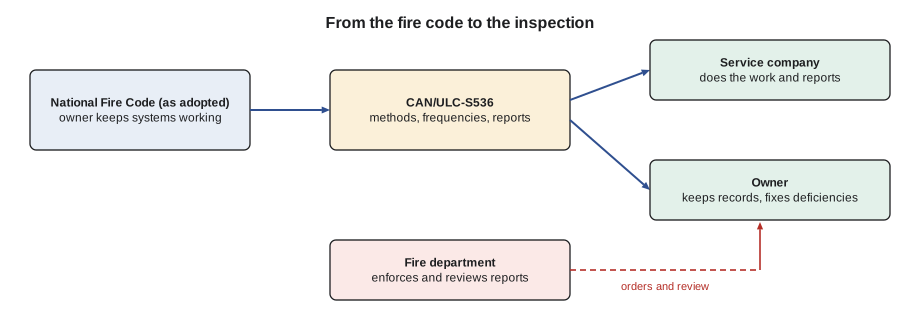
The National Building Code of Canada decides when a building must have a fire alarm system and what kind. Once the system is installed and verified, the National Fire Code takes over: it governs how the building and its fire protection systems are kept and used for the rest of the building's life. In Saskatchewan, the 2020 editions of both national codes have been in force since January 1, 2024, adopted through the province's building and fire safety legislation, and municipalities such as Saskatoon enforce them through their fire departments.
Part 6 of the National Fire Code covers fire protection systems. Its section on fire alarm and voice communication systems requires that these systems be kept in operable condition at all times, and that they be inspected and tested in conformance with CAN/ULC-S536. The code adopts a specific edition of the standard by reference: the 2020 National Fire Code references the 2019 edition, and the 2024 edition, published since, will apply where a province adopts a code that references it. Ontario, for example, moved to the 2024 edition in its own fire code from January 2026. The edition that applies to a building is the one the adopted code references, not the newest one on the shelf.
How CAN/ULC-S536 is organized
CAN/ULC-S536 is written to be used in the field. Its early sections set out scope, definitions and general requirements: who may do the work, what documents must be on site before testing starts, how occupants and the monitoring station are notified, and what to do when a fault is found. The core of the standard is a set of sections, one for each part of the system, each describing what to inspect and how to test: the control unit and transponders, the power supplies and batteries, annunciators and displays, field devices such as detectors and manual stations, signal devices, voice communication and two-way communication, and ancillary functions such as fan shutdown, door releases and elevator recall. The final part covers the report: the standard prescribes report forms in detail, with a separate record for each field device, and the 2024 edition is stricter than earlier ones about using the prescribed forms in full and listing deficiencies clearly.
The standard relies on other documents. It refers to the installation standard, CAN/ULC-S524, for how the system should have been installed, so that an inspection can recognize installation faults. It refers to the verification standard, CAN/ULC-S537, for the documents a verified system should have, and to the integrated testing standard, CAN/ULC-S1001, where the fire alarm system is tested with other fire protection and life safety systems.
| Part of CAN/ULC-S536 | What it covers |
|---|---|
| General requirements | Qualifications, documents on site, notification, faults found |
| Control unit and transponders | Indications, functions, supervision, trouble signals |
| Power supplies and batteries | Primary supply, charger, battery tests |
| Annunciators | Indications and controls |
| Field devices | Detectors, manual stations, waterflow and supervisory switches |
| Signal devices and voice | Audible and visual signals, speakers, two-way communication |
| Ancillary functions | Fans, dampers, doors, elevators, other outputs |
| Reports | Prescribed forms, device records, deficiencies |
Who enforces it
In Saskatoon, the Saskatoon Fire Department's fire prevention staff enforce the fire code. Captain Helen Strand, whom Sasha met during installation projects, reviews annual inspection reports for buildings she inspects, follows up on deficiencies, and can issue orders requiring an owner to correct them by a date. Other authorities have a stake too: the building's insurer may require copies of reports, and in hospitals the provincial health authority has its own expectations. The service company's report is the main evidence they all use.
The authority can also accept alternatives. Where a test method in the standard can't be used, for example because a detector is in a location that can't be reached safely without shutting down a process, the authority may accept another method or a longer interval. The service company doesn't decide this on its own: it asks the owner, who asks the authority, and the decision is recorded.
Before the visit: the documents on site
CAN/ULC-S536 expects certain documents to be available on site before inspection begins: the previous annual report, the verification report from when the system was installed and from any changes since, the record drawings or device list, the sequence of operation, and the panel programming information. The 2024 edition makes this explicit with a checklist of the documents the technician confirms are present, and missing documents are themselves reported. Without the device list, the technician can't prove that every device was tested; without the sequence of operation, the technician can't tell whether an output is doing what it should.
At Tamarind House, Sasha finds the documentation cabinet with the previous report, the as-built drawings from the panel replacement and the sequence of operation, all current. At an older building on Gerry's route, the cabinet holds only a fading drawing from 1994. Gerry builds a device list during the inspection by walking the building with the panel's point list, and records the missing documents in the report.
Reading the standard like a technician
Standards are written in a particular language. 'Shall' means a requirement; 'should' or explanatory notes in an annex or appendix explain the intent but are not requirements unless the authority adopts them. Definitions matter: a word such as 'supervisory', 'trouble' or 'alarm' has a precise meaning, and the right word goes in the report. Tables are often where the work is: the frequency for each component and the test method for each device type are in tables, and a technician learns to look up the row for the device in front of them rather than relying on memory.
Editions change. The 2024 edition of CAN/ULC-S536 tightened the report format and added test procedures, for example for circuit fault tolerance and batteries, that earlier editions described more loosely. A building inspected to an older edition last year may be inspected to the newer one this year if the province has adopted it, and the report will look different. Gerry keeps both editions in the truck until the change is complete.
# Which edition applies? Look up the edition the adopted code references.
adopted = {"NFC 2015": "S536-13", "NFC 2020": "S536-19"}
building_code_in_force = "NFC 2020"
edition = adopted[building_code_in_force]
print("Code in force:", building_code_in_force)
print("Inspection standard edition to use:", edition)
# A newer edition can be used only if the authority accepts it.
newest = "S536:2024"
if edition != newest:
print("Newer edition", newest, "is published; ask the authority before using it.")Code in force: NFC 2020 Inspection standard edition to use: S536-19 Newer edition S536:2024 is published; ask the authority before using it.
The table in the code is illustrative of the idea: always confirm the referenced edition in the code the province has adopted.
What the standard doesn't do
The inspection standard doesn't redesign the building. If the inspection finds that a room has no detector because it was built after the system was installed, the technician reports it as a deficiency or an observation, and the fix goes through design, installation and verification, not through the inspection report. Likewise, the inspection standard doesn't decide whether the system should have been required in the first place. The technician's job is to test the system as designed and installed, and to report honestly anything that keeps it from working or no longer fits the building.
Worked problem
Is it a requirement?
An owner at an older building on Gerry's route asks Sasha why she needs to test every heat detector in the parking garage every year, when the previous company only tested some of them. What should she answer?
Show solution
- The National Fire Code requires the system to be inspected and tested to CAN/ULC-S536.
- The standard requires each field device to be tested at the annual inspection, and the report has a record for each device.
- Testing only some devices doesn't meet the standard; the previous reports should have listed the untested devices.
- If a device truly can't be reached, an alternative needs the authority's acceptance and is recorded.
Answer: Sasha points to the code and the standard, not to company habit, and offers to show the owner the clauses.
A worked look at a clause
Gerry shows Sasha how he uses the standard on site. When a duct detector at Tamarind House can't be reached without a scissor lift, the question is whether it can wait. He opens CAN/ULC-S536 to the field device section and reads the requirement for duct detectors: it is tested at the annual inspection, by the method the maker approves, and the result recorded. Nothing in the clause offers an exemption for access. The answer to the owner is that the lift has to be booked, and if it can't be done this visit, the detector goes on the report as not tested, to be tested as soon as possible. Reading the clause took two minutes and settled the question.
The same habit protects the technician. When an owner, a tenant or another contractor disputes a finding, a clause reference ends the argument faster than experience does. Bramwell's reports cite the requirement next to each deficiency, so that the owner can see that the finding comes from the standard, not from the company.
Other standards the technician meets
Several other documents touch the annual inspection. CAN/ULC-S561 governs the signal receiving centres that monitor buildings, and the inspection confirms that signals reach them. The sprinkler inspection standard governs the sprinkler side of waterflow and valve tests. CSA B44 governs elevators, including the recall functions the fire alarm triggers. The building's fire safety plan, required by the National Fire Code, sets out who does what during a shutdown. A technician doesn't need to know all of these in depth, but needs to know they exist and who is responsible for each.
| Document | What it governs at an inspection |
|---|---|
| CAN/ULC-S536 | The inspection and testing of the fire alarm system |
| CAN/ULC-S561 | Signal receiving centres that monitor the building |
| Sprinkler inspection standard | The sprinkler side of waterflow and valve tests |
| CSA B44 | Elevator recall response |
| Fire safety plan | Who does what when systems are shut down |
Why the owner can't sign away the duty
Owners sometimes ask whether they can reduce the inspection, for example by testing half the building one year and the other half the next, to save money. The answer depends on the standard: where it requires every device to be tested at each annual inspection, a half-and-half plan doesn't meet it, and the service company can't agree to one on the owner's behalf. The owner can ask the authority for an alternative, and some authorities accept one for very large systems with good records, but the request and the acceptance must be in writing and kept with the system documents. Gerry tells owners plainly that a contract that tests less than the standard requires doesn't protect them; it only moves the gap from the building to the paperwork.
Leases add a twist. In many commercial buildings the lease makes a tenant responsible for the fire alarm devices inside its suite. The code still holds the owner responsible for the system as a whole, so the owner needs to know that the tenant's devices are tested too, usually by having them tested as part of the building's annual inspection.
Common mistakes
MistakeUsing the newest edition because it is newest.
InsteadUse the edition the adopted code references, unless the authority accepts another.
MistakeTreating explanatory notes as requirements.
InsteadRequirements use 'shall'; notes explain intent.
MistakeStarting an inspection without the device list.
InsteadConfirm the documents on site, or build the list and report the gap.
MistakeDeciding on your own to skip a device.
InsteadAsk the owner to seek the authority's acceptance of any alternative.
MistakeRedesigning the system through the inspection report.
InsteadReport the deficiency; changes go through design and verification.
Summary and key terms
- The National Fire Code requires inspection and testing to CAN/ULC-S536.
- The adopted code references a specific edition of the standard.
- CAN/ULC-S536 is organized by system part, with prescribed report forms.
- The authority enforces the code and can accept alternatives.
- System documents must be on site before testing starts.
- The inspection reports what it finds; it doesn't redesign the system.
- CAN/ULC-S536
- The Canadian standard for the inspection and testing of fire alarm systems.
- Adopted by reference
- Made part of the law by being named in an adopted code.
- Authority having jurisdiction
- The organization or person who enforces the code for a building.
- Record drawings
- Drawings showing the system as it was actually installed.
- Sequence of operation
- The description of what the system does for each input.
- Shall
- The word a standard uses for a requirement.
Practice problems
Work each problem on paper first, then reveal the answer to check.
Which code requires the annual inspection of an existing system?
Show answer
The National Fire Code, as adopted by the province.
Which edition of the standard applies?
Show answer
The edition referenced by the adopted code, unless the authority accepts another.
Who may accept an alternative test method?
Show answer
The authority having jurisdiction.
Name two documents that should be on site before testing.
Show answer
Any two of: device list or record drawings, sequence of operation, previous report, verification or completion record, programming.
What does 'should' mean in a standard?
Show answer
It explains intent or recommends; it isn't a requirement.
Lesson quiz · 5 questions
Score 60% or more to complete this lesson.
Create a free account to save your progress, take quizzes and earn a certificate.