
FAT-230 · Lesson 7 of 12 · 20 min
Smoke and heat detector testing
Most of an inspection day is spent on detectors. At Riverlight Tower there are over four hundred smoke detectors in corridors, lobbies, electrical rooms and service spaces, and close to a hundred heat detectors in the parking levels, garbage rooms and mechanical rooms. Each one is tested every year, and the smoke detectors also have their sensitivity checked on a schedule. Sasha spends her first morning at the tower on a pole with a can of test aerosol, working down a corridor while Gerry watches the panel. This lesson covers how smoke and heat detectors are inspected and tested, and what to do with the ones that fail.
Inspecting detectors
Before testing, each detector is inspected. The technician looks for:
- physical damage, missing or loose heads, broken bases, or a detector hanging from its wires;
- paint, tape, plastic bags or dust covers left from construction or painting, and heavy dust or grease on the detector;
- obstructions: a new bulkhead, a light fixture or a duct closer than the installation standard allows, shelving built up to the ceiling, or an air diffuser blowing across the detector;
- changes in the space that make the detector the wrong type: a room now used as a kitchen, a smoking area, a shower room or a workshop where a smoke detector will cause nuisance alarms and a heat detector would be right;
- detectors removed and not replaced, or covered by a new ceiling.
Inspection findings are deficiencies in their own right, even if the detector passes its test. A smoke detector covered by a dust cap passes the panel's supervision and responds to test aerosol sprayed into its cap, but it will not see smoke from a fire.
Functional testing of smoke detectors
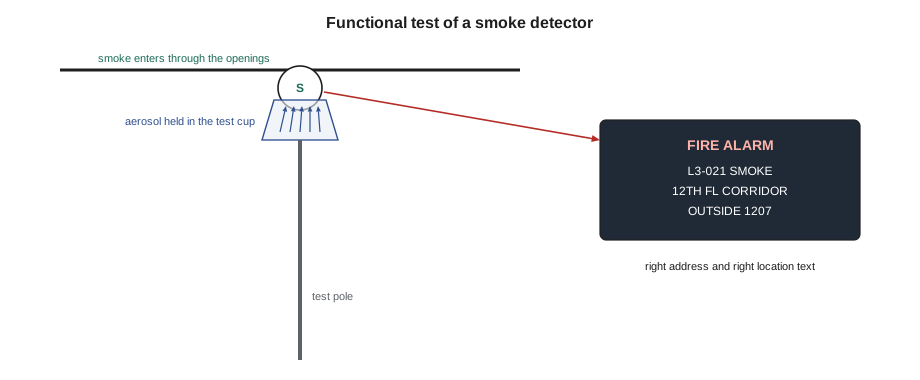
The functional test shows that smoke can enter the detector's chamber and that the detector sends an alarm to the control unit. CAN/ULC-S536 requires each smoke detector to be tested with a method the detector's maker approves, normally a listed smoke aerosol or a smoke generator applied through the detector's openings, not by a magnet or a test button alone, because a magnet or button tests the electronics but not whether smoke can get in. The technician confirms that the detector's indicator lights where it has one, and that the correct alarm, with the correct location text, appears at the control unit.
Technique matters. Too much aerosol leaves residue that attracts dust and can make the detector oversensitive; too little may not reach the alarm threshold, giving a false fail. A test cup on a pole holds the aerosol against the detector so that it reaches the chamber without blowing past. After an alarm, the detector needs time to clear before the next one is reset, and some detectors stay latched until the panel is reset.
Sensitivity testing
A functional test shows that a detector alarms, but not whether it alarms at the right smoke level. Over time a smoke detector can become less sensitive as dust and dirt coat its chamber, or more sensitive, as some kinds of contamination scatter light inside a photoelectric chamber. A detector that is too insensitive may not alarm until a fire is large; one that is too sensitive causes nuisance alarms. Sensitivity testing measures where each detector sits within its listed range.
CAN/ULC-S536 requires the sensitivity of smoke detectors to be confirmed within the range marked on the detector or specified by the maker, using a method the maker approves. Addressable systems usually report each detector's sensitivity directly from the control unit; for conventional detectors, a calibrated test instrument is used.
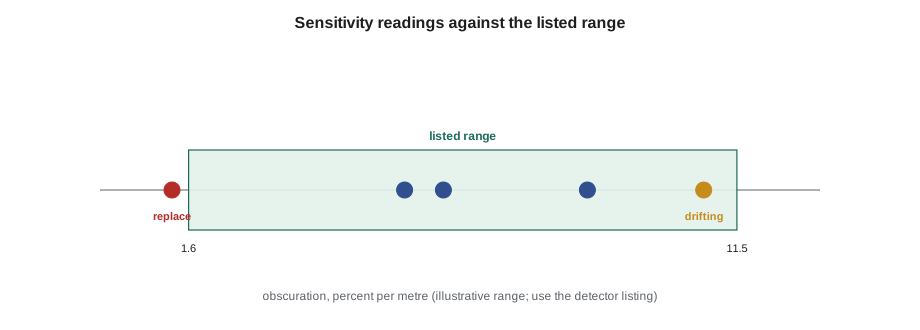
Most addressable control units can print a sensitivity report for every detector, showing each one's reading as a percentage of obscuration per unit length, or as a percentage of its alarm threshold, along with any detector the panel flags as dirty or needing maintenance. The technician checks that every reading is within the listed range and compares it with last year's report to find detectors drifting toward a limit.
# Check a sensitivity report against each detector's listed range
listed_low, listed_high = 1.6, 11.5     # obscuration, percent per metre
report = [("L3-021", 6.2, 6.0), ("L3-022", 10.9, 7.3), ("L3-023", 1.3, 2.4), ("L3-024", 5.5, 5.4)]
for point, now, last in report:
    if not listed_low <= now <= listed_high:
        verdict = "OUTSIDE RANGE - clean and retest, or replace"
    elif abs(now - last) > 2.0:
        verdict = "in range but drifting - note for next visit"
    else:
        verdict = "in range"
print(f"{point} now {now:.2f} last {last:.2f} {verdict}")L3-021 now 6.20 last 6.00 in range L3-022 now 10.90 last 7.30 in range but drifting - note for next visit L3-023 now 1.30 last 2.40 OUTSIDE RANGE - clean and retest, or replace L3-024 now 5.50 last 5.40 in range
The listed range in the code is illustrative; each detector model has its own range, marked on the detector or in its listing. In this report one detector is out of range and must be serviced or replaced, and one is still in range but has moved a long way since last year, which usually means contamination. Gerry cleans the drifting detector following the maker's instructions and records both readings.
Heat detectors
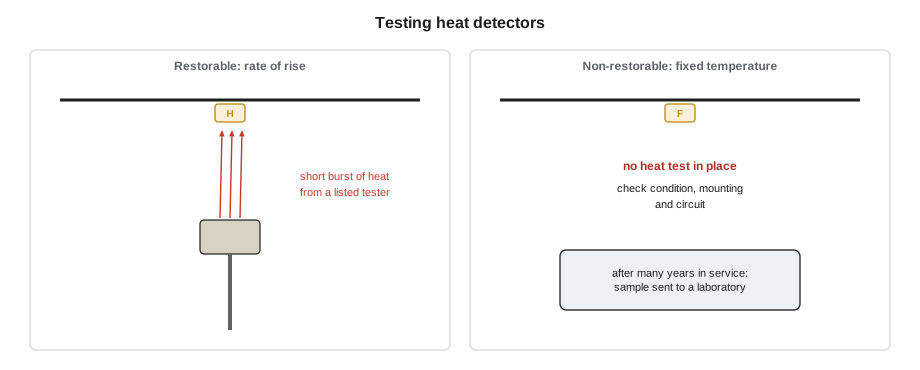
Heat detectors respond to temperature, either at a fixed temperature, at a rate of rise, or both. They are tested by heating the element, and how depends on whether the detector can be restored after it operates.
- Restorable heat detectors, such as rate-of-rise detectors and electronic fixed-temperature detectors, are tested with a heat source that doesn't damage them, such as a listed heat gun or a test heater on a pole, following the maker's instructions. Too much heat for too long can damage the detector or its plastic housing.
- Non-restorable fixed-temperature detectors, which melt a fusible element when they operate, can't be heat-tested without destroying them. They are tested mechanically and electrically, by checking the circuit and the device's condition, as the maker describes. Some standards require that, after a number of years in service, a sample of non-restorable detectors be removed and tested in a laboratory, and the rest replaced if the sample fails.
CAN/ULC-S536 sets out the heat detector test methods, and Gerry's crew follows the maker's instructions for each model. At Riverlight Tower's parking levels the detectors are combination fixed-temperature and rate-of-rise units; the crew tests the rate-of-rise function with a heat gun and checks the fixed-temperature element only visually and electrically.
Duct and special smoke detectors
Duct smoke detectors sample air from inside an air-handling duct through sampling tubes. Testing confirms that the sampling tubes are installed correctly, facing into the airflow, that the air pressure difference across the housing is within the maker's range with the fan running, and that smoke introduced into the housing, or into the duct where the maker requires, produces an alarm or supervisory signal and shuts down the fan as the sequence requires. A duct detector with blocked tubes will never see smoke, no matter how well its head tests.
Beam detectors are tested with the maker's test filters or by blocking the beam by the amount the maker specifies, and their alignment is checked. Air-sampling detectors are tested by introducing smoke at the furthest sampling hole and measuring the transport time to the detector, which must stay within the time set at commissioning; a longer time usually means a blocked or broken pipe. Multi-criteria detectors and carbon monoxide detectors are tested with the gas or the combination of stimuli the maker requires, and carbon monoxide sensors are replaced at the end of their rated life, which the detector usually signals itself.
# Air-sampling transport time check against the commissioned value
commissioned_s = 62
limit_s = 120
tests = [("pipe 1, last hole", 64), ("pipe 2, last hole", 97), ("pipe 3, last hole", 61)]
for where, t in tests:
    msgs = []
    if t > limit_s:
        msgs.append("over the limit")
    if t > commissioned_s * 1.3:
        msgs.append("much slower than at commissioning - check for blockage or a leak")
print(f"{where}: {t} s {'; '.join(msgs) if msgs else 'OK'}")pipe 1, last hole: 64 s OK pipe 2, last hole: 97 s much slower than at commissioning - check for blockage or a leak pipe 3, last hole: 61 s OK
When a detector fails
A detector that fails its functional test, is outside its sensitivity range, is damaged, or is the wrong type for the space is a deficiency. The technician records the address, location, model, the test done and the result, and either repairs it on the spot, such as cleaning or replacing the head with an identical listed model, or reports it for the owner to authorize. A replacement detector must be listed for use with the control unit, set to the correct address and type in the programming, tested in place, and recorded on the device record. Changing the detector type, such as replacing a smoke detector with a heat detector in a room that is now a kitchen, is a design change that should be reviewed, approved where the authority requires it, and verified.
The device record is kept for every detector, with this year's test result and sensitivity reading next to last year's. Over a few years, the records show which areas of a building eat detectors, such as a dusty parking ramp or a corridor outside a laundry, and the owner can plan for more frequent cleaning or a different detector type.
Worked problem
Corridor 12 at Riverlight
On the twelfth floor of Riverlight Tower, Sasha's functional tests find: (1) the corridor detector outside suite 1207 doesn't alarm with aerosol; the panel shows no trouble; (2) the detector in the garbage room alarms normally but is coated in grease; (3) the panel's sensitivity report shows the detector by the elevator lobby in range but up sharply from last year. What should she do with each?
Show solution
- Item 1: inspect it closely. Gerry finds a construction dust cap still on the head from a recent corridor repaint. The cap is removed, the detector retested and passed, and the finding recorded, because the detector was out of service until today.
- Item 2: a smoke detector in a garbage room is likely the wrong type; recommend the owner have it reviewed for replacement with a heat detector, and clean it for now.
- Item 3: clean or replace following the maker's instructions, retest the sensitivity, and note it for the next visit.
- Record each finding with its address, the test and the result.
Answer: Each finding is fixed or reported, and none is written off as a pass.
Detectors in hard places
Some detectors are in places where a test is difficult: high ceilings in atriums and warehouses, inside elevator hoistways, above operating rooms, in rooms with high voltage equipment. Each needs a plan. High detectors may need a lift, a long pole or a remote test feature that the maker provides. Hoistway detectors are tested with the elevator mechanic, who controls the car while the technician works from the car top. Detectors in electrical rooms are tested only after the hazard is assessed and the approach boundaries are respected. A detector that truly can't be reached safely is an issue for the owner and the authority, who may accept another method; it is never simply left off the report.
Carbon monoxide and multi-criteria detectors
Many newer buildings use multi-criteria detectors, which combine smoke sensing with heat, carbon monoxide or other sensors to tell real fires from nuisance sources such as cooking or steam. Their tests follow the maker's instructions closely, because a test that stimulates only one sensor may not produce an alarm by design. Detectors with carbon monoxide sensors also have an end-of-life date for the sensor, often seven to ten years after manufacture, after which the detector reports a trouble and must be replaced. The inspection records each detector's date and flags those nearing the end of their life.
Common mistakes
MistakeTesting smoke detectors with a magnet only.
InsteadPut smoke or listed aerosol into the chamber.
MistakeFlooding detectors with aerosol.
InsteadUse a test cup and the amount the maker recommends.
MistakeHeat-testing a non-restorable detector.
InsteadTest it mechanically and electrically; follow the sampling rules.
MistakeTesting a duct detector head without checking the tubes and airflow.
InsteadCheck the sampling tubes and pressure difference too.
MistakeReplacing a detector with a different type on the spot.
InsteadA change of type is a design change to review and verify.
Summary and key terms
- Inspect each detector for damage, covers, obstructions and the right type.
- Functional smoke tests put smoke or listed aerosol into the chamber.
- Sensitivity is confirmed within the listed range.
- Restorable heat detectors are heat-tested; non-restorable ones are not.
- Duct, beam and air-sampling detectors have their own tests.
- Failed detectors are recorded, repaired or reported, and retested.
- Functional test
- A test showing smoke or heat reaches the sensor and an alarm reaches the panel.
- Sensitivity
- The smoke level at which a detector alarms, within its listed range.
- Listed range
- The sensitivity range marked on the detector or stated in its listing.
- Restorable
- A detector that returns to normal after it operates.
- Transport time
- The time for smoke to travel from a sampling hole to an air-sampling detector.
- Dust cap
- A cover that protects a detector during construction and must be removed afterward.
Practice problems
Work each problem on paper first, then reveal the answer to check.
Why isn't a magnet test enough for a smoke detector?
Show answer
It tests the electronics but not whether smoke can enter the chamber.
What does a sensitivity test show that a functional test doesn't?
Show answer
Where the detector alarms within its listed range.
How is a non-restorable heat detector tested?
Show answer
Mechanically and electrically, not with heat, with sampling rules as the standard requires.
What is checked on a duct detector besides the head?
Show answer
The sampling tubes and the air pressure difference.
Air-sampling transport time is much longer than at commissioning. What does that suggest?
Show answer
A blocked or broken sampling pipe.
Lesson quiz · 5 questions
Score 60% or more to complete this lesson.
Create a free account to save your progress, take quizzes and earn a certificate.