
FAT-230 · Lesson 12 of 12 · 22 min
Capstone: the annual inspection of Riverlight Tower and its report
In December, the annual inspection of Riverlight Tower is Sasha's to lead, with Gerry as the responsible technician who will sign the report and Nadia Fortier, a first-year trainee, as her second. Riverlight is the building she has worked in most: an 18-storey apartment tower with voice evacuation, a fire pump, stair pressurization, elevators, two riser shafts, a parking garage below and remote power supplies on many floors. This capstone follows the inspection from planning to the signed report, and pulls together everything in the course.
The building and its system
Riverlight's system has a main control unit and voice control centre in the lobby, an annunciator at the fire department entrance, two addressable loops per floor group, and remote power supplies that feed the notification circuits. The field devices, from the panel point list, are summarized below.
| Device type | Count |
|---|---|
| Smoke detectors (corridors, lobbies, service rooms) | 412 |
| Heat detectors (garage, garbage rooms, mechanical) | 96 |
| Duct smoke detectors | 6 |
| Manual stations | 74 |
| Horn-strobes and strobes | 352 |
| Speakers | 168 |
| Waterflow switches | 20 |
| Valve supervisory switches | 20 |
| Firefighter telephone locations | 36 |
| Remote power supplies | 12 |
| Interface outputs | 18 |
The suites also have smoke alarms, which are separate from the fire alarm system under the building code; the owner's staff test them on their own schedule, and Bramwell's report notes the date of their last test from the owner's log but doesn't include them in the fire alarm device record.
Planning
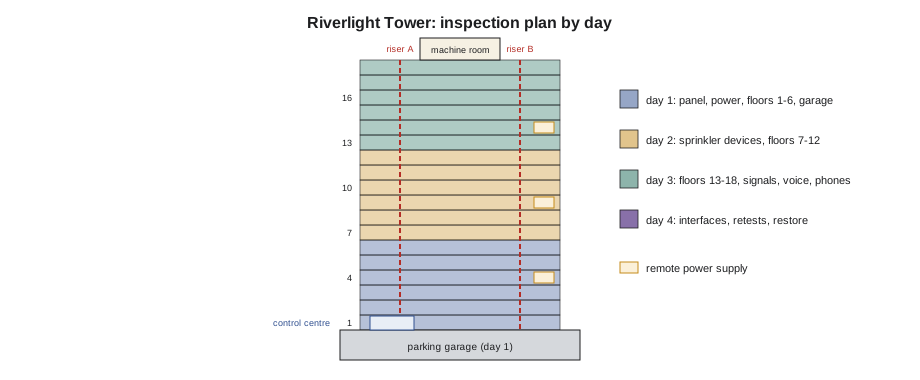
Sasha starts from last year's report, which had eleven deficiencies, all now closed, and three observations. She builds the plan: four days, a crew of three, with the sprinkler contractor on day two for waterflow and valve tests and the elevator mechanic and building operator on day four for interfaces. The owner sends tenant notices two weeks ahead with the days each floor's suites will be entered for bedroom audibility checks, which this year are needed because several suites have been renovated.
# Riverlight inspection plan: device work per day for a crew of three
days = {
    "day 1": ["panel, network and annunciator", "batteries and supplies", "smoke and heat, floors 1-6", "garage heat detectors"],
    "day 2": ["waterflow and valve switches", "fire pump signals", "smoke and heat, floors 7-12"],
    "day 3": ["smoke and heat, floors 13-18", "manual stations", "notification circuits and audibility", "voice and phones"],
    "day 4": ["elevator recall and shunt trip", "fans, dampers and stair pressurization", "doors", "retests and restore"],
}
for d, tasks in days.items():
print(d + ": " + "; ".join(tasks))day 1: panel, network and annunciator; batteries and supplies; smoke and heat, floors 1-6; garage heat detectors day 2: waterflow and valve switches; fire pump signals; smoke and heat, floors 7-12 day 3: smoke and heat, floors 13-18; manual stations; notification circuits and audibility; voice and phones day 4: elevator recall and shunt trip; fans, dampers and stair pressurization; doors; retests and restore
Day one: before testing
At 7:30 Sasha reads the event history: two ground faults that cleared, a trouble from RPS-14's AC supply when a breaker was switched off during a suite renovation, and repeated dirty-detector troubles from the garage ramp. She calls the signal receiving centre and puts the account in test for the floors and hours of the day, calls the fire department's line, makes a live announcement over the voice system, and disables the elevator recall, fan and door holder outputs, logging each bypass. Nadia stays at the control centre whenever devices are being tested elsewhere.
The control unit tests go well. Opening loop 3 mid-loop leaves every device reporting from both directions, and the network survives an opened node. The annunciator matches the floor plan. The panel clock is four minutes fast; Sasha sets it. The main batteries, replaced two years ago, pass their load test. At RPS-9 the batteries are past their replacement date and drop quickly under load, so Sasha replaces them with the owner's approval, which Donna arranged in advance for this exact case, and retests.
Days one to three: field devices
Working from the point list, the crew tests every smoke detector with aerosol, every heat detector with the methods for its type, and every manual station, and checks the panel's sensitivity report. The findings include:
- one corridor detector on floor 16 with a painter's dust cap still on it after a corridor repaint; removed, retested, passed, recorded;
- two garage ramp detectors outside their sensitivity range, the cause of the repeated troubles; replaced with identical listed detectors, programmed, tested and recorded, with an observation that the ramp needs a more frequent cleaning cycle or a different detector type;
- one manual station on floor 3 with a cracked cover and the glass rod missing; reported, and repaired on day four;
- one heat detector in a garbage room painted over; reported for replacement, since paint can change a heat detector's response.
# Running tally against the point list
from collections import Counter
listed = {"smoke": 412, "heat": 96, "duct": 6, "manual station": 74}
tested = {"smoke": 411, "heat": 96, "duct": 6, "manual station": 74}
failed = Counter({"smoke": 3, "heat": 1, "manual station": 1})
for k in listed:
    gap = listed[k] - tested[k]
    note = f"  {gap} not tested - find and test" if gap else ""
print(f"{k:15s} tested {tested[k]:3d} of {listed[k]:3d} failed {failed[k]}{note}")smoke tested 411 of 412 failed 3 1 not tested - find and test heat tested 96 of 96 failed 1 duct tested 6 of 6 failed 0 manual station tested 74 of 74 failed 1
One smoke detector hasn't been tested. The point list shows it in suite 1802's mechanical closet, which the tenant had locked. The owner arranges access for day four, and the detector passes.
On day two, Luis's crew flows water at each floor's test connection. Nineteen waterflow switches signal within 90 seconds. The floor 11 switch signals at 96 seconds; its retard is adjusted, and it passes at 61 seconds. All twenty valve switches signal within the allowed movement, and all restore only at fully open. Every valve is walked and photographed open at the end of the day. The fire pump's running, phase and controller signals are confirmed during the pump test.
Day three: signals, voice and phones
The crew walks every notification circuit with the panel in walk-test mode. Every appliance operates and strobes are synchronized, except a strobe in the renovated second-floor amenity room hidden behind a new display screen. Audibility is measured in corridors on every floor and, with the doors closed, in the bedrooms of the renovated suites. Two bedrooms fail: suite 1503, where last year's lesson about the solid-core door applies again, and suite 806, where a new acoustic ceiling was installed. Voltage at the last appliance on battery is above 16 volts on every circuit except RPS-14 circuit 1, where the two strobes added in the amenity room renovation push it to 15.6 volts.
The voice messages play correctly on every floor. Live announcements are clear except near the fifteenth-floor elevator lobby, where a new glass wall makes the message hard to understand. Thirty-five of the thirty-six firefighter telephone locations give a clear two-way call; stair B on floor 13 is one-way only, traced to a damaged handset cord and repaired on the spot.
Day four: interfaces and restoring
With the elevator mechanic, the building operator and security present, the crew works down the input-output matrix. Elevator recall works correctly from every lobby, hoistway and machine room detector, the hat signal flashes for hoistway and machine room detectors, and the shunt trip relay operates and is supervised; the actual trip isn't done this year by agreement with the mechanic, and the report says so. The stair pressurization fans start on alarm and on waterflow. All air handler shutdowns are correct. Thirty-four of thirty-five doors release and latch; the floor 9 corridor door releases but doesn't latch, a closer problem for the owner's door contractor.
At 3:40 every bypass is restored, the control unit shows normal with no disabled points, and the station confirms the account is back in service. The end-of-test calls and times go in the report.
Writing the report
The report follows the forms CAN/ULC-S536 prescribes: the system description, the documents found on site, the control unit and power supply tests, the device record with every field device and its result, the tests of voice and two-way communication and ancillary functions, the list of deficiencies, and the technicians' attendance record and signatures. Every device listed in the panel has a result. Measured values, such as sensitivity readings, battery voltages, waterflow times, sound levels and end-of-circuit voltages, are recorded so next year's inspection can compare.
# Build the deficiency summary for the Riverlight report
items = [
    ("D1", "major", "Strobe hidden by new display screen, amenity room, floor 2", "open - owner to move screen or strobe"),
    ("D2", "major", "Bedroom audibility below required level, suite 1503 (solid-core door)", "open - design review"),
    ("D3", "major", "Bedroom audibility below required level, suite 806 (acoustic ceiling)", "open - design review"),
    ("D4", "major", "RPS-14 circuit 1 end voltage 15.6 V on battery (strobes added)", "open - design review, split circuit"),
    ("D5", "major", "Speech hard to understand, floor 15 elevator lobby (new glass wall)", "open - acoustic and speaker review"),
    ("D6", "minor", "Floor 9 corridor fire door releases but doesn't latch", "open - door contractor"),
    ("D7", "major", "Heat detector painted, garbage room floor 7", "open - replace"),
    ("C1", "corrected", "Dust cap on corridor detector, floor 16", "removed, retested, passed"),
    ("C2", "corrected", "Two garage ramp detectors out of sensitivity range", "replaced, programmed, tested"),
    ("C3", "corrected", "RPS-9 batteries past date, weak under load", "replaced, load-tested"),
    ("C4", "corrected", "Floor 11 waterflow 96 s", "retard adjusted, 61 s"),
    ("C5", "corrected", "Floor 3 manual station cover cracked, rod missing", "repaired, tested"),
    ("C6", "corrected", "Firefighter phone stair B floor 13 one-way", "handset cord replaced, tested"),
    ("O1", "observation", "Garage ramp detectors foul quickly", "more frequent cleaning or a different detector type"),
]
open_items = [i for i in items if i[1] in ("major", "minor")]
print(f"open deficiencies: {len(open_items)}  corrected during visit: {sum(1 for i in items if i[1] == 'corrected')}  observations: {sum(1 for i in items if i[1] == 'observation')}")
for ref, level, what, action in items:
print(f"{ref:3s} {level:11s} {what} -> {action}")open deficiencies: 7 corrected during visit: 6 observations: 1 D1 major Strobe hidden by new display screen, amenity room, floor 2 -> open - owner to move screen or strobe D2 major Bedroom audibility below required level, suite 1503 (solid-core door) -> open - design review D3 major Bedroom audibility below required level, suite 806 (acoustic ceiling) -> open - design review D4 major RPS-14 circuit 1 end voltage 15.6 V on battery (strobes added) -> open - design review, split circuit D5 major Speech hard to understand, floor 15 elevator lobby (new glass wall) -> open - acoustic and speaker review D6 minor Floor 9 corridor fire door releases but doesn't latch -> open - door contractor D7 major Heat detector painted, garbage room floor 7 -> open - replace C1 corrected Dust cap on corridor detector, floor 16 -> removed, retested, passed C2 corrected Two garage ramp detectors out of sensitivity range -> replaced, programmed, tested C3 corrected RPS-9 batteries past date, weak under load -> replaced, load-tested C4 corrected Floor 11 waterflow 96 s -> retard adjusted, 61 s C5 corrected Floor 3 manual station cover cracked, rod missing -> repaired, tested C6 corrected Firefighter phone stair B floor 13 one-way -> handset cord replaced, tested O1 observation Garage ramp detectors foul quickly -> more frequent cleaning or a different detector type
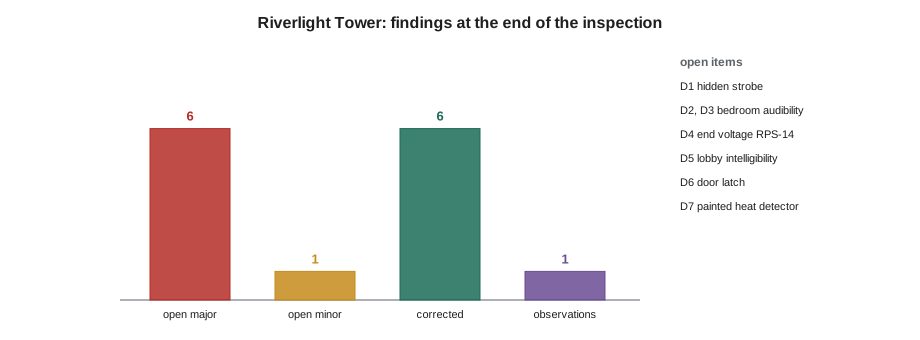
None of the open deficiencies takes part of the system out of service, so there is no impairment. Sasha still tells the building manager about each open item before leaving, and the written report goes to the owner within the time Bramwell's procedure and the authority require. Four of the open items, D2 to D5, are design questions, and Ravi will propose fixes. D1, D6 and D7 are for the owner to arrange.
Signing and filing
Gerry reviews every page, checks the device record total against the point list, and signs as the responsible technician; Sasha signs as the technician who led the inspection. The building manager signs to acknowledge the deficiencies. A copy stays in the documentation cabinet at the control centre, a copy goes to the owner, and the fire department receives the report as Captain Strand's office requires. When the open deficiencies are corrected, Bramwell tests each affected part and issues a supplementary report, and the owner signs that the deficiencies are resolved.
Looking back
The inspection found nothing dramatic, which is what a well-maintained system should look like. But most of what it found came from changes in the building since last year: a repaint, renovated suites, a new display screen, a new glass wall, two strobes added without a calculation. Each one quietly weakened the system, and none would have shown at the control unit. That is the lesson of periodic inspection: the system doesn't stay the way it was verified, because the building around it doesn't.
Sasha's final step is the plan for next year: the observation on the garage ramp, the follow-up on the open items, and a note to Donna that renovated suites should trigger a call to Bramwell so the fire alarm is checked when the work is done, not a year later.
Worked problem
Is the inspection complete?
At the end of day four, Sasha has results for every device on the point list, seven open deficiencies, six corrected items and one observation. The shunt trip was not fully tripped by agreement. Is the annual inspection complete?
Show solution
- Every device and function required by the standard has been tested, except the full shunt trip, which is recorded with the reason and the relay test that was done.
- Open deficiencies don't make the inspection incomplete; they make the system deficient until corrected, and the report says so.
- The report is complete when it lists every device's result, every deficiency, the measured values and the signatures.
- The inspection is complete; the follow-up work continues under supplementary reports.
Answer: A complete inspection is one where everything required was tested and honestly reported, not one with no deficiencies.
Common mistakes
MistakeTreating a report with no deficiencies as the goal.
InsteadThe goal is a complete, honest record of the system's condition.
MistakeLeaving a locked room's device untested.
InsteadArrange access and test it before closing the report.
MistakeFiling the report without telling the owner about open items.
InsteadTell the building manager before leaving and in writing.
MistakeRecording passes without measured values.
InsteadRecord the values so trends can be seen next year.
MistakeClosing deficiencies without retesting.
InsteadTest each corrected item and issue a supplementary report.
Summary and key terms
- The capstone inspection follows the course in order: plan, notify, test, restore, report.
- Every device on the point list must have a result.
- Most findings came from changes in the building since last year.
- Deficiencies are listed precisely, with actions, and the owner is told before the crew leaves.
- The report records measured values and is signed and filed as required.
- Corrections are retested and reported in a supplementary report.
- Responsible technician
- The qualified technician who signs for the inspection.
- Device record
- The part of the report listing every field device and its result.
- Supplementary report
- A report issued after open deficiencies are corrected and tested.
- Open deficiency
- A deficiency not yet corrected at the end of the visit.
- Corrected item
- A deficiency found and fixed during the visit, with a retest.
- Trend
- A change in measured values from one inspection to the next.
Practice problems
Work each problem on paper first, then reveal the answer to check.
What did most of Riverlight's findings have in common?
Show answer
They came from changes in the building since the last inspection.
Why was suite 1802's closet detector tested on day four?
Show answer
The closet was locked earlier; access was arranged so every device was tested.
Are open deficiencies an impairment at Riverlight?
Show answer
No; none takes part of the system out of service.
What happens when the open items are corrected?
Show answer
Each affected part is tested and a supplementary report issued.
Why record measured values?
Show answer
So next year's inspection can compare and spot drift.
Lesson quiz · 5 questions
Score 60% or more to complete this lesson.
Create a free account to save your progress, take quizzes and earn a certificate.