
FAT-220 · Lesson 2 of 12 · 21 min
Scope, definitions and how the standard is adopted
Before any wire is pulled at Eastview's north wing, Ravi Menon calls a meeting with Sasha, Gerry and Donna Achebe to go over the project's code basis: which documents apply, which editions, and who will review the work. 'Half the arguments on a job come from people reading different editions,' Ravi says. 'We settle that on day one.' He hands out a single page listing the building code, the fire code, the installation standard, the electrical code and the hospital's own requirements, each with its edition and the authority that enforces it. This lesson explains how the installation standard becomes law, what its scope covers and leaves out, and why its definitions matter so much in day-to-day work.
From model code to law
In Canada, the National Building Code and National Fire Code are model codes published by the national research organization. They have no legal force until a province or territory adopts them. Saskatchewan adopts the national codes by regulation under its construction codes legislation and fire safety legislation, with few provincial changes, so the National Building Code, and through it CAN/ULC-S524, applies to new construction across the province. Municipalities administer the building code for construction in their area, issuing building permits and inspecting, and the local fire department enforces the fire code in existing buildings. Other provinces adopt the national codes with more amendments, or publish their own codes based on them, so the rules a technician works to can change at a provincial border.
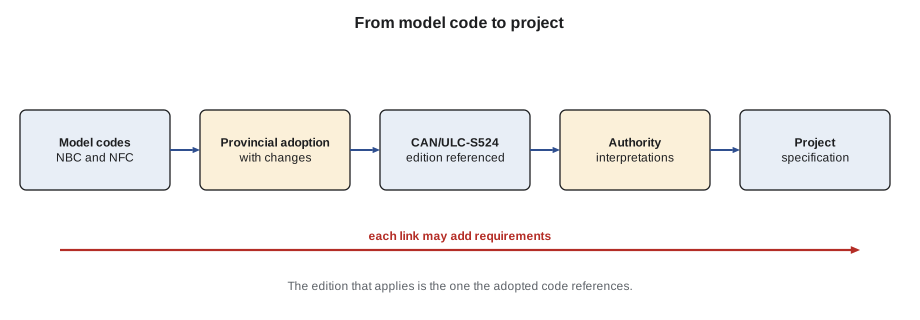
The chain matters because each link adds something. The model code says when a system is needed and references the standard. The adopting regulation may amend either. The authority enforcing the code may issue its own interpretations or bulletins. And the project specification may require more than all of them. A technician who knows only the standard is missing most of the picture.
Which edition applies
The edition that applies is fixed by the adopted code, not by what is newest. If the adopted building code references a particular edition of the installation standard, that edition governs the project, even if a newer one has been published. The newer edition can still be useful: it may clarify a rule, or reflect better practice, and a designer may choose to follow it where it is stricter. But it can't be used to relax a requirement of the edition that applies, unless the authority accepts it as an alternative.
For the Eastview north wing, Ravi's code basis page lists the National Building Code edition Saskatchewan has adopted, the edition of CAN/ULC-S524 it references, the Canadian Electrical Code as adopted in the province, CAN/ULC-S537 for verification, and the health authority's design standards for its facilities. The newest edition of S524 was published at the end of 2024; whether a project uses it depends on the code adopted when the permit was applied for.
Hospitals are an example of a building where several codes apply at once. Health-care facilities are often subject to requirements from the health authority or the agency that licenses or funds them, in addition to the building and fire codes. Where those requirements differ, the facility generally has to meet all of them, which in practice means the strictest.
What the standard covers
The scope of CAN/ULC-S524 is the installation of fire alarm systems in buildings, including the control units and transponders, the annunciators, the field wiring, the power supplies, the initiating and signal devices, and the connections to ancillary devices such as door releases and fan shutdowns. Its rules apply to new installations, and to alterations and additions to existing systems. It does not cover the testing and inspection of systems after they are installed, which belong to S537 and S536, nor the design decisions the building code makes, such as whether a building needs a two-stage system.
Some things fall outside the standard even though they are close to the fire alarm. Smoke alarms in dwelling units are installed under their own rules and are not part of the building's fire alarm system unless the code requires them to be connected to it. Sprinkler systems, kitchen hood suppression systems and clean-agent systems have their own standards; the fire alarm standard covers only how their status is monitored and how the fire alarm controls them. Electrical wiring methods for the fire alarm come from the electrical code, which the standard references.
Why definitions matter
Every installation standard defines its key terms, and the rules depend on those definitions. A rule about 'smooth ceilings' applies only to ceilings that meet the definition, and a rule about 'beams' applies only to projections deep enough to count as beams. A 'zone' in the standard is an area from which signals are indicated separately, not an architectural space. An 'annunciator' is a defined device with specific functions, not any display. Reading a rule with the everyday meaning of a word instead of the defined one is one of the most common ways to get an installation wrong.
Some definitions in CAN/ULC-S524 have no direct equivalent elsewhere. 'Single-stage' and 'two-stage' systems are defined there, as are 'alert signal' and 'alarm signal' in a two-stage system: the alert signal tells staff that an alarm has been initiated, and the alarm signal tells occupants to evacuate. 'Transponder' is defined for the remote equipment that handles field circuits on behalf of the control unit. 'Signal receiving centre' is defined for the monitoring station. These terms are used throughout the standard and are the vocabulary of Canadian fire alarm work.
| Term | What it means in the standard |
|---|---|
| Ceiling height | Measured to the highest point of the ceiling in the area, with defined rules for sloped ceilings |
| Smooth ceiling | A ceiling without projections deep enough to affect smoke or heat travel; small projections are allowed |
| Beam | A solid projection below the ceiling deeper than a defined minimum |
| Zone | An area from which a signal is identified separately at the control unit or annunciator |
| Supervised | Monitored so that a fault such as an open or ground is indicated as a trouble |
| Listed | Included in a list published by a recognized testing organization as suitable for a purpose |
Listed, approved and compatible
Three words recur in the installation standard and are easy to confuse. 'Listed' means the product appears in a list published by a recognized testing organization, which has tested it to a product standard and inspects its production. 'Approved' means acceptable to the authority having jurisdiction, which may rely on the listing. 'Compatible' means listed for use together: two-wire smoke detectors, for example, must be listed as compatible with the control unit's initiating circuit, because the panel's circuit and the detector's electronics are designed as a pair. A detector that works on the bench with a panel but isn't listed as compatible is not acceptable.
In Canada, fire alarm equipment is listed to ULC product standards, such as CAN/ULC-S527 for control units and CAN/ULC-S529 for smoke detectors, and carries a certification mark. CAN/ULC-S524 requires the equipment to be listed for its purpose. Equipment listed only to US standards is not acceptable unless it is also certified for Canada.
Compatibility applies to more than detectors. Notification appliances must be listed for the synchronization protocol the panel's circuit uses, batteries must be the type the panel's charger is listed for, and remote power supplies must be listed for use with the panel. The panel maker's compatibility document is the reference, and Sasha learns to check it before substituting any part.
# Compatibility check against a maker's compatibility list (illustrative data)
compatible = {
    "FACP-X idc": {"2W-PHOTO-A", "2W-PHOTO-B"},
    "FACP-X nac": {"HS-SYNC-1", "S-SYNC-1", "H-SYNC-1"},
}
installed = [("FACP-X idc", "2W-PHOTO-A"), ("FACP-X idc", "2W-PHOTO-C"),
             ("FACP-X nac", "HS-SYNC-1"), ("FACP-X nac", "HS-OTHER-9")]
for circuit, part in installed:
    ok = part in compatible[circuit]
print(f"{circuit:12s} {part:12s} {'listed compatible' if ok else 'NOT on the list'}")FACP-X idc 2W-PHOTO-A listed compatible FACP-X idc 2W-PHOTO-C NOT on the list FACP-X nac HS-SYNC-1 listed compatible FACP-X nac HS-OTHER-9 NOT on the list
New, altered and existing systems
The scope also covers alterations and additions, and this is where many questions arise. When an existing system is altered, the altered part must meet the standard that applies to the alteration, which is usually the current adopted edition, and the alteration must not reduce the protection of the rest of the system. Adding a wing to Eastview means the new wing's devices, circuits and power must meet the current rules, and the existing control unit must be shown to handle the added load and signals, or be upgraded.
What counts as an alteration matters. Replacing a failed detector with an identical one is maintenance. Replacing a control unit, adding devices, changing the sequence of operation or relocating devices because walls moved are alterations, and they generally need a permit, new documentation and verification or acceptance testing of the affected parts. Gerry tells Sasha that the test is simple: if the record drawings or the sequence of operation have to change, it is an alteration.
Saskatchewan municipalities usually require a building permit for fire alarm alterations, and the fire department may require notice before a system is taken out of service. The verification under CAN/ULC-S537 must cover the altered parts and the parts they affect.
When the standard is silent
No standard foresees everything. New technology, such as wireless devices or cloud-connected panels, may outpace the edition that applies, and unusual buildings may raise questions the standard doesn't address. When the standard is silent, the designer looks first to the maker's listing and instructions, then to the newer edition of the standard if it addresses the case, then to the authority for an interpretation. The decision and its basis are recorded in the project documents. A technician who meets an unaddressed situation in the field, such as a device location the drawings didn't anticipate, stops and asks the designer rather than improvising.
Worked problem
The north wing's code basis
Ravi's code basis page for the Eastview north wing must answer five questions before design begins. What are they, and why does each matter to the installation crew?
Show solution
- Which building and fire codes apply, and which editions? These decide whether the system is single-stage or two-stage, whether it needs voice, and which edition of the installation standard is referenced.
- Which edition of the installation standard applies? This decides the spacing, mounting, wiring and power rules the crew installs to.
- Which electrical code applies? This decides the cable types, wiring methods and separation rules.
- What do the hospital's own standards and other authorities require? These may add requirements, such as specific devices or extra survivability.
- Who reviews and accepts the work, and when? This decides who the crew calls with questions and who witnesses the final testing.
Answer: With the code basis settled and written down, the crew and the reviewers are working from the same rulebook.
Interpretations and how they are recorded
Authorities sometimes issue written interpretations or bulletins on how they read a clause, and some provinces publish interpretations of the national codes. When a question comes up on a project, the designer asks the authority in writing and records the answer, so that the same question doesn't have to be argued again during verification. On the north wing, Ravi asked the city's plan reviewer how the zoning rules applied to a floor split by a smoke barrier that wasn't also a fire separation, and the written answer is attached to the code basis page. The answer applies to this project; a different authority, or the same one on a different project, could answer differently.
Recorded interpretations also protect the people who come later. A technician who services the north wing in ten years may find an arrangement that looks wrong by the standard's plain words. If the interpretation that allowed it is in the documentation, the technician can see why it was done and won't 'correct' it into something that conflicts with the approved design. If it isn't, the technician has no way to know, and the system may be changed in a way nobody intended.
Sasha's notebook now has a page headed 'code basis' for every job she works on, with the editions, the authorities, and any interpretations she has been told about. Gerry tells her it is the most useful page in the book: on a busy day, it is the difference between installing confidently and phoning the office every hour.
Codes that aren't fire alarm codes
Several other documents shape a fire alarm installation without being about fire alarms. Accessibility standards affect the mounting heights of manual stations and the use of visual signals. The electrical code governs the wiring methods. The elevator code governs recall and shunt trip. Occupational health and safety rules govern how the work is done, including working at heights and in live electrical rooms. And the hospital's infection control rules, on the north wing, govern how ceilings are opened in occupied areas, with dust barriers and approvals before any tile is lifted. A technician who follows the fire alarm standard perfectly but ignores these can still be stopped on site.
Common mistakes
MistakeUsing the newest edition because it is newest.
InsteadUse the edition referenced by the adopted code, unless the authority accepts another.
MistakeReading defined terms with their everyday meaning.
InsteadCheck the standard's definitions before applying a rule.
MistakeSubstituting a device that works but isn't listed as compatible.
InsteadCheck the panel maker's compatibility list.
MistakeTreating an alteration as maintenance.
InsteadIf records or the sequence must change, it is an alteration.
MistakeImprovising when the drawings don't cover a situation.
InsteadStop and ask the designer.
Summary and key terms
- Model codes become law when a province, state or city adopts them.
- The adopted code fixes which edition of the installation standard applies.
- The standard covers installation; the building code decides when and what type of system.
- Definitions change how rules apply.
- Equipment must be listed, approved and compatible.
- Alterations must meet the current rules without reducing the rest of the system's protection.
- Model code
- A code published for adoption, with no legal force until adopted.
- Code basis
- The project list of codes, standards, editions and authorities.
- Listed
- Tested and listed by a recognized organization for a purpose.
- Approved
- Acceptable to the authority having jurisdiction.
- Compatible
- Listed for use together, such as a detector and a panel circuit.
- Alteration
- A change to a system that alters its records or operation.
Practice problems
Work each problem on paper first, then reveal the answer to check.
Who decides whether a building needs a fire alarm system?
Show answer
The adopted building and fire codes.
A newer edition of the standard relaxes a rule. Can the crew use it?
Show answer
Only if the authority accepts it; the referenced edition governs.
What does 'compatible' mean for a two-wire smoke detector?
Show answer
It is listed for use with that control unit's initiating circuit.
Is replacing a failed detector with an identical model an alteration?
Show answer
No, it is maintenance.
Why do hospitals often have more than one set of requirements?
Show answer
Health authorities or funding agencies add requirements to the building and fire codes.
Lesson quiz · 5 questions
Score 60% or more to complete this lesson.
Create a free account to save your progress, take quizzes and earn a certificate.