
ENGG-401 · Lesson 2 of 12 · 28 min
Interest and the time value of money
Interest is the price of money over time. A borrower pays it for the use of someone else's money; an investor earns it for postponing consumption and accepting risk. Because money can earn interest, a sum received today is worth more than the same sum received later, and every comparison of cash flows at different times must account for this. This lesson develops the mechanics of interest: simple and compound interest, the single-payment compound amount and present worth formulas, nominal and effective rates, compounding more often than once a year, continuous compounding, the rule of 72, and how interest rates are set in practice, including the minimum acceptable rate of return used by firms.
Why money has a time value
Three reasons give money a time value. First, money can be invested productively: a firm can use capital to build equipment that produces goods worth more than its cost, so capital has a return. Second, people prefer consumption now to consumption later, so they require compensation to wait. Third, the future is uncertain: a promised payment may not arrive, and inflation may erode its purchasing power. Interest rates reflect all three. Engineering economics treats the interest rate as given for an analysis and uses it to move cash flows backward or forward in time so that they can be compared.
Simple interest
With simple interest, interest is earned only on the original principal. If \(P\) is invested at a simple rate \(i\) per period for \(n\) periods, the interest earned is \(I = P\,i\,n\) and the total amount is:
Simple interest is used for some short-term loans and certain bonds, but it is rare in engineering economics, because in most real situations interest earned is itself reinvested and earns interest.
Compound interest
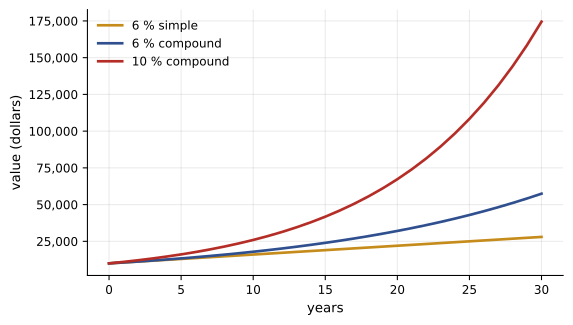
With compound interest, interest earned in each period is added to the principal, and the next period's interest is calculated on the larger balance. After one period, the amount is \(P(1 + i)\); after two, \(P(1 + i)^2\); after \(n\) periods:
The factor \((1 + i)^n\) is called the single-payment compound amount factor, written \((F/P, i, n)\). Reversing the relationship gives the present worth of a future amount:
The factor \((1 + i)^{-n}\) is the single-payment present worth factor. Moving a cash flow to an earlier time is called discounting, and the interest rate used is often called the discount rate.
Worked problem
Simple versus compound interest
An engineering firm invests $10,000 of surplus cash for 10 years at 6 % per year. How much will it have with simple interest and with annual compound interest?
Show solution
- Simple: \(F = 10{,}000 \times (1 + 0.06 \times 10) = 16{,}000\).
- Compound: \(F = 10{,}000 \times 1.06^{10} = 10{,}000 \times 1.7908 = 17{,}908\).
- The difference of $1,908 is interest earned on interest.
Answer: $16,000 with simple interest and about $17,908 with compound interest.
Equivalence
Two cash flows, or two sets of cash flows, are equivalent at a given interest rate if they have the same value when moved to the same point in time. At 6 %, $10,000 today and $17,908 in ten years are equivalent: a person indifferent to risk and able to earn 6 % would be equally happy with either. Equivalence depends on the interest rate: at 8 %, $10,000 today is equivalent to $21,589 in ten years, not $17,908. All the methods in this course rest on equivalence: they convert complex streams of cash flows into a single equivalent present amount, annual amount or rate of return.
Nominal and effective interest rates
Interest is often quoted as an annual rate but compounded more frequently, such as monthly for credit cards and many loans, or daily for some accounts. The quoted annual rate is the nominal rate \(r\), and the rate per compounding period is \(r/m\), where \(m\) is the number of compounding periods per year. Because interest compounds within the year, the true annual rate, the effective annual rate \(i_a\), is higher than the nominal rate:
For example, a nominal 12 % compounded monthly gives an effective annual rate of \((1.01)^{12} - 1 = 12.68\,\%\). Effective rates are the correct basis for comparing loans and investments with different compounding frequencies, and they are what the time value formulas require when the period is a year.
| Compounding | m | Effective rate for r = 12 % |
|---|---|---|
| Annually | 1 | 12.00 % |
| Semi-annually | 2 | 12.36 % |
| Quarterly | 4 | 12.55 % |
| Monthly | 12 | 12.68 % |
| Daily | 365 | 12.75 % |
| Continuously | ∞ | 12.75 % |
Matching the period to the cash flows
Time value formulas require the interest rate and the number of periods to use the same period as the cash flows. If payments are monthly, use the monthly rate and the number of months; if they are annual, use the effective annual rate and the number of years. A common error is to use the nominal annual rate with monthly payments. When the payment period differs from the compounding period, convert the rate to an effective rate per payment period:
where \(c\) is the number of compounding periods per payment period, which can be a fraction.
In Canada, the Interest Act requires that interest on blended-payment mortgages be calculated yearly or half-yearly, not in advance, so Canadian fixed-rate mortgages are conventionally quoted as nominal annual rates compounded semi-annually, even though payments are usually monthly. A quoted 5 % mortgage therefore has an effective annual rate of \((1.025)^2 - 1 = 5.0625\,\%\) and a monthly rate of \((1.025)^{1/6} - 1 = 0.4124\,\%\). Other Canadian consumer loans and credit cards usually compound monthly or daily, and provincial consumer protection laws require disclosure of the cost of credit.
Continuous compounding
As compounding becomes more frequent without limit, the effective rate approaches a limiting value given by continuous compounding:
At a nominal 12 %, continuous compounding gives \(e^{0.12} - 1 = 12.75\,\%\), barely more than daily compounding. Continuous models are useful in theoretical analysis, in finance and for cash flows that occur continuously over time, such as energy savings from a plant running all year, where the continuous flow model treats savings as spread evenly rather than lumped at year end.
The rule of 72
A quick mental estimate of the time for money to double at compound interest is the rule of 72: the doubling time in periods is approximately 72 divided by the interest rate in percent. At 6 %, money doubles in about 12 years (the exact value is 11.9); at 9 %, in about 8 years. The rule is useful for checking calculations and explaining compounding to non-specialists. The exact doubling time is \(n = \ln 2 / \ln(1 + i)\).
Where interest rates come from
Market interest rates reflect central bank policy, inflation expectations, the supply and demand for credit, the term of the loan and the borrower's risk. Governments borrow at the lowest rates because their default risk is lowest; corporations pay more, depending on their credit ratings; and individuals pay more still for unsecured credit. The interest rate used for engineering decisions within a firm is usually not a market rate but the minimum acceptable rate of return (MARR), also called the hurdle rate, set by management. The MARR typically starts from the firm's cost of capital, the weighted average cost of its debt and equity financing (WACC), and adds a margin for risk and for the fact that capital is limited and must be allocated to the best projects. Many firms use different MARRs for different risk classes: a low-risk cost-reduction project might use 10 %, a new product launch 20 % or more. Public agencies use social discount rates set by government guidance (Lesson 8).
Here \(E\) and \(D\) are the market values of equity and debt, \(V = E + D\), \(r_e\) and \(r_d\) the costs of equity and debt, and \(t\) the corporate tax rate, since interest on debt is generally tax-deductible.
Worked problem
Estimating a MARR
A company is financed 60 % by equity with a required return of 12 % and 40 % by debt at 6 %. Its combined corporate tax rate is 25 %. Management adds a 3 percentage point risk margin for routine projects. What is the WACC and the MARR?
Show solution
- After-tax cost of debt: \(6\,\% \times (1 - 0.25) = 4.5\,\%\).
- WACC: \(0.6 \times 12\,\% + 0.4 \times 4.5\,\% = 7.2\,\% + 1.8\,\% = 9.0\,\%\).
- MARR: \(9.0\,\% + 3\,\% = 12\,\%\).
Answer: A WACC of 9.0 % and a MARR of about 12 % for routine projects.
Interest on loans: amortization schedules
A loan repaid in equal instalments is amortized: each payment covers the interest on the outstanding balance, and the remainder reduces the principal. Early payments are mostly interest; later payments are mostly principal. An amortization schedule lists, for each period, the opening balance, interest, principal repaid and closing balance. For a $250,000 loan at a monthly rate of 0.5 % over 300 months, the payment is $1,610.75; in the first month, interest is $1,250 and principal $360.75, while in the last month nearly the whole payment is principal. Amortization schedules help engineers understand financing costs for equipment and buildings, compare loan offers, and calculate the remaining balance if a loan is repaid early, which equals the present worth of the remaining payments at the loan rate.
Worked problem
Remaining balance on a loan
A firm borrows $500,000 at 6 % per year, repaid in 10 equal annual payments. After 4 payments, what balance remains?
Show solution
- Annual payment: \(A = 500{,}000\,(A/P, 6\,\%, 10) = 500{,}000 \times 0.13587 = 67{,}934\).
- Remaining balance = present worth of the remaining 6 payments at 6 %: \(67{,}934\,(P/A, 6\,\%, 6) = 67{,}934 \times 4.9173 = 334{,}054\).
Answer: About $334,050 remains after four payments.
Interest rates and engineering decisions
Changes in interest rates have a direct effect on engineering investment. When rates rise, the cost of capital and the MARR tend to rise, so projects with large first costs and benefits spread over many years, such as energy efficiency retrofits, renewable energy and long-lived infrastructure, become less attractive relative to alternatives with lower first costs and higher operating costs. When rates fall, the opposite occurs. Between 2022 and 2024, central banks in both Canada and the United States raised policy rates sharply to fight inflation before beginning to lower them, and many capital-intensive projects were re-evaluated as financing costs changed. Engineers presenting long-term investments should show how their conclusions depend on the interest rate, rather than treating it as fixed.
Time value in everyday engineering
The time value of money appears throughout engineering practice, not only in formal studies. Warranty choices, prepaying maintenance contracts, early payment discounts from suppliers, retainage on construction contracts and delayed payments to subcontractors all involve trading money now against money later. A supplier offering a 2 % discount for paying in 10 days instead of 30 is effectively offering a very high annualized rate of return for paying early, roughly 2 % for 20 days, or about 44 % a year, so taking such discounts is almost always worthwhile when cash is available.
Common mistakes
MistakeUsing simple interest for multi-year investments.
InsteadUse compound interest unless a contract specifies otherwise.
MistakeComparing loans by nominal rates with different compounding.
InsteadCompare effective annual rates.
MistakeUsing an annual rate with monthly periods.
InsteadMatch the rate and number of periods to the cash flow period.
MistakeAssuming all mortgages compound monthly.
InsteadCheck the compounding convention of the jurisdiction and contract.
MistakeUsing the market borrowing rate as the MARR.
InsteadUse the firm's MARR, which includes risk and capital rationing.
Summary and key terms
- Money has a time value because capital is productive, people prefer the present and the future is uncertain.
- Simple interest earns on principal only; compound interest earns on interest too.
- F = P(1 + i)^n and P = F(1 + i)^−n convert single amounts through time.
- Equivalence means equal value at a given interest rate.
- Effective rates account for compounding within the year.
- Continuous compounding gives e^r − 1; the rule of 72 estimates doubling time.
- Firms use a MARR based on the cost of capital plus a risk margin.
- Interest
- Payment for the use of money over time.
- Simple interest
- Interest on the principal only.
- Compound interest
- Interest on principal and accumulated interest.
- Discounting
- Moving a cash flow to an earlier time.
- Equivalence
- Equal value at a given interest rate.
- Nominal rate
- Quoted annual rate without compounding effects.
- Effective rate
- Actual rate including compounding.
- Continuous compounding
- Compounding an infinite number of times per period.
- WACC
- Weighted average cost of capital.
- Hurdle rate
- Another name for the MARR.
Practice problems
Work each problem on paper first, then reveal the answer to check.
Future value of $5,000 at 8 % for 5 years, compounded annually?
Show answer
About $7,347.
Present worth of $20,000 due in 7 years at 10 %?
Show answer
About $10,263.
Effective annual rate of 6 % compounded quarterly?
Show answer
About 6.14 %.
Monthly rate for 9 % nominal compounded monthly?
Show answer
0.75 %.
Effective rate of 8 % compounded continuously?
Show answer
About 8.33 %.
Doubling time at 4 % by the rule of 72?
Show answer
About 18 years.
What does WACC combine?
Show answer
Costs of equity and after-tax debt weighted by their shares.
Why is the MARR usually above the WACC?
Show answer
Risk margins and limited capital.
Is $10,000 now equivalent to $15,000 in 5 years at 8 %?
Show answer
No; at 8 % it is equivalent to about $14,693.
Why match periods and rates?
Show answer
Formulas assume the rate applies per cash flow period.
Lesson quiz · 5 questions
Score 60% or more to complete this lesson.
Create a free account to save your progress, take quizzes and earn a certificate.