
ELV-420 · Lesson 9 of 12 · 20 min
Escalator and moving walk maintenance and tests
For two weeks in May, Lena lent Tamsin back to Nell Brady's escalator crew, because Brackenridge's eight escalators were due their annual tests and the light rail station's six heavy-duty units were due their spring service. Tamsin had learned how escalators work in ELV-330, ending with a skirt obstruction trip on E4 and a step chain inspection on E2. This time the subject was routine: what an escalator maintenance program contains, how the annual tests are run in a busy public building, and how the results are tracked from year to year. “An elevator carries ten people at a time behind closed doors,” Nell said. “An escalator carries thousands an hour with nothing between them and the machine but a comb and a skirt. Most of our work is about those gaps.” This lesson covers escalator and moving walk maintenance programs and periodic tests.
The escalator maintenance program
Escalators and moving walks need their own maintenance control programs under Section 8.6, with tasks and intervals set from the maker's procedures, the usage, the environment and the history, as lesson 2 described. Their usage is very different from an elevator's. A mall escalator runs for twelve or more hours a day in one direction, carrying a steady stream of people, shopping carts that should not be there, strollers and wheeled luggage, and the dirt of every shoe that steps on it. A transit escalator may run twenty hours a day, outdoors or in a draughty portal, in rain and road salt. Programs for such units have short intervals for cleaning and for examining the comb plates, steps, skirts and handrails, and longer intervals for the drive, chains and structure.
| Area | Typical tasks | Why |
|---|---|---|
| Combs and comb plates | examine teeth, replace broken segments, check mesh with steps | broken teeth and poor mesh catch shoes and fingers |
| Steps and step treads | examine for cracks, missing demarcation, damaged cleats; check step-to-step gaps | damaged steps catch feet and can fail under load |
| Skirts and deflectors | clean, check skirt-to-step clearance, examine brushes | entrapment between skirt and step |
| Handrails | examine surface, tension, speed against the steps, entry guards | a slow rail pulls riders off balance |
| Drive machine and brake | examine, measure brake and adjust to the maker's values | the brake stops a loaded escalator |
| Step chains and drive chain | lubricate, measure elongation, check rollers | chain wear leads to step misalignment and failure |
| Safety devices | operate each device on its interval | the devices are the protection when something goes wrong |
| Truss interior and pit | remove debris and dirt, check drainage and heaters | debris is a fire load and hides damage |
Cleaning matters even more on an escalator than on an elevator. Dirt packed between step cleats lifts shoes towards the comb, grit in the step tracks wears the rollers, and the truss interior of a busy escalator collects lint, paper and dust that is both a fire load and a cover for oil leaks. Brackenridge's program had the truss interiors cleaned with a vacuum on a fixed interval and after any spill, and the station units, open to weather at one end, had extra tasks for their drainage, heaters and corrosion.
Working on an escalator safely
Escalator work has its own hazards: the stopped steps can be moved by the drive or by gravity if the brake is released, a removed step leaves a hole into the truss, and the public will walk onto a stopped escalator unless barriers stop them. Nell's crew barricaded both landings fully before any work, locked out the main disconnect and the controller as ELV-110 described, and used the maker's maintenance inspection operation, with its own stop switches at each end, to move the steps. When steps were removed, the opening was kept at the bottom of the incline where possible and was never left unattended. On the transit units the station agent was told before work started, because a stopped escalator in a station changes how people move through it.
Annual tests on escalators and moving walks
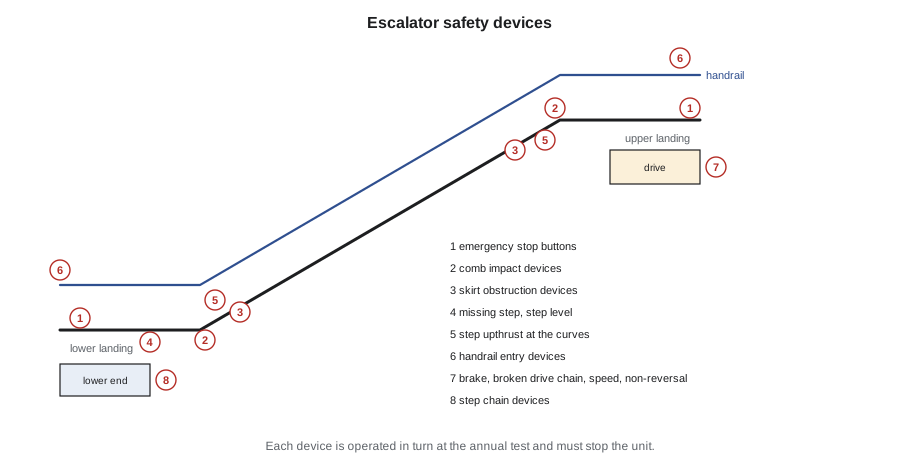
The Category 1 tests on an escalator or moving walk check its safety devices and its brake. The safety devices are operated one at a time and each must stop the unit: the emergency stop buttons at the landings, the skirt obstruction devices, the comb impact devices, the step upthrust devices, the missing step detection, the step level devices, the handrail entry devices, the broken drive chain and broken step chain devices, the speed monitoring and non-reversal protection, and the handrail speed monitoring where fitted. The brake is tested by stopping the unit and measuring how far the steps travel and how quickly they decelerate. The step-to-skirt clearance and the step and skirt performance index, which measures how likely the skirt is to trap a shoe, are measured where the code and the program call for it. The signs, lighting and barriers are checked as well.
Brackenridge's annual tests were done before the mall opened, between six and nine in the morning, two units at a time so that people could still move between floors when the doors opened. Nell's checklist for each unit ran to two pages, and each device was tested, recorded and reset before the next. The first unit took Tamsin almost the whole three hours; by the end of the week the crew was doing two units in that time.
The brake test
The escalator brake must stop the unit smoothly, not so suddenly that riders fall and not so slowly that they are carried into the comb. The code limits the deceleration during the stop and sets stopping distance requirements that depend on the speed and the edition; the inspection guide describes the test. In the usual annual test, the unit runs empty in the down direction at rated speed, the stop is initiated from the emergency stop button, and the travel of a marked step from the moment of the stop signal to rest is measured. From the distance and the speed, the average deceleration is worked out and compared with the limit, and the distance with the program's values for the unit. Some editions and some makers also call for a brake test with load at longer intervals, done with sandbags or weights on the steps or by the maker's alternative method.
# Escalator brake test results, Brackenridge E1 to E8, empty, down direction, from the emergency stop
speed = 0.5                        # rated speed, m/s
MAX_DECEL = 0.91                   # limit on average deceleration used in the program, m/s2
D_RANGE = (0.2, 1.0)           # stopping distance range in the program for this speed, m
stops = {"E1": 0.41, "E2": 0.44, "E3": 0.38, "E4": 0.47, "E5": 0.12, "E6": 0.43, "E7": 0.52, "E8": 0.49}
v = speed * 1.0
for unit, d in stops.items():
    dist_m = d * 1.0
    decel = v ** 2 / (2 * dist_m)
    flags = []
    if decel > MAX_DECEL:
        flags.append("stops too hard")
    if not D_RANGE[0] <= d <= D_RANGE[1]:
        flags.append("distance outside range")
print(f"{unit}: {d} m, average {decel:.2f} m/s2 {'; '.join(flags) or 'ok'}")E1: 0.41 m, average 0.30 m/s2 ok E2: 0.44 m, average 0.28 m/s2 ok E3: 0.38 m, average 0.33 m/s2 ok E4: 0.47 m, average 0.27 m/s2 ok E5: 0.12 m, average 1.04 m/s2 stops too hard; distance outside range E6: 0.43 m, average 0.29 m/s2 ok E7: 0.52 m, average 0.24 m/s2 ok E8: 0.49 m, average 0.26 m/s2 ok
E5 stopped far too hard. Nell found that its brake had been adjusted after a slipping complaint the previous autumn, by someone who had tightened the spring well beyond the maker's setting to cure the slip. The slip itself had been oil on the brake from a leaking gearbox seal, which had since been fixed. With the spring reset to the maker's value and the linings cleaned, E5 stopped in a distance like its neighbours. Tamsin recognized the pattern from lesson 3: an adjustment made by feel, to cure a symptom, had created a hazard of its own. A stop that hard on a crowded down escalator can throw people forward onto the steps.
Tracking results from year to year
Escalator test results are most useful as trends. The skirt index, the brake stopping distances, the step chain elongation and the handrail speed difference all change slowly with wear, and a unit drifting towards a limit can be corrected before it fails. Nell kept a sheet for each unit with five years of results, and the annual review of those sheets set the next year's repair plan. The skirt index on E4, after the corrections in ELV-330, had stayed well inside the lowest band; E7, the new modular unit, had the lowest values on the property.
# Five-year trend of handrail speed relative to step speed, Brackenridge (percent; positive = rail faster)
history = {   # unit: readings from the last five annual tests
    "E1": [0.5, 0.6, 0.4, 0.7, 0.6],
    "E2": [0.8, 0.4, -0.3, -1.1, -1.9],
    "E3": [0.3, 0.5, 0.4, 0.6, 0.5],
    "E6": [1.0, 1.2, 1.1, 1.3, 1.6],
}
WINDOW = (0.0, 2.0)           # the program's target window for handrail speed, percent of step speed
for unit, r in history.items():
    change = r[-1] - r[0]
    trend = "falling" if change < -0.8 else ("rising" if change > 0.8 else "steady")
    inside = WINDOW[0] <= r[-1] <= WINDOW[1]
    print(f"{unit}: latest {r[-1]:+.1f} %, {trend}, {'inside' if inside else 'OUTSIDE'} window")
print("a rail slower than the steps pulls riders backward; find the cause, often handrail drive wear or tension")E1: latest +0.6 %, steady, inside window E2: latest -1.9 %, falling, OUTSIDE window E3: latest +0.5 %, steady, inside window E6: latest +1.6 %, steady, inside window a rail slower than the steps pulls riders backward; find the cause, often handrail drive wear or tension
E2's handrail had been slowing for three years and was now running behind the steps, which pulls riders' hands back while their feet go forward. The cause was a worn handrail drive and low tension; the drive was added to the step chain replacement already booked after ELV-330's inspection, so that E2 would be out of service only once. Without the trend, the slow rail would have been found only when a rider complained or fell.
Moving walks
Moving walks are maintained and tested in much the same way as escalators, with their own devices and limits. The airport's four walks on the international pier had pallets instead of steps, lower inclines and handrails long enough that a small speed difference over their length was easy for riders to feel. The airport's facilities team scheduled their tests at night, when the pier was closed, and required each walk to be returned to service with a signed checklist handed to the duty manager. Luggage carts and wheeled bags were the main source of damage, so their programs had short intervals for examining combs, pallets and skirts.
Worked problem
A device that does not stop the unit
During E6's annual test, Tamsin operates the lower left skirt obstruction device and the escalator keeps running. The other devices work. What should happen?
Show solution
- The device has failed: the unit is not returned to service until it is repaired and tested.
- Check the device's switch, its adjustment and its wiring to the safety circuit; look for a jumper.
- Here the cause is a switch actuator bent so that the switch no longer opens when the skirt deflects; replace it and set it to the maker's value.
- Retest that device and the others on the same circuit, record the failure, cause, repair and retest.
Answer: Keep the unit out of service, find and repair the cause, retest the device and record everything.
Common mistakes
MistakeLeaving one landing open while working on an escalator.
InsteadBarricade both landings fully before any work.
MistakeTesting brakes in the up direction only.
InsteadTest as the guide describes, usually down direction with the unit running at rated speed.
MistakeCuring a slipping brake by tightening the spring.
InsteadFind the cause of the slip, such as oil on the linings, and adjust only to the maker's value.
MistakeLooking at one year's results only.
InsteadTrend skirt index, brake distances, chain elongation and handrail speed over several years.
MistakeReturning a unit to service with any device failed.
InsteadEvery safety device must work before the unit carries passengers.
Summary and key terms
- Escalators and moving walks need unit-specific maintenance programs, with short intervals for combs, steps, skirts, handrails and cleaning.
- Work starts with both landings barricaded, lockout and the maker's maintenance inspection operation.
- Annual tests operate every safety device in turn and test the brake, usually empty in the down direction at rated speed.
- Brake results are judged on stopping distance and deceleration; a stop that is too hard is as unsafe as one that is too long.
- Trends in skirt index, brake distance, chain elongation and handrail speed guide the repair plan.
- Moving walks follow the same pattern with pallets and their own devices and limits.
- Comb impact device
- A device that stops the escalator when an object strikes or jams the comb plate.
- Skirt obstruction device
- A device that stops the escalator when the skirt is deflected by an object caught between the skirt and the step.
- Step upthrust device
- A device that stops the escalator if a step is lifted out of its track.
- Missing step detection
- A device that stops the escalator if a step or pallet is missing.
- Handrail speed monitoring
- A device that detects a handrail running too slowly relative to the steps.
- Non-reversal protection
- A device that stops the escalator if it begins to run in the wrong direction.
Practice problems
Work each problem on paper first, then reveal the answer to check.
Why are cleaning intervals short on busy escalators?
Show answer
Packed dirt lifts shoes towards the comb, grit wears rollers and debris in the truss is a fire load.
How is an escalator brake usually tested annually?
Show answer
Running empty down at rated speed, stopped from the emergency stop button, with the travel of a marked step measured.
Why is a too-hard stop a problem on an escalator?
Show answer
Riders can be thrown forward onto the steps.
What does a handrail slower than the steps do to riders?
Show answer
It pulls their hands back while their feet go forward.
What must happen before an escalator with a failed safety device carries passengers?
Show answer
The device is repaired and retested, and the failure, cause and repair are recorded.
Lesson quiz · 5 questions
Score 60% or more to complete this lesson.
Create a free account to save your progress, take quizzes and earn a certificate.