
ELV-420 · Lesson 11 of 12 · 20 min
Records, logs and working with inspectors
Every Friday afternoon Ray spent an hour at the Northcrest shop with his route's records: the week's logs, the callback reports, the open repair items and any letters or reports from Technical Safety BC. In June Hugh asked Tamsin to sit in, and then to take over the hour for a month while Ray watched. She found it harder than any test. “The equipment tells you what is wrong with it,” Ray said. “The records tell you what is wrong with your maintenance.” This lesson covers the records a route keeps, how callback logs and test records are analysed to improve maintenance, and how to work with the inspectors and safety officers who read those records.
The records on a route
Lesson 2 listed the records a maintenance control program must keep: maintenance records, repair and replacement records, callback logs, oil usage records and periodic test records, all for at least five years. On a route these exist in two places. On site, the primary record is kept where the mechanic and the inspector can see it, as Technical Safety BC's directive requires, with instructions posted at the controller. At the contractor's office, the electronic system holds the same information in a form that can be searched, sorted and analysed across many units. The two must agree, and keeping them in step is a weekly job. A log that says a task was done on site, while the system shows it outstanding, or the reverse, is an audit finding even if the work was done.
Good records are specific. “Adjusted doors” tells the next mechanic nothing; “car door closing time at floor 3 was 2.9 s against a plate minimum of 3.2 s, operator speed reset, now 3.4 s” tells them what was found, what was done and what the result was. Ray's rule was that a record should let a stranger repeat the work and check the result.
Callback logs
Each callback is recorded with the date and time of the call, who called and what they reported, when the mechanic arrived, what was found, the cause, the corrective action, when the unit returned to service, and whether anyone was trapped. Over a year, those records show which units fail most, which components fail most and how long units are out of service. Two simple measures are used across the industry: callbacks per unit per year, which compares units and routes, and mean time between callbacks, which is the running time divided by the number of callbacks. The causes matter more than the counts, because the causes tell the mechanic what to change in the program.
# Route 7 callback analysis for the last 12 months
from collections import Counter
calls = [  # (unit, cause category, entrapment?)
    ("Seaview 1", "doors", False), ("Seaview 1", "doors", False), ("Seaview 2", "doors", False),
    ("Seaview 2", "doors", False), ("Seaview 1", "doors", False), ("Seaview 2", "vandalism", False),
    ("Tillicum 1", "controller", False), ("Tillicum 1", "controller", True), ("Tillicum 1", "doors", False),
    ("Tillicum 1", "power", False), ("Birchwood 2", "doors", True), ("Birchwood 1", "valve", False),
    ("Pemberton 1", "water in pit", False), ("Pemberton 1", "doors", False), ("Holloway 1", "doors", False),
    ("Holloway 2", "valve", False), ("Marlowe 1", "power unit", False), ("Larchmont 1", "belt monitor", False),
    ("Larchmont 1", "doors", True), ("Dunmore 1", "doors", False), ("Ashgrove 1", "doors", False),
]
UNITS = 14
HOURS_IN_SERVICE = 8760            # hours per unit per year, running or available
print(f"callbacks: {len(calls)}, per unit per year: {len(calls) / UNITS:.1f}")
print(f"mean time between callbacks per unit: {UNITS * HOURS_IN_SERVICE / len(calls):,.0f} hours")
print(f"entrapments: {sum(1 for c in calls if c[2])}")
by_cause = Counter(c[1] for c in calls)
print("by cause:", ", ".join(f"{k} {v}" for k, v in by_cause.most_common()))
by_unit = Counter(c[0] for c in calls)
print("worst units:", ", ".join(f"{k} {v}" for k, v in by_unit.most_common(3)))
share = by_cause["doors"] / len(calls)
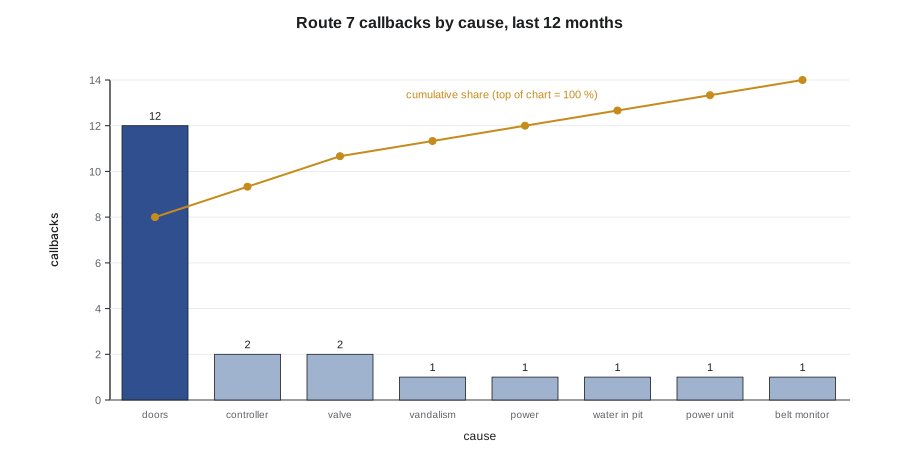
print(f"doors are {100 * share:.0f} % of callbacks: review door tasks first")callbacks: 21, per unit per year: 1.5 mean time between callbacks per unit: 5,840 hours entrapments: 3 by cause: doors 12, controller 2, valve 2, vandalism 1, power 1, water in pit 1, power unit 1, belt monitor 1 worst units: Tillicum 1 4, Seaview 1 3, Seaview 2 3 doors are 57 % of callbacks: review door tasks first
The result surprised no one who had worked in the trade: doors caused most of the callbacks, as they do on almost every route, and Seaview's heavily used cars and Tillicum's old car caused the most. Seaview's door tasks had already been shortened after lesson 2's review, and the callbacks since then had dropped. Tillicum car 1's controller faults would end with the modernization. The two door entrapments at Birchwood and Larchmont had different causes, a broken hall door roller and a cracked gib, but both were in hall door hardware, so Tamsin proposed adding an examination of hall door rollers and gibs at every landing every three months on all the route's cars. Hugh approved it, and the program review was recorded.
Test records and trends
Periodic test records are kept so that each result can be compared with the acceptance baseline and with earlier tests, as lessons 4, 7 and 9 showed for wear, governors and escalator brakes. A test record that cannot be compared, because it uses different units, a different method or no values, is almost useless. When Tamsin went through Route 7's five-year test records she found that the Pemberton's last safety test had recorded the stopping distance in inches and the one before it in centimetres, without saying so on the sheet; it took a phone call to the mechanic who had retired to sort out which was which. The program's test procedures were amended to state the units on every form.
Deficiencies and orders
Inspectors record what they find. Depending on the jurisdiction and the seriousness, a finding may be a deficiency to be corrected by a date, an order requiring action, or a notice that the equipment must be removed from service. Technical Safety BC's safety officers issue inspection reports and, where needed, compliance orders, and the contractor and owner must respond by the date given; Technical Safety BC also requires contractors to report each year on the devices they maintain. Whatever the form, the contractor tracks every open deficiency to its closure, with the date, the action and the evidence, because an uncorrected finding at the next inspection is a much more serious matter than the original one.
# Open deficiency tracker from the last round of inspections, as of 30 June 2027
from datetime import date
TODAY = date(2027, 6, 30)
items = [  # (unit, finding, due, closed on, evidence)
    ("Ashgrove 1", "emergency light battery not dated", date(2027, 7, 8), date(2027, 6, 18), "photo and note sent"),
    ("Seaview 2", "pit light guard missing", date(2027, 6, 15), None, None),
    ("Marlowe 1", "relief valve seal broken", date(2027, 5, 20), date(2027, 4, 22), "resealed, test record"),
    ("Birchwood 2", "hall door gap floor 4 over limit", date(2027, 7, 30), None, None),
    ("Pemberton 1", "machine room storage", date(2027, 6, 1), date(2027, 5, 28), "photo"),
]
for unit, finding, due, closed, evidence in items:
    if closed:
        state = f"closed {closed}" + (" (late)" if closed > due else "") + f", evidence: {evidence}"
    else:
        state = "OVERDUE" if TODAY > due else f"open, {(due - TODAY).days} days left"
    print(f"{unit:12s} {finding:36s} due {due}  {state}")
late = [i for i in items if i[3] is None and TODAY > i[2]]
print(f"overdue and open: {len(late)} - tell the owner and the authority today, with a date for correction")Ashgrove 1 emergency light battery not dated due 2027-07-08 closed 2027-06-18, evidence: photo and note sent Seaview 2 pit light guard missing due 2027-06-15 OVERDUE Marlowe 1 relief valve seal broken due 2027-05-20 closed 2027-04-22, evidence: resealed, test record Birchwood 2 hall door gap floor 4 over limit due 2027-07-30 open, 30 days left Pemberton 1 machine room storage due 2027-06-01 closed 2027-05-28, evidence: photo overdue and open: 1 - tell the owner and the authority today, with a date for correction
Seaview car 2's missing pit light guard had been ordered, but the part had not arrived and nobody had told the inspector. Hugh's rule was that a correction that will be late is reported before the due date, not after, with the reason and a new date; inspectors almost always accept a late correction that is explained in advance, and almost never accept silence. Tamsin called the inspector's office that afternoon.
Working with inspectors
Inspectors and safety officers are trained specialists, and in many jurisdictions they are certified under ASME QEI-1, the standard for qualified elevator inspectors, or an equivalent program, which requires experience in the trade and an examination. They have seen far more elevators than most mechanics, and most of them want the same thing the mechanic wants: equipment that is safe and records that are true. Ray's habits with inspectors were simple. Be on time, with the equipment ready and the records open. Answer the question asked, honestly, and say “I don't know, I will find out” rather than guess. Show the reading rather than describe it. Never hide a problem, because inspectors find most of them and remember the ones that were hidden. And keep the relationship professional in both directions: an inspector is not a customer to be pleased, and not an opponent to be beaten.
Inspectors also make mistakes, and a mechanic who believes a finding is wrong should say so politely, with the clause and the edition, and ask for the decision in writing if the inspector maintains it. As ELV-410 lesson 3 explained, interpretations can be requested formally from the authority, and a written interpretation is part of the record. What a mechanic must never do is ignore a finding because they disagree with it.
| Do | Do not |
|---|---|
| have the records open and up to date | make the inspector wait while records are found |
| run the tests the inspector asks for, safely | let the inspector operate the equipment |
| show the reading on the instrument | describe a reading from memory |
| say when you do not know and find out | guess an answer |
| report a late correction before its due date | let a due date pass in silence |
| disagree politely, with clause and edition, and ask for it in writing | argue in the car or ignore the finding |
Records as evidence
Records are also evidence. After an incident, a fall, an entrapment injury or a death, the maintenance and test records are among the first things investigators ask for, along with the program and the callback log. They show whether the equipment was maintained as the program required, whether known problems were acted on, and whether tests were done and passed. Records written at the time, specifically and honestly, protect the mechanic who did the work properly. Records written afterwards, altered or vague, do the opposite. Hugh put it plainly to every new mechanic: “Write every entry as if a coroner will read it, because one day one might.”
Worked problem
A gap in the log
Going through Dunmore Square's log, Tamsin finds that the monthly visit in February has no entry, although the van's tracking shows Ray was on site for ninety minutes that day. Ray remembers doing the visit but not the details. What should be done?
Show solution
- A missing entry cannot be filled in later as if it had been written at the time.
- Make a late entry dated today, stating that it is a late entry, recording what is known: the date and duration of the visit and that the details were not recorded.
- Do the tasks that were due in February again now, if they cannot be shown to have been done, and record them.
- Find out why the entry was missed and fix the process so it does not happen again.
Answer: Record a clearly marked late entry with what is known, redo any tasks that cannot be shown as done, and fix the cause; never backdate.
Common mistakes
MistakeWriting vague log entries such as 'adjusted doors'.
InsteadRecord what was found, what was done and the result, with values.
MistakeLetting the site log and the office system disagree.
InsteadReconcile them weekly; a disagreement is a finding.
MistakeCounting callbacks without analysing their causes.
InsteadGroup callbacks by cause and change the program where the causes point.
MistakeMissing a correction date without telling anyone.
InsteadReport a late correction before the due date with a reason and a new date.
MistakeBackdating or altering records.
InsteadMake clearly marked late entries; altered records destroy their value as evidence.
Summary and key terms
- Route records live on site and in the contractor's system; the two must agree.
- Good records are specific enough that a stranger could repeat the work and check the result.
- Callback logs give callbacks per unit per year, mean time between callbacks and, most usefully, causes that point to program changes.
- Test records must be comparable over time: same method, same units, every value recorded.
- Every deficiency is tracked to closure with evidence; late corrections are reported before the due date.
- Inspectors are trained specialists, often certified to ASME QEI-1; work with them openly, show readings, and settle disagreements in writing.
- Records are evidence after an incident; write them at the time, specifically, and never alter them.
- Callback rate
- The number of callbacks per unit per year.
- Mean time between callbacks
- Running or available hours divided by the number of callbacks.
- Deficiency
- A finding by an inspector that must be corrected by a date.
- Compliance order
- A formal order from the authority requiring action on equipment.
- QEI
- Qualified elevator inspector, certified under ASME QEI-1 or an equivalent program.
- Late entry
- A record made after the event and clearly marked as such, never backdated.
Practice problems
Work each problem on paper first, then reveal the answer to check.
What two simple measures are used to compare callback performance?
Show answer
Callbacks per unit per year, and mean time between callbacks.
Why are the causes of callbacks more useful than the counts?
Show answer
They show what to change in the program.
What should happen if a deficiency correction will be late?
Show answer
Tell the owner and the authority before the due date, with the reason and a new date.
What is ASME QEI-1?
Show answer
The standard for the qualification and certification of elevator inspectors.
How is a missed log entry corrected?
Show answer
With a clearly marked late entry, dated when it is written, never backdated.
Lesson quiz · 5 questions
Score 60% or more to complete this lesson.
Create a free account to save your progress, take quizzes and earn a certificate.