
ELV-420 · Lesson 12 of 12 · 21 min
Capstone: a maintenance audit and an acceptance test day
The term ended with one week that brought together everything Tamsin had learned on Route 7. On Monday and Tuesday, Hugh Mbeki audited the route's maintenance control programs and records, as he did on every Northcrest route once a year and as a Technical Safety BC safety officer might at any time. On Thursday, the new car at Larchmont East, installed over the spring by Northcrest's installation crew, had its acceptance inspection with Camille Draper, the Technical Safety BC safety officer for the area. Lena put Tamsin in charge of preparing for both, with Ray beside her and Priya on the Larchmont paperwork. “The audit asks whether we have been doing the work,” Lena said. “The acceptance asks whether a new car is fit to start. They are the same question at two ends of an elevator's life.” This lesson follows that week from start to finish.
Monday: the audit plan
Hugh's audit followed the questions he had given Tamsin in lesson 2, applied to every unit on the route, with a closer sample of five units for which he would check the equipment as well as the records. For each unit he scored four areas: the program (specific, justified, reviewed), the records (complete, specific, on site and in the system, in agreement), the tests (done on time, with values, comparable) and the equipment (consistent with the records). The sample was Tillicum car 1, Seaview car 2, Birchwood car 2, Holloway car 1 and Dunmore Square, chosen because they had the most callbacks, the most complicated equipment or the oldest records.
Tamsin's preparation was the weekly records hour of lesson 11, done for every unit at once. She reconciled the site logs with the office system, closed out or explained every open item, checked every unit's test dates against the tracker from lesson 6 and checked every program's references against the maker's current procedures. She did not try to make the records look better than they were. Where something was missing or late, the record said so and said what had been done about it.
Monday and Tuesday: the findings
Hugh worked through the binders and the system on Monday and the five sample units on Tuesday, with Tamsin and Ray showing him the equipment. His findings were a mixture of things the term had already found and fixed, and a few that were new.
| Unit | Finding | Area | Action |
|---|---|---|---|
| Larchmont 1 | belt examination task cited a superseded maker's procedure (found in lesson 2) | program | already corrected; review recorded |
| Larchmont 1 | buffer oil additions not recorded before this term (lesson 8) | records | already corrected; seal replaced |
| Pemberton 1 | annual test 13 days late after the flood callback (lesson 6) | tests | already done; reason recorded |
| Dunmore 1 | February visit not logged (lesson 11) | records | late entry made; tasks redone; reminder added to app |
| Seaview 2 | pit light guard correction late (lesson 11) | equipment | authority told in advance; guard fitted on Tuesday |
| Holloway 1 | two months of firefighters' operation checks not recorded on the posted sheet | records | checks done and recorded; hospital staff retrained |
| Birchwood 2 | oil usage recorded but not totalled; running total shows a slow rise | records | total added; leakage check planned |
| Tillicum 1 | wiring diagrams on site do not show 1990s changes to the door circuit | program | diagrams marked up; full set with the modernization |
The Birchwood finding was the one that mattered most. With the oil additions totalled, car 2 had needed about 6 L (1.6 gal) more oil over the year than the year before, with no matching oil in its drip pan. Car 2's cylinder was the same buried, unprotected type as car 1's, whose three-year leakage test had passed in lesson 5, but car 2's own test was not due until the next year. Hugh's recommendation was to do car 2's leakage test now rather than wait, and Lena agreed. Tamsin ran it on the Wednesday with the same method as in lesson 5, with temperature readings, and the unexplained loss was inside the tolerance; the extra oil turned out to have been lost through a weeping fitting on the valve body, hidden behind the power unit's cover and wiped clean on every visit by someone who had never recorded it. The fitting was replaced and the oil record annotated. The result was a small repair, but the process was the point: an audit had found a trend that the visits had missed.
# Audit scores for Route 7 (0 to 5 in each area; sample units also scored on the equipment)
scores = {   # unit: (program, records, tests, equipment or None if not sampled)
    "Tillicum 1":  (3, 4, 5, 4), "Tillicum 2":  (5, 5, 5, None), "Marlowe 1":   (4, 5, 5, None),
    "Larchmont 1": (4, 4, 5, None), "Ashgrove 1": (5, 5, 5, None), "Dunmore 1":   (5, 3, 5, 5),
    "Holloway 1":  (5, 3, 5, 5), "Holloway 2":   (5, 5, 5, None), "Birchwood 1": (5, 5, 5, None),
    "Birchwood 2": (5, 3, 5, 4), "Pemberton 1":  (5, 4, 3, None), "Seaview 1":   (5, 5, 5, None),
    "Seaview 2":   (5, 5, 5, 4), "Bakery":       (5, 5, 5, None),
}
areas = ["program", "records", "tests", "equipment"]
for i, area in enumerate(areas):
    vals = [s[i] for s in scores.values() if s[i] is not None]
    low = [u for u, s in scores.items() if s[i] is not None and s[i] <= 3]
    print(f"{area:9s}: average {sum(vals) / len(vals):.1f} of 5; units at 3 or below: {', '.join(low) or 'none'}")
overall = [x for s in scores.values() for x in s if x is not None]
print(f"route overall: {100 * sum(overall) / (5 * len(overall)):.0f} %")
weak = max(areas, key=lambda a: sum(1 for s in scores.values() if s[areas.index(a)] is not None and s[areas.index(a)] <= 3))
print("area to improve first:", weak)program : average 4.7 of 5; units at 3 or below: Tillicum 1 records : average 4.4 of 5; units at 3 or below: Dunmore 1, Holloway 1, Birchwood 2 tests : average 4.9 of 5; units at 3 or below: Pemberton 1 equipment: average 4.4 of 5; units at 3 or below: none route overall: 92 % area to improve first: records
The route scored well overall, and the scores pointed to records as the area to improve, which matched everything Tamsin had seen in the Friday hours. Hugh's report to Lena listed the eight findings with their actions, owners and dates, and made one route-wide recommendation: a photograph of every posted test sheet and every oil record page at every visit, attached to the visit in the office system, so that a missing entry would show up in the office within a day instead of at the next audit.
Wednesday: getting Larchmont East ready
Larchmont East was a six-storey rental building beside the original Larchmont, with one machine-room-less car on coated steel belts from the same maker, rated 1,135 kg (2,500 lb) at 1.0 m/s (200 ft/min). Northcrest's installation crew had finished the work two weeks earlier and run the full set of pre-tests, and Priya's readiness sheet, built like the one in lesson 10 but four pages long, had been closed item by item. On Wednesday afternoon, after the Birchwood test, Tamsin and Ray walked the whole installation once more as the inspector would: the control cabinet and its disconnects beside the top landing, the hoistway on inspection from top to bottom, the pit with its refuge space and signs, the car and the six landings. They found one thing: a pit sign stating the refuge space dimensions had been fixed to the wrong wall, where the counterweight screen hid it. It was moved before they left.
The documents were in a binder on top of the control cabinet: the permit, the product certificates for the controller, the machine and brake, the governor, the belts and their monitoring device, the door operator and the light curtain, the maker's installation and adjustment instructions, the as-built wiring diagrams, the pre-test records with every value, the data plates' text, and the new car's maintenance control program, written from Larchmont car 1's program with its reviewed door intervals and with extra first-year tasks for door adjustment. Because Larchmont East was permitted under British Columbia's adopted edition, its emergency communication was a two-way voice system with a monitored line, tested and recorded.
Thursday: the acceptance
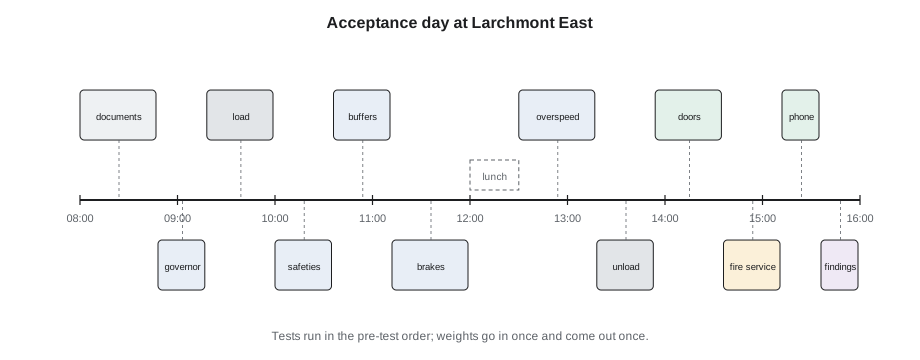
Camille Draper arrived at eight, read the binder for half an hour, and asked to see the control cabinet, the car top and the pit before any test. Then the tests began, run by Ray and Tamsin with Jonah moving the weights, in the order the pre-tests had used: the governor and its overspeed switch, using the maker's remote trip and reset; the safeties with rated load at rated speed; the oil buffers struck with rated load at the speed the procedure required; the brake holding 125 % of rated load and then each half of the brake on its own; ascending car overspeed and unintended movement in both directions; the belt monitoring device's test function; the terminal and emergency terminal devices; the doors, door protection and kinetic energy; firefighters' emergency operation with the building's fire alarm technician; the emergency communication and car lighting; and the battery rescue operation that brings the car to a landing in a power failure.
# Larchmont East car E1 acceptance results against the program's criteria
results = [  # (test, measured, low limit or None, high limit or None, unit)
    ("governor trip speed",            1.33,  1.15, 1.42, "m/s"),
    ("safety stopping distance",       0.21,  0.1, 0.4, "m"),
    ("platform tilt after safety stop", 1.1, None, 3.0, "%"),
    ("car buffer return time",          38,  None, 90, "s"),
    ("brake hold, 125 % load, creep",   0,   None, 0, "m"),
    ("brake half A stop from speed",   0.71, None, 1.2, "m"),
    ("brake half B stop from speed",   0.74, None, 1.2, "m"),
    ("unintended movement, up empty",  0.29, None, 1.22, "m"),
    ("unintended movement, down loaded", 0.24, None, 1.22, "m"),
    ("door average kinetic energy",    6.2, None, 10, "J"),
    ("rescue operation to landing",     95,  None, 300, "s"),
]
fails = 0
for name, x, lo, hi, u in results:
    ok = (lo is None or x >= lo) and (hi is None or x <= hi)
    fails += not ok
    rng = f"{lo if lo is not None else ''}..{hi if hi is not None else ''}"
    print(f"{name:33s} {x:>7} {u:6s} limits {rng:12s} {'pass' if ok else 'FAIL'}")
print(f"{len(results) - fails} of {len(results)} tests passed")governor trip speed 1.33 m/s limits 1.15..1.42 pass safety stopping distance 0.21 m limits 0.1..0.4 pass platform tilt after safety stop 1.1 % limits ..3.0 pass car buffer return time 38 s limits ..90 pass brake hold, 125 % load, creep 0 m limits ..0 pass brake half A stop from speed 0.71 m limits ..1.2 pass brake half B stop from speed 0.74 m limits ..1.2 pass unintended movement, up empty 0.29 m limits ..1.22 pass unintended movement, down loaded 0.24 m limits ..1.22 pass door average kinetic energy 6.2 J limits ..10 pass rescue operation to landing 95 s limits ..300 pass 11 of 11 tests passed
Every test passed, and the values matched the pre-test records closely, which Camille noted with approval: a pre-test sheet that matches the acceptance is good evidence that the contractor tests honestly. She raised two findings. The first was the pit sign, which she had found on the right wall and said nothing about until Tamsin mentioned it had been moved the day before; she smiled and wrote it down as corrected. The second was real: the governor's tripping speed was marked on its data tag in the maker's factory units, while the code requires the tag to show the tripping speed and rope details, and the tag's figure did not match the setting on the test record because it had been rounded differently. It was a minor item, to be corrected within thirty days with a new tag and a photograph.
At four o'clock Camille signed off the acceptance with the one open minor item. Technical Safety BC issued the operating permit the following morning. The car went into service that afternoon under its new maintenance control program, with its first visit scheduled for two weeks later and its acceptance values entered as the baseline for every test to come.
Friday: closing the week
On Friday Tamsin spent the records hour on the week itself. Hugh's audit findings went into the tracker with their owners and dates. Larchmont East's acceptance record, with every value, instrument and person, went into the binder and the system; the governor tag was ordered; the route model from lesson 1 was updated with the new car's actual first-month hours. Lena read the audit report and the acceptance record together and wrote a short note at the bottom of both: the route had found and fixed most of its own problems before the audit, and a new car had passed its acceptance at the first attempt. Both, she wrote, came from the same habit of measuring, recording and acting on what the records said.
The next term would bring Tillicum car 1's modernization, which ELV-430 follows from the first day of demolition to its own acceptance test day: the old car's last five-year test from lesson 7 would become the starting point for the new equipment's baseline.
Worked problem
Audit finding or acceptance finding?
During the Larchmont East acceptance, the inspector notices that the car's maintenance control program lists the belt examination at the interval from the maker's general manual, without the shorter first-year interval Northcrest had used on Larchmont car 1. Is this a reason to refuse the acceptance?
Show solution
- The program must exist before acceptance, and it does.
- Whether its intervals are right is mainly a maintenance question, which the authority can raise at any time.
- The inspector may record it as an observation or a minor finding; it does not make the car unsafe today.
- Northcrest should review the interval in light of Larchmont car 1's history and record the review, as lesson 2 described.
Answer: Not normally; the program exists, so the car can be accepted, but the interval should be reviewed and the review recorded.
Common mistakes
MistakeTidying the records to look better before an audit.
InsteadMake the records true; record what was missing and what was done about it.
MistakeTreating an audit as a test to pass rather than a check to learn from.
InsteadUse the findings to change the program and the route's habits.
MistakeBooking an acceptance before the program is written.
InsteadThe new car enters service under its program; it must exist first.
MistakeExpecting acceptance values to be forgotten after the permit is issued.
InsteadThey become the baseline for every later test.
MistakeLeaving minor findings open after the car is in service.
InsteadTrack them to closure with evidence by their dates.
Summary and key terms
- An audit scores each unit's program, records, tests and equipment, and samples some units in the field.
- The audit found a trend in Birchwood car 2's oil usage that routine visits had missed, led to an early leakage test and a repair.
- Preparation for acceptance means pre-tests with full values, a complete document binder, a written program and a final walk-through.
- Acceptance tests on a new traction elevator cover governors, safeties, buffers, brakes, overspeed and unintended movement, terminal devices, doors, firefighters' operation, communication and rescue.
- Matching pre-test and acceptance values show honest testing; minor findings are corrected by a date.
- The acceptance values become the baseline, and the car enters service under its maintenance control program.
- Maintenance audit
- A review of a route or unit by the contractor or the authority to check that the program is followed and the records are true.
- Sample unit
- A unit chosen in an audit for a check of the equipment as well as the records.
- Readiness sheet
- The list of items that must be closed before an acceptance is booked.
- Operating permit
- The authority’s permission for equipment to be used, issued or renewed after inspection.
- Observation
- A comment by an inspector that does not require correction but should be considered.
- First-year tasks
- Extra maintenance tasks for new equipment during its first year in service.
Practice problems
Work each problem on paper first, then reveal the answer to check.
What four areas did Hugh score in the audit?
Show answer
Program, records, tests and equipment.
What did the Birchwood oil total show, and what followed?
Show answer
A rise in oil use with no drip pan oil; an early leakage test passed and a weeping valve fitting was found and replaced.
Name five items in an acceptance document binder.
Show answer
Permit, product certificates, maker's instructions, as-built wiring diagrams, pre-test records, data plates, maintenance control program.
Why did matching pre-test and acceptance values matter to the inspector?
Show answer
They show the contractor's own tests are honest and reliable.
What happens to the acceptance values after the car enters service?
Show answer
They become the baseline for later periodic tests.
Lesson quiz · 5 questions
Score 60% or more to complete this lesson.
Create a free account to save your progress, take quizzes and earn a certificate.