
ELV-420 · Lesson 5 of 12 · 21 min
Hydraulic elevator periodic tests
April on Route 7 meant hydraulic tests. Six of the route's fourteen units were hydraulic, and four of them had their annual tests due within three weeks: Holloway's two bed cars, the Marlowe and Birchwood car 1, which also had its three-yearly cylinder test due. Ray planned the month around them, booked the hospital's quiet hours with the facilities manager, and put a pressure gauge with a current calibration certificate, a stopwatch, a thermometer, a tape and a drip tray in the van. “A hydraulic test is mostly about pressure and oil,” he told Tamsin on the drive to Holloway. “Where the pressure goes when it rises, and where the oil goes when it disappears.” This lesson covers the periodic tests the code requires for hydraulic elevators, how each is done and recorded, and how the results are read.
Test categories
Part 8 groups periodic tests into categories by interval. Category 1 tests are done at intervals not exceeding one year, Category 3 tests at intervals not exceeding three years and Category 5 tests at intervals not exceeding five years; the numbering leaves room for other intervals, and for hydraulic elevators all three apply. The tests themselves are listed for each type of equipment, with references to the inspection guide, ASME A17.2, for how they are carried out. In British Columbia, Technical Safety BC's mandatory maintenance directive repeats these intervals and requires the results to be recorded with their values in the unit's records. A test that is overdue is a finding on its own, even if the equipment would pass.
| Category | Interval (not exceeding) | Main hydraulic tests |
|---|---|---|
| 1 | 1 year | relief valve setting and system pressure test; cylinders and piping; terminal stopping devices; oil buffers; firefighters' operation; standby power; door systems; low oil protection; flexible hose and fittings; pressure switch; slack rope device |
| 3 | 3 years | unexposed portions of pistons and cylinders (leakage test); pressure vessels |
| 5 | 5 years | car and counterweight safeties and governors where fitted; oil buffers; plunger gripper; overspeed (rupture) valve; level and hold for some freight classes |
The relief valve and the system pressure test
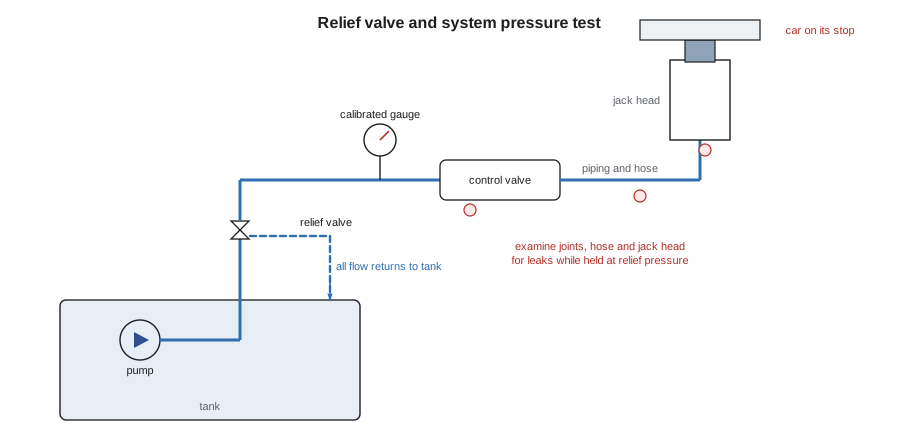
Every hydraulic power unit has a pressure relief valve between the pump and the control valve. Its job is to stop the pump from building pressure without limit if the car is jammed, the valve sticks or the jack reaches its stop. The annual test checks that the relief valve opens at the right pressure and can pass the full output of the pump, and then uses that pressure to test the system. The usual method is to run the car up onto its stop ring or to hold it against a firm stop with the pump running, so that all the pump's flow must go through the relief valve, and to read the pressure on a calibrated gauge at the gauge port. The code limits how high the relief setting may be relative to the working pressure, the pressure needed to run the car up with rated load, so that the jack, piping and fittings are never exposed to more than they were designed for; the jurisdiction's guidance and the inspection guide give the figures and the acceptable range. After the reading, the relief valve is sealed and tagged by the person who set or tested it.
With the pump still running against the relief, the system is held at relief pressure while the mechanic examines the cylinder head, the piping, the valves, the flexible hoses and every fitting for leaks or movement, for the time the code requires. This is the system pressure test. The pump must run long enough for the examination but not so long that the oil overheats; on most units the motor and oil temperature limit the time more than anything else.
# Annual relief valve test record check (Holloway car 2)
working = 2.78        # pressure to run up with rated load, from the acceptance record, MPa
empty = 1.67          # pressure with the empty car, MPa
relief = 3.55         # gauge reading with all pump flow passing the relief valve, MPa
LOW, HIGH = 1.10, 1.50          # acceptable relief range as a multiple of working pressure (guidance used here)
ratio = relief / working
print(f"working {working} MPa, relief {relief} MPa = {ratio:.2f} x working pressure")
if ratio < LOW:
    print("relief too low: the car may not lift rated load reliably; reset and retest")
elif ratio > HIGH:
    print("relief too high: system exposed to excess pressure; reset and retest")
else:
    print("relief setting within the range; seal and tag the valve, hold for the system pressure test")
print(f"empty-car pressure is {100 * empty / working:.0f} % of working: a rise since acceptance can point to binding guides or packing")working 2.78 MPa, relief 3.55 MPa = 1.28 x working pressure relief setting within the range; seal and tag the valve, hold for the system pressure test empty-car pressure is 60 % of working: a rise since acceptance can point to binding guides or packing
Holloway car 2's relief came in at about 1.28 times working pressure, within the range, and the empty-car pressure matched its acceptance record, which told Ray that the guides and packing were not binding. On the Marlowe, the relief valve's seal was found broken and the setting had crept up after someone had adjusted it to stop a car from stalling with a heavy load. That was a finding in two parts: the relief was reset and resealed, and the stalling, which turned out to be a worn pump, went on the repair list.
Cylinders, piping and flexible hoses
The annual examination of the cylinder and piping covers everything that can be seen: the cylinder head and its packing or seals, the exposed cylinder and plunger, the piping and its supports, the valves, and the scavenger pump and drip pan. The oil collected in the drip pan and the oil added to the tank are compared with the oil usage record. Flexible hose and fitting assemblies are examined for damage, abrasion, kinks, bulges and leaks, and are replaced at the intervals the code and the maker set; each assembly carries a tag or marking with its installation or manufacture date so the interval can be checked. A hose without a legible date is replaced, because there is no way to know its age.
Other annual items on a hydraulic elevator include the normal and final terminal stopping devices, which are tested by running the car onto them; the low oil protection, which shuts the pump down and lowers the car if the oil supply is too low to run it up; the pressure switch on units that have one; firefighters' emergency operation and standby power operation; the power door system; and, on roped hydraulics such as Dunmore Square's, the slack rope device that stops the car if a rope goes slack. Each is done to the inspection guide and recorded with its result.
Category 3: the leakage test for buried cylinders
A cylinder buried in the ground cannot be seen, and a slow leak from it can go on for years, contaminating soil and water and, in the worst case, ending with a cylinder failure. The Category 3 test exists for that reason. For cylinders and pistons whose unexposed portions are not protected by a casing and liner that can be monitored, the code requires a test at intervals not exceeding three years to show that the buried part is not leaking. Older single-bottom cylinders were the subject of a Technical Safety BC safety order requiring them to be replaced or brought up to the code's safety requirements, so most remaining buried cylinders in British Columbia now have a safety bulkhead, but many still lack a monitored casing. Holloway car 2 and the Marlowe now have protected cylinders with monitoring pipes, so the test does not apply to them; Birchwood's two cars have cylinders with safety bulkheads but no protective casing, so it does.
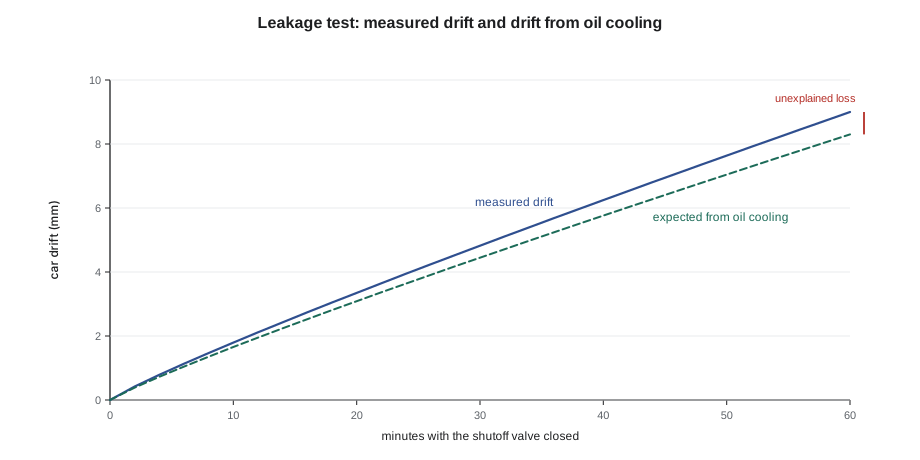
The test itself is a careful drift test. The car is run to a landing, the control valve is closed so that oil can neither enter nor leave the cylinder through the valve, and the car's position is measured against a fixed mark over a long period, commonly an hour or more, with the oil temperature recorded at the start and the end. If the car sinks, either oil is leaving through the valve or through the cylinder, or the oil in the cylinder and piping is cooling and contracting. The temperature reading separates the two: the expected contraction of the oil column is calculated and subtracted from the measured drift, and what remains is unexplained loss. Valve leakage is ruled out by checking the valve separately or by closing a manual shutoff valve close to the cylinder, so that any remaining loss must come from the cylinder.
# Category 3 leakage test, Birchwood car 1: separate oil contraction from unexplained loss
import math
plunger_d = 0.14             # plunger diameter, m
column = 260               # oil volume in cylinder and piping at the test landing, L
t_start, t_end = 31.0, 30.3  # oil temperature at start and end, C
drift = 9.0                 # car drift after 60 min with the manual shutoff valve closed, mm
BETA = 0.0007                # thermal expansion of hydraulic oil per degree (typical value)
area = math.pi * plunger_d ** 2 / 4
expected_volume = column * BETA * (t_start - t_end)                 # oil contraction
expected_drift = expected_volume * 1.0 / area                    # converted to drift (L per m2 gives mm; in3 per in2 gives in)
loss = drift - expected_drift
print(f"measured drift {drift:.1f} mm, expected from cooling {expected_drift:.1f} mm, unexplained {loss:.1f} mm")
lost_volume = loss * area / 1.0
print(f"unexplained oil loss about {lost_volume:.2f} L in 60 min")
print("result:", "no evidence of cylinder leakage" if loss <= 1.5 else "investigate: unexplained loss beyond measurement tolerance")measured drift 9.0 mm, expected from cooling 8.3 mm, unexplained 0.7 mm unexplained oil loss about 0.01 L in 60 min result: no evidence of cylinder leakage
Birchwood car 1's drift was almost entirely explained by the oil cooling after the morning's traffic, with the remainder inside the measurement tolerance, so the test passed and was recorded with all its readings. Ray pointed out what would have happened if the test had been run with no temperature readings: the car had sunk 9 mm (0.35 in) in an hour, which looks alarming until the cooling is accounted for. The reverse mistake is worse: a test run in the morning with oil that is warming up can hide a real leak.
The oil usage record supports the test. A buried cylinder that is leaking will usually show up first as oil being added to the tank with no matching oil in the drip pan or on the pit floor. That was how the Marlowe's old cylinder leak was found in ELV-220, and why every hydraulic program keeps a running record of oil added.
Category 5 tests on hydraulic elevators
Hydraulic elevators with safeties, such as some roped hydraulics, have their safeties and governors tested every five years, as traction elevators do; lesson 7 covers that work. Units with a plunger gripper, a device that clamps the plunger to stop or hold the car if it moves away from a landing or descends too fast, have the gripper tested. Units with an overspeed valve, the rupture valve that closes if the down flow from the cylinder rises above a set value, as it would if a pipe burst, have the valve tested by making the car run down fast enough to trip it; ELV-220 lesson 9 described the Marlowe's nuisance trips after a new valve was set too close to normal speed. Oil buffers, where fitted, are tested as lesson 8 describes. Some freight elevator classes also have a five-year test that the car can level and hold with full load.
Worked problem
Planning the rupture valve test
Dunmore Square's roped hydraulic has a rupture valve rated to close at a down flow corresponding to a car speed somewhat above rated speed. How is the five-year test usually done, and what is recorded?
Show solution
- The car is loaded as the procedure requires and run down from an upper landing.
- The down flow is increased beyond normal, commonly by opening a manual lowering or test valve fully or by the maker's test method, until the valve closes.
- The car must stop and hold within the distance the code and maker allow; the valve is then reset as the maker describes.
- The record shows the load, the method, the car speed or flow at closing, the stopping distance and the reset.
Answer: Run the car down with the specified load, raise the down flow until the valve closes, confirm the stop and hold, reset, and record all the values.
Common mistakes
MistakeReading relief pressure on an uncalibrated gauge.
InsteadUse a gauge with a current calibration certificate and record its identity.
MistakeLeaving the relief valve unsealed after the test.
InsteadSeal and tag the valve so any later adjustment is visible.
MistakeRunning a leakage test without temperature readings.
InsteadRecord oil temperature at start and end and subtract the expected contraction.
MistakeKeeping a flexible hose with no legible date.
InsteadReplace it; its age cannot be checked.
MistakeTreating the oil usage record as optional.
InsteadUnexplained oil loss is often the first sign of a buried leak.
Summary and key terms
- Hydraulic elevators have Category 1 (annual), Category 3 (three-year) and Category 5 (five-year) periodic tests.
- The annual relief valve test reads the pressure with all pump flow passing the relief valve, checks it against the allowed range, and seals the valve.
- The system pressure test holds the system at relief pressure while cylinders, piping, hoses and fittings are examined.
- Unprotected buried cylinders need the three-year leakage test: a drift test with temperature correction and the valve leakage ruled out.
- Five-year tests cover safeties and governors where fitted, plunger grippers, overspeed valves, buffers and some freight level-and-hold tests.
- Every test is recorded with its values; the oil usage record supports the leakage test.
- Relief valve
- The valve that limits pump pressure by returning oil to the tank when the set pressure is reached.
- Working pressure
- The pressure needed to run the car up with rated load.
- System pressure test
- Holding the hydraulic system at relief pressure while it is examined for leaks.
- Category 3 test
- The test at intervals not exceeding three years for unexposed portions of hydraulic cylinders and pistons.
- Drift test
- Measuring car movement over time with the valve closed, to detect leakage.
- Overspeed valve
- A valve that closes when down flow from the cylinder exceeds a set value, also called a rupture valve.
Practice problems
Work each problem on paper first, then reveal the answer to check.
What is the working pressure?
Show answer
The pressure needed to run the car up with rated load.
Why is the relief valve sealed after the test?
Show answer
So any later adjustment can be seen.
Why is oil temperature recorded during a leakage test?
Show answer
Cooling oil contracts and makes the car drift; the expected contraction must be subtracted.
Which cylinders need the Category 3 test?
Show answer
Those whose unexposed portions are not protected by a monitored casing and liner.
What usually shows a buried cylinder leak first?
Show answer
Oil added to the tank with no matching oil in the drip pan or pit.
Lesson quiz · 5 questions
Score 60% or more to complete this lesson.
Create a free account to save your progress, take quizzes and earn a certificate.