
ELV-420 · Lesson 10 of 12 · 21 min
Acceptance inspections and tests
In June, Ashgrove Clinic's twin-post holeless hydraulic had its old door operator and safety edge replaced with a closed-loop operator and a full-height light curtain. Under the code, replacing a door operator with one of a different type and adding new door protection was an alteration, as ELV-410 lesson 11 had sorted out, so the job needed a permit and an acceptance inspection before the car could carry patients again. It was a small job, three days of work, but it followed the same steps as the much larger acceptance at Larchmont East that would end the term. Priya Sandhu ran the paperwork, Ray and Tamsin did the work, and the acceptance was booked with a Technical Safety BC safety officer for the Thursday morning. This lesson covers what acceptance inspections and tests are, when they are required, how a contractor prepares for them and what happens on the day.
When acceptance is required
Section 8.10 of the code requires acceptance inspections and tests for new installations and for alterations, before the equipment is put into service or returned to service. The aim is to show, before anyone rides, that the equipment complies with the code that applies to it: the edition in force for a new installation, and for an alteration the current requirements that the alteration brings in, together with the edition that governs the rest of the equipment. Maintenance, repairs and most like-for-like replacements do not need acceptance inspections, although some replacements of safety-related parts need their own tests, and the authority may ask to witness them. In British Columbia, the contractor applies to Technical Safety BC for an installation or alteration permit before the work, and after the acceptance inspection a safety officer issues or updates the operating permit.
| Kind of work | Acceptance inspection and tests? |
|---|---|
| New installation | yes, full acceptance before first use |
| Alteration (for example a new door operator of a different type, a new controller, a capacity change) | yes, covering the altered parts and the requirements the alteration brings in |
| Repair (restoring a part to working order) | no, but the related tests are repeated after the repair |
| Replacement with an identical part | no, unless the code lists the part for its own test |
| Maintenance and periodic tests | no; recorded in the program |
What the inspection covers
An acceptance inspection follows the inspection guide, ASME A17.2, item by item for the kind of equipment, limited to the altered parts and the affected systems for an alteration. For a new traction elevator it covers the whole installation: the machine room or control spaces, the hoistway, the pit, the car top, the car, the landings, the clearances and runbys, every device and every circuit. The acceptance tests are the most complete tests the equipment will ever have: the car safeties with rated load at rated speed, the governor, oil buffers struck with rated load, the brake with its overload, emergency stopping, ascending car overspeed and unintended movement protection, terminal devices, door systems and protection, firefighters' emergency operation, standby power, emergency communication and lighting, and the car's capacity and data plates. On a hydraulic elevator they include the relief valve and system pressure test, the cylinder and piping, the overspeed valve and the low oil protection.
Ashgrove's alteration needed only part of that list: the door operator's closing time, force and kinetic energy; the light curtain's coverage and response; the reopening and nudging functions; the interlocks and car door contact; the door's behaviour during firefighters' operation; the emergency communication and lighting, which share the car's new wiring; and a check that the new equipment's certificates, wiring diagrams and data plates were on site. The safeties, buffers and hydraulic system were not touched and were not retested, although the inspector was free to look at anything.
Preparing for the inspector
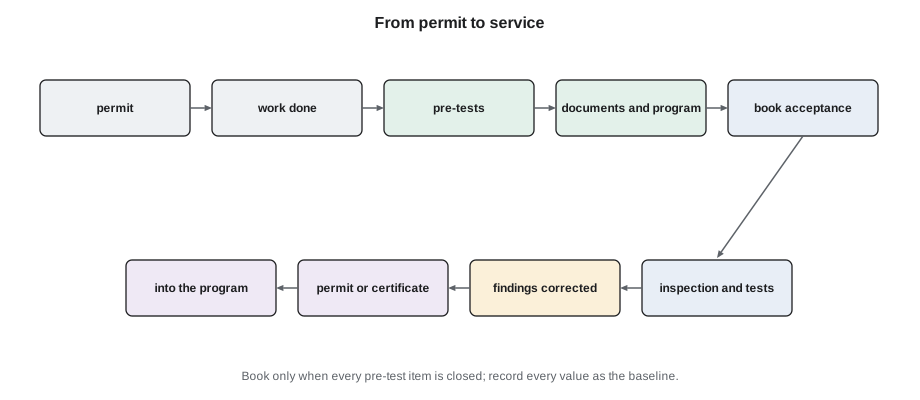
The contractor's job is to arrive at the acceptance with equipment that is finished, tested and documented, so that the inspector's visit confirms rather than discovers. Northcrest's practice was to run every acceptance test itself first, with the same procedure, instruments and records the inspector would see, and to fix whatever failed before booking. Priya called these pre-tests, and she would not book an acceptance until the pre-test sheet was complete with no open items. The documents were assembled at the same time: the permit, the product certificates for the door operator and the light curtain, the maker's installation and adjustment instructions, the updated wiring diagrams, the new data plate showing the door closing time, and the updated maintenance control program with the new door tasks. A clean machine room, a clean pit and a tidy car top help too; an inspector who has to climb over packaging to reach the controller starts the day looking for problems.
# Acceptance readiness for the Ashgrove door alteration: every item must be closed before booking
items = [  # (item, status, who)
    ("permit posted on site",                              "closed", "Priya"),
    ("door operator and light curtain certificates on site", "closed", "Priya"),
    ("wiring diagrams updated and on site",                "closed", "Ray"),
    ("door closing time and force measured, all landings", "closed", "Tamsin"),
    ("kinetic energy calculated from mass and speed",      "closed", "Tamsin"),
    ("light curtain coverage and response checked",        "closed", "Tamsin"),
    ("nudging and reopening checked",                      "open",   "Ray"),
    ("firefighters' operation door behaviour checked",     "closed", "Ray"),
    ("emergency phone and light retested on new wiring",   "closed", "Tamsin"),
    ("new data plate with minimum close time fitted",      "open",   "Priya"),
    ("maintenance program updated with door tasks",        "closed", "Priya"),
    ("machine room, pit and car top cleaned",              "closed", "Tamsin"),
]
open_items = [(i, w) for i, s, w in items if s != "closed"]
print(f"{len(items) - len(open_items)} of {len(items)} items closed ({100 * (len(items) - len(open_items)) / len(items):.0f} %)")
for i, w in open_items:
    print(f"  OPEN: {i} ({w})")
print("ready to book" if not open_items else "not ready: close all items, then book the acceptance")10 of 12 items closed (83 %) OPEN: nudging and reopening checked (Ray) OPEN: new data plate with minimum close time fitted (Priya) not ready: close all items, then book the acceptance
Two items were still open on the Tuesday afternoon. The nudging function, which closes the doors slowly with a buzzer if they are held open too long, had been set up but not yet checked against the new operator's settings; and the new data plate had been ordered with the wrong closing time engraved on it. Ray checked the nudging that evening, and Priya had the plate made again at a local engraver. Both were closed by Wednesday noon, and the acceptance went ahead on Thursday as booked.
One pre-test item needs a calculation rather than a reading: the door's kinetic energy. The code limits the energy of a closing door so that a door striking a person does not hurt them, with a lower limit when there is no reopening device and a higher one when there is. The energy depends on the moving mass of the door system, which the operator's maker gives or which is weighed, and on the door's speed. Tamsin worked it from the average closing speed over the code zone, as ELV-320 lesson 5 had shown, using the new operator's settings at Ashgrove.
# Ashgrove car door: average kinetic energy while closing, checked against the code's average limit
mass = 105             # moving mass of car door, hall door and linkages, kg (maker's data and scale)
travel = 0.84           # door travel measured over the timing zone, m
time = 2.6            # measured closing time over that zone, s
LIMIT = 10          # average kinetic energy limit with a working reopening device, J
v = travel / time
ke = 0.5 * mass * v ** 2
print(f"average speed {v:.2f} m/s, average kinetic energy {ke:.1f} J (limit {LIMIT} J)")
min_time = travel / ((2 * LIMIT  / mass) ** 0.5)
print(f"shortest closing time that keeps within the limit: {min_time:.1f} s; data plate should show at least this")average speed 0.32 m/s, average kinetic energy 5.5 J (limit 10 J) shortest closing time that keeps within the limit: 1.9 s; data plate should show at least this
The new operator's setting gave a comfortable margin, and the minimum closing time from the calculation, rounded up, was what the new data plate had to show; the misprinted plate had shown a shorter time, which was why Priya would not accept it.
On the day
On acceptance day the inspector usually starts with the documents and a walk around the equipment, then asks for the tests to be run, one at a time, while watching and taking readings. The contractor's mechanics operate the equipment; the inspector does not. The inspector may ask for any test to be repeated, for any cover to be removed, or for any measurement to be taken again with the inspector's own instrument. Ray's advice to Tamsin was simple: answer what is asked, show the reading, do not argue about a finding on the spot, and write down every item the inspector raises in the inspector's own words. A disagreement about a code interpretation is settled later, in writing, as ELV-410 lesson 3 described; arguing in the car only uses up the inspector's patience.
At Ashgrove, the inspector started with the paperwork, read the door operator certificate and the data plate, and then asked Tamsin to run the door closing force test at the ground floor and the second floor with her force gauge while he watched the reading. He measured the closing time himself with his own stopwatch at each landing, compared it with the plate, and then tested the light curtain with a test rod at several heights, checked that the doors reopened, and held them until nudging began. He checked firefighters' Phase II door operation with Ray in the car. Then he found the one thing Northcrest had missed: the car's emergency light, retested on the new wiring, ran for well over the required time, but its battery was not labelled with its installation date. The finding was written up as minor, to be corrected within thirty days, and did not stop the car returning to service.
| Kind of finding | Typical outcome |
|---|---|
| Item that makes the equipment unsafe | acceptance not passed; equipment stays out of service until corrected and reinspected |
| Item that does not comply but is not immediately hazardous | acceptance passed with the item to be corrected by a date, often with written confirmation |
| Missing document or plate | corrected by a date, or acceptance held until it is provided |
| Question of interpretation | settled in writing with the authority; the decision is kept with the records |
After the acceptance
Once the acceptance is passed, the equipment goes into service under its maintenance control program, and the acceptance records become part of the unit's history. The test values from the acceptance are the baseline that every later periodic test will be compared with: the governor tripping speed, the safety stopping distance, the brake slide, the door closing force and time. That is why the acceptance record should be as complete as any periodic test record, with every value, instrument and person recorded. For a new installation, the program's first year deserves special attention, because new equipment has its own early problems: settling rails, stretching ropes or belts, adjustments that drift, and software settings that need refining after the building fills with people.
Ashgrove's acceptance record went into the clinic's binder and Northcrest's system the same day, along with the minor finding and its correction a week later, when Tamsin labelled the battery and sent a photograph and a note to the inspector. Priya closed the permit when the inspector confirmed the correction.
Worked problem
Is it ready to book?
A contractor plans to book the acceptance for a new hydraulic car. The pre-tests are complete and passed, but the relief valve has not been sealed, the updated wiring diagrams are still at the office, and the maintenance program has not been written. Should the acceptance be booked?
Show solution
- Pre-tests passing is necessary but not enough.
- The relief valve must be sealed and tagged after its setting is confirmed.
- The wiring diagrams for the installed equipment must be on site.
- The equipment will enter service under its maintenance program, so the program must exist before acceptance.
Answer: No. Seal the relief valve, put the wiring diagrams on site and write the program, then book.
Common mistakes
MistakeBooking the inspector to find out what does not work.
InsteadPre-test everything with the same procedures and instruments first.
MistakeTreating an alteration like maintenance.
InsteadAlterations need a permit, acceptance tests and the authority's acceptance.
MistakeArguing a finding on the spot.
InsteadRecord the finding as stated and settle interpretations in writing.
MistakeRecording only pass or fail at acceptance.
InsteadRecord every value; they are the baseline for all later tests.
MistakeLeaving packaging and debris in the machine room or pit.
InsteadClean before the inspection; it shows the work is finished.
Summary and key terms
- Section 8.10 requires acceptance inspections and tests for new installations and alterations before the equipment is used.
- The inspection follows the inspection guide; for an alteration it covers the altered parts and the requirements the alteration brings in.
- The contractor pre-tests everything, assembles certificates, wiring diagrams, data plates and the program, and books only when nothing is open.
- On the day, the contractor's mechanics run the tests while the inspector watches and measures.
- Findings range from unsafe items that stop the acceptance to minor items corrected by a date.
- Acceptance values become the baseline for later periodic tests, and the unit enters its maintenance program.
- Acceptance inspection
- The inspection by the authority before new or altered equipment is put into service.
- Acceptance tests
- The tests carried out at acceptance, the most complete tests the equipment receives.
- Pre-test
- The contractor running all acceptance tests itself before booking the inspection.
- Data plate
- A plate on the equipment showing information the code requires, such as capacity, speed or door closing time.
- Baseline
- The acceptance test values against which later periodic tests are compared.
- Permit
- The authority's permission to carry out an installation or alteration.
Practice problems
Work each problem on paper first, then reveal the answer to check.
Which kinds of work need an acceptance inspection?
Show answer
New installations and alterations.
What is a pre-test?
Show answer
The contractor running all the acceptance tests itself before booking the inspection.
Who operates the equipment during an acceptance?
Show answer
The contractor's mechanics, while the inspector watches and measures.
What should a mechanic do with a finding they disagree with?
Show answer
Record it as the inspector stated it and settle the interpretation later in writing.
Why are acceptance test values important later?
Show answer
They are the baseline for every later periodic test.
Lesson quiz · 5 questions
Score 60% or more to complete this lesson.
Create a free account to save your progress, take quizzes and earn a certificate.