
ELV-420 · Lesson 7 of 12 · 21 min
Safety and governor tests with load
Tillicum car 1's five-year test was booked for a Saturday in May, three weeks before the modernization crew was due to start. Lena had considered skipping it, but the old car would carry residents for at least two more months, and its safeties and governor would stay in service after the modernization; the five-year test was owed and would be done. Ray ran the day, with Tamsin, an apprentice named Jonah Sweeney from another route and a truck of test weights from the Northcrest yard. Moira Kessler had said she would come to watch, in her new role at the training centre, because few apprentices see a full-load safety test on a 1962 car. This lesson covers the five-year tests of governors and car safeties: preparing the weights, testing the governor, running the safety test with load, measuring and judging the results and putting everything back.
What is being tested
The governor and the car safeties together stop a car that is overspeeding downward. The governor is driven by its own rope, which is attached to the car, so the governor sheave turns at a speed proportional to the car's. If the car exceeds the governor's tripping speed, the governor first opens its overspeed switch, cutting power to the machine and setting the brake, and then, if the car keeps accelerating, its jaws grip the governor rope. The rope stops while the car keeps moving, and the pull on the rope operates the safeties on the car, which grip the rails and bring the car to a stop. Tillicum car 1 had a flyball governor with a rope-gripping jaw and Type B wedge-clamp safeties, which apply a controlled, increasing grip and stop the car over a distance rather than instantly. ELV-320 covered how these devices work; the five-year test proves they still do.
Three things are measured. The governor's tripping speed must be within the range the code allows for the car's rated speed: at least 115 % of rated speed and no more than the maximum in the code's table, which for a car rated at 1.0 m/s (200 ft/min) is about 1.42 m/s (280 ft/min), with the overspeed switch set to open below the tripping speed. The governor's pull-through, the force with which a tripped governor holds its rope, must be enough to set the safeties and must be within the maker's range. And the car safeties, tripped by the governor with rated load in the car at rated speed, must stop the car within the minimum and maximum distances the code gives for the governor tripping speed, with the platform left within the allowed tilt.
Test weights
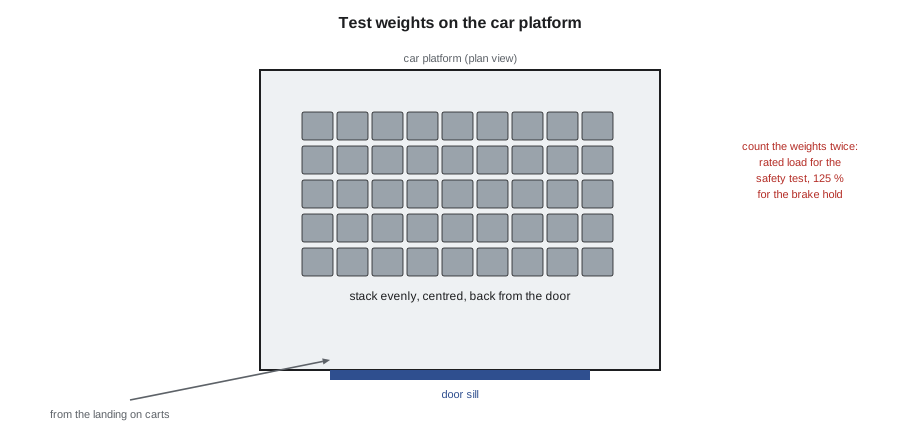
Rated-load tests need rated load in the car, and for some brake tests more. Northcrest kept a yard of certified test weights: cast iron blocks of 25 kg each, stamped with their mass and checked against a calibrated scale every year, stacked on pallets with their count. Moving a car's rated load into the car is hard physical work, and the plan for it matters as much as the plan for the test. The weights arrive at the main landing, are moved into the car on carts or by hand, and are stacked evenly on the platform, close to its centre and away from the doors, so that the load does not tilt the car or strain the guides. The car's rated load and the number of weights are checked twice: overloading a 1962 car with a 64-year-old safety is not a test, it is an accident.
# Test weight plan for Tillicum car 1: rated load for the safety test, 125 % for the brake hold
import math
rated = 1135                  # rated load, kg
weight = 25                     # each certified test weight, kg
crew = 3                         # people moving weights
seconds_per_weight = 150         # truck at the curb to stacked in the car, per person, average
for label, factor in (("rated load (safety test)", 1.00), ("125 % (brake hold test)", 1.25)):
    target = rated * factor
    n = math.ceil(target / weight)
    load = n * weight
    minutes = n * seconds_per_weight / crew / 60
    print(f"{label:26s}: {n} weights = {load:,.0f} kg ({100 * load / rated:.0f} % of rated), about {minutes:.0f} min to load")
print("unloading takes about the same again; plan two loadings if the brake test follows the safety test")rated load (safety test) : 46 weights = 1,150 kg (101 % of rated), about 38 min to load 125 % (brake hold test) : 57 weights = 1,425 kg (126 % of rated), about 48 min to load unloading takes about the same again; plan two loadings if the brake test follows the safety test
The plan showed that the crew would spend nearly as much time moving weights as running tests, which is true of most five-year test days. Ray arranged the day so that the governor tests came first, while the car was still empty, then the weights went in once for the safety test and the additional weights were added for the brake hold test in lesson 8, so that the full load came out only once.
Testing the governor
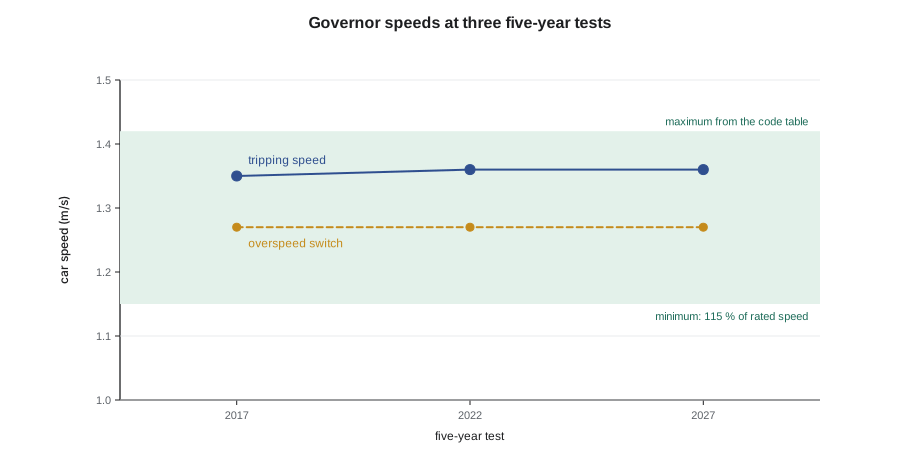
Tillicum's governor was tested in the machine room. Ray disconnected the governor rope from its normal path as the maker's procedure describes, so that the governor could be turned without moving the car, and drove the governor sheave with a variable-speed test drive while Tamsin read its rim speed with a calibrated tachometer. The speed was raised slowly until the overspeed switch opened, and the reading noted; then raised further until the jaws tripped, and that reading noted. The test was done three times, resetting the governor each time. The tachometer readings were converted from sheave rim speed to car speed, which on a 1:1 governor rope drive are the same. Finally, with the governor tripped, the pull-through was measured by pulling the rope through the jaws with a calibrated tension gauge and reading the force.
# Governor test analysis, Tillicum car 1 (rated 1.0 m/s)
rated = 1.0
MAX_TRIP = 1.42        # maximum tripping speed from the code table for this rated speed, m/s
MIN_TRIP = 1.15 * rated  # minimum tripping speed
switch = [1.27, 1.28, 1.27]          # overspeed switch opening speeds, three runs, m/s
trip = [1.36, 1.37, 1.36]            # jaw tripping speeds, three runs, m/s
pull = 1330            # pull-through with the governor tripped, N
PULL_RANGE = (1100, 1600)   # maker's range, N
avg = lambda xs: sum(xs) / len(xs)
print(f"trip speeds {trip} -> average {avg(trip):.2f} m/s (allowed {MIN_TRIP:.2f} to {MAX_TRIP:.2f})")
print(f"switch speeds {switch} -> average {avg(switch):.2f} m/s, opens {avg(trip) - avg(switch):.2f} m/s before the trip")
print(f"spread between runs {max(trip) - min(trip):.2f} m/s (a large spread suggests sticking parts)")
ok_trip = MIN_TRIP <= min(trip) and max(trip) <= MAX_TRIP
ok_switch = max(switch) < min(trip)
ok_pull = PULL_RANGE[0] <= pull <= PULL_RANGE[1]
print(f"pull-through {pull} N within {PULL_RANGE}: {ok_pull}")
print("governor:", "pass" if ok_trip and ok_switch and ok_pull else "fail - find the cause before retesting")trip speeds [1.36, 1.37, 1.36] -> average 1.36 m/s (allowed 1.15 to 1.42) switch speeds [1.27, 1.28, 1.27] -> average 1.27 m/s, opens 0.09 m/s before the trip spread between runs 0.01 m/s (a large spread suggests sticking parts) pull-through 1330 N within (1100, 1600): True governor: pass
Car 1's governor passed, tripping at about 1.36 m/s (268 ft/min), close to the value recorded five years earlier, with its switch opening well before the jaws and a tight spread between runs. Moira pointed out the most useful number on the sheet: the trip speed had hardly changed in five years, which meant the governor's flyweights and springs were not sticking or weakening. A trip speed creeping upward from test to test is a warning even while it is still inside the range, because a governor that trips too late lets the car build more speed before the safeties set.
The safety test with rated load
With the governor reconnected and the weights in the car, the safety test began. The crew cleared the hoistway and the pit, and the car was run to an upper floor. The rails were marked with chalk lines at a known position so that the stopping distance could be measured from the slide marks the safeties would leave. Ray ran the car down at rated speed on normal operation, with the overspeed switch bypassed only as the maker's procedure allows for the test, and Jonah, in the machine room, tripped the governor jaws by hand as the car passed the marked zone, as the procedure described. The machine stopped driving, the governor rope stopped, and the safeties set with a loud grinding stop.
The measurements came next, in the order Ray insisted on. First, the car stayed where it was: no one moved it until the readings were done. The slide marks on each rail were measured from where the safety jaws had started to grip to where they stopped, giving the stopping distance on each side. The platform's tilt was measured with a level across the car floor. Then the safeties and rails were examined for damage, the safety jaws were released by running the car up as the maker describes, the governor was reset, and the rail faces were dressed with a file and stone to remove the gouges and ridges the jaws had left, because a damaged rail face makes the guides run rough and can affect the next safety application.
# Safety test result, Tillicum car 1, rated load at rated speed, tripped by the governor
v_trip = 1.36                 # car speed at governor trip, m/s
marks = (0.18, 0.17)          # stopping distance from slide marks, left and right rails, m
LIMITS = (0.1, 0.4)         # minimum and maximum distances for this tripping speed, from the program (illustrative), m
tilt = 1.4                 # platform out of level after the stop, percent
TILT_LIMIT = 3.0              # limit used in the program, percent
G = 9.81
s = sum(marks) / len(marks)
v = v_trip * 1.0            # to m/s
s_m = s * 1.0               # to m
decel = v ** 2 / (2 * s_m)
print(f"stopping distance {s:.3f} m (left {marks[0]}, right {marks[1]}), limits {LIMITS[0]} to {LIMITS[1]}")
print(f"average deceleration {decel:.2f} m/s2 = {decel / G:.2f} g")
print(f"left-right difference {abs(marks[0] - marks[1]):.3f} m; platform tilt {tilt} % (limit {TILT_LIMIT} %)")
ok = LIMITS[0] <= s <= LIMITS[1] and decel / G <= 1.0 and tilt <= TILT_LIMIT
print("safety test:", "pass" if ok else "fail")stopping distance 0.175 m (left 0.18, right 0.17), limits 0.1 to 0.4 average deceleration 5.28 m/s2 = 0.54 g left-right difference 0.010 m; platform tilt 1.4 % (limit 3.0 %) safety test: pass
The car stopped in a little under 0.2 m (7 in) with an average deceleration of about half a g and the platform barely out of level, which was a pass. The left and right marks were close, showing that both safety jaws were gripping evenly. Moira asked the apprentices what an uneven result would have meant: one side setting late, from a worn linkage, a sticking jaw or a misadjusted gap, which could twist the car on its guides. That would have been a failure even if the average distance had been inside the limits.
Safety tests also have a counterweight side where counterweight safeties are fitted, which is required when there is occupied space below the pit. Tillicum's pit sat on solid ground, so car 1 had none; Quayside's counterweight safeties were tested in ELV-320 because of the storage room beneath its pit.
Putting it all back
After the tests, the governor rope was examined where the jaws had gripped it, because a tripped governor can flatten or damage the rope at the grip point; the rope was found in good condition and its position marked. The overspeed switch was confirmed reset, every jumper and test connection was removed and counted, the governor's seals were renewed, and the car was run on inspection through the hoistway to confirm that the safeties were fully released and nothing had shifted. Then the weights came out, the car was checked out and returned to service, and the record was completed with every reading, the tachometer and gauge identities and calibration dates, the people present and Moira's name as observer.
Worked problem
A trip speed that creeps upward
At three successive five-year tests, Seaview car 1's governor tripped at 92 %, 95 % and 98 % of the table maximum. It still passes. What should the mechanic recommend?
Show solution
- The governor is within the range, so the test passes.
- The steady upward trend suggests stiffening or wear in the governor's moving parts.
- Clean, examine and service the governor as the maker describes now, and retest it at the next annual visit rather than waiting five years.
- Record the trend and the recommendation, and plan replacement if the speed keeps rising.
Answer: Pass the test but act on the trend: service the governor, retest early and plan replacement if it continues to rise.
Common mistakes
MistakeMoving the car before measuring the slide marks.
InsteadLeave the car where it stopped until the distances and tilt are measured.
MistakeLoading test weights unevenly or against the door.
InsteadStack them evenly, centred on the platform and back from the door.
MistakeTesting the governor once.
InsteadTrip it at least three times and look at the spread and the trend.
MistakeLeaving gouged rail faces after a safety test.
InsteadDress the rails where the jaws gripped.
MistakeForgetting to examine the governor rope at the grip point.
InsteadA tripped governor can damage its rope; examine it after every trip.
Summary and key terms
- The governor's tripping speed must be at least 115 % of rated speed and no more than the code table's maximum, with the switch opening first.
- Pull-through is measured with the governor tripped and compared with the maker's range.
- The five-year safety test uses rated load at rated speed, tripped by the governor; stopping distance is measured from slide marks on both rails.
- Results are judged on distance, deceleration, left-right balance and platform tilt; trends between tests are as important as single results.
- Test weights are certified, counted twice and stacked evenly; loading usually takes longer than testing.
- After the test: examine the governor rope and rails, dress the rails, reset and seal, remove jumpers, check out and record everything.
- Governor
- A device driven by a rope from the car that opens a switch and then grips its rope if the car overspeeds downward.
- Type B safety
- A car safety that applies an increasing grip and stops the car over a distance.
- Slide marks
- Marks left on the rails by the safety jaws, used to measure stopping distance.
- Test weights
- Certified weights used to load a car for tests.
- Tachometer
- An instrument for measuring rotational or rim speed, used to find governor tripping speed.
- Rail dressing
- Filing and stoning the rail faces after a safety test to remove gouges.
Practice problems
Work each problem on paper first, then reveal the answer to check.
What is the minimum governor tripping speed?
Show answer
115 % of the car's rated speed.
Why test the governor three times?
Show answer
To see the spread between runs, which shows sticking parts, and to get a reliable average.
What is measured after a safety test?
Show answer
Stopping distance on each rail from the slide marks, and platform tilt.
Why are the left and right stopping distances compared?
Show answer
A large difference means one jaw is setting late, which can twist the car.
What must be done to the rails after a safety test?
Show answer
Dress the faces where the jaws gripped.
Lesson quiz · 5 questions
Score 60% or more to complete this lesson.
Create a free account to save your progress, take quizzes and earn a certificate.