
ELV-420 · Lesson 2 of 12 · 20 min
Maintenance control programs
Hugh Mbeki came to the Northcrest shop on Tamsin's second Monday with a box of binders and a laptop. He was the company's maintenance quality manager, a former route mechanic who now spent his time auditing routes, training mechanics on the paperwork and answering for the company when an authority asked hard questions. “Every unit you touch has a maintenance control program,” he told her. “It is the contractor's written promise of what will be done to that elevator, how often, by what procedure, and where the proof is kept. If the work is not in the program, the inspector will say it is not being done. If it is in the program and not in the records, the inspector will say the same thing.” He gave her the binder for Larchmont Residences and asked her to read it end to end before her next visit there. This lesson covers what a maintenance control program is, what the code requires it to contain, and how its records are kept.
What the code requires
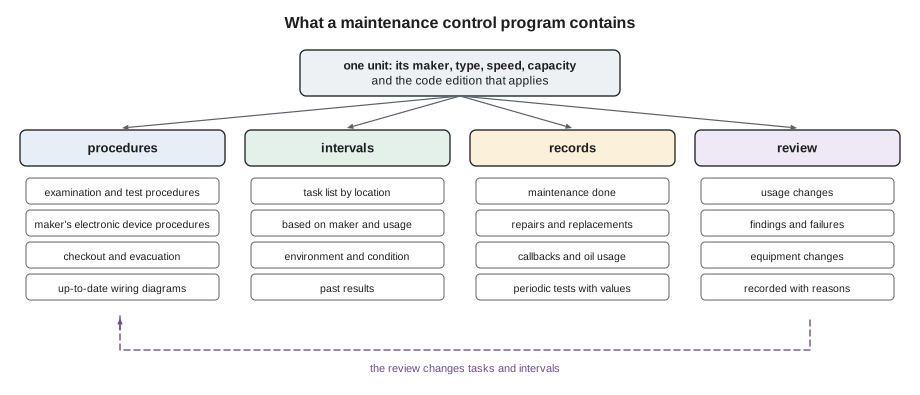
Section 8.6 requires a written maintenance control program for each unit, specific to that unit, which is kept on site or is otherwise available to the mechanics and the authority. The program sets out the examinations, maintenance and tests to be done and the intervals at which they are done. The intervals are not chosen freely. They must take account of the maker's procedures and recommendations, the age, condition and accumulated wear of the equipment, its design and the quality of its parts, the usage, the environment it works in, and the results of past maintenance and tests. A car that runs four hundred trips a day in a hospital needs a different program from the same model in a quiet apartment building, and a program that ignores the difference does not meet the code. The program must also include the procedures for the periodic tests required by Part 8, and for any tests the maker or the code requires for particular devices.
Several kinds of procedure must be in the program or available on site because a mechanic cannot work safely without them. They include the maker's procedures for testing and adjusting devices that use software or electronic safety systems, procedures for checking out the equipment and returning it to service after work, procedures for unique or product-specific tests, procedures to follow after a loss of traction or a safety application, and procedures for evacuating passengers. Up-to-date wiring diagrams must also be kept on site, because a mechanic tracing a fault on a controller cannot rely on memory or a diagram for a different job number.
The task list
The heart of the program is the task list. Each task names a component or device, what is to be done to it, the procedure or reference, and the interval. A typical traction elevator program has between a hundred and two hundred tasks: examine the brake and measure its lining, lubricate the rails if they are oiled, clean and examine the car door sill and tracks, check the door closing force and time, examine the governor and its rope, examine the suspension means and record its condition, test the car emergency light and the emergency communication, and so on through the machine, the control space, the hoistway, the car and the landings. Many contractors organize the list by location, so that a mechanic working through the machine room does all the machine room tasks due that month before moving to the car top, which saves time and keeps people out of the hoistway as much as possible.
| Task (Larchmont car 1) | Location | Interval | Reference |
|---|---|---|---|
| Examine machine and brake, record brake lining condition | control space and hoistway | 1 month | maker's procedure |
| Check suspension belt monitoring system status | controller | 1 month | maker's procedure |
| Examine belts and terminations, record findings | car top | 6 months | A17.6 and maker |
| Clean and examine car and hall door sills and tracks | car and landings | 1 month | maker's procedure |
| Measure door closing force and time | car | 6 months | code power door rules |
| Test emergency communication and car emergency light | car | 1 month | code emergency rules |
| Examine governor and governor rope in the hoistway | car top and pit | 3 months | maker's procedure |
| Examine pit, buffers, compensation and pit equipment | pit | 3 months | code and maker |
| Category 1 periodic tests | all | 12 months | Part 8 and inspection guide |
| Category 5 periodic tests | all | 5 years | Part 8 and inspection guide |
Tamsin noticed that several of Larchmont's intervals were shorter than the maker's recommendation. Hugh explained why: the program had been reviewed after the car's first winter, when a belt monitor trip in cold weather (from ELV-230) and a cracked hall door gib (from ELV-320) showed that the building's heavy furniture traffic and cold lobby were harder on the car than the maker had assumed. The program is a living document. When usage changes, when findings show unexpected wear, or when equipment is replaced or altered, the intervals and tasks must be reviewed and changed, and the change recorded.
Scheduling the tasks
Each task's interval and the month it was last done decide when it is next due, and each month's visit is built from the tasks that fall due. Most contractors now do this with software, but the logic is simple enough to write out, and Hugh asked Tamsin to do it for Larchmont so that she would understand what the software was doing. Some tasks also carry a usage factor: on a heavily used car, door and brake tasks come round more often.
# Build a 12-month schedule from a task list: (task, interval in months, month last done, heavy-use task?)
tasks = [
    ("machine and brake examination", 1, 12, False),
    ("belt monitor status check",     1, 12, False),
    ("door sills and tracks",         1, 12, True),
    ("door force and time",           6, 9,  True),
    ("belts and terminations",        6, 10, False),
    ("governor and governor rope",    3, 11, False),
    ("pit and buffers",               3, 10, False),
    ("emergency light and phone",     1, 12, False),
    ("Category 1 tests",             12, 4,  False),
]
HEAVY_USE = True     # Larchmont: heavy furniture traffic, so heavy-use tasks run at half interval (at least 1 month)
months = ["Jan", "Feb", "Mar", "Apr", "May", "Jun", "Jul", "Aug", "Sep", "Oct", "Nov", "Dec"]

def due_months(interval, last, heavy):
    if heavy and HEAVY_USE:
        interval = max(1, interval // 2)
    m, out = last, []
    while True:
        m += interval
        if m > 24:
            return out
        if 13 <= m <= 24:
            out.append(m - 12)

plan = {m: [] for m in range(1, 13)}
for name, interval, last, heavy in tasks:
    for m in due_months(interval, last, heavy):
        plan[m].append(name)
for m in (1, 3, 4, 6):
    print(f"{months[m - 1]}: {len(plan[m])} tasks -> " + "; ".join(plan[m]))
print("task count per month:", [len(plan[m]) for m in range(1, 13)])Jan: 5 tasks -> machine and brake examination; belt monitor status check; door sills and tracks; pit and buffers; emergency light and phone Mar: 5 tasks -> machine and brake examination; belt monitor status check; door sills and tracks; door force and time; emergency light and phone Apr: 7 tasks -> machine and brake examination; belt monitor status check; door sills and tracks; belts and terminations; pit and buffers; emergency light and phone; Category 1 tests Jun: 5 tasks -> machine and brake examination; belt monitor status check; door sills and tracks; door force and time; emergency light and phone task count per month: [5, 5, 5, 7, 5, 5, 5, 5, 5, 6, 5, 5]
The schedule shows the uneven months that a mechanic plans around. April carries the Category 1 tests as well as the regular tasks, so Ray booked a longer visit and a second person that month. Spreading the six-month and three-month tasks so they do not all land together is part of writing a good program; a schedule that puts every big job in one month will be done badly or late.
The records
A program without records proves nothing. Section 8.6 requires records of the maintenance done, of repairs and replacements, of callbacks or trouble calls with their causes and corrective action, of oil usage on hydraulic elevators, and of the periodic tests with their results. The records must show who did the work and when, and they must be available to the authority. The test records must include the actual values measured, not just a tick: a governor test record with no tripping speed, or a relief valve test with no pressure, is not a test record.
Technical Safety BC's directive on maintenance record requirements spells out how this works in British Columbia. Each record must show the site and unit, the contractor and its licence number, the mechanic and their certificate number, the date, each task with its interval and code reference, and confirmation that it was completed. Test records must show the code requirement, the date, who did the test and all the recorded values, including charts, and must note any alternative test method used. The contractor keeps both a hard copy and an electronic version, one of which is the primary record with full detail and must be viewable on site; instructions for finding the records, and for requesting the electronic version, must be posted at the controller. Records are kept for at least five years, and the electronic version must be given to the owner or to Technical Safety BC on request.
| Record | What it must show |
|---|---|
| Maintenance record | unit, date, mechanic, tasks done with their intervals and references |
| Repair and replacement record | what was repaired or replaced, why, with what part, by whom |
| Callback log | date and time, complaint, cause found, corrective action, time back in service |
| Oil usage record (hydraulic) | oil added, date, running total; unexplained loss is investigated |
| Periodic test record | code requirement, date, who tested, all measured values, method used |
| Program review record | what changed in the program, when and why |
Reading a program as an inspector does
Hugh gave Tamsin the four questions he asks of every program, because they are the questions the authority will ask. Is it specific to this unit, or a generic list copied from another job? Are the intervals justified by the maker, the usage and the history, and have they been reviewed when those changed? Do the records show every task done at its interval, with the tests carrying real values? And do the equipment and the records agree, or does the clean log sit beside a dirty pit and a brake worn past its limit? Tamsin read the Larchmont binder with those questions and found two things to raise: the belt examination task referred to the maker's procedure by a revision number that the maker had since replaced, and the oil usage page for the hydraulic buffer was blank because nobody had thought of the buffer as a place where oil is used. Hugh was pleased with both. The first was a document control problem; the second turned out to matter in lesson 8.
Worked problem
Is an interval justified?
Seaview Medical's two gearless cars run about 600 trips a day each. Their program sets door track cleaning every two months, copied from a quiet office building on another route. The callback log shows nine door-related callbacks on the two cars in six months. What should happen?
Show solution
- The interval does not reflect the usage, and the history shows the result.
- Review the door tasks: shorten track cleaning to monthly or more often, and add an examination of rollers and gibs.
- Record the change and the reason in the program review record.
- Watch the callback log over the following months to confirm the change worked.
Answer: Shorten the door task intervals to match the heavy usage, record the review and check the callback trend afterwards.
Common mistakes
MistakeCopying a generic task list between units.
InsteadThe program must be specific to the unit, its maker, usage, environment and history.
MistakeRecording tests without values.
InsteadTest records must include every measured value and the method used.
MistakeNever changing the program.
InsteadReview it when usage, findings or equipment change, and record the review.
MistakeKeeping wiring diagrams for a different job number.
InsteadUp-to-date wiring diagrams for the actual equipment must be on site.
MistakeForgetting small items such as buffer oil or emergency lighting.
InsteadEvery task and record the code requires belongs in the program, including the minor ones.
Summary and key terms
- Section 8.6 requires a written maintenance control program specific to each unit, available on site.
- Intervals must reflect the maker's procedures, the equipment's age and condition, usage, environment and past results, and must be reviewed when these change.
- The program includes test procedures, maker's procedures for electronic safety devices, checkout and evacuation procedures, and up-to-date wiring diagrams.
- Records cover maintenance, repairs and replacements, callbacks, oil usage and periodic tests with their values, and are kept for at least five years.
- Technical Safety BC requires primary and secondary records, one viewable on site, with posted instructions at the controller.
- Maintenance control program
- A written, unit-specific program of examinations, maintenance and tests with their intervals, procedures and records.
- Task list
- The list of maintenance tasks in a program, each with its component, action, reference and interval.
- Interval
- The time between repeats of a task, set from the maker, usage, environment, condition and history.
- Callback log
- The record of unscheduled calls, with the complaint, cause and corrective action.
- Program review
- A recorded change to a program after a change in usage, findings or equipment.
- Checkout procedure
- The procedure for confirming that equipment is safe before returning it to service after work.
Practice problems
Work each problem on paper first, then reveal the answer to check.
What must a maintenance control program take into account when setting intervals?
Show answer
The maker's procedures, the equipment's age, condition and wear, its design, usage, environment and the results of past maintenance and tests.
Name four kinds of maintenance records.
Show answer
Maintenance records, repair and replacement records, callback logs, oil usage records and periodic test records.
How long are maintenance records kept?
Show answer
At least five years.
Why must wiring diagrams on site be up to date?
Show answer
A mechanic tracing a fault needs diagrams for the actual equipment and its changes.
When must a program be reviewed?
Show answer
When usage, findings, the equipment or the maker's procedures change.
Lesson quiz · 5 questions
Score 60% or more to complete this lesson.
Create a free account to save your progress, take quizzes and earn a certificate.