
ELV-410 · Lesson 8 of 12 · 22 min
Electrical requirements and the electrical code
Priya's electrical drawings for Tillicum car 1 showed the supply from the building's main switchboard to the penthouse, a new mainline disconnect, the new controller and drive, the car lighting circuit, the hoistway and car top wiring, and the connections to the fire alarm system. Before the drawings went out, she asked Tamsin to check them against two books at once: the elevator code and the Canadian Electrical Code, as adopted in British Columbia (National Electrical Code, as adopted locally). “The elevator code tells you what the elevator's control system must do,” Priya said. “The electrical code tells you how it is wired and protected. An elevator job that satisfies one and not the other fails the inspection just the same.” This lesson covers the electrical requirements that sit in each code, how they divide the work, and how they applied to the Tillicum package.
Two codes, one installation
The elevator code covers the design and performance of the elevator's electrical equipment: what the control and operating circuits must do, which electrical protective devices must open the safety circuit, how the system must react to ground faults, single failures and loss of power, how inspection operation and emergency operations work, and what the controller and other equipment must be certified to. The electrical code covers the installation: the supply, disconnecting means, overcurrent protection, conductors, wiring methods, grounding and bonding, and the separate circuits for lighting and receptacles. In Canada this is Section 38 of the Canadian Electrical Code, which deals with elevators, dumbwaiters, material lifts, escalators, moving walks and similar equipment, read together with the rest of the CEC. British Columbia adopted the 2024 CEC, as the BC Electrical Code, from March 4, 2025. (In the United States this is Article 620 of the National Electrical Code, which deals with elevators, dumbwaiters, escalators, moving walks, platform lifts and stairway chairlifts, read together with the rest of the NEC. Washington enforces the 2023 NEC and has adopted the 2026 NEC effective December 31, 2026; Seattle adopts its own electrical code based on the NEC.)
The two codes refer to each other. The elevator code says that electrical equipment and wiring shall conform to the electrical code; the electrical code says that elevator equipment shall meet the elevator code and refers to it for things like the definition of a machine room. A third standard, CSA B44.1/ASME A17.5, (ASME A17.5/CSA B44.1,) sets the requirements for the electrical equipment itself, and controllers, drives and other components must be certified or listed to it. On the Tillicum drawings, every major component carried its certification mark, and Tamsin checked each mark against the equipment list.
Disconnecting means
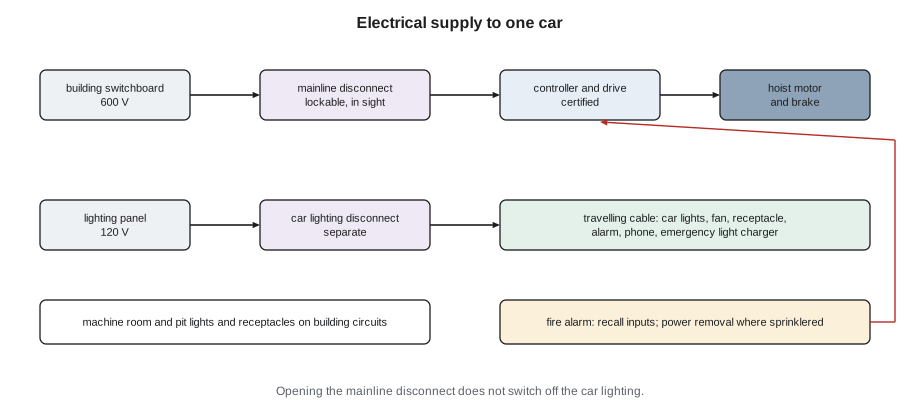
Each elevator must have its own mainline disconnecting means, a switch or circuit breaker that opens all ungrounded supply conductors to the controller and drive. It must be located where it can be reached readily, normally inside the machine room or control space near the door, within sight of the controller, and it must be capable of being locked in the open position so that a mechanic can lock out the car. It must not be capable of being opened from anywhere else, such as by a remote control, except where the codes allow automatic removal of power for fire protection, discussed below. Where there is more than one car, each disconnect must be marked to show which car it serves.
The mainline disconnect does not switch everything. The car lights, the car fan, the car receptacle, the alarm and the emergency light charger are on a separate circuit with its own disconnect, so that opening the mainline disconnect to work on the controller does not leave passengers, or a mechanic on the car top, in the dark. The machine room and pit lighting and receptacles have their own circuits as well, not taken from the elevator's power supply. Tillicum's 1962 installation had the car lights fed from the controller, which is not uncommon in old buildings; the package added a separate car lighting disconnect beside the mainline switch, with a label.
# Disconnect inventory for Tillicum car 1: what the codes require, what the drawings show
required = {
    "mainline disconnect, lockable open, within sight of controller": True,
    "car lighting, fan and receptacle disconnect, separate from mainline": True,
    "machine room lighting on a separate branch circuit": True,
    "pit lighting and receptacle on a separate branch circuit": True,
    "ground fault (GFCI) protection on pit and machine room receptacles": True,
    "disconnects marked with the car they serve": True,
}
drawings = {k: True for k in required}
drawings["pit lighting and receptacle on a separate branch circuit"] = False   # not yet on the drawings
for item, need in required.items():
    print(f"{'ok  ' if drawings[item] else 'ADD '} {item}")
# car lighting circuit load against a 120 V, 15 A circuit
loads_w = {"LED ceiling": 96, "car fan": 70, "emergency light charger": 15, "receptacle allowance": 180, "alarm and phone": 10}
total = sum(loads_w.values())
print(f"car lighting circuit load {total} W = {total / 120:.1f} A on a 15 A circuit")ok mainline disconnect, lockable open, within sight of controller ok car lighting, fan and receptacle disconnect, separate from mainline ok machine room lighting on a separate branch circuit ADD pit lighting and receptacle on a separate branch circuit ok ground fault (GFCI) protection on pit and machine room receptacles ok disconnects marked with the car they serve car lighting circuit load 371 W = 3.1 A on a 15 A circuit
The script's single gap matched a real gap in the drawings: the pit light and receptacle were shown, but as a branch from the car lighting circuit rather than a separate building circuit. Priya corrected the drawing. Tamsin also added a line she remembered from ELV-110: Tillicum's electrical equipment had no arc flash labels, which the electrical safety standards in both countries expect on equipment likely to be worked on while energized, and the new disconnects and controller would get them.
Overcurrent protection, conductors and wiring
The feeder to an elevator must be sized for the duty of the motor and drive, which the electrical code treats differently from a continuously running motor because elevators start and stop many times an hour and the drive's input current depends on its design. Overcurrent devices must protect the conductors and coordinate so that a fault on one car does not trip the supply to other cars; where several elevators are fed from one supply, the electrical code requires the overcurrent devices to be selectively coordinated in many cases. Conductors in hoistways, machine rooms and on cars must be of the types the electrical code allows, in approved raceways, cables or travelling cables, and the travelling cable must be supported and protected so that it cannot be damaged by the car or hoistway equipment. Only wiring that belongs to the elevator may run in the hoistway, the same rule lesson 4 met for pipes.
Grounding and bonding tie the machine, the controller, the rails and the car frame into one system so that a fault cannot leave a metal part live, and the elevator code requires the control system to react safely to a ground fault in the safety circuit: the car must stop rather than run with a device bypassed. ELV-310 explained why the safety circuit is wired so that a ground fault opens it rather than bridging it. On the Tillicum job, the existing rail and machine grounding would be tested and the new controller bonded to it.
What the elevator code requires of control circuits
Section 2.26 of the elevator code sets the requirements for operating devices and control equipment, and it is where most of the electrical safety rules for the elevator itself live. It lists the electrical protective devices that must open the safety circuit, such as door contacts and interlocks, the governor and safety switches, buffer switches, final limits, stop switches and slack rope switches, and it requires them to act directly to remove power from the machine and set the brake. It requires protection against the failure of a single component, such as a welded contactor or a shorted relay, so that the car cannot start or keep running with a fault; this is the requirement behind the redundancy and checking that ELV-310 showed in the new controllers. It requires the motor and brake circuits to be opened by at least two independent means. It sets the rules for inspection operation, hoistway access and car top operation, for phase reversal and phase failure protection, and for the absorption of power the motor regenerates when an empty car rises or a full car descends.
For a modernization, most of these requirements are met inside the new controller, which is certified as a whole. The package's job is to show that the controller is certified, that the field devices it monitors are all present and wired as the controller's maker requires, and that the parts of the old installation being kept, such as hoistway limit switches and door contacts, are suitable for the new controller. Tamsin's list of kept devices from lesson 7 became the list of field devices on the wiring diagrams.
| Requirement | Code that sets it | How Tillicum's package meets it |
|---|---|---|
| Mainline disconnect | electrical code | new lockable switch at the machine room door |
| Separate car lighting circuit | electrical code | new disconnect and circuit |
| Controller and drive certification | electrical equipment standard | certified controller and drive |
| Safety circuit devices | elevator code, 2.26 | kept devices listed and rewired to the new controller |
| Single-failure protection | elevator code, 2.26 | built into the certified controller |
| Regenerated power absorbed | elevator code and electrical code | drive's braking resistor sized by the maker |
| Ground fault response | elevator code | safety circuit design; grounding tested |
| Arc flash labels | electrical safety standards | added to disconnects and controller |
Fire alarm interfaces and power removal
Elevators connect to the building's fire alarm system in several ways. Smoke detectors in elevator lobbies, machine rooms and hoistways initiate firefighters' emergency operation, recalling the cars, as ELV-310 and ELV-320 described. Where a building's sprinklers protect the machine room or hoistway, the codes require power to the elevator to be removed automatically before water is discharged, so that a car does not run with water on its brakes and controls. This is usually done with heat detectors next to the sprinkler heads, set lower than the sprinkler's operating temperature, operating a shunt trip on the mainline disconnect or a similar means. The codes forbid the use of water-flow switches for this when the sprinkler system has a delay, and they set how the power removal must interact with emergency power and with the car's emergency lighting.
These interfaces are wired by the fire alarm contractor to terminals the elevator contractor provides, and the dividing line is a common source of trouble: an elevator that recalls to the wrong floor because a detector was wired to the wrong input, or a shunt trip that never operates because nobody tested it. The Tillicum penthouse had no sprinklers, so the package needed no shunt trip, but it did need the recall inputs from the existing smoke detectors connected to the new controller, with a test plan for the day of the acceptance inspection that included the fire alarm technician.
Emergency and standby power
Where a building has an emergency or standby generator and the building code requires elevators to run on it, the elevator code requires the elevators to be sequenced onto the generator in an orderly way, as ELV-310 described, and the electrical code requires the supply arrangements to match. A drive running from a generator must not push regenerated power back into it, because a generator cannot absorb it, so the elevator must have a means to absorb regenerated power, such as a braking resistor, whenever it runs on the generator. Tillicum had no generator. The package stated this, so that the inspector would not look for emergency power operation, and noted that the car's emergency lighting and alarm were battery backed as the elevator code requires regardless of the building's power.
Worked problem
Car lights fed from the controller
Tamsin finds that the 1962 car lighting at Tillicum is fed from a transformer in the old controller, so opening the mainline disconnect darkens the car. Is this a problem for the modernization?
Show solution
- Under the current electrical code the car lighting must have its own disconnect, separate from the mainline disconnect.
- The modernization replaces the controller, so the old transformer goes with it; the car lighting has to be fed from somewhere, and it must be fed in the way the current codes require.
- The package therefore adds a separate car lighting circuit with its own lockable disconnect in the machine room, marked for car 1.
- The emergency light and alarm stay battery backed, so a power failure or an open car light disconnect still leaves the car with emergency light.
Answer: Yes; the new installation must have a separate car lighting circuit and disconnect, and the package adds one.
Common mistakes
MistakeChecking the elevator code and forgetting the electrical code.
InsteadBoth apply; the installation must meet each.
MistakeFeeding the pit light from the car lighting circuit.
InsteadPit and machine room lighting and receptacles are on separate building circuits.
MistakeLocking out the mainline disconnect and assuming the car is dead.
InsteadThe car lighting circuit and other circuits remain live; lock out each one you need.
MistakeWiring sprinkler power removal to a delayed water-flow switch.
InsteadUse heat detectors or other means the codes allow, set to operate before the sprinkler.
MistakeIgnoring regenerated power on generator operation.
InsteadProvide a means to absorb it whenever the elevator runs on standby power.
Summary and key terms
- The elevator code covers control system design and performance; the electrical code covers supply, protection, wiring and grounding; an equipment standard covers certification.
- In Canada the electrical rules for elevators are in CEC Section 38; British Columbia adopted the 2024 CEC from March 4, 2025.
- Each car needs a lockable mainline disconnect within sight of the controller; car lighting has its own disconnect.
- Section 2.26 lists the electrical protective devices and requires single-failure protection, two independent means to remove power, and safe responses to ground faults and regeneration.
- Fire alarm interfaces recall cars and, where sprinklers protect elevator spaces, remove power before water is discharged.
- On standby power, cars are sequenced and regenerated power must be absorbed.
- Mainline disconnecting means
- The switch or breaker that opens all supply conductors to an elevator controller and drive.
- Car lighting disconnect
- A separate disconnect for the car lights, fan, receptacle and alarm circuits.
- Electrical protective device
- A device listed in the elevator code that opens the safety circuit when it detects an unsafe condition.
- Selective coordination
- Arranging overcurrent devices so only the one nearest a fault opens.
- Shunt trip
- A means of opening a disconnect remotely, used to remove elevator power before sprinklers discharge.
- Regenerated power
- Power returned by the motor when the load drives it, which must be absorbed or returned safely.
Practice problems
Work each problem on paper first, then reveal the answer to check.
Which code sets the requirements for the mainline disconnect?
Show answer
The electrical code (CEC Section 38), with the elevator code.
Why does the car lighting have its own disconnect?
Show answer
So opening the mainline disconnect does not leave the car and car top in the dark.
What must happen to elevator power before sprinklers discharge in a machine room?
Show answer
It must be removed automatically, usually by heat detectors operating a shunt trip.
What does single-failure protection prevent?
Show answer
A car starting or running with a single failed component such as a welded contactor.
Why must regenerated power be absorbed on generator operation?
Show answer
A generator cannot absorb power pushed back into it.
Lesson quiz · 5 questions
Score 60% or more to complete this lesson.
Create a free account to save your progress, take quizzes and earn a certificate.