
ELV-410 · Lesson 3 of 12 · 21 min
Codes, regulations and the authority having jurisdiction
Priya's first job for Tamsin on the Tillicum package was not about elevators at all. “Before we check anything, tell me which rules apply,” she said. “Which edition of the code, which regulation, which amendments, who issues the permit and who does the acceptance inspection. If we get that wrong, every other answer in the package is wrong too.” Tamsin spent an afternoon on Technical Safety BC's website and the provincial regulations (the city's code pages, the state's rules and the permit portal) and came back with a page of notes. This lesson follows her notes: how a code becomes law, who enforces it, which edition applies to a given elevator, and what permits, licences and inspections hang off the adopted code.
From standard to law
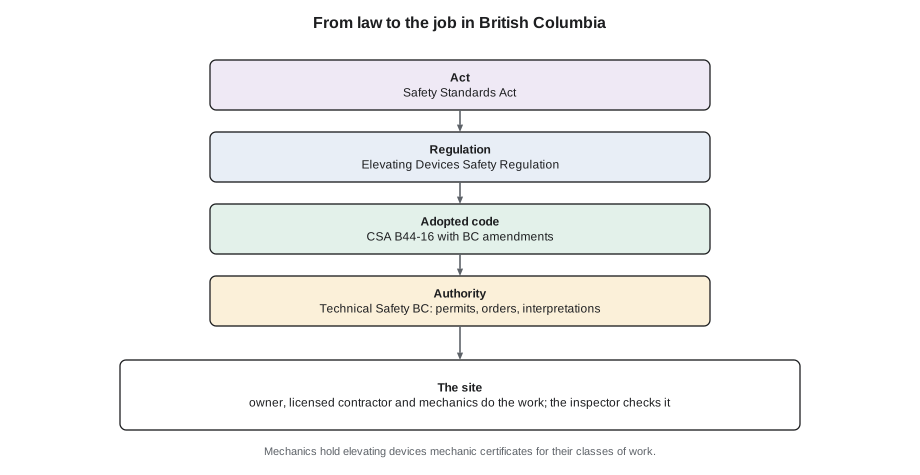
The chain has the same links in both countries. A legislature passes an act that gives a government the power to regulate elevating devices. A regulation made under that act adopts an edition of the elevator code, usually with amendments that add, delete or change clauses, and sets up the system of permits, licences and inspections. An authority having jurisdiction, the body named by the act or regulation, then applies the adopted code: it issues permits, accepts or rejects installations, inspects equipment in service, investigates incidents and decides how the code applies in cases that are unclear. Between new editions, the authority can usually issue its own documents, such as orders, directives or bulletins, that require specific actions or explain how it will apply the code.
In British Columbia the act is the Safety Standards Act, and the regulation is the Elevating Devices Safety Regulation. The authority is Technical Safety BC, an independent, self-funded organization that administers the act for the province. The current adopted edition is CSA B44-16, adopted with British Columbia amendments effective April 30, 2020. Technical Safety BC consulted in 2023 on adopting B44:19, with proposals that included making the accessibility appendix mandatory and allowing fire alarm technicians to test hoistway devices through an access panel, so a mechanic must check the edition in force on the date that matters. Technical Safety BC also issues safety orders, directives and information bulletins; some safety orders require upgrades to existing equipment, such as the order on firefighters' key switches that was in place for over a decade.
Which edition applies?
The basic rule is that equipment is held to the code in force when it was installed, unless something later requires it to meet a newer rule. Three things can make a newer rule apply. An alteration, covered in lesson 11, brings the altered parts and some related requirements up to the code in force at the time of the alteration. A retroactive rule, such as a safety order or an existing-equipment code like A17.3, can require specific upgrades to all equipment of a certain kind. And the authority can require correction of a condition it considers unsafe, whatever the code said when the equipment was new. Otherwise an elevator installed under an old edition remains acceptable as long as it is maintained in its approved condition.
This is why the installation date and the alteration history matter so much. Tillicum car 1 was installed in 1962 under a code that had no requirement for ascending car overspeed protection, car top guardrails, light curtains or modern emergency communication. It has never needed them, because none of the retroactive rules caught them and it has never been altered in a way that triggered them. The modernization will change that: the new controller and drive are alterations, and with them come the requirements of the edition in force on the permit date.
# Which code edition applies? Look up the edition in force on a given date.
from datetime import date
table = [  # (from date, edition) for British Columbia (Technical Safety BC); older dates fall back to the record
    (date(2020, 4, 30), "CSA B44-16 with BC amendments"),
]
def edition(d):
    best = None
    for start, ed in table:
        if d >= start:
            best = ed
    return best or "older edition: check the installation record"
for label, d in [("Tillicum car 1 installed", date(1962, 5, 1)), ("Larchmont car installed", date(2025, 3, 1)), ("modernization permit", date(2026, 12, 1))]:
print(f"{label:28} {d} {edition(d)}")Tillicum car 1 installed 1962-05-01 older edition: check the installation record Larchmont car installed 2025-03-01 CSA B44-16 with BC amendments modernization permit 2026-12-01 CSA B44-16 with BC amendments
The table holds only the edition Tamsin could confirm for the province; for older equipment the installation record and the authority's files are the source. When a new edition is adopted, the table needs a new row and a check of the transition rules, because a project permitted before the change date may be allowed to finish under the older edition.
Permits, licences and certificates
Around the adopted code sits a system of paperwork that every mechanic deals with. Installing a new elevator, and altering an existing one, requires a permit issued before work starts, based on drawings and data that show the equipment will meet the code. When the work is done, an acceptance inspection and tests, witnessed or reviewed by the authority, decide whether the equipment may be put in service. After that, the owner must hold a current operating permit or certificate for each unit, renewed periodically and usually tied to a periodic inspection and to the owner's maintenance obligations.
People need licences too. In British Columbia, the contractor doing the work holds a licence from Technical Safety BC, and the mechanics hold elevating devices mechanic certificates in the classes that cover the work they do; apprentices work under the supervision of certified mechanics. Work outside a mechanic's class, or by an unlicensed contractor, is not allowed. (In Washington, L&I licenses elevator contractors and elevator mechanics, with licence categories for different kinds of conveyance work, and apprentices work under licensed mechanics. The licensing rules apply statewide, including in Seattle.) A mechanic who signs a test report or an inspection record is putting their own licence behind it, which is why Northcrest is strict about who signs what.
| Item | Who holds it | What it covers |
|---|---|---|
| Installation permit | contractor, for the owner | new equipment, before work starts |
| Alteration permit | contractor, for the owner | an alteration, before work starts |
| Acceptance inspection and tests | authority witnesses or reviews | permission to put equipment in service |
| Operating permit or certificate | owner | permission to keep the unit in service |
| Contractor licence | elevator contractor | doing regulated work |
| Mechanic certificate or licence | individual mechanic | the classes of work the holder may do |
What the authority does
The authority has several roles, and it helps to keep them apart. It reviews permit applications, sometimes in detail and sometimes only for completeness, depending on the work. It witnesses or audits acceptance tests. It carries out periodic inspections, or audits the inspections and tests that contractors perform, and it can order corrections, take a unit out of service or refuse a permit. It investigates incidents, which the owner and contractor must report, and it publishes what it learns, often as bulletins or orders that change practice across the jurisdiction. It also decides requests for variances, where an owner asks to meet a requirement in a different way because the requirement cannot reasonably be met, usually in an existing building.
Moira's advice about the authority was simple. Ask early, in writing, and keep the answer. A permit application that raises an unusual condition with a proposed solution goes faster than one that hides it. An interpretation or variance on file protects the owner, the contractor and the mechanic. And an inspector who rejects something is usually pointing at a real problem, even when the clause is cited wrongly; fix the problem, then discuss the clause.
Existing equipment and retroactive rules
Old equipment is not frozen in time. Some jurisdictions adopt the existing-equipment code, which sets minimum safety upgrades for old elevators and escalators, such as door restrictors, car door contacts, pit stop switches and emergency communication. Others issue specific orders that require particular upgrades by a deadline. British Columbia uses safety orders and directives for this, aimed at particular hazards or particular equipment. (Washington has adopted ASME A17.3-2015 for existing elevators and escalators, and Seattle's code has its own provisions for existing conveyances.) A mechanic doing routine maintenance should know which of these rules apply to the units on their route, because a missing upgrade is a finding at the next inspection.
Worked problem
Setting the rules for the Tillicum package
Tamsin must list, for Priya, the rules that apply to the Tillicum car 1 modernization.
Show solution
- The equipment is an existing electric traction elevator in British Columbia, so the Safety Standards Act and the Elevating Devices Safety Regulation apply, administered by Technical Safety BC. (Seattle, so the city's elevator code in the Seattle Building Code applies, administered by SDCI, with licensing under chapter 70.87 RCW and chapter 296-96 WAC.)
- The alteration will be held to the code edition in force on the permit date, with the jurisdiction's amendments, for the parts altered and the related requirements that the alteration section triggers.
- Unaltered parts remain under the edition in force when the car was installed, unless a retroactive rule applies to them.
- Any orders, directives or bulletins in force for the equipment type must also be checked, and any condition the authority considers unsafe must be corrected.
Answer: The package must be checked against the edition in force on the permit date, the local amendments, the alteration rules and any retroactive orders.
Reporting incidents and working with inspectors
The regulation also tells owners and contractors what to do when something goes wrong. Incidents involving elevating devices, such as injuries, entrapments over a set length of time in some jurisdictions, falls into hoistways, safety settings, fires in machine rooms and serious equipment failures, must be reported to the authority, and the equipment involved must usually be left as it is until the authority releases it, except to make it safe or free a trapped person. The purpose is to let the authority investigate, find the cause and, where the cause could affect other equipment, warn everyone else. Many of the orders and bulletins a mechanic reads began as an incident report. Northcrest's procedure tells mechanics to make the equipment safe, protect the scene, call the supervisor and record what they saw before anything is moved or adjusted.
Periodic inspections are the other regular contact with the authority. Depending on the jurisdiction, the authority's own inspectors may inspect each unit on a set cycle, or the contractor may perform the periodic tests and the authority audits the results and the maintenance records. Either way, the inspector expects the maintenance control program, the test records and the log of callbacks and repairs to be on site and up to date, which ELV-420 covers in detail. Moira's advice was to treat the inspector as part of the safety system: be there for the inspection when you can, answer questions directly, point out problems you already know about, and send the correction report on time. An inspector who trusts a contractor's records spends less time looking for what is hidden and more time on what matters.
| Event | What the mechanic does | What the authority does |
|---|---|---|
| Injury or serious incident | make safe, protect the scene, report through the supervisor | investigates, may hold the equipment |
| Periodic inspection | attend, have records ready, answer questions | inspects or audits, issues findings |
| Inspection findings | correct within the time given, report back | reviews the correction, renews the permit |
| Unclear requirement | ask in writing before acting | issues an interpretation or decision |
| Work outside licence class | do not do it | may take action against the contractor or mechanic |
None of this paperwork changes the work itself, but all of it depends on it. A test that was not recorded, a finding that was corrected but not reported, or an incident cleaned up before anyone looked at it can cost a contractor its licence and leave a hazard unexplained.
Common mistakes
MistakeChecking the package against the edition on your shelf.
InsteadCheck against the edition the authority has adopted for the permit date.
MistakeAssuming an old elevator must meet the newest edition.
InsteadIt is held to its installation edition unless altered, ordered or found unsafe.
MistakeIgnoring local amendments.
InsteadThe adopted code is the edition plus the jurisdiction's amendments.
MistakeTreating a verbal answer from an inspector as final.
InsteadAsk in writing and keep the interpretation or variance on file.
MistakeWorking outside your licence class to finish a job.
InsteadOnly certified or licensed people may do the work their class covers.
Summary and key terms
- An act gives the power to regulate; a regulation adopts a code edition with amendments; an authority having jurisdiction applies it.
- In British Columbia, Technical Safety BC administers the Safety Standards Act and the Elevating Devices Safety Regulation, with CSA B44-16 adopted from April 30, 2020.
- Equipment is held to the edition in force when installed, unless altered, caught by a retroactive rule or found unsafe.
- Permits come before installation and alteration; acceptance tests come before service; operating permits keep units in service.
- Contractors and mechanics are licensed for the classes of work they do.
- Authority having jurisdiction
- The body that enforces the adopted code in an area.
- Amendment
- A local change to an adopted code edition.
- Variance
- Permission to meet a requirement in another way where it cannot reasonably be met.
- Retroactive rule
- A requirement that applies to existing equipment regardless of its installation date.
- Operating permit
- The permission an owner needs to keep a unit in service.
- Acceptance inspection
- The inspection and tests that decide whether new or altered equipment may enter service.
Practice problems
Work each problem on paper first, then reveal the answer to check.
Which edition applies to an unaltered 1962 elevator?
Show answer
The edition in force when it was installed, unless a retroactive rule or an unsafe condition requires more.
What brings newer rules to an existing elevator?
Show answer
An alteration, a retroactive rule such as an order or existing-equipment code, or an order to correct an unsafe condition.
Who administers elevating devices in British Columbia?
Show answer
Technical Safety BC.
What should you do when a code question is unclear on a permit job?
Show answer
Ask the authority early, in writing, and keep the answer on file.
Who must hold a licence to do regulated work?
Show answer
The contractor and the individual mechanics, in the classes that cover the work.
Lesson quiz · 5 questions
Score 60% or more to complete this lesson.
Create a free account to save your progress, take quizzes and earn a certificate.