
ELV-410 · Lesson 7 of 12 · 21 min
Suspension, safeties, governors and buffers in the code
Tamsin had worked on every one of Tillicum car 1's safety devices in earlier terms: she had helped replace its ropes, tested its flyball governor, examined its wedge-clamp safeties and checked its spring buffers. This time she was asked to read about them instead. The modernization would keep the machine, the governor, the safeties and the buffers, and add a new device, so Priya wanted a page for the package that showed, device by device, which code requirements applied to the kept equipment, which to the new device, and what data the inspector would want to see. “The devices have not changed since last term,” Moira told the class, “but now you are going to read why they look the way they do.” This lesson walks through the code sections on suspension means, safeties, governors, ascending car overspeed and unintended movement protection, counterweights, buffers and the brake, as they apply to a modernization.
Suspension means
The code's section on suspension means covers the ropes or belts that carry the car and counterweight, and it relies heavily on the companion suspension standard, A17.6, for the details of rope construction, testing and replacement criteria. The basic requirements are few but firm. A traction elevator must have at least three ropes or belts, so that the failure of one cannot drop the car. Ropes must be of a type and construction the code recognizes, with a minimum diameter. The factor of safety, the ratio of the ropes' combined breaking strength to the load they carry, must be at least the value in the code's table for the elevator's rope speed, higher for faster elevators and higher for passenger than freight elevators. Ropes must run on sheaves of a minimum diameter compared with the rope, at least forty times the rope diameter for the usual constructions, so that bending does not wear them out.
The code also requires a rope data tag on the crosshead, recording the number, diameter, construction, material, maker and breaking strength of the ropes, the date they were installed and who installed them, and it sets rules for fastenings: the shackles, sockets and other terminations that attach the ropes to the car and counterweight, and the means of equalizing tension. Replacement criteria, such as the number of broken wires or the loss of diameter at which a rope must be replaced, are in A17.6 and in Part 8. When Tillicum car 1's ropes were replaced in ELV-230, the new tag recorded five 13 mm (1/2 in) ropes with a factor of safety of about 13; the package simply cited the tag and the replacement record.
Car and counterweight safeties
Every electric elevator car must have a safety, a mechanical device on the car frame that grips the guide rails to stop and hold the car if it overspeeds downward or if the suspension fails. The code recognizes three types. A Type A safety, an instantaneous safety, applies a rapidly increasing pressure and stops the car in a very short distance; it is allowed only at low speeds. A Type B safety applies a limited pressure that increases more gradually, stopping the car within a range of distances set by a code table for the governor tripping speed, so that the deceleration stays within limits passengers can survive. A Type C safety, now rare, combines an instantaneous safety with an oil buffer. Counterweight safeties are required where there is occupied space below the hoistway, and are tripped by a counterweight governor or by the breaking of the suspension.
Safeties must be marked with a data plate giving their type, the maker, the maximum and minimum loads and speeds they were designed for, and, for Type B safeties, the pull-through of the governor rope. The code requires each safety design to be certified by type tests, so that a field safety is known to work before it is installed. The acceptance tests in Part 8 prove the installed safety, and the periodic tests prove it again; ELV-420 covers those tests. For Tillicum, the safety was a Type B wedge-clamp design from 1962. It had passed its five-year test in ELV-320, and the modernization would not alter it, so it stayed under its installation code, but the package had to show that the new drive and controller would not change the conditions under which it was tested, such as the speed and the governor.
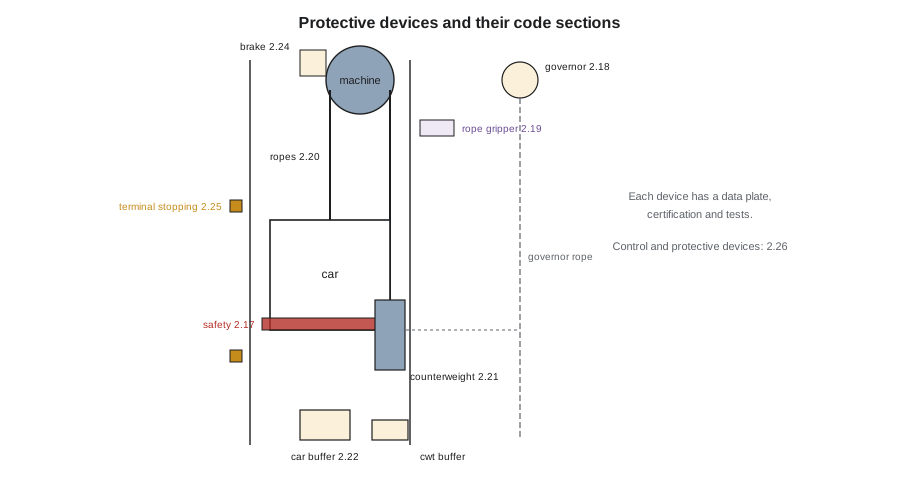
Governors
The governor is the device that senses overspeed and trips the safety, and the code requires one for every car with a safety. Its tripping speed must be at least 115 % (115 %) of the rated speed, so that it does not trip in normal running, and no more than the maximum in the code's table for the rated speed, so that the safety sets before the car is going too fast for it. For most governors the code also requires an overspeed switch that opens the control circuit at a lower speed than the trip, so that the machine brake stops the car first if it can. The governor rope must meet its own requirements for construction, diameter and factor of safety, and the governor must be marked with its tripping speed, the rope it was designed for and other data. Governors must be accessible for inspection and must be sealed once adjusted, so that a tripping speed cannot be changed without a record.
# Device data against code requirements for Tillicum car 1 (summary values)
rated = 1.0                         # m/s
trip = 1.36                       # m/s, governor tripping speed from its marking plate
trip_max = 1.42                   # m/s, table maximum for this rated speed
print(f"governor trip {trip} m/s: minimum {1.15 * rated:.2f}, maximum {trip_max}:",
      "ok" if 1.15 * rated <= trip <= trip_max else "out of range")
ropes, fs = 5, 13.3                 # from the rope data tag after the ELV-230 replacement
fs_screen = 7.60 + (10.25 - 7.60) * (200 - 50) / (500 - 50)   # rough screen between two table rows
print(f"{ropes} ropes (at least 3 needed); factor of safety {fs} against a screen of about {fs_screen:.1f}:",
      "ok" if ropes >= 3 and fs >= fs_screen else "check")
sheave, rope_d = 760, 13          # mm
print(f"sheave to rope ratio {sheave / rope_d:.0f} (40 or more needed):", "ok" if sheave / rope_d >= 40 else "low")
print("spring buffers allowed at this speed:", "yes" if rated <= 1.0 else "no, oil buffers needed")governor trip 1.36 m/s: minimum 1.15, maximum 1.42: ok 5 ropes (at least 3 needed); factor of safety 13.3 against a screen of about 8.5: ok sheave to rope ratio 58 (40 or more needed): ok spring buffers allowed at this speed: yes
The rope factor screen in Tamsin's script is a straight line between two rows of the code's table that she had in her notes; the real table steps from row to row, and the package used the value printed in the table for the rope speed. It made the point clearly enough: the new ropes have a large margin.
Ascending car overspeed and unintended movement
The safety and governor protect against a car that falls or runs away downward. Two newer hazards are covered by section 2.19. Ascending car overspeed is a car that runs away upward, which can happen with a traction elevator when the counterweight is heavier than the car and its load, if the brake or machine fails; an empty car is pulled up by the counterweight. Unintended movement is a car that moves away from a landing with its doors open, which can shear a person stepping in or out. The code requires protection against both on electric elevators: a device that detects the condition and an emergency brake that stops the car, acting on the car, the counterweight, the suspension ropes or the drive sheave, independent of the machine brake that might have failed. The device must stop an ascending car within limits on deceleration, and stop unintended movement within a set distance, 1,220 mm (48 in) in the editions Tamsin read.
These requirements were added to the code around 2000, so Tillicum car 1, like most older cars, has neither protection. The code applies them to existing elevators when certain alterations are made, and replacing the controller of an electric elevator is one of the alterations that brings them in. The Tillicum package therefore proposed a rope gripper, an emergency brake that clamps the suspension ropes between two jaws, triggered by the new controller from the governor overspeed switch and from a door zone monitor. The package had to give the rope gripper's certification, its data plate, the loads and speeds it was rated for, its mounting on the machine room floor and its wiring, and to show that gripping the ropes would not overload them or the sheave.
Counterweights and buffers
Counterweights must be designed so that their weights cannot shift or fall out: filler weights are held by tie rods through the frame, with a means of preventing them from jumping. The counterweight must run in its own guide rails, guarded in the pit where people could be struck, and the code limits the clearances around it. Counterweight buffers and car buffers stop the counterweight and car if they pass the terminal landings. Spring buffers are allowed only at low rated speeds, up to 1.0 m/s (200 ft/min); above that, oil buffers are required. Oil buffers must have enough stroke to stop a car arriving at 115 % (115 %) of rated speed at an average deceleration no greater than gravity, with limits on the peak, and they must carry a data plate showing the stroke, the load range, the oil and other data. Reduced-stroke buffers are allowed where emergency terminal speed limiting devices prove the car cannot arrive at full speed. Buffers must be checked for oil level and return regularly, a maintenance item ELV-110's capstone found wanting at Tillicum car 2.
Tillicum car 1, at 1.0 m/s (200 ft/min), sits at the top of the spring buffer range. The modernization did not change its speed, so the spring buffers stayed. Had the owner wanted a faster car, the buffers, the governor, the safety and perhaps the pit would all have come into the package, which is one reason modernizations usually keep the original speed.
Machines, brakes and terminal stopping
The driving machine section covers the machine itself, its sheaves, the brake and the means of moving the car in an emergency. The brake must stop and hold the car under the conditions the code sets, including holding the car with 125 % (125 %) of rated load at the landings, and it must be applied by springs or gravity and released electrically, so that a power failure sets it. Sheaves must have grooves and diameters suitable for the ropes, with rules on groove wear that ELV-230 covered. Terminal stopping devices, the normal and final terminal stopping devices and on faster cars the emergency terminal speed limiting devices, slow and stop the car at the ends of travel independently of the normal control. On a modernization these are partly in the new controller and partly mechanical switches in the hoistway, and the package must show which devices are retained, which are new and how the new controller monitors them.
| Device | Kept or new at Tillicum | Code questions for the package |
|---|---|---|
| Suspension ropes | kept (replaced in ELV-230) | rope data tag, factor of safety, fastenings |
| Governor | kept | tripping speed within the table, overspeed switch, rope data |
| Car safety (Type B) | kept | unchanged conditions; data plate; next test |
| Ascending car and unintended movement protection | new rope gripper | certification, data plate, triggering, mounting |
| Buffers (spring) | kept | speed within spring buffer range; condition |
| Brake | kept, new monitoring | holding capacity, adjustment, brake monitoring by the new controller |
| Terminal stopping devices | new switches and controller logic | independence from normal control |
Worked problem
Why the rope gripper comes with the controller
The owner asks why replacing a controller should require a new brake on the ropes, when the old controller never had one.
Show solution
- The ascending car overspeed and unintended movement requirements were added to the code long after 1962.
- The code's alteration section lists the changes that bring those requirements into an existing elevator, and replacing the controller of an electric elevator is among them, because a new controller changes the way the car is controlled and stopped.
- The rope gripper provides an emergency brake independent of the machine brake, which is what the requirement asks for.
- Without it, the alteration would not meet the code in force on the permit date, and the authority would not accept it.
Answer: The new controller is an alteration that brings in the 2.19 protection, so the package must include an emergency brake such as the rope gripper.
Common mistakes
MistakeTreating retained devices as outside the package.
InsteadShow why retained devices are unaffected and give their data.
MistakeReading a rope factor of safety from memory.
InsteadUse the code table value for the rope speed and the data on the rope tag.
MistakeSetting a governor trip at the maximum of the table to avoid nuisance trips.
InsteadSet it within the range, and investigate nuisance trips instead.
MistakeAssuming spring buffers can stay if the speed is raised.
InsteadAbove the spring buffer limit, oil buffers are required.
MistakeForgetting that 2.19 protection has its own certification.
InsteadInclude the device's certification, data plate and ratings in the package.
Summary and key terms
- Traction elevators need at least three ropes or belts, with a factor of safety from the code table and sheaves at least forty rope diameters for usual ropes.
- Safeties are Type A, B or C; Type B stopping distances are set by a table; safeties carry data plates and are type tested.
- Governors trip at no less than 115 % of rated speed and no more than the table maximum, with an overspeed switch and a seal.
- Section 2.19 requires ascending car overspeed and unintended movement protection, brought into old elevators by alterations such as a new controller.
- Spring buffers are allowed only up to 1.0 m/s (200 ft/min); oil buffers stop a car arriving at 115 % of rated speed at no more than 1 g average.
- Brakes are spring applied and electrically released and must hold 125 % of rated load; terminal stopping devices act independently of normal control.
- Factor of safety
- The ratio of combined breaking strength of the ropes to the load they carry.
- Type B safety
- A safety that stops the car with limited, increasing pressure within distances set by a code table.
- Tripping speed
- The speed at which the governor trips the safety.
- Ascending car overspeed protection
- Protection that detects and stops a car running away upward.
- Unintended movement
- Car movement away from a landing with the doors open.
- Rope gripper
- An emergency brake that clamps the suspension ropes to stop the car.
Practice problems
Work each problem on paper first, then reveal the answer to check.
What is the minimum number of ropes for a traction elevator?
Show answer
Three.
Between what limits must a governor trip?
Show answer
At least 115 % of rated speed and no more than the table maximum for the rated speed.
What two hazards does section 2.19 cover?
Show answer
Ascending car overspeed and unintended movement away from a landing with the doors open.
Up to what speed are spring buffers allowed?
Show answer
1.0 m/s (200 ft/min).
What load must the brake hold at the landings?
Show answer
125 % of rated load.
Lesson quiz · 5 questions
Score 60% or more to complete this lesson.
Create a free account to save your progress, take quizzes and earn a certificate.