
ELV-410 · Lesson 4 of 12 · 21 min
Hoistways, pits and enclosures
The first part of the Tillicum package Priya gave Tamsin was a survey: measure the hoistway, pit and overhead of car 1, and compare what was there with the current code, item by item. “Most of this will not change in the modernization,” Priya said. “But we need to know where the old hoistway falls short, because the alteration rules may bring some of it up to date, and because the inspector will ask.” Tamsin and Ray spent a morning in the hoistway with a tape, a laser measure and a camera. This lesson covers what the code requires of a hoistway, its enclosure and openings, the pit, the clearances and runbys at the top and bottom of travel, and the refuge spaces that protect a mechanic, using the Tillicum survey as the example.
The hoistway and its enclosure
A hoistway is the shaft in which the car and counterweight travel. The code requires it to be enclosed for its full height, on all sides, with the strength and fire resistance the building code requires, so that people cannot reach moving equipment and fire and smoke cannot spread through the shaft from floor to floor. The enclosure must be strong enough that a person pushing against it cannot deflect it into the path of the car, and its inside surfaces must be smooth enough that nothing on the car can catch on them. Where a wall has a ledge or recess deeper than a small amount, the code requires the ledge to be bevelled at a steep angle so that a person or object on the car top cannot be caught on it; ELV-120 met this requirement when the Quayside hoistway was checked before rails went in.
The code also limits what may be in a hoistway. Only equipment and wiring that belong to the elevator are allowed, with narrow exceptions such as sprinklers and the fire alarm devices needed to protect the hoistway, and the building's pipes, ducts and other services must run elsewhere. This rule protects mechanics, who would otherwise share the shaft with other trades' equipment, and it protects the elevator from water, steam and other services failing into it. At Tillicum, Tamsin found an abandoned steam pipe crossing a corner of the hoistway near the top, a relic of the 1962 heating system. It was capped and dead, but it was still a finding for the survey.
Openings, doors and access
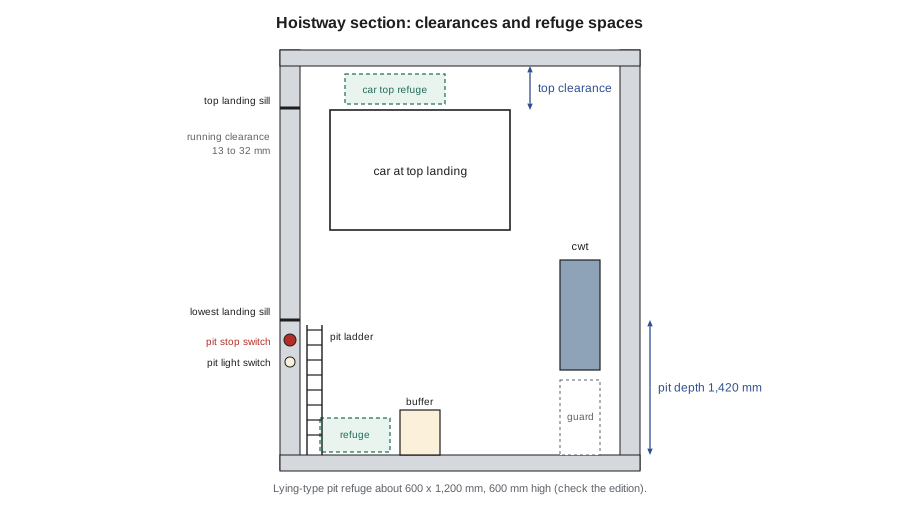
Every opening into the hoistway must be protected. Landing openings have hoistway doors with interlocks, covered in ELV-320, and the clearances between the car and the landing are limited so that people cannot fall into the gap or be caught in it. The running clearance between the car sill and the landing sill is small, between about 13 mm and 32 mm (1/2 in and 1 1/4 in), and the distance between the hoistway face of the landing door and the car door is limited so that a person cannot stand between them when the car moves. Emergency doors are required in blind hoistways, where a car runs past a long stretch with no landings, so that passengers can be rescued. Access to the hoistway for mechanics is controlled with hoistway access switches and unlocking devices, so that only authorized people can open a door and move the car slowly to reach the car top or pit.
Horizontal clearances inside the hoistway are set too. There must be a minimum clearance between the car and the hoistway enclosure, between the car and the counterweight, and between the counterweight and its guard or the enclosure, so that nothing on the car can strike anything fixed. Where two or more cars share a hoistway, the code sets minimum clearances between them and requires guards in the pit and, in some cases, along the hoistway, so that a mechanic working on one car cannot be struck by the next.
The pit
The pit is the part of the hoistway below the lowest landing. It holds the buffers, the governor tension sheave and often the compensation, and it is where mechanics work on the bottom of the car. The code requires the pit floor to be level and strong enough for the buffer reactions, the pit to be kept free of water and dirt, and any drain or sump not to connect directly to a sewer. It requires a means of safe access: in most cases a fixed ladder from the lowest landing door, unless the pit is shallow, and a separate pit access door where the pit is very deep. It requires lighting at the pit floor, with the light switch reachable from the access door, a duplex receptacle, and a pit stop switch that can be reached from the access door before anyone enters the pit and, in deep pits, a second one at the pit floor.
The point of all of these is the moment of entering and leaving the pit, when a mechanic is most exposed. With the stop switch and light switch reachable from the landing, the mechanic can stop the car and light the pit before stepping in. With a fixed ladder in a known place, they are not tempted to climb down the buffer or the counterweight guard. And with a level, dry pit floor, they are not slipping on oil and water while the car hangs overhead.
| Item | Current code (summary) | Tillicum car 1, 1962 |
|---|---|---|
| Pit depth | set by buffer stroke and runby | 1,420 mm (56 in) |
| Access | fixed ladder for pits over a set depth | no fixed ladder; a portable ladder is kept on site |
| Pit stop switch | reachable from the access door | one switch, on the far wall behind the buffer |
| Pit light and switch | light at the floor, switch reachable from access | one bulb, pull chain in the middle of the pit |
| Receptacle | duplex, protected | none |
| Refuge space | required clear volume | available, between buffer and wall |
| Drain | no direct sewer connection | floor drain to the building drain, trapped |
Clearances, runbys and refuge spaces
At each end of travel the code requires clearances that leave room for the equipment to stop and for a person to survive if the car goes too far. The bottom runby is the distance from the car buffer striker to the buffer when the car is level with the bottom landing; it lets the car level and stop without touching the buffer. The bottom car clearance is the space between the pit floor and the lowest parts of the car when the car rests on its fully compressed buffer, and certain parts are allowed to project into it only within limits. At the top, the top car clearance is the space between the highest parts of the car and the overhead structure when the counterweight rests on its fully compressed buffer, plus an allowance for the car to jump upward as the counterweight stops. Counterweight runby and clearance follow the same logic.
Refuge spaces are the newest of these ideas, and they reflect how mechanics are actually hurt. Recent editions require a clear refuge space in the pit, and one on the car top, where a person can survive if the car or counterweight comes to the end of its travel. The pit refuge can be either a low space, roughly the size of a person lying down, about 600 mm by 1,200 mm and 600 mm high (24 in by 47 in and 24 in high), or a smaller footprint that is taller, for a person crouching; the car top refuge has its own dimensions. Refuge spaces must be identified, so that a mechanic knows where to go. Older elevators often have the space without the markings, and many have neither.
# Pit and overhead survey check (code values summarized; confirm against the edition in force)
pit_depth = 1420           # mm
ladder_needed_over = 900  # mm, fixed ladder needed in pits deeper than this
refuge = (1500, 700, 640)        # length, width, clear height found, mm
refuge_min = (1200, 600, 600)    # lying-type pit refuge, mm
stop_switch_from_door = 1650  # mm horizontal reach from the access door to the pit stop switch
reach_limit = 600          # mm, the reach Tamsin used as "reachable from the door"
checks = {
    "fixed pit ladder required": pit_depth > ladder_needed_over,
    "pit refuge dimensions met": all(f >= m for f, m in zip(refuge, refuge_min)),
    "pit stop switch reachable from the door": stop_switch_from_door <= reach_limit,
}
for item, ok in checks.items():
    print(f"{item:42} {'yes' if ok else 'no'}")
print(f"refuge found {refuge} against minimum {refuge_min} mm")fixed pit ladder required yes pit refuge dimensions met yes pit stop switch reachable from the door no refuge found (1500, 700, 640) against minimum (1200, 600, 600) mm
The ladder figure and the reach Tamsin used are her summary of the current edition and of the inspection guide's practice, and the survey sheet says so; for the package they are checked against the adopted edition. The result matched what she expected: the pit needs a fixed ladder under the current code, its refuge space is there, and its stop switch is out of reach from the door.
The overhead
At the top of the hoistway, Tamsin measured from the car top to the underside of the machine room floor with the car at the top landing, then worked out what the clearance would be with the counterweight on its compressed buffer. Car 1's overhead was generous, as it often is on old geared cars with a machine room above, and the clearance passed the current rule with room to spare. What it lacked was a car top guardrail. Current editions require a guardrail on the car top where the clear distance to the hoistway wall beside the car top exceeds a small amount, because a mechanic stepping back on the car top can fall into the gap. Tillicum's car top had a gap of about 450 mm (about 18 in) on the back side. A car top inspection station with a stop switch was also out of date: the 1962 station had a stop switch and an inspection switch but no enable button.
Overhead also includes what is above the car: the machine room floor, with openings for ropes and the governor rope that must be guarded and sized so that nothing falls through, and any secondary level or sheave space. These belong partly to the machine room rules in lesson 5.
Pits and hoistways on hydraulic and machine-room-less elevators
The same ideas carry over to other equipment with changes. A hydraulic elevator's pit holds the jack and often the cylinder head and its fittings, and the code adds requirements for the cylinder, its protection when buried and the oil it may leak. A machine-room-less elevator puts the machine and often the controller inside the hoistway, so the code requires working platforms, means of moving the car for rescue and maintenance from outside the hoistway, and refuge and clearance rules that account for equipment at the top of the shaft. At Larchmont and Quayside, the pit and overhead are tighter than Tillicum's, and the car top refuge is marked with the maker's labels; there is little room to spare, and that is why the refuge markings matter.
Worked problem
Is a finding a defect or just old?
Tamsin's survey lists six items where Tillicum car 1 does not meet the current code: no fixed pit ladder, pit stop switch out of reach, pit light switch in the middle of the pit, no pit receptacle, no car top guardrail, and an old car top inspection station. She has to sort them.
Show solution
- None of these were required in 1962, so in an unaltered car they are not defects under the installation code.
- Some may be required now by a retroactive rule; Tamsin checks the orders and existing-equipment rules that apply, and notes that a pit stop switch and pit light reachable from the access are common upgrade items.
- The modernization's alteration rules may trigger others, such as the car top inspection station when the controller is replaced; lesson 11 sorts these.
- Any item the authority considers an unsafe condition must be corrected regardless, and Ray's opinion is that the far-wall pit stop switch is exactly that.
Answer: The items are not defects under the 1962 code, but some may be required by retroactive rules or the alteration, and the pit stop switch should be moved as a safety correction in any case.
Common mistakes
MistakeTreating every current-code gap on an old elevator as a defect.
InsteadCheck the installation edition, retroactive rules and alteration triggers first.
MistakeLeaving an abandoned pipe in a hoistway because it is dead.
InsteadOnly elevator equipment belongs in a hoistway; record it and have it removed.
MistakeEntering a pit before reaching the stop switch.
InsteadStop the car and light the pit from the access door first.
MistakeMeasuring top clearance only with the car at the top landing.
InsteadWork out the clearance with the counterweight on its compressed buffer, plus the allowance for jump.
MistakeUsing a refuge space without knowing where it is.
InsteadRefuge spaces must be identified; find them before you need them.
Summary and key terms
- The hoistway must be enclosed full height, with strength and fire resistance, smooth inside surfaces and bevelled ledges.
- Only elevator equipment belongs in the hoistway, with narrow exceptions such as sprinklers and hoistway fire alarm devices.
- Landing openings, running clearances and the space between car and hoistway doors are limited to keep people from falling or being trapped.
- Pits need safe access, lighting, a receptacle, a stop switch reachable from the access door, drainage without sewer connection and a refuge space.
- Runbys, bottom and top clearances and refuge spaces protect against the car or counterweight reaching the end of travel.
- Old hoistways often fall short of the current code; whether a gap must be fixed depends on the edition, retroactive rules and alterations.
- Hoistway
- The enclosed shaft in which the car and counterweight travel.
- Pit
- The part of the hoistway below the lowest landing.
- Bottom runby
- The distance from the car buffer striker to the buffer with the car level at the bottom landing.
- Top car clearance
- The space above the car when the counterweight rests on its compressed buffer.
- Refuge space
- A clear, identified space where a mechanic can survive if the car or counterweight reaches the end of travel.
- Blind hoistway
- A section of hoistway with no landing openings, needing emergency doors.
Practice problems
Work each problem on paper first, then reveal the answer to check.
Why must the pit stop switch be reachable from the access door?
Show answer
So the mechanic can stop the car before entering the pit.
What may run through a hoistway besides elevator equipment?
Show answer
Only narrow exceptions such as sprinklers and the fire alarm devices that protect the hoistway.
When is top car clearance measured?
Show answer
With the counterweight resting on its fully compressed buffer, plus an allowance for car jump.
Name two items Tamsin found at Tillicum that the current code would require.
Show answer
A fixed pit ladder and a car top guardrail; also a reachable pit stop switch, pit receptacle and a modern car top station.
Why are refuge spaces marked?
Show answer
So a mechanic knows where to go if the car or counterweight moves.
Lesson quiz · 5 questions
Score 60% or more to complete this lesson.
Create a free account to save your progress, take quizzes and earn a certificate.