
ELV-410 · Lesson 12 of 12 · 22 min
Capstone: a code review of an alteration package
Three weeks before the Tillicum package was due at Technical Safety BC, Priya put the whole thing on the lunchroom table: a binder of drawings, a folder of equipment data and certificates, a compliance table running to nine pages, a test plan and a schedule. Lena had arranged for Moira to come in on a Saturday and review it as an inspector would, with Tamsin taking notes and writing the findings. “Do not be polite to it,” Priya told Moira. “I would rather hear it from you than from the authority.” This capstone follows that review from start to finish: what an alteration package contains, how Moira read it, the findings Tamsin recorded, how each was resolved, and the package that finally went in.
What the package contained
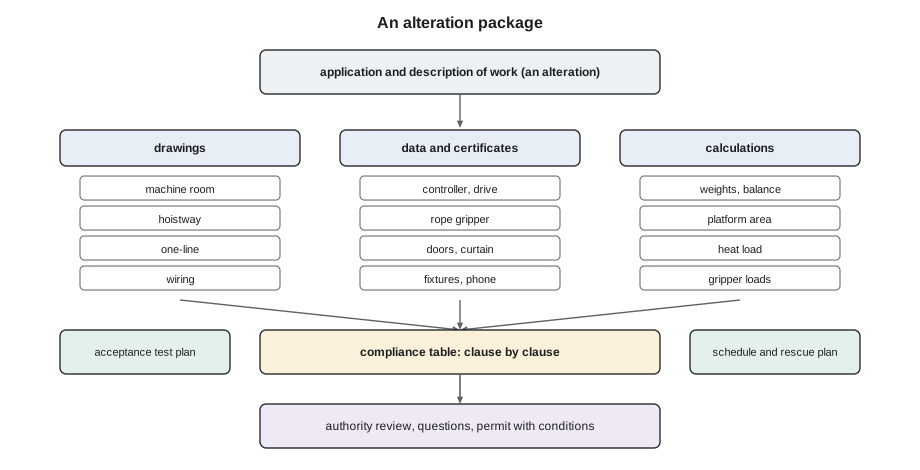
An alteration package has to let the authority understand the existing equipment, the work proposed, and how the altered elevator will meet the code. Priya's package for car 1 had seven parts. The application form and a description of the work, written in the code's terms as an alteration of an electric traction elevator, listing every item. Drawings: the machine room layout with the new equipment and working clearances, a hoistway section with clearances and the new devices, the one-line electrical diagram and the controller maker's wiring diagrams. Equipment data and certificates for the controller, the drive, the rope gripper, the door operator and light curtain, the fixtures and the emergency phone. Calculations: the car weight before and after, the counterweight change, the inside net platform area against the capacity table, the machine room heat load and the rope gripper loads. A compliance table, listing each clause that applied and how it was met. An acceptance test plan. And a schedule, with the car's out-of-service period and the arrangements for tenants while only car 2 ran.
How Moira read it
Moira read the package in the order an inspector does, which is not the order it was written. She started with the description of work and the edition: what is being altered, and to which code. Then she went to the compliance table to see whether the clauses listed matched the alteration items in section 8.7 and their related requirements. Only then did she open the drawings and data, checking each claim in the compliance table against the document it pointed to. “The table is the package,” she said. “Everything else is evidence for the table. If a line in the table points to a drawing that does not show it, that line is a finding.” As she went, Tamsin wrote each finding with a number, the clause or document involved, what was wrong, and what would fix it.
Moira's first question stopped the review for ten minutes. The compliance table cited clause numbers from the 2019 edition of B44, which Northcrest's office copy happened to be, but the edition adopted in British Columbia was B44-16 with the province's amendments. Most of the clause numbers were the same, but not all, and two of the requirements Priya had cited were worded differently in the 2016 edition. (The compliance table was headed with chapter 296-96 WAC and L&I's form references, copied from a Northcrest job outside the city, but Tillicum is in Seattle, where SDCI administers the city's own elevator code. The edition was the same, but the city's amendments and forms were different, and two of the requirements Priya had cited were amended locally.) The first finding was therefore the foundation of everything else: the table had to be redone against the edition and amendments that actually applied.
The findings
By the end of the day Tamsin had eleven findings. Some were paperwork; some were real gaps that would have failed the acceptance inspection or, worse, left a hazard in place. She sorted them into three groups for Priya: errors in the package that only needed correcting, missing work that had to be added to the job, and questions to put to the authority in writing before submission.
| No. | Finding | Group | Resolution |
|---|---|---|---|
| 1 | compliance table against the wrong edition or amendments | package error | redo the table against the adopted edition and local amendments |
| 2 | rope gripper model rated for a rope diameter range that does not include car 1's ropes | package error | select the model rated for car 1's rope size; new certificate |
| 3 | car lighting shown fed from the new controller on one drawing | package error | show the separate car lighting circuit and disconnect throughout |
| 4 | door timing values left blank in the controller parameter sheet | package error | enter the notification times from lesson 9 and the car call time |
| 5 | no code data plate in the materials list | package error | add the new code data plate |
| 6 | car top guardrail not in the work list | authority question | ask whether the alteration brings it in; propose to add it |
| 7 | pit stop switch relocation shown as an owner option | missing work | make it firm work; it is a safety correction |
| 8 | fixed pit ladder conflicts with the counterweight guard | authority question | propose an alternative ladder position; request a variance if needed |
| 9 | machine room ventilation fan not on the drawings | missing work | add the fan, sensor and louvre, with the mechanical engineer's sizing |
| 10 | fire alarm interface test without the fire alarm technician | package error | add the technician and a joint test step |
| 11 | no rescue plan for car 2 while car 1 is out of service | missing work | add a single-car rescue and response plan to the schedule |
Finding 2 was the one that made Priya wince. The rope gripper data sheet listed a range of rope diameters, and car 1's 13 mm (1/2 in) ropes sat just outside the range of the model in the package, which had been copied from a quote for a smaller car. A rope gripper rated for a different rope may not grip with the force its certification assumes, and it was exactly the kind of error an inspector would find on the acceptance day, with the car stripped and the tenants waiting. Finding 7 was the one Ray cared about most: the far-wall pit stop switch had been in the package as an optional extra, and he wanted it out of the options list and into the job, whatever the code edition said, because the next mechanic to enter that pit would be exposed for the length of the pit before reaching it.
# Compliance table summary: count statuses and list what stops submission
rows = [
    ("8.7 alteration items listed", "complies"), ("2.26 control circuits", "complies"),
    ("2.19 ascending car and unintended movement", "open: finding 2"), ("2.27 fire service and communication", "open: finding 10"),
    ("2.14 car enclosure and lighting", "open: finding 3"), ("2.16 capacity and loading", "complies"),
    ("2.7 machine room environment", "open: finding 9"), ("2.2 pit access and stop switch", "open: findings 7, 8"),
    ("2.14 car top guardrail", "question to authority: finding 6"), ("door timing and accessibility", "open: finding 4"),
    ("8.9 code data plate", "open: finding 5"), ("edition and amendments", "open: finding 1"),
]
from collections import Counter
kinds = Counter(r[1].split(":")[0] for r in rows)
for k, n in kinds.items():
    print(f"{k:22} {n}")
blocking = [r for r in rows if not r[1].startswith("complies")]
print(f"{len(blocking)} of {len(rows)} lines must be closed before submission:")
for clause, status in blocking:
print(f" {clause:44} {status}")complies 3 open 8 question to authority 1 9 of 12 lines must be closed before submission: 2.19 ascending car and unintended movement open: finding 2 2.27 fire service and communication open: finding 10 2.14 car enclosure and lighting open: finding 3 2.7 machine room environment open: finding 9 2.2 pit access and stop switch open: findings 7, 8 2.14 car top guardrail question to authority: finding 6 door timing and accessibility open: finding 4 8.9 code data plate open: finding 5 edition and amendments open: finding 1
Questions to the authority
Two findings could not be settled by Northcrest alone. Finding 6 asked whether the controller alteration brought in a car top guardrail. Moira's reading was that a guardrail was not on the list of related requirements for a controller alteration in the edition that applied, but that the new car top inspection station, which was on the list, came with requirements for the car top that the old gap made hard to meet; she advised asking. Finding 8 was a conflict between two requirements: the pit was deep enough to need a fixed ladder, but the only place a ladder could go, beside the hoistway door, was where the counterweight guard ran, and the ladder would have had to cut into the guard or leave too little clearance. The choices were a ladder in a different position, which would mean a mechanic stepping across the counterweight run, or a variance allowing a retractable ladder at the door that met the ladder's strength and clearance requirements when deployed.
Priya wrote both questions in the authority's preferred form, each with a sketch, the clauses involved, the proposed solution and the reason for it. Technical Safety BC's safety officer replied within two weeks: the car top guardrail was to be provided, as a condition of the permit, because the alteration created a new car top operating position; and a variance would be considered for the retractable ladder, with the maker's data. (SDCI's plan reviewer replied within two weeks: the car top guardrail was to be provided, as a condition of the permit, because the alteration created a new car top operating position; and a modification would be considered for the retractable ladder, with the maker's data.) Both answers went into the package, the letters filed with the permit records.
Putting the package right
The corrections took a week. Priya redid the compliance table against the adopted edition and amendments, line by line, with Tamsin reading each clause aloud from the correct book while Priya checked the drawing it pointed to. The rope gripper was changed to the model rated for car 1's ropes, with its new certificate and data sheet, and the machine room drawing was updated for its slightly larger footprint. The electrical drawings were made consistent, with the car lighting circuit shown on its own disconnect everywhere. The controller parameter sheet got its door times. The materials list gained the code data plate, the car top guardrail, the ventilation fan and louvre, the pit stop switch and light switch at the door, a pit receptacle on a building circuit and the retractable ladder. The test plan gained a joint step with the fire alarm technician and a line for timing the door notification at the lobby. The schedule gained a page on car 2 operating alone: a mechanic on call within a set time for any entrapment, and a notice to tenants with the dates.
| Package section | Before review | After review |
|---|---|---|
| Edition and amendments | wrong reference | adopted edition and local amendments |
| Compliance table | 9 pages, 12 lines open | 11 pages, all lines closed or answered |
| Rope gripper | wrong rope range | correct model, new certificate |
| Car top | new station only | new station and guardrail, as a permit condition |
| Pit | stop switch optional | stop switch, light switch, receptacle, retractable ladder by variance |
| Machine room | no ventilation change | fan, temperature sensor and louvre added |
| Test plan | elevator steps only | joint fire alarm step and door timing added |
| Schedule | work dates only | single-car rescue plan and tenant notice |
What the review taught
At the end of the Saturday, Moira summed up the review for the class she would teach the following week, and Tamsin wrote it into her notebook as five lessons. Read the code that applies, not the code on your shelf: edition and amendments come first. Build the compliance table from the alteration list in section 8.7, not from memory, so that every related requirement is caught. Check every claim against its evidence, especially data copied from another job. Treat a safety problem as work, not as an option, whatever the edition says. And ask the authority in writing early, with a proposed answer, whenever two requirements collide or the code is unclear.
The package went in on time. Technical Safety BC issued the permit with two conditions, the car top guardrail and the ladder variance terms, and set a date for the acceptance inspection after the work. The work itself, the strip-out of the motor-generator set and relay controller, the installation of the new equipment, the adjustment and the acceptance tests, belongs to the next two courses: ELV-420 covers the inspections, tests and maintenance control program that the code requires, and ELV-430 covers the modernization and troubleshooting work that turns a permit into a running car.
Worked problem
Writing a finding the reader can act on
Tamsin's first draft of finding 2 read “Rope gripper wrong.” Priya sent it back. Rewrite it.
Show solution
- Say where: the rope gripper data sheet and certificate in section 3 of the package, and the machine room drawing.
- Say what is wrong and why it matters: the model's certified rope diameter range does not include car 1's 13 mm (1/2 in) ropes, so its certified gripping performance does not apply.
- Cite the requirement: the ascending car overspeed and unintended movement protection clauses in 2.19, and the device's certification.
- Say what fixes it: select the model certified for car 1's rope size and load, replace the data sheet and certificate, and update the drawing for its footprint.
Answer: A finding names the document, the problem and its consequence, the clause, and the fix, so that anyone can act on it without asking.
Common mistakes
MistakeReviewing a package in the order it was written.
InsteadStart with the edition and the description of work, then the compliance table, then the evidence.
MistakeCopying device data from another job.
InsteadCheck every model, rating and certificate against this car.
MistakeListing a safety correction as an owner option.
InsteadMake safety corrections firm work.
MistakeSettling a conflict between requirements on site.
InsteadAsk the authority in writing before submission, with a proposed solution.
MistakeWriting findings without the clause or fix.
InsteadGive the document, the problem, the clause and the fix.
Summary and key terms
- An alteration package contains the application and description of work, drawings, equipment data and certificates, calculations, a compliance table, an acceptance test plan and a schedule.
- The compliance table is the core; every line points to evidence that must actually show the claim.
- The Tillicum review found eleven items: package errors, missing work and questions for the authority, beginning with the wrong edition reference.
- Conflicts and unclear requirements went to the authority in writing, with sketches and proposed solutions; the answers became permit conditions and a variance.
- The corrected package was accepted with conditions; the work and the acceptance tests follow in ELV-420 and ELV-430.
- Alteration package
- The application, drawings, data, calculations, compliance table, test plan and schedule submitted for an alteration permit.
- Compliance table
- A clause-by-clause list showing how the altered equipment will meet each applicable requirement.
- Finding
- A recorded problem in a package or installation, with its location, clause and fix.
- Permit condition
- A requirement the authority attaches to a permit.
- Acceptance test plan
- The list of tests to be run before the altered equipment returns to service.
- Variance
- Permission from the authority to meet a requirement another way.
Practice problems
Work each problem on paper first, then reveal the answer to check.
What did Moira read first in the package?
Show answer
The description of work and the edition and amendments it was written to.
Why was the rope gripper finding serious?
Show answer
The model's certified rope range did not include car 1's ropes, so its certified performance did not apply.
How should a conflict between the pit ladder rule and the counterweight guard be handled?
Show answer
By asking the authority in writing with a proposed solution, such as a variance for a retractable ladder.
What makes a finding useful?
Show answer
It gives the document, the problem and why it matters, the clause, and the fix.
Which courses cover the work and tests after the permit?
Show answer
ELV-420 and ELV-430.
Lesson quiz · 5 questions
Score 60% or more to complete this lesson.
Create a free account to save your progress, take quizzes and earn a certificate.