
ELV-410 · Lesson 11 of 12 · 21 min
Alterations, repairs and replacements
When Priya first described the Tillicum job to the owner, she used the word modernization. When she wrote the permit application, she used a different word: alteration. “Modernization is a sales word,” she told Tamsin. “The code does not use it. The code asks one question about any work on existing equipment: is it maintenance, a repair, a replacement or an alteration? The answer decides whether you need a permit, which edition the work must meet, what else the work brings with it, and what tests you run before the car goes back in service.” This lesson covers the definitions that sort work into those categories, the rules for repairs and replacements in Part 8's maintenance section, the alteration requirements in section 8.7, and how the Tillicum work was sorted.
Four kinds of work
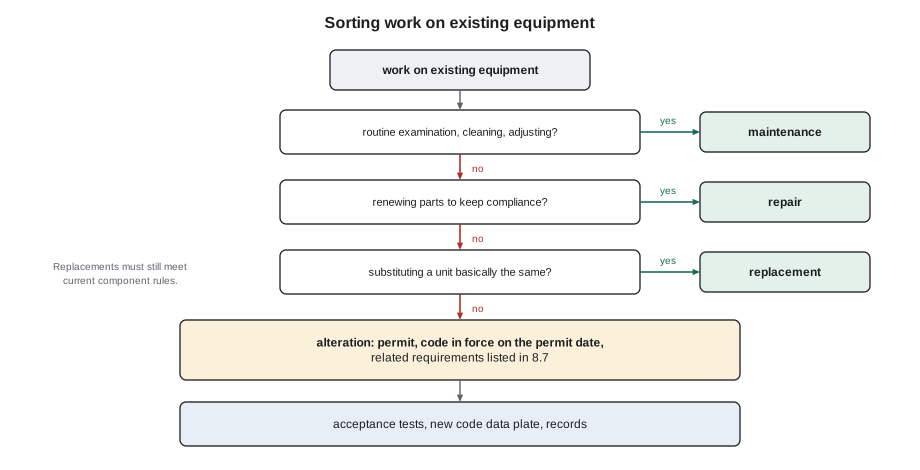
Maintenance is the routine work of keeping equipment in its approved condition: examining, lubricating, cleaning, adjusting and testing, under a maintenance control program, as ELV-420 will cover. A repair, in the code's definition, is reconditioning or renewing parts as needed to keep the equipment in compliance with the code that applies to it; replacing worn guide shoe liners, rewinding a motor or rebuilding a valve are repairs. A replacement is the substitution of a device, component or subsystem, in its entirety, with a unit that is basically the same as the original, for the purpose of preserving compliance; replacing a hoist rope set with ropes of the same kind, or a door operator with an equivalent one, can be a replacement. An alteration is any change to equipment other than maintenance, repair or replacement: something that changes what the equipment is or how it works, such as a new controller of a different kind, a new drive, a change in speed, load or travel, or a heavier car.
The definitions sound tidy, but the boundaries are where the arguments happen. A new controller from the same maker, built to the same design, might be argued to be a replacement; a microprocessor controller in place of a relay controller certainly is not. A door operator that is basically the same is a replacement, but one that changes the door's speed, closing force or reopening device is something more. Part 8 lists many specific cases, and where a job is not clearly covered, the authority decides. Priya's rule of thumb, borrowed from Moira, was that if the work changes the design, it is an alteration until the authority says otherwise.
Repairs and replacements
Part 8's maintenance section sets rules for repairs and replacements. Repairs must use parts of at least equal material and strength to the original and must not change the design. Replacements must be basically the same as the original and, for many components, must meet requirements of the current code even though the elevator as a whole stays under its installation edition: replacement ropes must meet the current rope requirements, a replacement governor must have the markings the current code requires, a replacement door operator must meet the current door force and energy limits. The code lists, component by component, what a replacement must comply with. Many replacements also require tests before the elevator goes back in service, such as a governor tripping test after a governor replacement or a brake test after brake work, and some jurisdictions require a permit or notification for certain replacements.
The point of these rules is to stop old equipment being kept going with parts that would not be accepted on a new installation, without forcing a full upgrade every time something is replaced. When Tillicum car 1's ropes were replaced in ELV-230, the new ropes met the current rope rules, the rope data tag was replaced, and the tests and records were done as the replacement rules required; the car's code edition did not change.
| Work | Category | Why |
|---|---|---|
| Lubricating the guide rails | maintenance | routine work in the maintenance control program |
| Rebuilding the brake with new linings of the same type | repair | renewing parts to keep compliance |
| New hoist ropes of the same kind, same number | replacement | substitution basically the same as the original |
| New microprocessor controller in place of a relay controller | alteration | changes the design of the control system |
| Removing the motor-generator set and adding a static drive | alteration | changes the drive and power system |
| New cab interior that adds weight | alteration if the weight change is beyond the listed limit | changes the car's design load |
| Increasing rated speed | alteration | changes the elevator's rating |
Alterations: section 8.7
Section 8.7 covers alterations, with subsections for electric elevators, hydraulic elevators, escalators and moving walks, and other equipment. Its general rules say that an altered installation must be made to comply with the code in force on the date of the alteration permit for the parts altered, and it lists, for each kind of alteration, the related requirements the alteration brings with it. For example, the clauses on electric elevators list alterations such as changes to the hoistway enclosure, the car enclosure, the car frame and platform, the rated load, the speed, the travel, the driving machine, the brake, the controller, the type of operation and the power supply, and for each one they state which other sections must be met. Some items bring in only the requirements for the altered part; others bring in a long list of related upgrades, because the alteration changes the conditions under which other devices work.
Replacing the controller is one of the alterations with the longest list, because the controller governs almost everything the car does. Depending on the edition, a controller alteration typically brings in the current requirements for the control and operating circuits, the electrical protective devices, inspection operation and car top operating devices, hoistway access, door operation and its protection, firefighters' emergency operation, emergency communication, terminal stopping devices, ascending car overspeed and unintended movement protection, and the machine brake's monitoring. That is why the Tillicum package, which began as new controls, ended up touching the car top station, the doors, the fire service, the phone and the ropes.
# Sort the Tillicum work list and list the related requirements each alteration brings in
# (an illustrative summary of a controller and drive alteration; the package cites the adopted edition)
work = [
    ("replace relay controller with a microprocessor controller", "alteration"),
    ("replace motor-generator set with a static DC drive", "alteration"),
    ("new car door operator and full-height light curtain", "alteration"),
    ("new cab interior, weight change within the listed limit", "replacement"),
    ("new hall and car fixtures", "alteration"),
    ("new car top inspection station", "required by the controller alteration"),
    ("relubricate machine and governor", "maintenance"),
]
brings_in = {
    "replace relay controller with a microprocessor controller": [
        "control and operating circuits, protective devices (2.26)", "inspection and car top operation",
        "firefighters' operation and emergency communication (2.27)", "ascending car and unintended movement protection (2.19)",
        "terminal stopping devices (2.25)", "brake monitoring"],
    "new car door operator and full-height light curtain": ["door force and kinetic energy limits", "door protection"],
    "new hall and car fixtures": ["accessibility requirements for the altered fixtures", "signals and jamb markings"],
}
for item, kind in work:
    print(f"[{kind}] {item}")
    for req in brings_in.get(item, []):
print(f" brings in: {req}")[alteration] replace relay controller with a microprocessor controller
brings in: control and operating circuits, protective devices (2.26)
brings in: inspection and car top operation
brings in: firefighters' operation and emergency communication (2.27)
brings in: ascending car and unintended movement protection (2.19)
brings in: terminal stopping devices (2.25)
brings in: brake monitoring
[alteration] replace motor-generator set with a static DC drive
[alteration] new car door operator and full-height light curtain
brings in: door force and kinetic energy limits
brings in: door protection
[replacement] new cab interior, weight change within the listed limit
[alteration] new hall and car fixtures
brings in: accessibility requirements for the altered fixtures
brings in: signals and jamb markings
[required by the controller alteration] new car top inspection station
[maintenance] relubricate machine and governorTamsin's list was a working summary for the package, not a quotation of the code: the actual list for each alteration item is in section 8.7 of the edition in force on the permit date, and the package's compliance table cited each clause. Several items were close calls. The cab weight change was within the limit for a replacement of the enclosure, so the car frame and platform did not have to be re-rated, but the counterweight was rebalanced anyway, as lesson 6 described. The new hall fixtures were an alteration of their own, bringing in the accessibility rules of lesson 9.
What alterations bring with them
Beyond the listed related requirements, an alteration brings three things. It brings a permit: alterations need one before work starts, with drawings, data and a description of the work, and the authority may review the package in detail. It brings acceptance tests: after an alteration, the tests in the acceptance section of Part 8 that relate to the altered parts must be run, witnessed or reviewed as the authority requires, before the car returns to service; for a controller alteration this usually means most of the tests a new installation would get, including the safety test, the buffer test where relevant, the brake test and the full set of electrical protective device and fire service tests. And it brings a new code data plate, showing the edition the alteration was made to, so that the next inspector knows which rules apply to which parts.
Alterations can also bring retroactive items that the owner has been able to defer. In some jurisdictions, an alteration permit is the point at which outstanding orders or existing-equipment upgrades must be completed. Lesson 4's pit findings, the far-wall pit stop switch, the pull-chain pit light and the missing ladder, were not strictly triggered by the controller alteration, but Priya listed them in the package as work to be done at the same time, with the owner's approval, because the inspector would see them during the acceptance inspection and because two of them were safety problems in any case.
Escalators and hydraulics
The same structure applies to other equipment. Section 8.7's hydraulic subsection lists alterations such as replacement of the cylinder, the plunger, the pump unit, the valve and the controller, and states what each brings in; replacing a cylinder, the work that the British Columbia safety order on single-bottom cylinders described in ELV-220 pushed many owners into, comes with requirements for the new cylinder's protection and safety bulkhead. The escalator subsection covers changes to the truss, drive, steps, handrails and controls. When the Brackenridge escalators in ELV-330 receive new controllers, the escalator alteration rules will set what else must be upgraded, from brakes to the step and skirt devices.
Worked problem
Is this a replacement or an alteration?
A building on Route 7 asks Northcrest to replace a failed door operator on a 1985 car with the current model from the same maker. The new operator has a different motor and electronic control, and the maker says it gives the same door times and forces.
Show solution
- The work substitutes a complete door operator, so the question is whether it is basically the same as the original.
- A different motor and control system change the design, even if the performance is similar; the code's list of alterations and replacements, and the authority, decide.
- As a replacement it would still have to meet the current door force and kinetic energy limits and pass the door tests; as an alteration it would need a permit and might bring in door protection upgrades.
- Tamsin's answer is to check the maintenance section's list of replacements for door operators in the adopted edition and, if it is not clearly a replacement, to ask the authority before ordering.
Answer: It may be either; check the adopted edition's rules for door operator replacement and ask the authority in writing before starting.
Common mistakes
MistakeCalling a job a modernization on the permit application.
InsteadUse the code's categories: maintenance, repair, replacement or alteration.
MistakeAssuming a replacement part can be to the old code.
InsteadMany replacements must meet current requirements for that component.
MistakeTreating an alteration as affecting only the part changed.
InsteadSection 8.7 lists related requirements each alteration brings in.
MistakeReturning an altered car to service without acceptance tests.
InsteadRun the acceptance tests for the altered parts first.
MistakeLeaving the old code data plate after an alteration.
InsteadInstall a new code data plate showing the edition the alteration met.
Summary and key terms
- Work on existing equipment is maintenance, repair, replacement or alteration, as defined in the code.
- Repairs renew parts without changing the design; replacements substitute a unit basically the same as the original, and must meet the current requirements listed for that component.
- Alterations are any other change; they need a permit and must meet the code in force on the permit date for the altered parts.
- Section 8.7 lists alteration items and the related requirements each brings in; a controller alteration brings in many.
- Alterations end with acceptance tests and a new code data plate, and may be the point at which outstanding upgrades are made.
- Repair
- Reconditioning or renewing parts to keep equipment in compliance with the code that applies to it.
- Replacement
- Substituting a device or component in its entirety with one basically the same as the original.
- Alteration
- Any change to equipment other than maintenance, repair or replacement.
- Related requirement
- A requirement that section 8.7 says an alteration brings with it.
- Code data plate
- The plate showing the code edition equipment was installed or altered to.
- Modernization
- A trade term for upgrading old equipment; in the code it is usually an alteration.
Practice problems
Work each problem on paper first, then reveal the answer to check.
Is replacing ropes with the same kind and number a repair, replacement or alteration?
Show answer
A replacement.
Which edition must an alteration meet?
Show answer
The edition in force on the date of the alteration permit, for the parts altered and related requirements.
Name three requirements a controller alteration typically brings in.
Show answer
Control circuit and protective device requirements, firefighters' operation, and ascending car and unintended movement protection; also inspection operation and emergency communication.
What plate changes after an alteration?
Show answer
The code data plate, to show the edition the alteration was made to.
Who decides when a job is not clearly a replacement?
Show answer
The authority having jurisdiction.
Lesson quiz · 5 questions
Score 60% or more to complete this lesson.
Create a free account to save your progress, take quizzes and earn a certificate.