
ELV-410 · Lesson 10 of 12 · 22 min
Emergency operation, communication and seismic requirements
Moira opened the evening on emergencies with a question: what is the elevator supposed to do when things go wrong in the building rather than in the elevator? A fire on the eighth floor, a power failure, an earthquake, a passenger trapped between floors at two in the morning. “Most of the elevator code is about keeping the equipment from hurting people,” she said. “Section 2.27 and the seismic requirements in Part 8 are about what the elevator does for people when the building is in trouble.” Tillicum car 1 had almost none of the modern features: an alarm bell, a 1998 recall relay that ELV-310 had found undocumented, and a telephone in a cabinet that only worked by voice. This lesson covers the code's requirements for emergency communication and signals, emergency and standby power, firefighters' emergency operation, related building code features, and the seismic requirements that matter in Vancouver (Seattle), and how they shaped the Tillicum package.
Emergency communication and signals
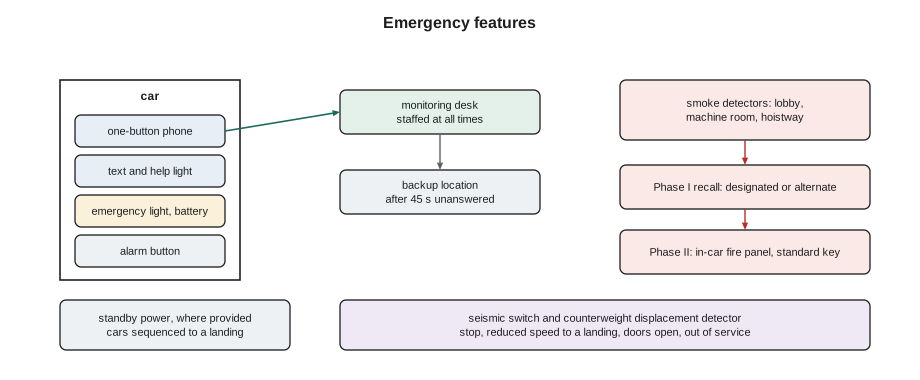
Every passenger elevator must have a two-way emergency communication means in the car that connects to a location staffed by people who can take action, at all times the elevator is in service. The person in the car must be able to activate it with one button, without a handset to lift, and it must identify the building and the car to the person who answers. If a call is not acknowledged within a set time, 45 seconds (45 seconds) in the editions Tamsin read, it must be rerouted automatically to a backup location. Recent editions add requirements for people who cannot hear or speak: the system must be usable without voice, must show visibly when the call has been received and when help is on the way, and in newer installations must support text or video communication with the person answering. The communication system must have standby power so that it keeps working when normal power fails, for four hours in current editions, and it must be tested regularly.
There must also be an emergency alarm, a button in the car that sounds an audible signal in the building, and in many buildings a means of communication between the car and the machine room or the fire command centre for firefighters. In taller buildings the code requires a separate means for emergency personnel to talk to the car, and building codes may require emergency responder radio coverage in hoistways and lobbies; the 2025 edition of the elevator code added provisions on radio coverage. The Tillicum package proposed a new car phone with a text display, a help-on-the-way indicator and a link to Northcrest's monitoring centre, with automatic rerouting to an answering service, and a battery sized for the standby time.
Emergency and standby power
The elevator code does not require a building to have a generator; the building code decides which buildings need standby power for their elevators, usually high-rise buildings and buildings where elevators are part of the evacuation plan. Where standby power is provided, the elevator code sets how the cars use it. When normal power fails and the generator starts, the cars must be brought to a designated landing one or more at a time, so that the generator is not overloaded, and then one or more selected cars may be returned to normal service on the generator. A selector switch, usually in the lobby or the fire command centre, lets firefighters or building staff choose which car runs. ELV-310 described the sequence at Holloway, the hospital, where every car is on the generator. Regardless of standby power, the code requires battery-backed car emergency lighting and communication, covered in lessons 6 and 8.
Tillicum has no generator. Without standby power, a power failure stops car 1 wherever it is, with its emergency light and phone on battery, and passengers wait for a mechanic or firefighters to release them. Some owners add a battery rescue unit that brings the car to the nearest landing on its own battery power and opens the doors. The Tillicum owner asked about it; the package listed it as an option the new controller could support, outside the code requirements.
# Emergency communication: standby time and call rerouting (summary of the requirements)
battery_wh = 24                 # rated energy of the phone's standby battery
standby_w, call_w = 1.6, 6.0     # watts idle and during a call
hours_needed, call_minutes = 4.0, 30   # four hours of standby with a half-hour call at the end
usable = battery_wh * 0.8          # allow for ageing
need = standby_w * (hours_needed - call_minutes / 60) + call_w * call_minutes / 60
print(f"needs {need:.1f} Wh, usable {usable:.1f} Wh:", "ok" if usable >= need else "battery too small")
# call handling: a call not acknowledged in 45 s rolls over to the backup location
answer_times = {"monitoring centre, day": 12, "monitoring centre, night": 51, "test call after change": 38}
for case, t in answer_times.items():
    route = "answered at primary" if t <= 45 else "rerouted to backup at 45 s"
print(f"{case:26} {t:3d} s {route}")needs 8.6 Wh, usable 19.2 Wh: ok monitoring centre, day 12 s answered at primary monitoring centre, night 51 s rerouted to backup at 45 s test call after change 38 s answered at primary
The night answer time in Tamsin's table came from a real test call at Larchmont the month before, when the monitoring centre had been short-staffed; the call had rolled over correctly to the answering service. The code requires the rollover precisely because the first location will sometimes be slow.
Firefighters' emergency operation
Firefighters' emergency operation, which ELV-310 and ELV-320 covered in detail, is one of the most closely specified parts of the code. Phase I recalls the cars to the designated landing, or to an alternate landing if the fire is at the designated floor, when a smoke detector in a lobby, machine room or hoistway operates or when the lobby key switch is turned. The cars are then out of normal service, with their doors open at the recall floor. Phase II lets a firefighter in the car operate it from the in-car fire panel with a key, with door operation and car calls under the firefighter's control and a set of rules for what happens at each step. The code prescribes the switches and their positions, the key, which must be the standard fire service key so that firefighters can use any elevator, the signs and instructions, the visual signal that flashes when the machine room or hoistway detector has operated, and the tests.
Some details differ between the two countries, because the fire services and building codes differ. In the harmonized code, the clauses for jurisdictions enforcing the National Building Code of Canada and for other jurisdictions set out these differences, and local fire departments may have their own expectations about switch locations and recall floors. In British Columbia, Technical Safety BC and the local fire department both have an interest; the 2014 safety order on firefighters' key switches, rescinded in 2026, showed how a retroactive rule can reach every elevator in a province. (In Seattle, SDCI and the Seattle Fire Department both have an interest, and the fire department's expectations for recall floors and lobby panels are part of plan review.) For Tillicum, the new controller would provide full Phase I and Phase II operation to the current edition, replacing the undocumented 1998 relay, with new lobby and in-car switches and a new fire panel.
| Feature | Purpose | Tillicum car 1 now | After the package |
|---|---|---|---|
| Phase I recall | clear the cars and bring them to the recall floor | undocumented relay, designated floor only | full Phase I, designated and alternate floors |
| Phase II | firefighter control from the car | none | in-car fire panel with standard key |
| Visual signal in car | warns of fire in machine room or hoistway | none | fire hat signal |
| Two-way communication | passenger to staffed location | voice-only phone in a cabinet | one-button phone with text and help indicator |
| Rerouting | backup if not answered | none | automatic after the set time |
| Standby power | keep phone and light working | phone on building power | battery-backed phone and light |
| Seismic operation | safe response to an earthquake | none | seismic switch and displacement detector |
Occupant evacuation and fire service access
Building codes now allow, and in some tall buildings require, elevators to be used for evacuation and by firefighters during a fire, which reverses the old rule that elevators must never be used in a fire. A fire service access elevator is one designed for firefighters to use, with a protected lobby, a protected hoistway and machine room, standby power and water protection. Occupant evacuation operation lets the cars evacuate occupants automatically from the floors affected by a fire, with signs and announcements in the lobbies. The elevator code contains the elevator-side requirements for these, in recent editions, but whether a building has them is a building code decision made when the building is designed. Tillicum, a 1962 office building, has neither, and a modernization does not add them; Quayside, a new tower, was designed with one fire service access elevator in its group.
Seismic requirements
Vancouver (Seattle) sits in a region where large earthquakes are expected, and the code's seismic requirements, in Part 8, apply to new elevators in buildings in areas of significant seismic risk, as defined by the building code. Their aim is to keep the counterweight and car in their rails, keep ropes on their sheaves, keep machines and controllers anchored, and stop the elevator in a safe way when an earthquake happens. They require rail brackets, rails and fastenings designed for seismic forces; retainers on counterweight frames and car frames that keep them on the rails if the guide shoes fail; rope retainers on sheaves; guards against snag points in the hoistway where ropes and travelling cables could catch; anchorage of machines, controllers and other equipment; and, on hydraulic elevators, support of piping and protection of the cylinder.
The code also requires seismic operation. A seismic switch, which senses ground motion, and a counterweight displacement detector, which senses that the counterweight has left its rails, tell the controller that an earthquake has occurred. The controller then stops the car, and, depending on which device operated and where the car is, moves it at reduced speed, away from the counterweight if it may be displaced, to the nearest landing, opens the doors and removes the car from service until a mechanic has inspected it and reset the system. A car that runs normally after an earthquake, with its counterweight out of the rails, can strike the counterweight in the hoistway; seismic operation is designed to prevent exactly that.
# Seismic operation logic, simplified, for a traction car
def seismic_response(seismic_switch, cwt_displaced, car_moving, near_counterweight):
    steps = []
    if not (seismic_switch or cwt_displaced):
        return ["normal service"]
    if car_moving:
        steps.append("stop the car")
    if cwt_displaced and near_counterweight:
        steps.append("move at reduced speed away from the counterweight to the nearest landing")
    else:
        steps.append("move at reduced speed to the nearest landing")
    steps += ["open the doors", "remove from service until inspected and reset by a mechanic"]
    return steps
cases = {
    "seismic switch only, car moving": (True, False, True, False),
    "counterweight displaced, car passing it": (True, True, True, True),
    "no event": (False, False, True, False),
}
for name, args in cases.items():
    print(name + ":")
    for s in seismic_response(*args):
print(" ", s)seismic switch only, car moving:
stop the car
move at reduced speed to the nearest landing
open the doors
remove from service until inspected and reset by a mechanic
counterweight displaced, car passing it:
stop the car
move at reduced speed away from the counterweight to the nearest landing
open the doors
remove from service until inspected and reset by a mechanic
no event:
normal serviceThe real logic is more detailed, with rules on speed, direction and which device takes precedence, and it is part of the certified controller. What the mechanic must know is what the car will do, why, and how to inspect and reset it afterward.
Tillicum car 1 was installed long before the seismic requirements existed. The package had to decide which seismic items the alteration brought in, a question for lesson 11. The new controller would include seismic operation as standard, so Priya proposed adding a seismic switch in the machine room and a counterweight displacement detector, and checking the counterweight frame for retainers and the sheaves for rope retainers, with the work listed whether or not the alteration rules strictly required all of it.
Worked problem
Testing emergency communication at acceptance
Tamsin is writing the acceptance test steps for car 1's new emergency phone. What must the tests show?
Show solution
- Pressing the one button in the car connects to the monitoring centre, which can identify the building and car.
- The person in the car can communicate without voice, and the visual indicator shows when the call is received and when help is on the way.
- An unanswered call reroutes automatically to the backup location after the set time.
- With normal power off, the phone still works on its standby battery, and the battery is sized for the standby time.
Answer: The tests prove one-button connection, identification, non-voice use and visual acknowledgment, rerouting and battery operation.
Common mistakes
MistakeLeaving a voice-only phone in a modernized car.
InsteadCurrent editions require communication usable without voice and visual acknowledgment.
MistakeAssuming the code requires a generator.
InsteadThe building code decides; the elevator code sets how cars use standby power when it exists.
MistakeResetting a car after an earthquake without inspecting it.
InsteadInspect the counterweight, rails, ropes and equipment before reset.
MistakeUsing a building's own key for fire service switches.
InsteadFire service switches use the standard fire service key.
MistakeTesting the phone only on normal power.
InsteadTest it with normal power off, on its standby battery.
Summary and key terms
- Every passenger car needs one-button two-way communication to a staffed location, with automatic rerouting, non-voice use, visual acknowledgment and four hours of standby in current editions.
- Where the building code provides standby power, cars are brought down in sequence and selected cars run on the generator.
- Firefighters' emergency operation recalls cars on Phase I and gives firefighters control on Phase II, with standard keys, signs and signals.
- Fire service access elevators and occupant evacuation operation are building code features with elevator-side requirements in the code.
- In seismic regions, Part 8 requires rail, frame and sheave retainers, anchorage, snag point guards and seismic operation that brings the car to a landing and removes it from service.
- Two-way emergency communication
- The means in the car to call and talk or text with a staffed location.
- Rerouting
- Automatic transfer of an unanswered emergency call to a backup location.
- Designated landing
- The main recall floor for Phase I.
- Fire service access elevator
- An elevator designed for firefighters to use during a fire.
- Seismic switch
- A device that senses ground motion and starts seismic operation.
- Counterweight displacement detector
- A device that senses that the counterweight has left its rails.
Practice problems
Work each problem on paper first, then reveal the answer to check.
How long may an emergency call go unanswered before it reroutes, in the editions Tamsin read?
Show answer
45 seconds.
What decides whether a building needs standby power for elevators?
Show answer
The building code.
What does Phase I do?
Show answer
Recalls the cars to the designated or alternate landing and removes them from normal service.
Name two devices that start seismic operation.
Show answer
The seismic switch and the counterweight displacement detector.
Why move away from the counterweight after a displacement?
Show answer
So the car does not strike a counterweight that has left its rails.
Lesson quiz · 5 questions
Score 60% or more to complete this lesson.
Create a free account to save your progress, take quizzes and earn a certificate.