
ELEC-420 · Lesson 10 of 12 · 25 min
The commissioning process: planning, testing and handover
Commissioning is the systematic process of verifying that a new or modified installation is installed correctly, performs as designed and meets the owner's requirements, and that the people who will operate and maintain it have the information and training they need. It is the counterpart of troubleshooting: instead of finding faults after something fails, commissioning finds them before the building opens or the plant starts producing, when they are cheaper and safer to fix. This lesson covers why commissioning matters, the roles involved, the stages from planning through pre-functional checks to functional and integrated testing, start-up procedures for electrical systems, documentation and handover, and the special case of retro-commissioning existing facilities.
Why commissioning matters
Modern facilities contain thousands of interconnected devices, and many problems only appear when systems operate together: a generator that starts but does not pick up its loads in the right sequence, a fire alarm that does not shut down the correct air handlers, a VFD set to the wrong motor data, a protective relay with factory default settings, a lighting control system whose occupancy sensors were never adjusted. Studies of commercial buildings have found that commissioning typically pays for itself through energy savings and avoided failures within a few years, and that buildings that were never commissioned frequently operate far below their design performance. In industrial settings, commissioning prevents equipment damage, unsafe conditions and costly delays at start-up.
Roles and documents
Commissioning involves several parties:
- The owner, who defines the owner's project requirements (OPR): what the facility must do, its performance expectations and operational needs.
- The designers, who prepare the basis of design (BOD), explaining how the design meets the OPR, and the drawings and specifications.
- The commissioning authority or commissioning provider (CxA), ideally independent of the designers and contractors, who plans and leads the process, reviews documents and witnesses tests.
- Contractors, including electricians, who install equipment, perform pre-functional checks and start-up, correct deficiencies and provide documentation.
- Manufacturers' representatives, who start up complex equipment such as generators, switchgear, UPS systems and drives.
- Operators and maintenance staff, who participate in testing and receive training.
The commissioning plan sets out the scope, schedule, responsibilities, test procedures and documentation requirements. Standards and guidelines such as ASHRAE Guideline 0 and Standard 202, CSA Z320 (Building commissioning) in Canada, and NETA acceptance testing specifications for electrical equipment provide frameworks.
Stages of commissioning
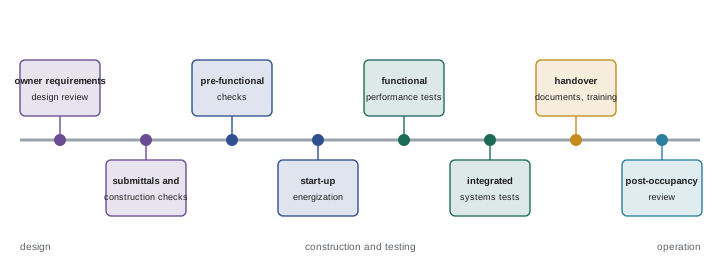
Commissioning ideally starts at the beginning of a project, not at the end:
- Pre-design and design: define the OPR, review design documents for commissionability (access for testing, adequate metering, test points), and write commissioning requirements into specifications.
- Construction: review submittals, inspect installation as it proceeds, and verify that equipment delivered matches what was specified.
- Pre-functional (static) checks: inspections and tests before energizing, confirming correct installation.
- Start-up: energizing equipment for the first time in a controlled sequence.
- Functional performance testing: verifying that each system operates correctly through all modes.
- Integrated systems testing: verifying that interconnected systems work together, especially life safety systems (ELEC-410 Lesson 11).
- Handover: documentation, training and transfer of responsibility.
- Post-occupancy: seasonal testing, warranty review and resolution of remaining issues, often 10 months after handover.
Pre-functional checks
Pre-functional checks confirm that equipment is installed correctly and safely before power is applied. For electrical systems, typical checklists include:
- Equipment matches the approved submittals: ratings, voltage, short-circuit rating, catalogue numbers.
- Physical installation: anchoring, clearances, working space, ventilation, cleanliness (debris inside switchgear is a classic cause of failures at first energization), and removal of shipping braces.
- Connections: terminations torqued to manufacturer specifications and marked, phasing and labelling correct, grounding and bonding complete.
- Insulation resistance of cables, busways and equipment (Lesson 3), continuity of grounding conductors, and polarity.
- Protective device settings applied according to the coordination study, not left at factory defaults.
- Arc flash and other labels installed, covers and barriers in place, and doors and interlocks working.
Each item is signed and dated by the person who checked it. Deficiencies are recorded in an issues log and tracked to resolution.
Start-up and energization
First energization of distribution equipment is a high-risk activity that requires a written energization plan. The plan identifies the sequence of switching, from the utility service through the main switchgear to feeders and panels; the people involved and their roles; communication methods; PPE; and checks at each step, such as verifying voltage and phase rotation before closing the next device. Equipment is energized with no load first, then loads are added progressively, with measurements of voltage, current, temperature and phase rotation at each stage. Motors are bumped to check rotation before connecting to driven equipment where possible. Generators, UPS systems and transfer switches are started by or with manufacturers' representatives according to their procedures. Keeping all non-essential people clear, closing doors on switchgear before operating it, and standing to the side during switching reduce risk.
Worked problem
Planning first energization of a panel
A new 600 A distribution panel fed from a main switchboard is ready for energization. List the key steps.
Show solution
- Confirm pre-functional checks are complete: torque, insulation resistance, grounding, breaker settings, labelling, and debris removed.
- Hold a job briefing; confirm all feeder breakers in the new panel are open and all covers are installed.
- Close the switchboard feeder breaker with the panel main open (if any), wearing PPE per the arc flash label and standing clear.
- Measure incoming voltages phase to phase and phase to neutral, and check phase rotation at the panel.
- Close the panel main, then energize branch circuits one at a time, checking for trips, and record readings on the start-up sheet.
Answer: Verify readiness, brief the team, energize step by step with measurements and record results.
Functional performance testing
Functional performance tests (FPTs) verify that systems operate correctly in every mode, not just that they turn on. Test scripts specify initial conditions, the actions to perform, the expected results and the actual results, with pass or fail. Electrical FPTs include, for example: transfer switch operation on loss of normal power, with timing and load pickup; generator load tests; UPS transfer to battery and back; lighting control sequences, including occupancy and daylight sensors and time schedules; ground-fault protection operation; metering accuracy; and motor control sequences with interlocks. Tests should include abnormal and failure conditions, such as loss of a sensor or a communication link, because that is when systems most often misbehave. Witnessing by the commissioning authority provides independent verification.
| Stage | Purpose | Electrical examples | Records |
|---|---|---|---|
| Pre-functional checks | Correct installation | Torque, IR tests, settings, labels | Signed checklists |
| Start-up | Safe first operation | Energization sequence, rotation, voltages | Start-up sheets |
| Functional tests | Correct performance in all modes | ATS transfer, lighting controls, GFPE | Test scripts with results |
| Integrated tests | Systems working together | Power failure with fire alarm and HVAC response | Integrated test reports |
| Handover | Operational readiness | O&M manuals, as-builts, training | Commissioning report |
Integrated systems testing
Integrated systems tests verify interactions across systems. A typical test in a hospital or high-rise is a simulated utility power failure: the normal supply is opened, and the team verifies that the generators start and transfer within the required time, that emergency lighting, fire alarm, fire pumps, elevators and critical HVAC behave as designed, that load shedding and restoration occur in sequence, and that the building returns to normal when utility power is restored. In Canada, CAN/ULC-S1001 describes integrated testing of fire protection and life safety systems; NFPA 4 serves the same purpose in the United States. These tests require extensive planning, coordination with occupants and authorities, and contingency plans if something fails.
Documentation and handover
A facility is not complete until it can be operated and maintained. Handover documentation includes as-built drawings reflecting all changes; operation and maintenance manuals with equipment data, settings and maintenance requirements; test reports and certificates; the coordination and arc flash studies with current settings; warranties; spare parts lists; and the commissioning report summarizing tests, issues and their resolution. Training for operators and maintenance staff covers normal operation, emergency procedures, safety, and routine maintenance, ideally recorded for future staff. Electricians contribute by keeping accurate records of changes throughout construction, which is far easier than reconstructing them at the end.
Retro-commissioning and recommissioning
Existing buildings drift from their intended performance as settings are changed, sensors fail and uses change. Retro-commissioning applies the commissioning process to a building that was never commissioned, and recommissioning repeats it periodically for one that was. Typical findings include lighting schedules that run around the clock, equipment running in hand mode, failed sensors, defeated controls, and protective device settings that no longer match the system. Fixes are often inexpensive, mainly adjustments and repairs, and produce significant energy savings and improved reliability.
Commissioning documentation in practice
Commissioning generates a large volume of documents, and managing them well is part of the job. Electronic commissioning platforms are now common: checklists and test scripts are completed on tablets, with photos, signatures and time stamps, and issues are logged and assigned automatically. This makes progress visible to the whole project team and produces a complete record at handover. Electricians should expect to complete checklists for every piece of equipment they install, and to fix and close issues assigned to them. Accuracy matters: a checklist signed without the work being done can hide problems that surface later at much greater cost, and in regulated facilities such as hospitals it can have legal consequences.
Seasonal and deferred testing
Some systems cannot be fully tested at handover. Heating systems cannot be tested at full capacity in summer, cooling systems in winter, and daylight-responsive lighting controls need sunny and cloudy conditions. Commissioning plans therefore include deferred or seasonal tests, scheduled for the appropriate time after occupancy. Similarly, some issues only appear after months of operation, which is why a post-occupancy review, often around ten months after handover and before warranties expire, is part of comprehensive commissioning. Electrical issues found at this stage often include nuisance tripping under real loads, lighting control complaints and power quality problems from equipment added by occupants.
Commissioning in industrial projects
Industrial projects use similar principles with different emphasis. Mechanical completion is followed by pre-commissioning (cleaning, flushing, loop checks, motor rotation checks, as in ELEC-410), then commissioning with process fluids, and finally performance testing at production rates. Safety instrumented systems undergo formal validation. Systems are often handed over in stages, area by area, with careful control of which systems are energized and who may work on them, using permits and system status boards to prevent accidents during the transition from construction to operation.
The electrician's role
Electricians are central to commissioning. They complete pre-functional checks and test records, assist with start-up, correct deficiencies, and often operate equipment during functional tests. Electricians who understand the purpose of each test, keep accurate records and communicate problems promptly make commissioning faster and smoother, and are valued by contractors, commissioning authorities and owners alike.
Common commissioning findings
Experience shows that commissioning repeatedly finds the same kinds of electrical issues: breakers left at factory default settings, phase rotation reversed on motors, VFD parameters not matched to motor nameplates, missing or incorrect labels, incomplete grounding connections, lighting controls with sensors pointing the wrong way or time schedules not programmed, emergency lighting circuits fed from normal power, and documentation that does not match the installation. Checking specifically for these common issues makes pre-functional checks more effective.
Commissioning also protects the electrician's own business, because documented tests demonstrate that work was done correctly if questions arise later about failures, warranty claims or disputes.
Common mistakes
MistakeStarting commissioning at the end of construction.
InsteadBegin with the owner's requirements and design review.
MistakeLeaving breakers and relays at factory settings.
InsteadApply and verify settings from the coordination study.
MistakeEnergizing switchgear without checking for debris.
InsteadInspect and clean thoroughly before energization.
MistakeTesting only normal operation.
InsteadInclude abnormal and failure modes in functional tests.
MistakeHanding over without accurate as-builts.
InsteadRecord changes throughout and deliver complete documentation.
Summary and key terms
- Commissioning verifies installation, performance and operational readiness.
- Roles include owner, designers, commissioning authority, contractors and operators.
- The OPR, basis of design and commissioning plan guide the process.
- Pre-functional checks confirm correct installation before energizing.
- Energization follows a written, stepwise plan with measurements.
- Functional and integrated tests verify performance in all modes and across systems.
- Documentation and training complete the handover.
- Commissioning
- Systematic verification that systems meet requirements.
- OPR
- Owner's project requirements.
- Basis of design
- Designers' explanation of how they meet the OPR.
- Commissioning authority
- Party leading and verifying commissioning.
- Pre-functional check
- Inspection and testing before energization.
- Start-up
- First controlled operation of equipment.
- Functional performance test
- Scripted test of system operation in all modes.
- Integrated systems test
- Test of interacting systems together.
- Issues log
- Record of deficiencies and their resolution.
- Retro-commissioning
- Commissioning an existing building for the first time.
Practice problems
Work each problem on paper first, then reveal the answer to check.
What is the purpose of commissioning?
Show answer
Verify installation, performance and readiness to operate.
What does the OPR describe?
Show answer
What the owner needs the facility to do.
Why should the commissioning authority be independent?
Show answer
To verify objectively.
Name four pre-functional electrical checks.
Show answer
Torque, IR tests, grounding, settings, labels, debris removal.
Why energize without load first?
Show answer
To verify voltage and rotation before adding loads.
What does a functional test script contain?
Show answer
Initial conditions, actions, expected and actual results.
Why test failure modes?
Show answer
Systems often misbehave under abnormal conditions.
Give an example of an integrated systems test.
Show answer
Simulated utility failure with generator, fire alarm and HVAC response.
Name three handover documents.
Show answer
As-builts, O&M manuals, test reports, studies.
What is retro-commissioning?
Show answer
Commissioning an existing building never commissioned.
Lesson quiz · 5 questions
Score 60% or more to complete this lesson.
Create a free account to save your progress, take quizzes and earn a certificate.