
DCT-230 · Lesson 5 of 12 · 20 min
Chillers, cooling towers and economizers
The cooling units in the halls only move heat from the air into water. The water then has to give the heat up to the outside world, and that happens in the central plant: a building of pumps, chillers and heat exchangers, and a roof or yard of dry coolers and cooling towers. Data centre technicians at Stonebridge do not operate the chillers themselves; licensed operators and the chiller contractor do. But technicians walk the plant on rounds, read its screens, respond to its alarms and need to know how a failure in the plant shows up in the halls. Anjali Desai, the site manager, arranges for Jamal to spend two shifts in the plant with the operators.
The chilled-water loop
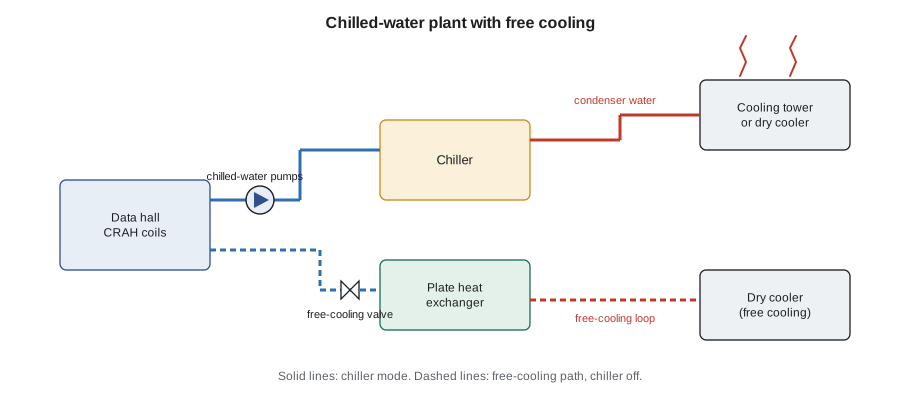
Chilled water is the link between the halls and the plant. Pumps push water through a closed loop of insulated pipes: out to the CRAH coils in the halls at a supply temperature, back to the plant warmer, through the chillers or heat exchangers to be cooled again, and out once more.
- Supply temperature: the water leaving the plant. Older plants used 7 °C (45 °F); modern data centre plants run much warmer, often 14 to 20 °C (57 to 68 °F), because warm water lets the chillers work less and allows more free cooling.
- Return temperature: the water coming back from the coils, typically 6 to 12 K (11 to 22 °F) warmer than the supply.
- Flow: set by the pumps, which run at variable speed to hold a pressure difference across the far end of the loop.
Stonebridge's YUL-2 plant supplies water at 18 °C (64 °F) to Halls A, B and C and receives it back at about 26 °C (79 °F). A separate, warmer loop serves the CDUs in Hall D, which Lesson 9 describes.
How a chiller works
A chiller is a large refrigeration machine. It uses the same vapour-compression cycle as a household refrigerator, at a much larger scale:
- In the evaporator, liquid refrigerant at low pressure boils as it absorbs heat from the chilled water passing on the other side of the tubes. The water leaves colder.
- The compressor draws in the refrigerant vapour and compresses it, raising its pressure and temperature.
- In the condenser, the hot, high-pressure vapour gives up its heat to condenser water or to outside air and condenses back to liquid.
- An expansion device drops the pressure of the liquid, and it returns to the evaporator to boil again.
The compressor needs electrical power to push heat from the cold chilled water to the warmer condenser. The bigger the temperature gap between the chilled water and the condenser, called the lift, the more power it needs. Warmer chilled water and cooler outdoor conditions both reduce the lift. That is the reason modern plants run warm chilled water.
Chillers are rated in tons or kilowatts of cooling, and their efficiency is given either as a coefficient of performance, COP, the heat removed divided by the power used, or as kilowatts of electricity per ton of cooling. A COP of 6 is the same as about 0.59 kW per ton. Higher COP and lower kW per ton both mean a more efficient chiller.
# Chiller power for the same cooling load under different conditions (illustrative COP model)
load_kw = 1800                      # heat to remove, kW (about 512 tons)
def cop(chw_c, cond_c):
    evap, cond = chw_c - 4, cond_c + 6   # refrigerant runs colder than the water and hotter than the condenser
    lift = max(cond - evap, 12)           # temperature gap the compressor must pump across, K
    return 0.5 * (evap + 273.15) / lift   # real chillers reach roughly half the ideal (Carnot) value
cases = [("Hot afternoon", 18, 40), ("Mild evening", 18, 30), ("Cool night", 18, 22), ("Cool night, warmer water", 22, 22)]
for name, chw, cond in cases:
    c = cop(chw, cond)
    kw = load_kw / c
print(f"{name:26s} water {chw} C, condenser {cond} C: COP {c:4.1f}, {kw:5.0f} kW, {kw / (load_kw / 3.517):.2f} kW/ton")Hot afternoon water 18 C, condenser 40 C: COP 4.5, 401 kW, 0.78 kW/ton Mild evening water 18 C, condenser 30 C: COP 6.5, 276 kW, 0.54 kW/ton Cool night water 18 C, condenser 22 C: COP 10.3, 176 kW, 0.34 kW/ton Cool night, warmer water water 22 C, condenser 22 C: COP 12.1, 148 kW, 0.29 kW/ton
The output shows how strongly efficiency depends on conditions. The same chiller uses less than half as much power per ton on a cool night as on a hot summer afternoon, and less again with warmer chilled water. The model is illustrative, but real chillers follow the same pattern. This is why operators raise the chilled-water setpoint whenever the halls allow it.
Rejecting the heat: dry coolers and cooling towers
The heat from the chillers' condensers, plus the heat of the compressors themselves, must go to the outside. Two kinds of equipment do this:
- Dry coolers: large finned coils with fans, like a car radiator, cooling a loop of water or glycol with outside air. They use no water but can cool the loop only to a few degrees above the outdoor dry-bulb temperature.
- Cooling towers: water is sprayed over fill material while fans draw air through. Some of the water evaporates, cooling the rest. A tower can cool water to within a few degrees of the outdoor wet-bulb temperature, which on a dry day is far below the dry bulb. Towers use water, both through evaporation and through blowdown, the water drained off to keep dissolved minerals from building up.
The difference between the water leaving a tower and the outdoor wet-bulb temperature is called the approach. The difference between the water entering and leaving is called the range. A tower with a growing approach on a steady day may have fouled fill, failed fans or clogged nozzles.
YUL-2 uses dry coolers only. Beauharnois summers are short and mild, and the operators prefer not to use water. On the few hottest days, adiabatic pads on the dry coolers, wetted mats that precool the incoming air, give extra capacity.
Economizers and free cooling
When it is cold enough outside, the chillers are not needed at all. The heat can go from the chilled water straight to the outdoor air through the dry coolers or towers and a heat exchanger. This is called free cooling, waterside economization or simply economizer mode. The chillers stay off and only the pumps and fans use power.
Plants switch among three modes as the weather changes:
- Full free cooling: outdoor conditions are cold enough to make chilled water at the supply setpoint without the chillers.
- Partial free cooling: outdoor air precools the return water through the heat exchanger, and the chillers finish the job with less lift.
- Mechanical cooling: it is too warm outside; the chillers do all the work and the dry coolers or towers reject their heat.
Some sites use airside economizers instead, bringing filtered outside air directly into the halls when conditions allow, or passing it through a heat exchanger wheel. Stonebridge's halls use only waterside economization, which keeps outside air, smoke and dust out of the white space.
# Hours of full free cooling, partial and mechanical cooling from a temperature bin table
setpoint = 18             # chilled-water supply setpoint
approach = 6             # dry cooler plus heat exchanger approach
bins = {  # outdoor dry-bulb bin centre: hours per year (illustrative)
    -25: 120, -15: 900, -5: 1700, 5: 1900, 15: 2400, 22: 1300, 28: 400, 32: 40,
}
full = partial = mech = 0
for t, hours in bins.items():
    water = t + approach
    if water <= setpoint:
        full += hours
    elif water <= setpoint + 12:
        partial += hours
    else:
        mech += hours
total = full + partial + mech
print(f"Full free cooling: {full:5d} h ({full / total:.0%})")
print(f"Partial:           {partial:5d} h ({partial / total:.0%})")
print(f"Mechanical: {mech:5d} h ({mech / total:.0%})")Full free cooling: 4620 h (53%) Partial: 3700 h (42%) Mechanical: 440 h (5%)
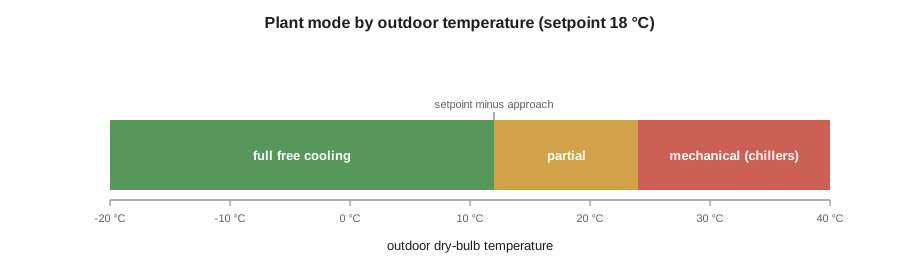
Because of its cold climate and warm supply water, YUL-2 runs on full or partial free cooling for about 95 percent of the year and on mechanical cooling alone only for a few hundred hours in summer, as the bin calculation shows. That is one reason the campus has a low PUE. Hydro-Québec's mostly hydroelectric power makes the little electricity the chillers do use low in carbon as well.
How plant problems show in the halls
A technician in a hall sees the plant only through its effects. Roz teaches Jamal to recognize the signs:
- Chilled-water supply temperature rising across all the CRAHs at once: a plant problem, such as a chiller trip or a mode change that did not complete. Check the plant screen and tell the shift lead.
- Valves on all CRAHs opening wider while temperatures hold: the water is a little warmer or the flow a little lower, and the units are compensating.
- Low chilled-water pressure difference at the halls: a pump problem or a stuck valve. Units far from the plant suffer first.
- One CRAH warm while others are fine: almost always a local problem at that unit, not the plant.
When a chiller trips, the plant controls start a standby chiller. In the minutes before it reaches full capacity, the stored cold water in buffer tanks and in the pipes carries the load. Technicians in the halls watch inlet temperatures during these events and report any rack that rises above the recommended range.
Water use and water treatment
Cooling towers and adiabatic coolers use water, and data centres are increasingly asked how much. The measure most used is water usage effectiveness, WUE: litres of water used per kilowatt-hour of IT energy. A site with towers in a hot climate may use more than a litre per kilowatt-hour on its annual average; a site with dry coolers in a cold climate may use almost none.
Closed chilled-water loops use very little water but need treatment to prevent corrosion, scale and biological growth. Treatment contractors test the water and adjust chemical levels. Technicians should never add water or chemicals to a loop themselves, and should report leaks, which waste treated water and can cause corrosion where they drip.
Worked problem
Is the plant in free cooling?
On an October night at YUL-2, the outdoor air is 6 °C (43 °F). The chilled-water supply setpoint is 18 °C (64 °F), and the dry coolers can cool their loop to about 4 K (7 °F) above the outdoor air. The heat exchanger adds another 2 K (4 °F). Can the plant make supply water without the chillers?
Show solution
- Find the coldest water the dry coolers can make: 6 + 4 = 10 °C (43 + 7 = 50 °F).
- Add the heat exchanger approach: 10 + 2 = 12 °C (50 + 4 = 54 °F).
- Compare with the setpoint of 18 °C (64 °F): the free-cooling water is colder than needed.
- The plant can run in full free cooling, with the chillers off; the controls will slow the dry cooler fans to avoid making the water too cold.
Answer: Yes. Free cooling works whenever the outdoor air, plus the dry cooler and heat exchanger approaches, is colder than the chilled-water setpoint.
Plant rounds for technicians
Although licensed operators run the chillers, Stonebridge's technicians walk the plant on every night shift as a second set of eyes. Roz gives Jamal the short list they use:
- Look and listen at each pump: no unusual noise, vibration or heat at the motor; no water at the seal.
- Read the main chilled-water supply and return temperatures and pressures at the plant panel and compare them with the values on the round sheet.
- Check the buffer tank level gauge and the make-up water meter; a meter that moves when no work is scheduled can mean a leak.
- Walk past the chillers: no alarms on their panels, no oil or refrigerant stains on the floor, no hissing.
- On the roof or in the yard, look at the dry coolers or towers: fans turning as the screen says, no debris on the coils, no ice in winter, no unusual plume or drift from towers.
- Note anything unusual in the round log and tell the operator on duty before leaving the plant.
The round takes about twenty minutes. Its value lies in catching small things early, such as a weeping pump seal or a fan that has stopped, before they become alarms or failures.
Winter and summer
At YUL-2, winter brings its own plant tasks. Dry coolers carry a glycol mixture so they cannot freeze, but snow can drift against their coils and block the air, and freezing rain can coat their fans. After every storm, technicians check the roof walkways for safe access, look for snow on the coils and report anything the plant team must clear.
Common mistakes
MistakeThinking chillers always run in a data centre.
InsteadIn cold weather, free cooling can carry the whole load with the chillers off.
MistakeLowering the chilled-water setpoint to fix one warm rack.
InsteadOne warm rack is a local airflow problem; colder water costs energy across the whole plant.
MistakeAdding make-up water or chemicals to a loop.
InsteadWater treatment is the contractor's job; report leaks instead.
MistakeAssuming dry coolers cool to the wet-bulb temperature.
InsteadDry coolers are limited by the dry bulb; only evaporative equipment approaches the wet bulb.
MistakeReporting a hall-wide rise as a single CRAH fault.
InsteadIf every unit's supply rises together, look to the plant first.
Summary and key terms
- Chilled water carries heat from hall cooling units to the central plant and back.
- Chillers use a vapour-compression cycle; their power depends on the lift between chilled water and condenser.
- Efficiency is given as COP or kW per ton; warmer chilled water improves it.
- Dry coolers reject heat to the dry bulb; cooling towers approach the wet bulb but use water.
- Economizers provide free cooling when outdoor conditions are cold enough, with the chillers off.
- Hall-wide changes point to the plant; single-unit problems are usually local.
- Chiller
- A refrigeration machine that cools water for building or data centre cooling.
- Lift
- The temperature gap a chiller's compressor must pump heat across.
- COP
- Coefficient of performance: heat removed divided by electrical power used.
- Approach
- How close a cooling tower or heat exchanger brings its water to the limiting temperature.
- Free cooling
- Cooling with outdoor air or water while the chillers are off.
- WUE
- Water usage effectiveness: litres of water per kilowatt-hour of IT energy.
Practice problems
Work each problem on paper first, then reveal the answer to check.
A chiller has a COP of 5. About how many kW per ton is that?
Show answer
3.517 / 5 = about 0.70 kW per ton.
Why do modern data centres run warmer chilled water?
Show answer
It reduces chiller lift and power and allows more hours of free cooling.
What limits how cold a dry cooler can make its water?
Show answer
The outdoor dry-bulb temperature plus its approach.
All twelve CRAHs in a hall show their supply temperatures rising together. Where do you look first?
Show answer
At the central plant: a chiller, pump or mode problem.
Lesson quiz · 5 questions
Score 60% or more to complete this lesson.
Create a free account to save your progress, take quizzes and earn a certificate.