
DCT-230 · Lesson 2 of 12 · 20 min
Air, temperature, humidity and dew point
On Jamal's second morning Roz hands him a small instrument the size of a phone: a digital psychrometer that reads air temperature, relative humidity and dew point at the press of a button. "Temperature is only half of what the air is telling you," she says. "The other half is water." Every cubic metre of air in the hall carries some water vapour, and how much it carries decides whether static builds up, whether coils sweat, and whether the hall can use outside air to cool itself. This lesson covers the properties of air a technician reads and records every day.
Air is a mixture
The air in a data hall is a mixture of dry air, mostly nitrogen and oxygen, and water vapour. The dry air part hardly changes. The water vapour part varies from almost nothing on a cold winter day to a few percent of the mass on a humid summer afternoon. That small amount of water matters a great deal, because it can change from vapour to liquid and back again, and when it does, it absorbs or releases a large amount of heat.
The study of moist air is called psychrometrics. Engineers use psychrometric charts and software to design cooling systems. Technicians do not need to design anything, but they do need to understand four or five measurements and what each one says about the hall.
Dry-bulb temperature
The ordinary air temperature, measured by a thermometer that is dry and shielded from radiation, is called the dry-bulb temperature. When a monitoring screen shows a rack inlet at 24 °C (75 °F), that is a dry-bulb reading. It is the number servers care about most, because it sets how hot their components run.
Dry-bulb temperature can be measured in degrees Celsius or Fahrenheit. A difference in temperature, such as the rise across a server, is often written in kelvins in Canada, because a difference of 1 K equals a difference of 1 °C. In the United States temperature differences are written in degrees Fahrenheit; a difference of 1 °C is a difference of 1.8 °F. Mixing up an absolute temperature and a temperature difference is a common error when converting: 20 °C (68 °F) is 68 °F, but a rise of 20 K is a rise of 36 °F, not 68.
Relative humidity
Warm air can hold more water vapour than cold air before it becomes saturated. Relative humidity, RH, compares the water vapour actually in the air with the most the air could hold at the same temperature, as a percentage. Air at 100 percent RH is saturated; any cooler surface it touches will collect condensation.
Relative humidity is easy to measure and easy to misread, because it changes with temperature even when the amount of water in the air does not. Take the same air from a cold aisle at 20 °C (68 °F) and 50 percent RH and heat it through a server to 32 °C (90 °F). No water has been added or removed, but the relative humidity in the hot aisle falls to about 25 percent, because the warmer air could hold more. A technician who compares an RH reading in the hot aisle with one in the cold aisle and concludes that the servers are drying the air has misread the instrument.
This is why modern guidelines prefer to control moisture by dew point, which does not change when air is heated or cooled without condensation.
Dew point
The dew point is the temperature at which air would become saturated if it were cooled without adding or removing water. Cool the air below its dew point and water condenses: on a cold drink can in summer, on a window in winter, or on a cooling coil. The dew point is a direct measure of how much water the air carries. Two air samples with the same dew point carry the same amount of water vapour, whatever their temperatures.
For a technician, the dew point answers two practical questions:
- Will this surface sweat? Any pipe, coil or cold plate colder than the dew point of the air around it will collect water. Chilled-water pipes are insulated for this reason, and liquid cooling loops are kept above the room's dew point.
- Is the air within the moisture limits of the thermal guidelines? The ASHRAE guidelines set limits on dew point as well as on relative humidity, as Lesson 3 explains.
The psychrometer calculates dew point from the temperature and relative humidity using a standard formula. The Magnus approximation, below, is accurate to within a few tenths of a degree in the range found in data halls.
Here T is the dry-bulb temperature in degrees Celsius and RH is in percent. Jamal does not need to work it by hand; the monitoring system and his instrument do it. But running it once in code helps him see how dew point behaves.
import math
# Dew point from dry-bulb temperature and relative humidity (Magnus approximation)
def dew_point_c(t_c, rh):
    g = math.log(rh / 100) + 17.62 * t_c / (243.12 + t_c)
    return 243.12 * g / (17.62 - g)

def rh_at(t_c, dp_c):
    """Relative humidity of air with dew point dp_c once it is at t_c."""
    es = lambda t: math.exp(17.62 * t / (243.12 + t))
    return 100 * es(dp_c) / es(t_c)

samples = [("Cold aisle", 20, 50), ("Hot aisle (same air)", 32, None),
           ("Summer, outside", 31, 65), ("Winter, outside", -15, 70)]
dp_cold = dew_point_c(20, 50)
print(f"{'Air':22s} {'T, C':>6s} {'RH %':>6s} {'dew point, C':>13s}")
for name, t, rh in samples:
    if rh is None:
        rh = rh_at(t, dp_cold)
    dp = dew_point_c(t, rh)
print(f"{name:22s} {t:6.1f} {rh:6.1f} {dp:13.1f}")Air T, C RH % dew point, C Cold aisle 20.0 50.0 9.3 Hot aisle (same air) 32.0 24.6 9.3 Summer, outside 31.0 65.0 23.6 Winter, outside -15.0 70.0 -19.3
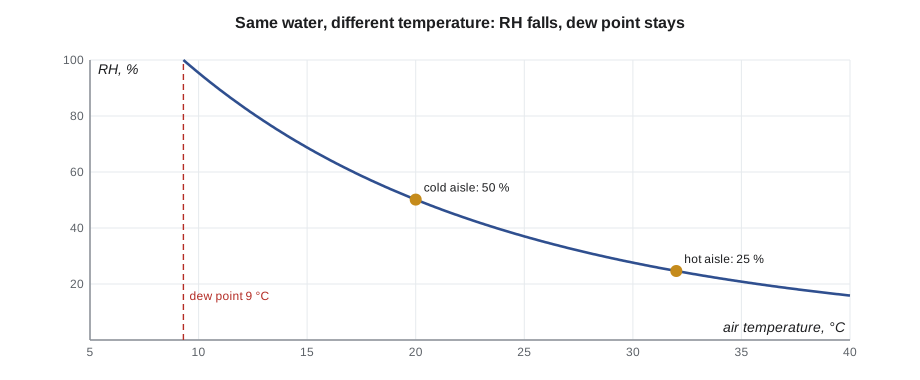
The first two rows show the same air before and after it passes through a server: the temperature rises, the RH falls, and the dew point stays the same. The third row is a humid summer day at the cooling tower; the fourth is a cold winter day, when the outside air holds very little water.
Wet-bulb temperature
If a thermometer bulb is wrapped in a wet wick and air blows across it, water evaporates from the wick and cools the bulb. The temperature it settles at is the wet-bulb temperature. In dry air, more water evaporates and the wet bulb reads much lower than the dry bulb; in saturated air, nothing evaporates and the two readings are equal.
Wet-bulb temperature matters most outside the hall. A cooling tower or evaporative cooler can cool water only down to near the outdoor wet-bulb temperature, so the wet bulb sets how well that equipment works on a given day. Weather files for cooling design list both dry-bulb and wet-bulb temperatures. Inside the hall, technicians rarely use the wet bulb except when checking evaporative equipment.
Humidity ratio
Engineers often express moisture as the humidity ratio: the mass of water vapour per kilogram of dry air, usually in grams per kilogram (in the United States usually in grains per pound, where 7,000 grains make a pound). Air at a dew point of 10 °C (50 °F) carries about 7.6 g of water for every kilogram of dry air (53 grains of water for every pound of dry air). The humidity ratio, like the dew point, does not change when air is heated or cooled without condensation. It is the number used to calculate how much water a humidifier must add or a coil will remove.
import math
# Humidity ratio (grams of water per kilogram of dry air) from the dew point, at sea level
P = 101.325   # kPa
def vp_kpa(dp_c):
    return 0.61094 * math.exp(17.625 * dp_c / (dp_c + 243.04))
for dp in (-9, 0, 10, 15, 20):
    pw = vp_kpa(dp)
    w = 622 * pw / (P - pw)
print(f"dew point {dp:4d} C -> {w:5.1f} g of water per kg of dry air")dew point -9 C -> 1.9 g of water per kg of dry air dew point 0 C -> 3.8 g of water per kg of dry air dew point 10 C -> 7.6 g of water per kg of dry air dew point 15 C -> 10.6 g of water per kg of dry air dew point 20 C -> 14.7 g of water per kg of dry air
Why moisture matters in a data hall
Too little moisture and too much moisture both cause problems, and the limits in modern guidelines are a balance between them.
- Static electricity: very dry air lets static charges build up on people and surfaces. A discharge can damage sensitive components. The risk is controlled mainly by grounding and electrostatic discharge practice, which the DCT-120 safety course covers, rather than by humidifying the room.
- Condensation: air near saturation will condense on any surface cooler than its dew point, wetting equipment and floors.
- Corrosion: high humidity combined with gaseous pollutants, such as sulfur compounds from industry or nearby traffic, can corrode the copper and silver in circuit boards. The guidelines tighten the humidity limit where pollution is present.
- Energy: adding or removing moisture uses a lot of energy. Humidifiers that boil water to make steam are especially costly, so most modern halls allow a wide humidity range and humidify little or not at all.
At Beauharnois, the winter outside air is very dry, often with a dew point well below freezing, and the hall's humidity drifts low through January and February. Stonebridge decided years ago not to run humidifiers in Hall A and to rely on electrostatic discharge controls instead, a choice supported by research ASHRAE used when it widened its humidity limits.
Measuring humidity correctly
Humidity sensors drift more than temperature sensors and are easily fooled. Roz gives Jamal her rules:
- Compare like with like: compare dew points, not relative humidities, between places at different temperatures.
- Let the instrument settle: a handheld psychrometer brought from a warm office into a cold aisle needs a few minutes to reach the air temperature before its RH reading is meaningful.
- Do not breathe on the sensor or hold it in the exhaust of a server; read it in the free air stream.
- Check fixed sensors against a calibrated reference at the interval the maintenance program sets, often once a year, and record the offset.
- Report sensors that disagree with their neighbours by more than the site's tolerance; do not quietly adjust them.
Altitude and air density
Air at higher altitude is thinner. A cubic metre of air at Beauharnois or Ashburn, both near sea level, weighs about 1.2 kg (A cubic foot of air at Beauharnois or Ashburn, both near sea level, weighs about 0.075 lb); the same volume in a mountain city weighs noticeably less and carries less heat for the same temperature rise. Equipment ratings and the air-flow formulas in this course assume sea-level air. Technicians working at sites well above sea level will see derating tables on cooling equipment and IT equipment nameplates for this reason.
Worked problem
Will the new chilled-water pipe sweat?
A contractor is running an uninsulated section of chilled-water pipe through a corridor next to Hall A during a summer shutdown. The water in the pipe is at 12 °C (54 °F). Jamal measures the corridor air at 26 °C (79 °F) and 60 percent relative humidity. Will the pipe collect condensation?
Show solution
- Find the dew point of the corridor air: with the Magnus formula, 26 °C (79 °F) at 60 % RH has a dew point of about 17.6 °C (64 °F).
- Compare the pipe surface temperature with the dew point. The pipe surface will be close to the water temperature, 12 °C (54 °F).
- The surface is about 5.6 K (10 °F) below the dew point, so moisture will condense on it.
- Record the finding and ask for the pipe to be insulated, or for a drip tray to be placed under it until it is.
Answer: Yes. Any surface colder than the dew point of the surrounding air will sweat; the fix is insulation with a vapour barrier, not a fan.
Common mistakes
MistakeComparing relative humidity in the hot aisle with the cold aisle.
InsteadCompare dew points; RH falls as air warms even when the water content is unchanged.
MistakeConverting a temperature difference as if it were a temperature.
InsteadA difference of 1 K is 1.8 °F; only absolute temperatures need the +32 offset.
MistakeReading a handheld instrument the moment it enters the room.
InsteadLet it settle to the air temperature for a few minutes.
MistakeAdjusting a drifting sensor to match its neighbours without a reference.
InsteadReport it and check it against a calibrated instrument.
MistakeAssuming dry air must always be humidified.
InsteadModern practice controls static with grounding and ESD procedures; humidifying costs energy.
Summary and key terms
- Dry-bulb temperature is the ordinary air temperature servers respond to.
- Relative humidity changes with temperature even when the water content is constant.
- Dew point measures water content; surfaces colder than the dew point collect condensation.
- Wet-bulb temperature limits how well cooling towers and evaporative coolers can work.
- Humidity ratio is the mass of water per kilogram of dry air.
- Too dry raises static risk, too damp risks condensation and corrosion; modern halls allow a wide range.
- Dry-bulb temperature
- The air temperature read by an ordinary dry thermometer.
- Relative humidity
- Water vapour in the air as a percentage of the most the air could hold at that temperature.
- Dew point
- The temperature at which air becomes saturated when cooled; a direct measure of water content.
- Wet-bulb temperature
- The temperature of a wetted thermometer in moving air; it limits evaporative cooling.
- Humidity ratio
- Grams of water vapour per kilogram of dry air.
- Psychrometrics
- The study of the properties of moist air.
Practice problems
Work each problem on paper first, then reveal the answer to check.
Air at 20 °C (68 °F) and 50 % RH is heated to 30 °C (86 °F) without adding water. What happens to its dew point?
Show answer
It stays the same, about 9.3 °C (49 °F); only the relative humidity falls.
Why are chilled-water pipes insulated?
Show answer
Their surface is colder than the room's dew point, so they would collect condensation.
What does the wet-bulb temperature limit?
Show answer
How cold a cooling tower or evaporative cooler can make its water or air.
Why do many halls not run humidifiers in winter?
Show answer
Humidifying uses a lot of energy; static is controlled by grounding and ESD practice instead.
Lesson quiz · 5 questions
Score 60% or more to complete this lesson.
Create a free account to save your progress, take quizzes and earn a certificate.