
DCT-120 · Lesson 9 of 12 · 19 min
Hot aisles, noise and heat stress
Jamal's first long job in a hot aisle was a cable audit in Hall B, aisle 6. After forty minutes he noticed a headache and that he had stopped sweating as much as he had at the start. Roz sent him out to the break room with a bottle of water and a lecture he did not forget. A data hall is cool where the equipment breathes in and hot where it breathes out. The hot aisles of modern containment systems can be as hot as a desert afternoon, and the fans that push air through thousands of servers make the halls loud. This lesson covers heat stress, noise and the other physical conditions of the hall floor.
How hot is a hot aisle?
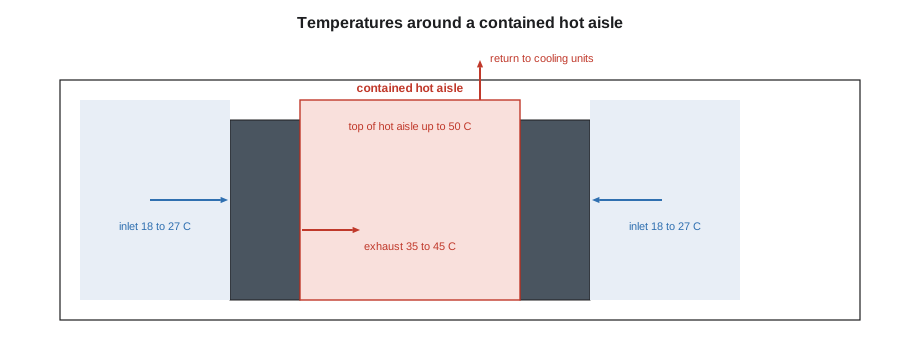
IT equipment draws air in from the cold aisle and exhausts it into the hot aisle, warmer by the heat it has absorbed. The thermal guidelines most data centres follow recommend equipment inlet temperatures of about 18 to 27 °C (64 to 81 °F). The exhaust is typically 10 to 20 °C (18 to 36 °F) warmer, and in a closed hot aisle the air can reach 40 to 50 °C (104 to 122 °F). Liquid-cooled halls such as Hall D send most of their heat to the coolant, but the part that still goes to air, and the hot coolant pipes in the technical galleries, create hot zones too. The hot aisle is a place where people work, not just a duct, so its conditions must be managed like any hot workplace.
Heat stress and heat illness
The body keeps its core temperature near 37 °C (98.6 °F) by sweating and by moving blood to the skin. In hot conditions, especially with physical work, the body may not be able to lose heat fast enough. Heat stress is the load on the body; heat strain is the body's response. When the body cannot keep up, heat illness follows:
- Heat rash and heat cramps: uncomfortable warnings that the body is under strain.
- Heat exhaustion: heavy sweating, weakness, dizziness, headache, nausea, pale clammy skin. The person must stop work, move to a cool place, drink water and be watched. Untreated, it can progress to heat stroke.
- Heat stroke: a medical emergency. The body's cooling has failed; the core temperature rises sharply. Signs include confusion, slurred speech, collapse, seizures, and hot skin that may be dry or still sweating. Call emergency services at once and start cooling the person while waiting.
Dehydration, illness, some medications, lack of acclimatization and heavy clothing such as arc-rated suits increase the risk. Workers who are new to hot work, or returning after time away, need to build up their exposure gradually over several days, a process called acclimatization.
Measuring heat: the WBGT index
Air temperature alone does not describe heat stress, because humidity, air movement and radiant heat all matter. The most widely used measure is the wet bulb globe temperature, WBGT, which combines a natural wet-bulb temperature, a globe temperature for radiant heat and the dry air temperature. Indoors, without sunlight, it is calculated as:
Quebec's regulation sets out a method for assessing exposure to heat and the CNESST publishes guidance on work-rest regimes based on the WBGT and the work rate, following the threshold limit values of the American Conference of Governmental Industrial Hygienists (ACGIH).
The code below uses the indoor formula and a simplified version of the kind of work-rest table those values produce. It is illustrative only; a site's heat stress program uses the full method for its workers and conditions.
# Indoor WBGT and a simplified work-rest guide (illustrative values only)
def wbgt(t_nw, t_g):
    return 0.7 * t_nw + 0.3 * t_g
# limits in degrees C WBGT for moderate work, acclimatized workers (illustrative)
regimes = [(28.0, "continuous work"), (29.0, "75 % work, 25 % rest each hour"),
           (30.0, "50 % work, 50 % rest"), (31.5, "25 % work, 75 % rest"), (99, "stop: re-plan the job")]
spots = [("Hall A cold aisle", 16.0, 22.0), ("Hall B hot aisle 6", 26.5, 41.0),
         ("Hall D gallery by CDU-3", 24.0, 33.0), ("Hall B hot aisle, cooling unit down", 29.5, 46.0)]
for where, t_nw, t_g in spots:
    w = wbgt(t_nw, t_g)
    plan = next(text for lim, text in regimes if w <= lim)
print(f"{where:36s} WBGT {w:4.1f} C {plan}")Hall A cold aisle WBGT 17.8 C continuous work Hall B hot aisle 6 WBGT 30.8 C 25 % work, 75 % rest Hall D gallery by CDU-3 WBGT 26.7 C continuous work Hall B hot aisle, cooling unit down WBGT 34.4 C stop: re-plan the job
The difference between the hot aisle on a normal day and the same aisle with a cooling unit out of service is the difference between a planned rest break and no work at all. Dmitri's rule is that any hot aisle work longer than twenty minutes is planned with a buddy, water and scheduled breaks, and that hot aisle work stops if cooling is degraded.
Controlling heat exposure
The hierarchy of controls applies to heat too:
- Plan to reduce time in the hot aisle: prepare cables, labels and tools in the cold aisle and go into the hot aisle only for the part of the job that needs it.
- Use the cold aisle side where the task allows; many tasks on the rear of a rack can be done by sliding equipment forward.
- Schedule long hot aisle jobs for periods when the load or outside temperature is lower, if the work allows.
- Use portable spot coolers or open a containment door only when the facilities team agrees; opening containment mixes hot and cold air and can raise inlet temperatures for the racks.
- Take regular breaks in a cool area, drink water often, and watch each other for signs of heat illness.
- Wear light, breathable clothing where arc-rated clothing is not required, and plan extra breaks when it is.
Containment doors must never be propped open for comfort without telling the shift lead, for the same reason. Stonebridge's monitoring will show the effect within minutes, but the racks nearest the door may have already been running hot.
Noise
Thousands of server fans, cooling unit fans, pumps and UPS cooling fans make data halls loud. Typical levels in modern halls range from about 75 to over 90 dBA, and AI racks with high-speed fans, or rooms with large air handlers, can be louder. Noise damages hearing gradually and permanently: the damage depends on both the level and the time spent in it. The decibel scale is logarithmic, so small increases in level mean large increases in sound energy, and the allowed time falls quickly as the level rises.
Quebec's regulation now sets an exposure limit of 85 dBA averaged over 8 hours with a 3 dB exchange rate: every 3 dB increase halves the allowed time. Above the limit, the employer must reduce the noise or provide hearing protection, and must have a hearing conservation program.
# Daily noise dose from time spent in different areas (85 dBA, 3 dB exchange rate)
criterion, exchange = 85, 3
def allowed_hours(level):
    return 8 / 2 ** ((level - criterion) / exchange)
shift = [("operations office", 55, 4.0), ("Hall A aisles", 82, 3.0),
         ("Hall D aisles", 91, 1.5), ("UPS room B", 88, 0.5)]
dose = 0.0
for place, level, hours in shift:
    if level < 80:
        continue
    t = allowed_hours(level)
    dose += hours / t
    print(f"{place:18s} {level:3d} dBA  {hours:3.1f} h  allowed {t:5.1f} h")
print(f"Daily dose: {dose * 100:.0f} % of the limit")
print("Hearing protection required" if dose > 1 else "Within the limit; protection still recommended above 85 dBA")Hall A aisles 82 dBA 3.0 h allowed 16.0 h Hall D aisles 91 dBA 1.5 h allowed 2.0 h UPS room B 88 dBA 0.5 h allowed 4.0 h Daily dose: 106 % of the limit Hearing protection required
Under the 3 dB rule, an hour and a half in Hall D's aisles uses up most of a day's allowance by itself. Stonebridge's policy is simpler than any calculation: hearing protection is mandatory in Hall D, the UPS rooms and the generator areas, and recommended everywhere in the white space for jobs longer than an hour. Earplugs and earmuffs are kept at every hall entrance, and technicians are taught to fit foam plugs properly, rolled thin and inserted deep, because a badly fitted plug gives little protection.
Communication in noisy halls
Noise also makes it hard to hear instructions, alarms and warnings. Two people doing a method of procedure in a loud UPS room cannot rely on speech alone. Stonebridge uses hearing protection with built-in radios for paired work in the loudest areas, written checklists that both people can see, and agreed hand signals for stop and wait. Alarms in noisy areas include visual signals such as strobes, so that a person wearing hearing protection still knows when to leave.
Lighting, cold and other conditions
Data halls are often lit only where people are, using motion sensors that switch lights off in empty aisles to save energy. A technician working on the floor or deep in a rack may find the lights going out around them; carrying a headlamp or flashlight is standard practice. Cold aisles in some halls are cool enough for long jobs to become uncomfortable, and liquid cooling galleries can have cold pipes and condensation. Technicians dress in layers so they can adapt between cold aisles and hot aisles during a single job.
Worked problem
A cable audit in a warm week
In July, a customer in Hall B asks for an audit of the cabling at the rear of 24 racks in hot aisle 6. One of the hall's cooling units is out for maintenance, and the hot aisle WBGT is running high.
Show solution
- Dmitri checks the cooling status: with one unit out, he postpones the audit until the unit returns the next afternoon.
- The next day, Jamal and a second technician plan the job: they print the expected port map and do the comparison work in the cold aisle, going into the hot aisle only to photograph and read labels.
- They work in 20-minute periods followed by 10-minute breaks in the cool break room, with water.
- They wear earplugs throughout, because the hall measures about 84 dBA and the job takes most of the shift.
- At the end they compare notes and photos in the office, where the mismatches are listed for the customer.
Answer: The audit is finished in one shift with no heat symptoms. The planning, not toughness, is what made it safe.
Hydration and personal factors
Drinking water before you are thirsty is the simplest heat control. Thirst lags behind the body's need, so people working in heat are advised to drink small amounts often, roughly a cup every 15 to 20 minutes during heavy hot work, rather than large amounts occasionally. Stonebridge keeps chilled water in the break rooms next to each hall, outside the white space where drinks are not allowed. Energy drinks and large amounts of caffeine are a poor substitute. Personal factors change a person's risk from day to day: a cold or stomach illness, poor sleep, a heavy meal, some medications and returning from holidays all reduce heat tolerance. Workers are encouraged to tell the shift lead when they are not at their best, so that hot jobs can be shared out, without needing to explain why.
The buddy system is the backbone of hot aisle work. Two people watch each other for the early signs: flushed or very pale face, slowed speech, clumsiness, irritability or a change in sweating. A person with heat illness often does not notice their own symptoms, because confusion is one of them. Either buddy may call a break, and either may stop the job.
# Simple hydration reminder for a hot aisle job
job_minutes = 120
interval = 20      # minutes between drinks
cup_ml = 250
cups = job_minutes // interval
print(f"Job length {job_minutes} min: {cups} drinks of about {cup_ml} mL, total about {cups * cup_ml / 1000:.1f} L")Job length 120 min: 6 drinks of about 250 mL, total about 1.5 L
Common mistakes
MistakeWorking long periods in a hot aisle without breaks.
InsteadPlan short periods, breaks in a cool area and water.
MistakePropping open a containment door for comfort.
InsteadAsk the shift lead; it changes inlet temperatures.
MistakeIgnoring a headache and reduced sweating.
InsteadStop, cool down, drink water and tell someone.
MistakeWearing foam earplugs loosely.
InsteadRoll them thin and insert them deep.
MistakeRelying on speech in a loud room during paired work.
InsteadUse radio headsets, written checklists and agreed signals.
Summary and key terms
- Hot aisles can reach 40 to 50 °C (104 to 122 °F); plan heat exposure like any hot workplace.
- Heat exhaustion and heat stroke are serious; heat stroke is a medical emergency.
- WBGT combines humidity, radiant heat and air temperature and is used to set work-rest regimes.
- Reduce time in hot aisles, take breaks, drink water and watch each other.
- Noise in data halls is often 75 to 90 dBA or more; exposure limits depend on level and time.
- Wear hearing protection where required, fit it properly, and use visual alarms and radios in loud areas.
- Heat stroke
- A medical emergency in which the body's cooling fails and core temperature rises sharply.
- Acclimatization
- The gradual adaptation of the body to working in heat over several days.
- WBGT
- Wet bulb globe temperature, an index of heat stress combining humidity, radiant heat and air temperature.
- Exchange rate
- The increase in noise level, in dB, that halves the allowed exposure time.
- Noise dose
- A worker's noise exposure as a percentage of the daily limit.
Practice problems
Work each problem on paper first, then reveal the answer to check.
Name three signs of heat exhaustion.
Show answer
Heavy sweating, weakness, dizziness, headache, nausea, pale clammy skin.
Under a 3 dB exchange rate with an 85 dBA limit, how long may someone spend at 91 dBA?
Show answer
2 hours.
Why should containment doors not be propped open for comfort?
Show answer
It mixes hot and cold air and can overheat racks near the door.
What should you do if a colleague becomes confused and collapses in a hot aisle?
Show answer
Call emergency services and start cooling them; it may be heat stroke.
Lesson quiz · 5 questions
Score 60% or more to complete this lesson.
Create a free account to save your progress, take quizzes and earn a certificate.