
DCT-120 · Lesson 3 of 12 · 20 min
Arc flash labels, boundaries and PPE
Every piece of electrical distribution equipment at Stonebridge carries an arc flash label: the main switchboards, the UPS input and output boards, the PDUs in Hall A, the busway feeders in Halls B, C and D and the panels in the mechanical rooms. Roz takes Jamal to the window of the Hall A electrical room and points at a label on switchboard SB-A2. 'You will never work on that board,' she says, 'but you will walk past it, escort contractors to it and stand beside people who work on it. You need to be able to read this label as easily as a street sign.' This lesson explains what the label says, the boundaries it describes and the protective equipment it calls for.
Why labels exist
CSA Z462 and the Canadian Electrical Code require electrical equipment that is likely to be examined, adjusted, serviced or maintained while energized to be marked with a warning about arc flash, and Z462 sets out what the label should contain when an arc flash risk assessment has been done. The label is the end product of the arc flash study: a short summary of the hazard at that piece of equipment, written for the person standing in front of it.
Labels are only as good as the study behind them. When the electrical system changes, for example when a transformer is replaced, breaker settings are changed or the utility increases the available fault current, the study must be updated and the labels replaced. Stonebridge reviews its study at least every five years and after every significant change, and the facilities team keeps a register of every label. A technician who sees a damaged, faded or missing label reports it.
What the label says
A typical label at Stonebridge contains:
- A signal word and colour: the word warning on an orange label for most equipment, the word danger on a red label where the incident energy is too high for any available protective equipment or the voltage is above a threshold the program sets.
- The nominal voltage of the equipment.
- The arc flash boundary: the distance at which the incident energy falls to 1.2 cal/cm².
- The incident energy at the working distance, with the working distance stated, or alternatively the arc flash PPE category.
- The limited approach boundary and restricted approach boundary for shock.
- The equipment name, the date of the study and the name of the firm that did it.
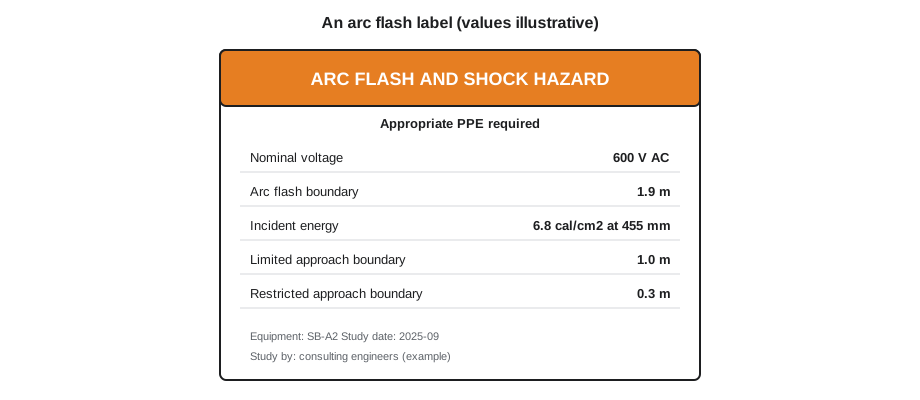
Labels give either the incident energy or a PPE category, not both, because the two methods of choosing protective equipment should not be mixed. Stonebridge's study reports incident energy, which lets qualified workers choose clothing with an arc rating at least equal to the hazard.
The shock approach boundaries
The standards define two boundaries around exposed energized parts for shock protection. They are distances, measured from the energized part, that depend on the voltage.
- Limited approach boundary: the distance inside which a shock hazard exists. Unqualified persons may not cross it unless a qualified person escorts them and has told them about the hazards.
- Restricted approach boundary: the distance inside which there is an increased chance of shock from arc-over or accidental movement. Only qualified persons may cross it, with shock protection such as rubber insulating gloves and insulated tools, under a documented plan.
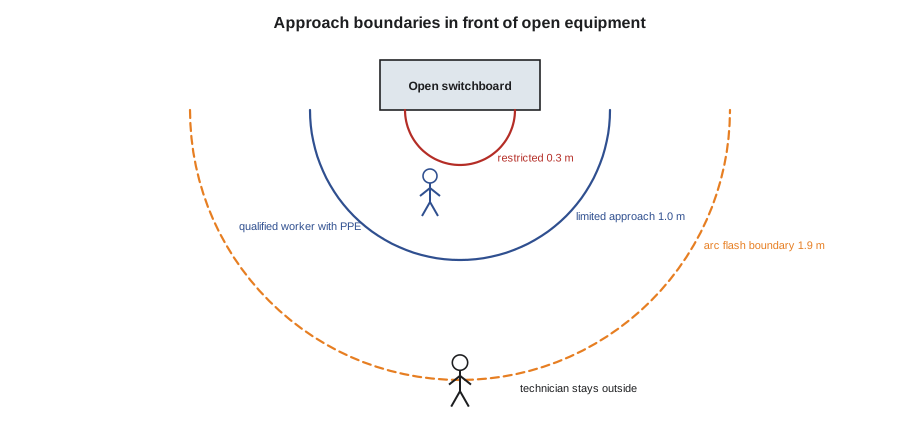
The arc flash boundary is separate. It may be larger or smaller than the limited approach boundary, depending on the energy available. Anyone inside the arc flash boundary, qualified or not, must wear arc-rated protection appropriate to the hazard, and in practice Stonebridge keeps unqualified people outside it altogether while equipment is open.
| Nominal voltage, AC | Limited approach, fixed circuit part | Restricted approach |
|---|---|---|
| 50 to 150 V | 1.0 m (3 ft 6 in) | Avoid contact |
| 151 to 750 V | 1.0 m (3 ft 6 in) | 0.3 m (1 ft 0 in) |
| 751 V to 15 kV | 1.5 m (5 ft 0 in) | 0.7 m (2 ft 2 in) |
| 15.1 kV to 36 kV | 1.8 m (6 ft 0 in) | 0.8 m (2 ft 7 in) |
# Check where a person may stand near open equipment, using the label values
label = {"equipment": "SB-A2", "volts": 600, "afb": 1.9, "lab": 1.0, "rab": 0.3}  # m
people = [("Jamal, technician (unqualified)", False, 2.5),
          ("Contractor electrician (qualified)", True, 0.5),
          ("Visitor on the escorted tour", False, 1.5)]
for name, qualified, d in people:
    if d < label["rab"]:
        verdict = "inside restricted boundary: qualified only, with shock PPE and a plan"
        if not qualified: verdict = "NOT ALLOWED inside the restricted boundary"
    elif d < label["lab"]:
        verdict = "inside limited boundary: qualified, or escorted and briefed" if qualified else "only with a qualified escort and briefing"
    else:
        verdict = "outside the shock boundaries"
    if d < label["afb"]:
        verdict += "; inside arc flash boundary: arc-rated PPE needed"
print(f"{name:36s} {d:6.1f} m {verdict}")Jamal, technician (unqualified) 2.5 m outside the shock boundaries Contractor electrician (qualified) 0.5 m inside limited boundary: qualified, or escorted and briefed; inside arc flash boundary: arc-rated PPE needed Visitor on the escorted tour 1.5 m outside the shock boundaries; inside arc flash boundary: arc-rated PPE needed
In the example the visitor would be inside the arc flash boundary while standing outside the limited approach boundary. That is exactly why Stonebridge does not take tours past open equipment, and why technicians escorting contractors stay well back and keep others back while the work is under way.
Arc-rated protective equipment
Arc-rated clothing is tested to find how much incident energy it can block before the wearer would receive a second-degree burn. The result is its arc rating, in cal/cm², printed on the label of every garment. Qualified workers choose a clothing system whose arc rating is at least the incident energy on the equipment label. When the program uses the PPE category method instead, the standards define four categories with minimum arc ratings:
| PPE category | Minimum arc rating | Typical clothing |
|---|---|---|
| 1 | 4 cal/cm² | Arc-rated long-sleeve shirt and trousers or coverall, arc-rated face shield, hard hat, safety glasses, hearing protection, leather gloves |
| 2 | 8 cal/cm² | As category 1, with an arc-rated balaclava and face shield, or an arc flash suit hood |
| 3 | 25 cal/cm² | Arc flash suit: jacket and trousers or coverall, hood, arc-rated gloves |
| 4 | 40 cal/cm² | Multi-layer arc flash suit with hood and arc-rated gloves |
Underneath, workers wear natural-fibre clothing such as cotton or wool, or arc-rated base layers; synthetic fabrics that melt are not allowed. Shock protection is separate: rubber insulating gloves of the right voltage class, with leather protectors over them, insulated tools and insulating mats or blankets. Rubber gloves are air-tested before each use and electrically tested at regular intervals, and a glove past its test date is not used.
Technicians at Stonebridge wear arc-rated clothing in one common situation: when they are assigned as a safety watch or second person on electrical work and must stand inside the arc flash boundary. The program sets out when that is allowed, and the qualified worker in charge of the job briefs the watch beforehand.
Working on equipment is the last option
The standards are clear that the safest way to work on electrical equipment is to put it into an electrically safe work condition first: switched off, locked out, tested for absence of voltage and grounded where needed. Energized work is justified only when de-energizing would create greater hazards or is not feasible because of the equipment's design or function, and it requires an energized electrical work permit approved by management. Diagnostic tasks such as voltage testing and thermography of energized equipment are allowed under the program with the right protective equipment, but they are still done by qualified persons.
In a data centre, the argument 'we can't switch it off because the customer can't have an outage' is not, on its own, a reason for energized work. The A and B design exists so that one path can be de-energized while the other carries the load. Where a single point of failure means a piece of equipment can only be worked on live, Stonebridge's policy is to schedule the work in a maintenance window with the customer's agreement and, wherever possible, to change the design so the problem does not recur.
Infrared windows and remote racking
Engineering controls reduce how often anyone needs to stand in front of open equipment. Stonebridge's newer switchgear has infrared windows, so thermography can be done without opening covers, and remote racking devices, so that breakers can be racked in and out from outside the arc flash boundary. Some gear is arc-resistant, built to direct the blast away from the front. Maintenance switches on main breakers can temporarily speed up tripping while people are working, lowering the incident energy. A technician should recognize these features, but operating them is for the critical facilities team.
Escorting contractors on electrical work
When an electrical contractor arrives to work on infrastructure, a Stonebridge technician is often the escort. The escort's job is not to supervise the electrical work, which belongs to the qualified worker, but to make sure the job happens under the right permit, in the right place, without surprises. Stonebridge's escort checklist includes:
- Confirm the permit to work and, for energized work, the energized electrical work permit, are issued, signed and displayed at the work location.
- Confirm the method of procedure has been reviewed with the shift lead and the redundancy board shows the expected status.
- Set up barriers or tape at the arc flash boundary or limited approach boundary, whichever is larger, and keep others outside it.
- Stay outside the boundary yourself unless assigned as safety watch and dressed for it.
- Know where the nearest emergency power off and fire alarm pull station are, and how to call for help.
- Stop the job if the work moves outside the permit's scope.
Worked problem
Reading the SB-A2 label
Jamal is asked to set up barriers before an electrician performs a thermographic scan on switchboard SB-A2 with the doors open. The label reads: 600 V; arc flash boundary 1.9 m (6 ft 2 in); incident energy 6.8 cal/cm² at 455 mm (6.8 cal/cm² at 18 in); limited approach boundary 1.0 m (3 ft 6 in); restricted approach boundary 0.3 m (1 ft).
Show solution
- The arc flash boundary is larger than the limited approach boundary, so the barrier goes at 1.9 m (6 ft 2 in) from the front of the board.
- The electrician needs arc-rated clothing rated at least 6.8 cal/cm² (6.8 cal/cm²); Jamal sees that her suit is labelled 8 cal/cm², which is enough.
- Jamal places the barrier stands, hangs the danger sign and stays outside.
- When a colleague tries to take a shortcut through the room, Jamal stops him at the barrier.
- After the scan the doors are closed and latched before Jamal removes the barrier.
Answer: The scan finds a warm connection on one feeder, which is scheduled for repair under lockout during the next maintenance window.
Caring for protective equipment
Arc-rated clothing protects only if it is in good condition. Garments are inspected before each use for holes, tears, burns, contamination with oil or flammable liquids, and worn closures. They are washed following the maker's instructions, because some softeners and bleaches can reduce the arc rating, and they are retired when damaged. Face shields are checked for scratches and cracks that would let heat through. Rubber insulating gloves are air-tested by rolling the cuff to trap air and looking and listening for leaks, and are sent for electrical testing at the interval the program sets, usually every six months for gloves in service. Leather protectors go over them, because the rubber is easily cut. Hard hats rated for electrical work, hearing protection and safety glasses complete the set. Stonebridge keeps a PPE station outside each electrical room, with the arc-rated suits sorted by rating and size, a test log for the gloves and a sign showing the label values for each room's equipment. A technician assigned as a safety watch picks the clothing from the station that matches the label, and the qualified worker in charge checks it before the job starts.
Labels also have to be readable. The facilities team checks them during the yearly electrical inspection, and any technician who finds a label that is faded, damaged, painted over or on equipment that has been modified opens a ticket. A missing label is treated as unknown hazard: nobody opens that equipment until the study has been checked and a new label fitted.
Common mistakes
MistakeGuessing boundaries from experience.
InsteadRead them from the label on that equipment.
MistakeMixing incident energy and PPE category methods.
InsteadUse one method; Stonebridge uses incident energy.
MistakeWearing synthetic clothing under arc-rated garments.
InsteadWear natural fibres or arc-rated base layers.
MistakeTreating 'the customer can't have an outage' as justification for live work.
InsteadUse the redundant path; energized work needs a permit and a real justification.
MistakeIgnoring a faded or missing label.
InsteadReport it; labels must match the current study.
Summary and key terms
- Arc flash labels summarize the study for each piece of equipment: voltage, arc flash boundary, incident energy or PPE category, and shock boundaries.
- Unqualified persons stay outside the limited approach boundary unless escorted and briefed, and never cross the restricted approach boundary.
- Anyone inside the arc flash boundary needs arc-rated PPE rated at least the incident energy.
- PPE categories 1 to 4 have minimum arc ratings of 4, 8, 25 and 40 cal/cm².
- De-energizing is the preferred approach; energized work needs a permit and a justification.
- Escorts set barriers at the larger boundary and keep others out.
- Arc flash boundary
- The distance from an arc at which the incident energy is 1.2 cal/cm².
- Limited approach boundary
- The shock boundary inside which unqualified persons need a qualified escort.
- Restricted approach boundary
- The shock boundary inside which only qualified persons with shock protection may work.
- Arc rating
- The incident energy a garment can block before a second-degree burn would occur, in cal/cm².
- Energized electrical work permit
- Management approval, with a justification and plan, for work on energized equipment.
Practice problems
Work each problem on paper first, then reveal the answer to check.
A label shows an arc flash boundary of 1.4 m (4 ft 7 in) and a limited approach boundary of 1.0 m (3 ft 6 in). Where do you put the barrier?
Show answer
At the larger distance, 1.4 m (4 ft 7 in).
What minimum arc rating does PPE category 2 require?
Show answer
8 cal/cm².
Name two engineering controls that reduce arc flash exposure.
Show answer
Infrared windows, remote racking, arc-resistant gear, maintenance switches.
Why does a label give either incident energy or a PPE category, but not both?
Show answer
The two methods of choosing PPE should not be mixed.
Lesson quiz · 5 questions
Score 60% or more to complete this lesson.
Create a free account to save your progress, take quizzes and earn a certificate.