
DCT-120 · Lesson 2 of 12 · 21 min
Electrical hazards: shock and arc flash
Roz starts the electrical sessions in the corridor outside the Hall A electrical room, where a window lets Jamal see the switchgear without entering. 'Everything in this building runs on electricity,' she says, 'and electricity hurts people in three ways: it passes through them, it burns them, and it explodes beside them.' This lesson explains the three, so that the rules in the next two lessons make sense. A data centre technician is not an electrician and must not do electrical work, but a technician works beside electrical equipment every day, plugs and unplugs equipment cords, reads power strip displays and opens cabinets that contain energized parts. Knowing how electrical injuries happen is part of the job.
How electric shock happens
Electric shock happens when current flows through the body. For current to flow there must be a complete path: the body must touch something energized and, at the same time, something at a different voltage, such as the ground, a grounded metal rack or another conductor. The amount of current depends on the voltage and on the resistance of the path, which includes the skin, the inside of the body and the contact points. Dry, intact skin has a high resistance; wet, sweaty or broken skin has a much lower one. Once current passes the skin, the inside of the body offers little resistance. Ohm's law gives the current: it equals the voltage divided by the resistance.
The effects of current on the body depend on how much flows, for how long and along which path. Current that crosses the chest, from hand to hand or from hand to foot, can disturb the heart's rhythm. The figures below are the commonly quoted ranges for alternating current at 50 or 60 Hz; they vary from person to person and are given here to show how small a dangerous current is.
| Current through the body (AC) | Typical effect |
|---|---|
| About 1 mA | Barely felt, a tingle |
| About 5 mA | Painful shock; the reason ground fault protection for people trips at a few milliamperes |
| About 10 to 20 mA | Muscles contract; the person may be unable to let go |
| About 50 to 100 mA | Heart rhythm disturbed; ventricular fibrillation possible |
| Above about 1 A | Severe burns, heart stops, tissue damage |
The let-go threshold explains why shocks from ordinary building voltages can kill. A person who grasps an energized conductor may find their hand closing on it, because the current makes the forearm muscles contract. The shock then continues until someone switches off the power. That is why a rescuer must never touch a person still in contact with a conductor.
# Current through the body at building voltages (Ohm's law, illustrative resistances)
voltages = [120, 208, 600]
paths = {"dry hands, light contact": 100_000, "sweaty hands, firm grip": 1_500, "wet skin or cut": 500}
for v in voltages:
    for path, r in paths.items():
        ma = v / r * 1000
        effect = ("felt" if ma < 5 else "painful" if ma < 10 else "may not let go" if ma < 50
                  else "heart at risk")
        print(f"{v:4d} V  {path:26s} {ma:8.1f} mA  {effect}")
print()120 V dry hands, light contact 1.2 mA felt 120 V sweaty hands, firm grip 80.0 mA heart at risk 120 V wet skin or cut 240.0 mA heart at risk 208 V dry hands, light contact 2.1 mA felt 208 V sweaty hands, firm grip 138.7 mA heart at risk 208 V wet skin or cut 416.0 mA heart at risk 600 V dry hands, light contact 6.0 mA painful 600 V sweaty hands, firm grip 400.0 mA heart at risk 600 V wet skin or cut 1200.0 mA heart at risk
The numbers show why dry skin is not a defence anyone can rely on. A technician working in a warm hot aisle, sweating, gripping a metal tool, has a low enough resistance for a 120 V circuit to push a dangerous current through the body. The voltages in the white space are lower than in the switchgear rooms, but they are not safe.
Where shock hazards are in a data centre
At Stonebridge's YUL-2 campus, power arrives at 120 kV, is distributed across the campus at 25 kV, and reaches each building's low-voltage switchgear at 600 V. In Hall A, power distribution units step 600 V down to 208Y/120 V for the racks; Hall D distributes at 415 V. Every one of these voltages can kill.
The shock hazards a technician meets most often are not in the switchgear, which is behind locked doors, but in the white space:
- Damaged equipment cords and plugs, especially where cords have been pinched in rack doors or rails.
- Rack power strips with damaged housings, missing outlet covers or loose plugs.
- Removed covers on busway tap-off boxes or PDU panels left open during contractor work.
- Server and switch power supplies opened outside the procedure; some hold a charge after they are unplugged.
- Liquid near electrical equipment, from a leak, a condensation drip or a spilled drink brought into the hall against the rules.
The rule for technicians is simple: do not open any electrical enclosure, cover or panel; do not use equipment with damaged cords or housings; report damage and keep others away; and leave all work on fixed electrical equipment to qualified electrical workers.
Arc flash
An arc flash is an electrical explosion. It happens when current jumps through the air between conductors, or from a conductor to ground, because something has bridged the gap or the insulation has failed. A dropped tool, a loose connection that overheats, an animal, dust and moisture, a wrong test probe or the wrong breaker being racked in can start it. Once it starts, the arc ionizes the air and keeps going, fed by the full fault current of the system, until a protective device clears it.
The arc can reach temperatures of many thousands of degrees, several times hotter than the surface of the sun. The air and the metal of the conductors vaporize. Within a fraction of a second, a person standing in front of the equipment can receive burns through ordinary clothing, which may ignite and keep burning. Copper expands many thousands of times when it vaporizes, so the arc also produces an arc blast: a pressure wave strong enough to throw a person across a room, burst eardrums and collapse lungs, carrying molten metal and pieces of the equipment with it. The flash is bright enough to damage the eyes, and the noise can exceed 140 dB.
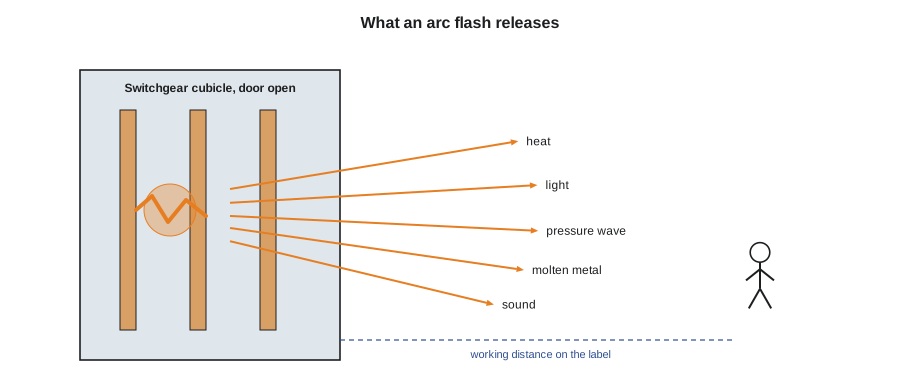
The energy that reaches a person depends on the fault current available at that point in the system, how long the protective device takes to clear the fault, the distance from the arc and the arrangement of the equipment. Large data centre switchgear, fed by big transformers, can deliver very high fault currents. That is why arc flash hazards are often highest not at the medium-voltage gear but at the low-voltage switchboards and the main breakers of large UPS systems, where fault current is high and some breakers are set to clear slowly so that the system stays selective.
Measuring arc flash hazard: incident energy
Engineers measure arc flash hazard as incident energy: the heat energy that would reach a surface at a given working distance, in calories per square centimetre (cal/cm²). The commonly quoted threshold for the onset of a second-degree burn on bare skin is about 1.2 cal/cm², roughly what a finger feels in a second from the blue part of a lighter flame. An arc flash study, done by an engineer for every piece of equipment in the building, calculates the incident energy at the normal working distance and the arc flash boundary: the distance at which the incident energy falls to 1.2 cal/cm². Inside that boundary, anyone exposed needs arc-rated protective equipment.
Incident energy falls quickly with distance. Close to the arc it falls roughly with the square of the distance, so doubling the distance cuts it to about a quarter. The real relationship depends on the equipment, and engineers use detailed methods from IEEE 1584, but the simple rule shows why distance is protection. The code below uses it only to illustrate the shape of the curve.
# How incident energy falls with distance (simple inverse-square illustration only)
e_at_working = 8.0     # cal/cm2 at the label's working distance
d_working = 455         # mm
for d in [230, 455, 900, 1200, 1600, 2000]:
    e = e_at_working * (d_working / d) ** 2
    note = "second-degree burn possible on bare skin" if e >= 1.2 else "below 1.2 cal/cm2"
print(f"{d:6.0f} mm {e:6.2f} cal/cm2 {note}")230 mm 31.31 cal/cm2 second-degree burn possible on bare skin 455 mm 8.00 cal/cm2 second-degree burn possible on bare skin 900 mm 2.04 cal/cm2 second-degree burn possible on bare skin 1200 mm 1.15 cal/cm2 below 1.2 cal/cm2 1600 mm 0.65 cal/cm2 below 1.2 cal/cm2 2000 mm 0.41 cal/cm2 below 1.2 cal/cm2
Real arc flash boundaries come from the study and are printed on the equipment label, which lesson 3 explains. A technician never estimates them; the point of the example is that stepping back from open equipment is one of the most effective protections there is.
Arc flash in the white space
Arc flash is usually discussed for switchgear, but it can happen anywhere there is enough energy. Busway above a row of racks carries hundreds of amperes. A tap-off box being plugged into live busway, a power strip plug being forced into a damaged receptacle, or a metal tool dropped across the terminals of an open PDU panel can all start an arc. The incident energy at rack power strips is usually low, but at busway and PDU panels it can be much higher. That is another reason the white space rule is that technicians do not open electrical covers and do not install or remove tap-off boxes; qualified electrical workers do.
Battery systems add a special case. A battery cannot be switched off: it is always energized until it is disconnected and discharged. A UPS battery string can hold hundreds of volts of direct current and deliver very high fault current into a short circuit. Lesson 5 covers battery hazards.
Burns, falls and secondary injuries
Electrical injuries are often worse than they first appear. Current passing through the body can damage muscles, nerves and organs along its path while leaving only small marks on the skin. A person who has had a significant shock should always be seen by medical staff, even if they feel fine, because heart rhythm problems can appear hours later. Shocks also cause secondary injuries: a person on a ladder who receives even a small shock may fall. Arc flash causes flash burns, ignited clothing, eye damage, hearing loss and blast injuries. Synthetic clothing that melts makes burns far worse, which is one reason arc-rated clothing is made of materials that do not melt or keep burning.
Who may do electrical work
In Quebec, electrical installation work is regulated work. Construction electrical work must be done by holders of the appropriate competency certificates issued under the construction industry rules, and electrical contractors must hold the appropriate licence. Maintenance electricians in a building need recognized qualifications too. Electrical safety practice in Canada follows CSA Z462, Workplace electrical safety, which Stonebridge's electrical safety program adopts.
These standards divide workers into two groups. A qualified person has the training and knowledge to recognize and avoid the hazards of the specific equipment and task and has been authorized by the employer for that work. An unqualified person has not. A data centre technician is an unqualified person for almost all electrical work. Unqualified people may not cross the limited approach boundary of exposed energized parts unless a qualified person escorts them and has told them about the hazards, and they may never cross the restricted approach boundary. Lesson 3 explains the boundaries.
What technicians may do is the ordinary, low-risk work their training covers: plugging listed equipment into rack power strips, reading strip displays, checking that cords are routed to the A and B sides correctly, and reporting what they see. Even these tasks have rules, such as never plugging into a strip that is overloaded, never using adapters or extension cords in a rack and never forcing a plug.
Worked problem
A smell of hot plastic
Midway through a night shift, Jamal smells hot plastic near cabinet A-09-12. The rack power strip on the B side shows a load well within its rating, but one outlet is discoloured and the plug in it is warm to the back of his hand when he holds it close without touching.
Show solution
- Jamal does not touch the plug or the strip. He steps back and calls Dmitri.
- Dmitri checks the strip's outlet metering remotely: one outlet shows a normal load, so the heat is probably a poor contact, not overload.
- Dmitri calls the customer, who confirms that the server on that outlet also has a supply on the A side and agrees to let it run on A alone.
- A qualified electrician, under a permit, switches off that outlet from the strip's controller, removes the plug wearing the protective equipment the procedure requires, and finds a scorched contact.
- The strip is replaced in a scheduled change the next day; Jamal files a hazard report.
Answer: The early report found a failing contact before it could start a fire or an arc. Jamal did the two things a technician should do: kept his hands off and told the shift lead immediately.
Common mistakes
MistakeThinking 120 V cannot kill.
InsteadSweaty skin and a firm grip can let a dangerous current flow at 120 V.
MistakeTouching a person who is still in contact with a conductor.
InsteadGet the power off first.
MistakeTreating arc flash as a switchgear-only hazard.
InsteadBusway, PDUs and batteries can arc too.
MistakeOpening a cover to look inside.
InsteadTechnicians do not open electrical enclosures; call a qualified person.
MistakeSkipping medical checks after a shock.
InsteadHeart problems can appear hours later; get checked.
Summary and key terms
- Shock happens when current flows through the body; Ohm's law shows that low resistance from sweat or wet skin makes building voltages dangerous.
- A few milliamperes are painful, tens of milliamperes can prevent letting go and around 50 to 100 mA can stop the heart.
- Arc flash is an electrical explosion that releases heat, light, pressure, molten metal and noise.
- Incident energy, in cal/cm², measures arc flash hazard; 1.2 cal/cm² is the commonly used burn threshold, and distance is a strong protection.
- Technicians are unqualified persons for electrical work: they do not open enclosures, do not use damaged equipment and report hazards.
- Electric shock
- Injury caused by current passing through the body.
- Let-go threshold
- The current above which muscle contraction stops a person releasing a conductor.
- Arc flash
- An electrical explosion caused by current flowing through air between conductors.
- Arc blast
- The pressure wave from the rapid expansion of vaporized metal and air in an arc flash.
- Incident energy
- The heat energy from an arc reaching a surface at a given distance, in cal/cm².
- Qualified person
- A worker trained and authorized to recognize and avoid the hazards of specific electrical equipment and tasks.
Practice problems
Work each problem on paper first, then reveal the answer to check.
Using Ohm's law, what current flows through a body of 1,500 ohms touching 208 V?
Show answer
About 139 mA, enough to disturb the heart.
Why must a rescuer not touch a person still in contact with an energized conductor?
Show answer
The rescuer becomes part of the circuit; switch the power off first.
What happens to incident energy, roughly, when you double your distance from the arc?
Show answer
It falls to about a quarter in the simple model.
Name two shock hazards a technician may find in the white space.
Show answer
Damaged cords and plugs, damaged power strips, open busway or PDU covers, liquid near equipment.
Lesson quiz · 5 questions
Score 60% or more to complete this lesson.
Create a free account to save your progress, take quizzes and earn a certificate.