
DCT-120 · Lesson 6 of 12 · 20 min
Electrostatic discharge and equipment protection
Most of the hazards in this course can hurt a person. Electrostatic discharge, ESD, almost never hurts anyone, but it can destroy the equipment a technician is there to protect. A spark too small to feel can damage a memory module, a processor or a drive controller, and the damage may not show until days later, when the server fails in production. Jamal has already used a wrist strap on his first remote hands ticket. This lesson explains why, how static charge builds up, how an ESD protected area works and what to check before handling components.
What static electricity is
Static electricity is an imbalance of electric charge on the surface of an object. It builds up when two materials touch and separate, a process called triboelectric charging: one material gives up electrons and becomes positively charged, the other gains them and becomes negative. Walking across a floor, pulling tape off a roll, sliding a component out of a plastic bag or taking off a sweater all separate charge. The charge stays until it finds a path to an object at a different potential. When it does, it moves very quickly, in nanoseconds, as a discharge. People feel a discharge only above about 3,000 V. Many electronic components can be damaged by discharges of a few hundred volts, and some by less than 100 V.
How much charge builds up depends heavily on humidity. Moist air lets charge leak away through a thin film of water on surfaces; dry air does not. The figures below are the kind commonly quoted in ESD training to show the effect; real values depend on the materials, the person and the activity.
| Activity | Typical voltage at 10 to 25 % relative humidity | Typical voltage at 65 to 90 % relative humidity |
|---|---|---|
| Walking across a carpet | 35,000 V | 1,500 V |
| Walking across a vinyl floor | 12,000 V | 250 V |
| Worker at a bench, moving | 6,000 V | 100 V |
| Picking up a common plastic bag | 20,000 V | 1,200 V |
| Sliding a part out of a foam-lined box | 18,000 V | 1,500 V |
Data centres are often kept relatively dry, because humidity control costs energy and modern equipment tolerates a wide humidity range. The current thermal guidelines for IT equipment allow dew points and relative humidity much lower than older practice, and research for those guidelines found that ESD risk at lower humidity is managed well by grounding and good handling practice rather than by adding moisture to the air. That puts the emphasis on the technician's habits.
How ESD damages equipment
A discharge into a component can melt microscopic conductors, punch through the thin insulating layers inside transistors or weaken them. Damage takes two forms:
- Catastrophic failure: the component stops working immediately. This is the easier case, because it is found during testing.
- Latent damage: the component is weakened but still works. It may fail days or months later, often under load or heat. Latent damage is believed to cause many unexplained field failures.
Components are most vulnerable when they are out of the server: memory modules, processors, drives, network cards and system boards with their connectors exposed. Inside a closed, grounded chassis they are well protected. That is why ESD rules apply whenever a technician opens equipment, removes or installs parts, or handles parts outside their protective packaging.
ESD control programs
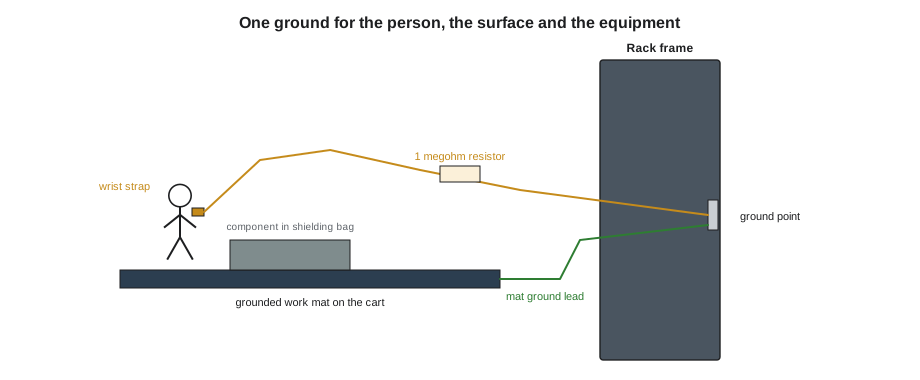
Electronics manufacturers and repair centres follow formal ESD control programs under the international standard IEC 61340-5-1 or the North American standard ANSI/ESD S20.20, which set requirements for grounding, protective equipment, packaging, training and verification. A data centre is not an electronics factory, but Stonebridge's remote hands procedures borrow the main ideas, and many customers' contracts require them. The core principle is simple: bring everything that will touch the component, including the person, the work surface and the tools, to the same potential, connected to ground, so that no discharge can happen.
The wrist strap
The wrist strap is the most important ESD tool. It is a conductive band worn snugly against the skin, connected by a coiled cord to a ground point, usually the bare metal of the rack frame or a grounding jack on the cabinet. The cord contains a current-limiting resistor, typically 1 megohm, in series. The resistor lets static charge drain away safely and limits the current that could flow through the wearer if they touched an energized conductor by accident. A wrist strap without its resistor, or a bare wire wrapped around the wrist, is dangerous and is never used.
Wrist straps must be tested, because the cord can break inside its jacket or the band can lose contact with the skin without anyone noticing. Stonebridge's technicians test their strap at the start of each shift on a wrist strap tester at the hall entrance, which passes current through the strap and the wearer and shows pass, low fail or high fail. A high fail usually means a broken cord or poor skin contact, often from a loose band or very dry skin; a low fail means the resistance is too low, which can happen if the resistor has been bypassed. The ESD standards set an upper limit on the total resistance from the person to ground through a wrist strap, of about 35 megohms in S20.20, while the built-in resistor keeps it above about 1 megohm.
# Interpret wrist strap test results at the start of a shift (limits as commonly used, illustrative)
low_limit = 0.75e6      # ohms; below this the resistor may be bypassed
high_limit = 35e6       # ohms; above this the strap is not grounding the wearer reliably
tests = [("J. Pierce", 1.4e6), ("R. Kerr", 2.1e6), ("night contractor", 82e6), ("temp badge 117", 0.3e6)]
for who, r in tests:
    if r < low_limit:
        result = "LOW FAIL - check the cord resistor; do not use"
    elif r > high_limit:
        result = "HIGH FAIL - tighten band, moisten skin or replace the cord, then retest"
    else:
        result = "pass"
print(f"{who:18s} {r / 1e6:6.1f} megohm {result}")J. Pierce 1.4 megohm pass R. Kerr 2.1 megohm pass night contractor 82.0 megohm HIGH FAIL - tighten band, moisten skin or replace the cord, then retest temp badge 117 0.3 megohm LOW FAIL - check the cord resistor; do not use
Grounding the work
The wrist strap protects only if the strap, the work surface and the equipment share the same ground. In a data hall the reference is the rack frame, which is bonded to the building's grounding system through the rack bonding conductor. Technicians clip their strap to bare metal on the same rack as the equipment they are working on, not to a painted surface, a plastic part or a neighbouring rack. When a server is removed for work, it goes onto an ESD work mat on a cart or bench, and the mat is connected to the same ground. Stonebridge's remote hands carts carry a mat and a ground lead for this purpose.
Some customers' cages have ESD flooring and require ESD footwear or heel straps, which ground the wearer through the floor. In ordinary data hall flooring, heel straps are not reliable on their own, and a wrist strap is still required for component work.
Packaging and handling
Components travel in ESD protective packaging: shielding bags, usually silvery or metallic-looking, which block external fields and discharges, and dissipative trays and boxes. Pink antistatic bags are low-charging but do not shield, and are used only for items that are not sensitive. Good handling practice follows a few rules:
- Keep components in their shielding packaging until the moment of installation, and open the packaging only while grounded.
- Hold modules and cards by their edges, never by the contacts or the components.
- Do not place components on top of shielding bags, which can carry charge on the outside; place them on the grounded mat or inside the packaging.
- Keep ordinary plastics, foam, cups, tape dispensers and paper away from the work area; they charge easily.
- Do not hand a component directly to another person unless both are grounded; put it down on the mat first.
- Put removed components into shielding packaging immediately, including failed parts being returned for analysis, so the failure can be studied.
ESD and safety
ESD control must never create an electrical safety hazard. The wrist strap resistor is the first protection; the second is the rule that technicians work only on equipment that is powered down and disconnected, or on hot-swappable components designed to be handled while the system runs, such as drives and power supplies with their own guarded connectors. A technician never wears a wrist strap while working near exposed energized conductors, such as inside a power distribution panel, where the strap could provide a path to ground; but technicians do not work inside such panels anyway. When hot-swapping a power supply, the technician grounds themselves and handles the supply by its handle, following the manufacturer's procedure.
Before opening any equipment: a checklist
# Pre-work ESD checklist for a component swap
checks = {
    "wrist strap tested this shift and passed": True,
    "strap clipped to bare metal on the same rack": True,
    "ESD mat on the cart and grounded to the rack": True,
    "replacement part still sealed in shielding bag": True,
    "server powered down, or part is hot-swappable": True,
    "cups, foam and loose plastics cleared from the cart": False,
}
missing = [k for k, ok in checks.items() if not ok]
for k, ok in checks.items():
    print(("[x] " if ok else "[ ] ") + k)
print("Ready to open the equipment" if not missing else "Not ready: " + "; ".join(missing))[x] wrist strap tested this shift and passed [x] strap clipped to bare metal on the same rack [x] ESD mat on the cart and grounded to the rack [x] replacement part still sealed in shielding bag [x] server powered down, or part is hot-swappable [ ] cups, foam and loose plastics cleared from the cart Not ready: cups, foam and loose plastics cleared from the cart
Humidity, monitoring and the building
The building plays its part. Stonebridge's monitoring system logs temperature and humidity at many points in each hall, and the facilities team keeps humidity within the range the site's design follows. Very dry conditions, which can happen in winter when cold outside air is brought in for economizer cooling, are flagged to technicians at shift handover as a reminder to be extra careful with component work. Floors in the halls are cleaned with products that do not leave insulating residue, and carpet is not allowed in the white space.
# Flag ESD caution conditions from the hall humidity log (illustrative thresholds)
readings = [("Hall A row 4", 22.5, 24), ("Hall A row 9", 23.0, 18), ("Hall B row 2", 24.0, 35), ("Hall D gallery", 26.5, 12)]
for where, temp, rh in readings:
    note = "very dry: extra ESD care at handover" if rh < 20 else "dry: normal ESD practice" if rh < 30 else "normal"
print(f"{where:16s} {temp:5.1f} C RH {rh:3d} % {note}")Hall A row 4 22.5 C RH 24 % dry: normal ESD practice Hall A row 9 23.0 C RH 18 % very dry: extra ESD care at handover Hall B row 2 24.0 C RH 35 % normal Hall D gallery 26.5 C RH 12 % very dry: extra ESD care at handover
Worked problem
A memory module replacement in a dry week
In January the Hall A humidity is running at about 18 %. A customer asks for a failed memory module to be replaced in a powered-down server in cabinet A-22-05.
Show solution
- Jamal tests his wrist strap at the hall entrance: high fail. He tightens the band, which was loose over his sleeve, and retests: pass.
- At the cabinet, he confirms the server is powered off and both power cords are unplugged, as the ticket says.
- He slides the server onto the cart's grounded mat, clips his strap to the rack frame and connects the mat lead to the same rack.
- He opens the replacement module's shielding bag only after he is grounded, removes the failed module by its edges and puts it straight into the empty bag.
- He installs the new module, closes the server, reinstalls it and plugs the cords into the A and B strips as before, then updates the ticket with photos.
Answer: The server passes its memory test on boot. The failed module goes back to the vendor in its shielding bag so the failure can be analyzed.
Common mistakes
MistakeThinking a discharge you cannot feel is harmless.
InsteadComponents can be damaged far below the 3,000 V people feel.
MistakeUsing an untested or loose wrist strap.
InsteadTest it each shift and wear it snugly against the skin.
MistakeClipping the strap to paint or another rack.
InsteadClip to bare metal on the same rack as the work.
MistakeSetting a component on top of a shielding bag.
InsteadPut it on the grounded mat or inside the bag.
MistakeWearing a strap near exposed energized conductors.
InsteadTechnicians do not work there; the resistor is not a licence to try.
Summary and key terms
- Static charge builds up when materials touch and separate, especially in dry air.
- Components can be damaged by discharges of a few hundred volts or less, too small to feel; damage can be latent.
- ESD control brings the person, work surface and equipment to the same grounded potential.
- Wrist straps include a current-limiting resistor of about 1 megohm and are tested every shift.
- Keep parts in shielding packaging, handle them by the edges and keep charging materials away.
- ESD practice never overrides electrical safety; work only on powered-down or hot-swappable parts.
- ESD
- Electrostatic discharge: a rapid transfer of static charge between objects at different potentials.
- Triboelectric charging
- Charge separation caused by materials touching and separating.
- Latent damage
- Hidden ESD damage that causes a component to fail later.
- Wrist strap
- A grounded band with a current-limiting resistor worn to keep a person at ground potential.
- Shielding bag
- Packaging that blocks external electrostatic fields and discharges.
Practice problems
Work each problem on paper first, then reveal the answer to check.
Why does dry air increase ESD risk?
Show answer
Without a moisture film on surfaces, charge cannot leak away and builds to higher voltages.
What does a high fail on a wrist strap tester usually mean?
Show answer
A broken cord or poor skin contact; the strap is not grounding the wearer.
Where should a removed failed component go?
Show answer
Into shielding packaging immediately.
Why must the strap and the mat be grounded to the same rack?
Show answer
So the person, surface and equipment are at the same potential.
Lesson quiz · 5 questions
Score 60% or more to complete this lesson.
Create a free account to save your progress, take quizzes and earn a certificate.