
DCE-460 · Lesson 6 of 12 · 24 min
Water use and stewardship
Water has become one of the most contentious aspects of data centre development. A large campus with evaporative cooling can consume as much water as a small town, often in regions already facing drought, and residents increasingly ask what a new data centre will do to their water supply. At the same time, evaporative cooling is one of the most energy-efficient ways to reject heat, and the electricity that dry cooling would need also consumes water at power plants. Managing water well means understanding how data centres use it, measuring it properly, weighing it against energy and carbon in local context, and choosing sources and technologies responsibly. This lesson covers water use in cooling, withdrawal versus consumption, cycles of concentration and treatment, the trade-off with energy, water sources, water stress and stewardship, and the regulations that apply.
How data centres use water
Most data centre water is used for cooling. In evaporative systems, such as cooling towers and evaporative coolers, warm water or air is cooled by evaporating part of the water, which carries away heat as latent heat. Evaporating one kilogram (one litre) of water absorbs about 2,400 kJ, so rejecting 1 kWh (3,600 kJ) of heat entirely by evaporation consumes about 1.5 L. In practice, part of the heat is rejected sensibly (by warming air without evaporation), especially in cool weather, so annual evaporation is somewhat less. Other uses include humidification, which some facilities need in dry climates, and domestic uses such as washrooms and landscaping, which are usually small by comparison.
Withdrawal and consumption
Two quantities must be distinguished. Withdrawal is the water taken from a source; consumption is the water that is not returned, mainly because it evaporates. A cooling tower withdraws make-up water, evaporates most of it, and discharges the rest as blowdown, which returns to sewers or treatment plants (often with concentrated minerals and treatment chemicals). The local impact depends mainly on consumption, but withdrawal and discharge quality also matter to water utilities and regulators.
Cycles of concentration and blowdown
As water evaporates in a cooling tower, the dissolved minerals in the remaining water become more concentrated, and if they become too concentrated, they form scale and promote corrosion. To control this, some water is continually drained (blowdown) and replaced with fresh make-up water. The cycles of concentration (COC) is the ratio of dissolved solids in the circulating water to those in the make-up water. Blowdown and make-up follow from evaporation:
# Water consumed by an evaporative cooling tower rejecting server heat
heat_MW = 20.0            # heat rejected (IT load plus most overheads)
hours = 8760
evap_fraction = 0.8       # share of heat rejected by evaporation over a year (rest is sensible)
latent_kJ_per_kg = 2430   # latent heat of vaporization near 30 C

heat_kJ = heat_MW * 1000 * hours * 3600
evap_m3 = heat_kJ * evap_fraction / latent_kJ_per_kg / 1000
print(f"Evaporation: {evap_m3:,.0f} m3/yr ({evap_m3 * 1000 / (heat_MW * 1000 * hours):.2f} L per kWh of heat)")

for coc in (3, 6):
    blowdown = evap_m3 / (coc - 1)               # water discharged to control dissolved solids
    makeup = evap_m3 + blowdown
    print(f"Cycles of concentration {coc}: blowdown {blowdown:,.0f} m3, make-up {makeup:,.0f} m3")

# Compare with a dry cooler that uses no water but more fan and chiller energy
extra_MWh = heat_MW * hours * 0.06               # assume 6 % of heat as extra electricity
for name, l_per_kWh in [("thermal-heavy grid", 2.0), ("wind and solar grid", 0.1)]:
print(f"Dry cooling on a {name}: {extra_MWh:,.0f} MWh extra, upstream water {extra_MWh * l_per_kWh:,.0f} m3")Evaporation: 207,644 m3/yr (1.19 L per kWh of heat) Cycles of concentration 3: blowdown 103,822 m3, make-up 311,467 m3 Cycles of concentration 6: blowdown 41,529 m3, make-up 249,173 m3 Dry cooling on a thermal-heavy grid: 10,512 MWh extra, upstream water 21,024 m3 Dry cooling on a wind and solar grid: 10,512 MWh extra, upstream water 1,051 m3
A 20 MW heat load evaporates about 210,000 m³ a year, about 1.2 L per kWh of heat. At three cycles of concentration, blowdown adds another 100,000 m³; raising the cycles to six, with better water treatment (softening, chemical or non-chemical scale control), cuts blowdown by 60 % and total make-up by 20 %. Increasing cycles is one of the most effective water savings for existing evaporative plants, limited by the make-up water's chemistry.
The energy and water trade-off
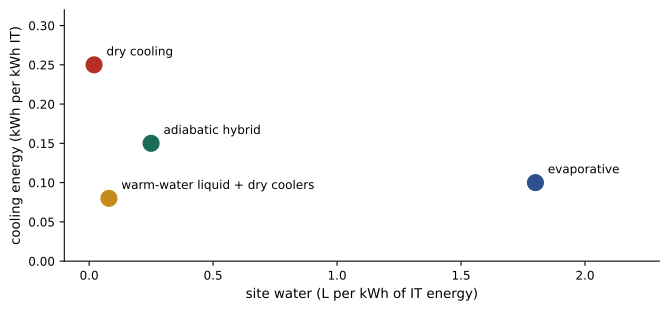
Dry cooling (air-cooled chillers, dry coolers) uses essentially no water on site but needs more electricity, especially in hot weather, because air cannot cool below its dry-bulb temperature while evaporative systems approach the lower wet-bulb temperature. That extra electricity has its own water footprint at power plants that use water for cooling, and its own carbon footprint. In the example, dry cooling adds about 10,500 MWh a year; on a grid dominated by thermal plants, generating that electricity might consume about 21,000 m³ of water, far less than the 250,000 to 310,000 m³ saved on site, while on a wind and solar grid it consumes almost none. In most locations, therefore, dry or hybrid cooling saves water overall, but it increases energy use and, on a carbon-intensive grid, emissions. The right choice depends on local water stress, grid carbon and climate.
Many modern designs use hybrid approaches: dry cooling for most of the year, with evaporative assistance only on the hottest days (adiabatic cooling), or closed-loop liquid cooling at temperatures warm enough to reject heat with dry coolers year-round (Lesson 4). These can achieve low WUE with modest energy penalties.
Water sources
Where water is needed, its source matters as much as its quantity:
- Potable (drinking) water from the municipal system is convenient but competes directly with residential use and is treated at public expense.
- Reclaimed or recycled water (treated municipal wastewater) is increasingly used for cooling, sparing potable supplies; it needs additional treatment for cooling towers.
- Groundwater may be available but can deplete aquifers and is regulated in many regions.
- Surface water from rivers, lakes or the sea can be used for direct cooling in some locations, subject to environmental limits on withdrawal and on the temperature of returned water.
- Rainwater harvesting and on-site storage can supplement supplies.
Using non-potable sources and returning treated water in good condition reduce the impact of the water a facility does use.
Water stress and stewardship
A litre of water consumed in a wet region with abundant supply has a very different impact from a litre consumed in an arid region where rivers and aquifers are over-allocated. Tools such as the World Resources Institute's Aqueduct water risk atlas map baseline water stress (the ratio of demand to available supply) and drought risk by basin. Responsible siting considers water stress alongside energy and carbon (Lesson 1). Water stewardship goes further: understanding the shared water challenges in the basin, engaging with water utilities and communities, investing in projects that restore water or improve local supply, and reporting transparently. Some large operators have committed to being "water positive", replenishing more water than they consume in the basins where they operate, through projects such as wetland restoration, leak repair in municipal systems and agricultural efficiency. Such claims should be judged by their accounting methods and by whether the replenishment occurs in the same basin and at the same times of scarcity.
Regulation and permits
In Canada, water is managed by the provinces. Large withdrawals require permits, for example Ontario's Permit to Take Water for withdrawals over 50,000 L per day, and provinces set rules for discharge to sewers and watercourses. Municipalities set conditions for connection to water and sewer systems, and some have begun asking data centre proponents for water use plans.
Discharges of blowdown containing treatment chemicals must meet sewer use bylaws or discharge permits, and cooling towers must be managed to control Legionella bacteria under public health rules and industry standards such as ASHRAE 188.
Worked problem
Choosing a cooling approach for a water-stressed site
A 30 MW data centre is proposed in a region rated as having high baseline water stress, on a grid averaging 300 g CO₂/kWh. Evaporative cooling would give an annual PUE of 1.20 and consume about 350,000 m³ of potable water a year; an adiabatic hybrid would give PUE 1.28 and consume about 40,000 m³; dry cooling would give PUE 1.35 and consume almost none. Assuming the IT load averages 24 MW, compare the options.
Show solution
- IT energy: 24 MW × 8,760 h ≈ 210,000 MWh.
- Extra energy relative to evaporative: hybrid 0.08 × 210,000 ≈ 16,800 MWh; dry 0.15 × 210,000 ≈ 31,500 MWh.
- Extra emissions at 300 g/kWh: hybrid ≈ 5,000 t CO₂; dry ≈ 9,500 t CO₂ a year.
- Water saved relative to evaporative: hybrid ≈ 310,000 m³; dry ≈ 350,000 m³ a year.
Answer: In a high-stress basin, the adiabatic hybrid saves almost 90 % of the water for a modest energy and carbon penalty, and is likely the best balance; sourcing reclaimed water for its remaining needs and procuring clean electricity (Lesson 8) would reduce both impacts further. Dry cooling saves a little more water at nearly twice the energy penalty.
Measuring and managing water on site
Water management requires meters on make-up water, blowdown, and any other significant uses, read continuously and compared with the cooling load so that unexpected increases, such as a leaking valve, a stuck float or overflowing basins, are caught quickly. Water treatment programmes should be monitored for cycles of concentration, scaling, corrosion and biological growth, because poorly treated towers waste water, lose efficiency and pose health risks. Seasonal operating strategies help: running evaporative assistance only when outdoor conditions require it, and switching to dry operation in cool weather. Reporting WUE monthly alongside PUE shows the interplay between water and energy as conditions change through the year.
Community engagement is part of stewardship. Publishing expected and actual water use, explaining choices of technology and source, and working with the local water utility on drought plans build trust and reduce the risk of conflict when supplies are tight.
Finally, plan for drought. Water utilities in stressed regions may restrict supply during droughts, and a data centre that depends entirely on evaporative cooling could face a choice between breaking restrictions and losing cooling. Designs that can switch to dry operation, on-site storage and alternative sources make facilities resilient as well as responsible.
Common mistakes
MistakeReporting withdrawal and consumption interchangeably.
InsteadDistinguish water withdrawn from water consumed by evaporation.
MistakeRunning cooling towers at low cycles of concentration.
InsteadImprove treatment to raise cycles and cut blowdown.
MistakeAssuming dry cooling is always the sustainable choice.
InsteadWeigh energy, grid carbon and upstream water against local water stress.
MistakeUsing potable water when reclaimed water is available.
InsteadPrefer non-potable sources for cooling.
MistakeIgnoring basin context in water claims.
InsteadAssess water stress and replenish in the same basin.
Summary and key terms
- Evaporating water absorbs about 2,400 kJ/kg; rejecting 1 kWh of heat by evaporation uses about 1.5 L.
- Withdrawal differs from consumption; blowdown returns water with concentrated minerals.
- Blowdown = evaporation ÷ (COC − 1); higher cycles save water.
- Dry cooling saves site water but uses more energy, with upstream water and carbon.
- Hybrid adiabatic and warm-water liquid cooling reduce both water and energy.
- Prefer reclaimed and non-potable sources; assess basin water stress.
- Water use is regulated by provinces or states and by municipalities; cooling towers need Legionella control.
- Withdrawal
- Water taken from a source.
- Consumption
- Water not returned to the source, mainly evaporated.
- Make-up water
- Water added to replace evaporation and blowdown.
- Blowdown
- Water drained to limit dissolved solids.
- Cycles of concentration
- Ratio of dissolved solids in circulating to make-up water.
- Wet-bulb temperature
- The lowest temperature reachable by evaporative cooling.
- Adiabatic cooling
- Evaporative pre-cooling of air used only when needed.
- Reclaimed water
- Treated wastewater reused for non-potable purposes.
- Baseline water stress
- Water demand relative to available supply in a basin.
- Water positive
- Replenishing more water than is consumed.
Practice problems
Work each problem on paper first, then reveal the answer to check.
About how much water evaporates to reject 1 kWh of heat entirely by evaporation?
Show answer
About 1.5 L.
What is the difference between withdrawal and consumption?
Show answer
Withdrawal is taken; consumption is not returned, mainly evaporated.
Evaporation is 100,000 m³ at 4 cycles. What is blowdown?
Show answer
100,000 / 3 ≈ 33,300 m³.
From the output, how much does raising cycles from 3 to 6 reduce make-up?
Show answer
From about 311,000 to 249,000 m³, about 20 %.
Why does dry cooling need more energy?
Show answer
Air cannot cool below its dry-bulb temperature; evaporative systems approach the lower wet-bulb.
Why does dry cooling's extra electricity have a water footprint?
Show answer
Thermal power plants consume water for cooling.
Name two non-potable water sources for cooling.
Show answer
Reclaimed wastewater, rainwater, some groundwater or surface water.
What does the WRI Aqueduct tool map?
Show answer
Baseline water stress and other water risks by basin.
In the example, what is the hybrid's extra annual emission?
Show answer
About 5,000 t CO₂.
Which standard addresses Legionella risk management?
Show answer
ASHRAE 188.
Lesson quiz · 5 questions
Score 60% or more to complete this lesson.
Create a free account to save your progress, take quizzes and earn a certificate.