
DCE-460 · Lesson 10 of 12 · 24 min
Embodied carbon and circularity
The concrete, steel, copper, aluminum, generators, chillers, batteries and servers that make up a data centre all carry emissions from their extraction, manufacture and transport, long before the facility uses its first kilowatt-hour. This embodied carbon was long overlooked because operational emissions were so much larger. As data centres move to clean electricity, the balance changes: on a clean grid, embodied carbon can be the larger part of a facility's lifetime footprint, and it is emitted up front, when it matters most for climate goals. Alongside carbon, data centres consume large quantities of materials and generate electronic waste as hardware is replaced. This lesson covers how embodied carbon is measured, where it comes from in buildings, equipment and IT, how to reduce it, and the principles of circularity: designing out waste and keeping materials in use.
Measuring embodied carbon
Embodied carbon is estimated with life cycle assessment (LCA), which accounts for emissions across a product's life stages: raw material extraction and manufacturing (the product stage), transport and construction, use (including maintenance and replacement), and end of life. For buildings, the European standard EN 15978 and the international ISO 21930 and ISO 14040/14044 define methods and stage modules (A1 to A3 for products, A4 and A5 for transport and construction, B for use, C for end of life, D for benefits beyond the life cycle). Product-level data come from environmental product declarations (EPDs), third-party verified documents reporting a product's impacts per unit, now widely available for concrete, steel, insulation and increasingly for electrical and mechanical equipment. Where EPDs are unavailable, industry-average databases or spend-based estimates are used, with greater uncertainty.
Whole-building LCA tools combine material quantities from the design with EPD or database factors to estimate embodied carbon, allowing designers to compare structural systems, materials and equipment choices before construction, when changes are cheapest.
Where embodied carbon comes from
In a data centre, embodied carbon arises in three main areas:
- The building: concrete foundations, slabs and walls; structural steel; roofing; envelope; and site works. Concrete and steel dominate, through cement production and steelmaking.
- Mechanical, electrical and plumbing (MEP) equipment: switchgear, transformers, UPS systems, batteries, generators, chillers, air handlers, pipework, cable and busway. Copper and aluminum in cables and busbars, and the steel in equipment, are significant, and MEP equipment is replaced one or more times during the building's life.
- IT equipment: servers, storage and networking, with high embodied carbon per kilogram because of semiconductors, printed circuit boards and memory, and short lives of three to six years, so they are replaced many times over a facility's life.
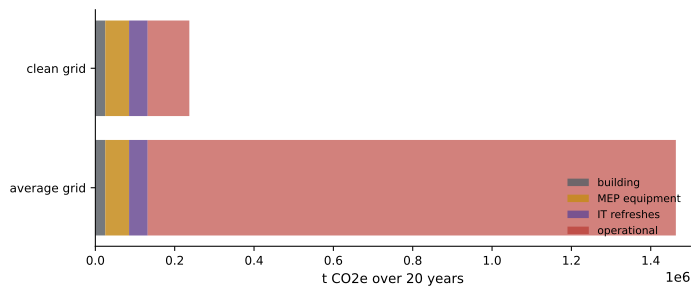
# Embodied versus operational carbon over a 20-year life for a 20 MW (IT) facility (illustrative values)
years = 20
building_t = 25000            # structure, envelope, site works
mep_t = 30000                 # electrical and mechanical equipment, replaced once mid-life
it_refresh_t = 9000 * 1.3     # 9,000 servers at about 1.3 t each, refreshed every 5 years
annual_MWh = 20 * 8760 * 0.8 * 1.25

embodied = building_t + mep_t * 2 + it_refresh_t * (years // 5)
for grid_name, g in [("average grid, 380 g/kWh", 380), ("clean grid, 30 g/kWh", 30)]:
    operational = annual_MWh * g / 1000 * years
    share = embodied / (embodied + operational)
    print(f"{grid_name:<26} operational {operational:>9,.0f} t, embodied {embodied:>7,.0f} t, embodied share {share:5.1%}")

# Effect of lower-carbon concrete and steel (30 % less building carbon) and server life extension to 7 years
improved = building_t * 0.7 + mep_t * 2 + it_refresh_t * (years / 7)
print(f"With low-carbon structure and 7-year servers: embodied {improved:,.0f} t ({1 - improved / embodied:.0%} less)")average grid, 380 g/kWh operational 1,331,520 t, embodied 131,800 t, embodied share 9.0% clean grid, 30 g/kWh operational 105,120 t, embodied 131,800 t, embodied share 55.6% With low-carbon structure and 7-year servers: embodied 110,929 t (16% less)
On an average grid of 380 g/kWh, operational emissions over 20 years are about 1.3 million tonnes and embodied carbon is less than a tenth of the total. On a clean grid of 30 g/kWh, operational emissions fall to about 105,000 t, and embodied carbon, about 130,000 t, becomes more than half of the lifetime footprint. IT hardware, refreshed every five years, accounts for about a third of the embodied total in this example. Lower-carbon structural materials and extending server life to seven years together cut embodied carbon by about 16 %.
Reducing embodied carbon in the building
Measures that reduce the embodied carbon of the building include:
- Using less material: efficient structural design, avoiding over-specification of concrete strength and thickness, and right-sizing foundations.
- Lower-carbon concrete: replacing part of the cement with supplementary cementitious materials such as fly ash, slag or calcined clay; using blended cements (such as Portland-limestone cement); specifying performance-based mixes; and in some cases using concrete that absorbs CO₂ during curing.
- Lower-carbon steel: specifying steel made in electric arc furnaces from recycled scrap, which typically has much lower emissions than steel from blast furnaces.
- Alternative structures: mass timber (cross-laminated timber and glulam) for offices and some data hall structures, with fire protection designed accordingly; several operators have built timber-framed data centres.
- Reuse: adapting existing buildings rather than building new, and designing for disassembly so components can be reused at end of life.
In Canada, the federal government's Standard on Embodied Carbon in Construction requires embodied carbon reporting and reduction for major federal construction projects, and the National Research Council has developed national guidelines for whole-building LCA. Portland-limestone cement (type GUL) is widely used, reducing cement emissions by around 10 %, and several provinces and municipalities, such as Toronto through its Green Standard, are introducing embodied carbon limits for new buildings.
Reducing embodied carbon in equipment and IT
For MEP equipment, the main levers are right-sizing (not installing capacity that will never be used), modular designs that add capacity as needed, specifying equipment with EPDs and lower-carbon materials, extending equipment life through maintenance and refurbishment, and choosing refrigerants with low GWP (Lesson 4). For IT, they include extending server lives where performance per watt allows (Lesson 5), reusing components such as memory, drives and chassis across generations, buying refurbished equipment for less demanding workloads, and designing infrastructure that does not force premature replacement. Open hardware designs, such as those developed by the Open Compute Project, emphasize modularity and serviceability, which support longer lives and component reuse.
Circularity and electronic waste
A circular economy aims to keep products and materials in use at their highest value for as long as possible, through maintenance, reuse, refurbishment, remanufacturing and, finally, recycling. Data centres retire large volumes of IT hardware, batteries and equipment. Responsible end-of-life practice includes:
- Secure data sanitization or destruction of storage media, verified and documented, so that equipment can be reused without data risk.
- Resale or redeployment of working equipment, through internal reuse or certified IT asset disposition (ITAD) providers.
- Harvesting of usable components for spares.
- Certified recycling of the remainder, recovering metals including copper, gold and rare elements, and handling hazardous materials safely. Certifications such as R2 and e-Stewards set standards for electronics recyclers.
- Battery recycling: lead-acid batteries are recycled at very high rates; lithium-ion recycling is growing, and second-life uses for batteries are emerging.
Metrics help: the share of retired equipment reused or refurbished, the share of material recycled, and waste sent to landfill. Contracts with suppliers can require take-back and recycled content.
Worked problem
Deciding when to replace servers
A cluster of 1,000 servers, five years old, uses 500 W each on average. New servers would deliver the same work with 400 machines at 600 W each. Each new server has about 1.3 t of embodied carbon. The grid is 100 g/kWh with PUE 1.3. How long until the operational savings repay the embodied carbon of the new servers?
Show solution
- Old cluster: 1,000 × 0.5 kW × 1.3 = 650 kW. New: 400 × 0.6 kW × 1.3 = 312 kW. Saving 338 kW.
- Annual energy saving: 338 × 8,760 ≈ 2,960 MWh; carbon saving at 100 g/kWh ≈ 296 t per year.
- Embodied carbon of new servers: 400 × 1.3 = 520 t. Payback: 520 / 296 ≈ 1.8 years.
Answer: About 1.8 years on this grid, so replacement is clearly worthwhile in carbon terms if the new servers will last several years, especially if the old servers can be resold or redeployed rather than scrapped. On a grid of 20 g/kWh, the payback would be about nine years, longer than the servers' life, and life extension would be the better choice. The grid's carbon intensity decides the answer.
Embodied carbon in procurement
Because most embodied carbon is locked in by purchasing decisions, procurement is where reductions happen. Owners increasingly include embodied carbon in tender requirements: asking contractors for EPDs of major materials, setting maximum global warming potential values for concrete and steel, requiring suppliers of switchgear, generators, UPS and cooling equipment to provide product carbon footprints, and asking IT vendors for product carbon footprints and take-back commitments. Weighting embodied carbon in bid evaluation, alongside price and quality, rewards suppliers who invest in lower-carbon products. Industry groups have begun to standardize product category rules for data centre equipment, which will make comparisons more reliable.
Longer-lived, adaptable buildings
A data centre building lasts far longer than the equipment inside it, but technology changes quickly: rack densities have risen from a few kilowatts to over 100 kW, and cooling has shifted from air to liquid. Buildings designed for flexibility, with structural capacity for heavier equipment, space and routes for liquid cooling pipework, and electrical infrastructure that can be upgraded in modules, can be adapted rather than replaced, saving the embodied carbon of new construction. Adaptability is therefore a sustainability feature, even if it adds some cost at the start.
Finally, end-of-life planning for the building itself, documenting materials and connections so that components can be recovered, prepares for a future in which construction materials are increasingly reused.
Embodied carbon is also increasingly reported. Customers ask for the embodied emissions of the capacity they lease, investors look for whole-life carbon in green building certifications, and building codes in several jurisdictions now require whole-building LCA for large projects. Operators who measure embodied carbon early, using design-stage LCA tools, can respond to these requests with evidence and can show reductions achieved through design choices.
Common mistakes
MistakeIgnoring embodied carbon because operational emissions are larger.
InsteadAssess it, especially on clean grids where it can dominate.
MistakeSpecifying concrete and steel by habit.
InsteadUse lower-carbon mixes, recycled steel and EPD-based limits.
MistakeRefreshing servers on a fixed schedule regardless of grid.
InsteadCompare energy savings with embodied carbon at the local grid intensity.
MistakeScrapping working equipment.
InsteadSanitize, reuse, resell or harvest before recycling.
MistakeUsing uncertified recyclers.
InsteadUse certified ITAD and recyclers such as R2 or e-Stewards.
Summary and key terms
- Embodied carbon comes from making, transporting and building materials, equipment and IT.
- LCA with EPDs, following EN 15978 and ISO standards, measures it by life cycle stage.
- On clean grids, embodied carbon can exceed operational emissions over a facility's life.
- Buildings: use less material, lower-carbon concrete and steel, timber and reuse.
- Equipment and IT: right-size, modularize, extend life and reuse components.
- Circular end of life: sanitize, reuse, resell, harvest and recycle with certified providers.
- Server refresh decisions depend on the grid's carbon intensity.
- Embodied carbon
- Emissions from producing, transporting, installing and disposing of materials and equipment.
- LCA
- Life cycle assessment of environmental impacts.
- EPD
- Environmental product declaration reporting verified impacts.
- Supplementary cementitious material
- A material such as slag or fly ash replacing part of the cement.
- Electric arc furnace
- A steelmaking process melting scrap with electricity.
- Mass timber
- Engineered structural wood products.
- Circular economy
- An economy keeping products and materials in use at high value.
- ITAD
- IT asset disposition: managed reuse, resale and recycling of IT equipment.
- Data sanitization
- Verified removal of data from storage media.
- Design for disassembly
- Design allowing components to be separated and reused.
Practice problems
Work each problem on paper first, then reveal the answer to check.
What do LCA modules A1 to A3 cover?
Show answer
The product stage: raw materials, transport to factory and manufacturing.
What is an EPD?
Show answer
A verified declaration of a product's environmental impacts per unit.
From the output, what is the embodied share on a clean grid?
Show answer
About 56 %.
Why does IT hardware contribute so much embodied carbon over a facility's life?
Show answer
High embodied carbon per unit and many refreshes.
Name two ways to lower the carbon of concrete.
Show answer
Supplementary cementitious materials, blended or limestone cements, optimized mixes, less material.
Why is electric arc furnace steel lower in carbon?
Show answer
It is made from recycled scrap using electricity rather than from iron ore in blast furnaces.
In the example, what is the payback on a 100 g/kWh grid?
Show answer
About 1.8 years.
What would it be on a 20 g/kWh grid?
Show answer
About 9 years.
Name the steps of circular end-of-life practice.
Show answer
Sanitize, reuse or resell, harvest components, recycle with certified providers.
Name two electronics recycling certifications.
Show answer
R2 and e-Stewards.
Lesson quiz · 5 questions
Score 60% or more to complete this lesson.
Create a free account to save your progress, take quizzes and earn a certificate.