
CSCO-190 · Lesson 6 of 12 · 22 min
Building a study plan
▶ Video coming soon A video version of this lesson is on the way.
The Monday after he books his exam, Jordan sits down with Marisol to turn ten weeks into a plan. He has a full-time job, a forty-minute bus ride each way and a habit, which he admits sheepishly, of studying in bursts: three hours on a Sunday, then nothing until the next Sunday. Marisol shakes her head. "Three hours once a week is the least effective way to spend three hours," she says. "Thirty minutes six days a week will beat it every time." She is not guessing. Decades of research on learning point the same way: spreading study out over time, testing yourself rather than rereading, and mixing topics produce better long-term memory than cramming. This lesson turns those findings into a practical plan, using Jordan's and Lila's plans as worked examples.
Start with a diagnostic
A plan should start from where you are, not from the beginning of the textbook. Take a diagnostic: an untimed set of practice items covering every exam area, answered without notes. The lesson quizzes in this program work well for this, or a practice set from a reputable provider. Record the result for each exam area separately. Jordan's diagnostic in mid-November shows strong results on hardware and operating systems, which he has handled every day at Brightline, middling results on connectivity, and weak results on threats and on the job tasks area, particularly questions about priorities and service levels. That profile tells him where his hours should go.
Be honest with the diagnostic. It is tempting to look up an answer you half remember, or to skip a section that feels hard. A diagnostic that flatters you produces a plan that leaves gaps. Mark items you guessed, even if you guessed correctly, because a lucky guess is not knowledge.
What the research says about studying
Three findings from learning research are especially useful for exam preparation. The first is the spacing effect: material reviewed several times with gaps between sessions is remembered much better than the same material studied for the same total time in one block. The second is the testing effect, also called retrieval practice: trying to recall information, by answering questions or explaining a topic from memory, strengthens memory more than rereading notes or highlighting. The third is interleaving: mixing different kinds of problems in one session, rather than doing all of one kind before moving on, improves the ability to choose the right method when problems are mixed, as they are on an exam. Each of these feels harder than the alternative while you are doing it, which is part of why they work.
These findings explain why rereading the course a second time is a poor use of the final weeks. Rereading feels productive because the material looks familiar, but recognition is not recall. An exam item asks you to retrieve and apply knowledge, so practise retrieving and applying it. Spend most study time answering questions, explaining topics aloud or on paper, and working through scenarios, and use the course text to check and fill gaps.
Turning weeks into sessions
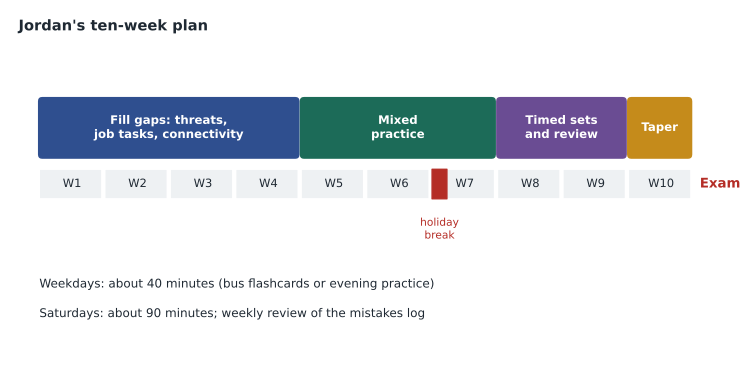
Count the time you actually have. Jordan has ten weeks between booking and the exam, minus a week over the December holidays when he will be visiting family. On working days he can manage about forty minutes: twenty on the bus in each direction with flashcards and practice items on his phone, or forty at home in the evening. On Saturdays he can do ninety minutes. That adds up to roughly five hours a week, or about forty-five hours over nine study weeks. For someone who has already completed the program's two IT Support courses, that is a comfortable amount for a fifty-minute entry-level exam.
# Jordan's available study time
weekday_minutes = 40
weekdays = 5
saturday_minutes = 90
study_weeks = 9          # ten weeks minus a holiday week
weekly = weekday_minutes * weekdays + saturday_minutes
total_hours = weekly * study_weeks / 60
print(f"Per week: {weekly} minutes ({weekly / 60:.1f} hours)")
print(f"Total over {study_weeks} weeks: {total_hours:.1f} hours")Per week: 290 minutes (4.8 hours) Total over 9 weeks: 43.5 hours
Divide the plan into phases. In the first phase, roughly the first four weeks, fill the gaps the diagnostic found: Jordan works through the threats and job tasks lessons again, this time answering every practice question before reading the explanation, and writes his own one-page summary of each. In the second phase, about three weeks, he switches to mixed practice: sessions that combine items from every exam area, so that he gets used to switching between hardware, networking and security in consecutive questions. In the final phase, he takes timed practice sets, as lesson 5 described, and reviews each one carefully. The last few days are for light review and rest.
| Phase | Weeks | Main activity | Measure of progress |
|---|---|---|---|
| Fill gaps | 1 to 4 | Weak areas from the diagnostic; retrieval practice and summaries | Scores on area quizzes rise |
| Mixed practice | 5 to 7 | Interleaved items from every area; explain answers aloud | Fewer repeated mistakes in the log |
| Timed rehearsal | 8 to 9 | Two or three timed sets a week with careful review | Consistent scores and checkpoints met |
| Taper | 10 | Light review of summaries and the mistakes log; rest | Confidence, sleep and a calm exam day |
The mistakes log
The single most useful study tool is a mistakes log: a notebook or spreadsheet with one line for every practice item you get wrong or guess. Each line records the topic, what you chose, what the correct answer was and, most importantly, why you went wrong. Was it a gap in knowledge, a misread word, a calculation slip or a trap distractor? Once a week, read the whole log and look for patterns. Jordan's log shows that half his mistakes on job tasks come from the same misunderstanding: he treats the first request received as the most urgent. Fixing that one idea removes a whole category of errors.
Review the log in the taper week instead of rereading the course. It is a short, personal list of exactly what you are most likely to get wrong, which is the most valuable thing you can read the night before an exam.
Lila's plan
Lila's situation is different. Her CCST Networking exam is in April 2027, at the end of a school year. Her Networking Academy course gives her a structure: a unit every two weeks, labs in class and a teacher who checks progress. Her plan therefore fits around the course rather than replacing it. She studies for twenty-five minutes on four school nights a week, answering practice items on the unit she has just finished and, from February, mixing in items from earlier units. On weekends she spends an hour in Cisco Packet Tracer, building and troubleshooting the networks from the week's labs, which lesson 7 describes. In March she starts a weekly timed set with her class.
Her biggest risk is the busy spring of a final school year: exams in other subjects, a part-time job and university applications. Her teacher's advice is to protect the short sessions even in busy weeks, because a missed week costs more than its hours: it breaks the spacing that makes the earlier sessions stick. On the busiest days she does ten minutes of flashcards on the bus rather than nothing.
Study habits that make a plan work
Study at a regular time and place when you can, so that starting is automatic rather than a decision. Remove distractions: put your phone in another room unless you are using it to study, and close everything except the practice set. Work in short focused blocks, such as twenty-five minutes with a five-minute break, and stop while you are still alert. Explain topics to someone else, or to an empty room, because teaching forces you to organize what you know. Keisha, who mentored two technicians through security certifications last year, also recommends a study partner or group: Jordan joins an online CCST study group run by a Networking Academy instructor, and Lila studies with two classmates on Fridays.
Look after the basics. Sleep consolidates memory, so cutting sleep to study more is counterproductive. Physical activity helps concentration. Short breaks between topics help more than long sessions without breaks. And keep the exam in proportion: it is a fifty-minute entry-level exam with unlimited attempts, not a final judgement on your career. A plan that is sustainable for ten weeks beats an intense plan that collapses in week three.
Choosing practice material
Practice items are only as good as their source. Good sources include the quizzes and exams in this program, the official study resources Cisco links from its exam pages and Learning Network, Cisco Networking Academy course assessments, and practice sets from established training publishers who write their own items from the published topics. Check that a practice set matches the current exam number and topic list; a set written for an older version of an exam can waste time on topics that are no longer tested. Read reviews and look for providers that explain why each answer is right or wrong, because explanations are where most of the learning happens.
Avoid anything that claims to contain real exam questions. Those collections, often called dumps, break the confidentiality agreement every candidate accepts, and using them can cost you the certification. They also teach the wrong skill: memorizing answers instead of understanding the topic, which fails the moment an item is worded differently. Lesson 7 returns to this.
Adjusting the plan
Plans need adjusting. Review progress at the end of each week: are your practice scores rising in the weak areas? Are the same mistakes reappearing in the log? If a phase is going faster than expected, move on early. If an area is not improving, change the method rather than simply adding hours: try explaining the topic aloud, drawing a diagram, building it in a lab, or asking a colleague to walk you through a real example. If something major disrupts your plan, such as illness or a family emergency, reschedule the exam rather than sitting it underprepared. Rescheduling early is usually straightforward.
Worked problem
Planning hours for a weak area
Jordan's diagnostic gives him 9 of 20 on job tasks and threats combined, his weakest result. He decides to give those areas two fifths of his phase-one study time. At five hours a week, how many hours does that give them?
Show solution
- Phase one is four weeks at about five hours a week: 4 times 5 is 20 hours.
- Two fifths of 20 hours is 0.4 times 20, which is 8 hours.
- Eight hours is about sixteen thirty-minute sessions, enough to rework each of the relevant lessons with retrieval practice and summaries.
- He will retest these areas at the end of week four; if the score has not reached about 16 of 20, he will extend the phase by a week.
Answer: About 8 hours over four weeks, with a retest to decide whether to move on.
Common mistakes
MistakeStudying in long, infrequent blocks.
InsteadUse short, frequent sessions spread over weeks.
MistakeRereading the course as the main study method.
InsteadPractise recall by answering questions and explaining topics.
MistakeStudying one topic at a time until the exam.
InsteadInterleave topics in the later weeks to mirror the exam.
MistakeIgnoring guessed answers that happened to be right.
InsteadLog guesses as well as mistakes.
MistakeCutting sleep to study more.
InsteadProtect sleep; it consolidates what you learned.
Summary and key terms
- Begin with a diagnostic and plan by exam area, not by page order.
- Spacing, retrieval practice and interleaving improve long-term memory and exam performance.
- Count the time you actually have and divide it into phases: fill gaps, mixed practice, timed rehearsal, taper.
- Keep a mistakes log with the reason for each error, and review it weekly and before the exam.
- Fit the plan to your situation, whether work, school or both.
- Short focused sessions, regular times, a study partner and good sleep make a plan sustainable.
- Review progress weekly and change methods, not just hours, when an area is stuck.
- Diagnostic
- An initial practice set used to find strengths and weaknesses.
- Spacing effect
- Better memory from reviewing material in sessions separated by time.
- Retrieval practice
- Strengthening memory by recalling information rather than rereading it.
- Interleaving
- Mixing different types of problems within a study session.
- Mistakes log
- A record of wrong or guessed answers and the reason for each.
- Taper
- A final period of light review and rest before an exam.
Practice problems
Work each problem on paper first, then reveal the answer to check.
Why is thirty minutes six days a week better than three hours once a week?
Show answer
Spacing: reviewing over many sessions produces better long-term memory than one block of the same total time.
What is retrieval practice?
Show answer
Recalling information from memory, for example by answering questions, rather than rereading it.
Why mark guessed answers on a diagnostic, even when they were right?
Show answer
A lucky guess is not knowledge, and the plan should cover that topic.
What four things should each line of a mistakes log record?
Show answer
The topic, your answer, the correct answer and the reason you went wrong.
Someone studies 40 minutes on five weekdays and 90 minutes on Saturday. How many minutes is that per week?
Show answer
290 minutes, a little under five hours.
What should you do when an area is not improving after extra hours?
Show answer
Change the method: explain it aloud, draw it, build it in a lab or ask someone to walk you through it.
When is rescheduling better than sitting the exam?
Show answer
When a major disruption, such as illness, has left you clearly underprepared.
Lesson quiz · 5 questions
Score 60% or more to complete this lesson.
Create a free account to save your progress, take quizzes and earn a certificate.