
CSCO-190 · Lesson 2 of 12 · 22 min
Booking a CCST exam
▶ Video coming soon A video version of this lesson is on the way.
Jordan books his exam on a Tuesday evening at his kitchen table, with Marisol's checklist open beside the laptop. It takes him forty minutes, and half of that time goes into one thing: making sure the name on his Cisco profile matches his driver's licence exactly, including the middle name he never uses. "People lose exam fees over that," Marisol had warned him. "The check-in staff can only compare what is on the screen with what is on the card." By the end of the evening he has a confirmation email for the CCST IT Support exam on a Thursday morning in late January 2027, and a calendar entry with three reminders. This lesson walks through the same steps, and the decisions behind them, so that booking your own exam is routine rather than stressful.
Step 1: create your Cisco certification profile
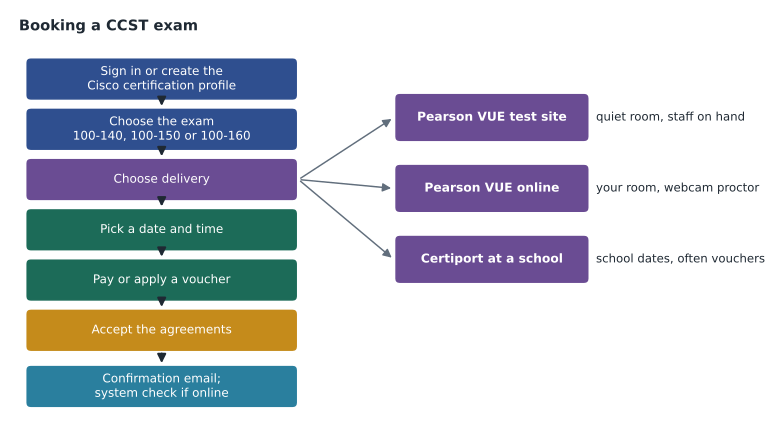
Every Cisco exam starts with a candidate profile in Cisco's certification tracking system. The exam pages send you there through a Schedule exam link, and Cisco's frequently asked questions describe the first step as signing in to, or creating, a Cisco Certification Candidate Profile. The profile holds your legal name, contact details and a candidate identifier, and later it will hold your exam history, your certifications and their expiry dates. Create it once and use it for every Cisco exam you ever take; a second profile splits your history and can cause problems when you renew.
Enter your name exactly as it appears on the government-issued photo identification you will bring on the day. If your licence says Jordan Michel Pelletier, the profile should too, not Jordan Pelletier or Jordan M. Pelletier. Use an email address you will still have in five years, because certification notices and renewal reminders go there. A school or work address can disappear when you change schools or jobs. Lila, who is 17, uses a personal address her parents can also see, and her teacher keeps a list of the class's candidate identifiers in case anyone has trouble at check-in.
Step 2: choose a delivery partner and format
Cisco's frequently asked questions say that CCST exams are delivered by two testing partners, Pearson VUE and Certiport. Through Pearson VUE you can sit the exam at a Pearson VUE test centre or online with a remote proctor. Certiport delivers exams through Certiport Authorized Testing Centers, often called CATCs, which are usually schools, colleges and training organizations; Cisco notes that educational institutions and Networking Academies can register as CATCs and run the exams themselves. Most working adults book through Pearson VUE, while most students sit the exam at their own school through Certiport. Both lead to the same certification.
Each format has trade-offs. A test centre provides a quiet room, a computer that is known to work and staff to deal with problems, but you have to travel there and fit its opening hours. Online proctoring lets you test from home or the office, but you must supply a private room, a clear desk, a reliable connection and a computer that passes the testing software's system check, and a proctor watches you through the webcam for the whole exam. A school testing centre is familiar ground and often free or discounted for enrolled students, but dates are set by the school. Lesson 3 describes what happens on the day in each format.
| Format | Where | Good for | Things to arrange |
|---|---|---|---|
| Pearson VUE test centre | An authorized testing centre | Candidates who want a controlled, quiet room | Travel time, opening hours, two pieces of identification |
| Pearson VUE online proctored | Home or office, watched by a remote proctor | Candidates far from a centre or short of time | Private room, clear desk, webcam, stable connection, system check |
| Certiport testing centre | A school, college or training organization | Students in Networking Academy and similar courses | The school's dates, voucher arrangements, teacher's instructions |
Step 3: pick a date with a purpose
The date you choose shapes your preparation. Book too far ahead and the exam stops feeling real; book too soon and you either rush or reschedule. A common approach, and the one Marisol uses with her technicians, is to book when two things are true: you have worked through all the exam topics at least once, and you have a realistic study plan that fills the remaining weeks. For most people with the courses on this site already done, that means booking six to ten weeks ahead. The booking itself is a useful commitment device: once the date is in the calendar, study sessions stop being optional.
Choose the time of day as carefully as the date. Most people think best in the morning, and a morning slot means less time to grow anxious. Avoid days when you have a long shift or a late night beforehand. If you are booking online proctoring, choose a time when your home or office will be quiet and your internet connection is least busy. Jordan picks a Thursday morning because Thursday is his lightest day at Brightline and because he can do a final review on Wednesday evening. Lila's teacher books the whole class for a single afternoon in April 2027, after the course's last unit.
Step 4: pay, or use a voucher
Cisco's exam pages listed each CCST exam at 125 US dollars when this course was written. The amount you pay may differ: prices can change, local currency and taxes apply in many countries, and the delivery partner may show the final amount only at checkout. Many candidates do not pay the full price themselves. Employers often pay for exams that relate to the job, as Brightline does for Jordan. Cisco Networking Academy courses sometimes include discount vouchers for students who complete them, and schools that run Certiport testing may provide vouchers to their students. Ask before you pay; a voucher is usually applied by entering a code during checkout.
Keep the receipt or voucher confirmation with your booking email. If your employer is paying, check whether it pays for a retake too and whether it expects you to sit the exam by a certain date. Brightline's policy, which Owen Larkin wrote in 2025, pays for the first attempt at any certification linked to a technician's role and for one retake, as long as the technician logs their study in the ticketing system's training queue. That is generous; many employers pay only on a pass.
Step 5: read and accept the agreements
During registration, and again before the exam starts, you will be asked to accept Cisco's exam agreements, including a confidentiality agreement. Cisco's exam policy says that candidates must take no action to compromise the integrity or confidentiality of any Cisco certification exam, must not discuss the exam's content with anyone before or after testing, and must not bring prohibited items such as notes, books, phones or recording devices. Declining the agreement ends the exam and forfeits the fee. Breaking it can lead to penalties up to a lifetime ban from all Cisco exams. Lesson 7 explains why this rules out exam dumps, the collections of supposedly real exam questions sold online.
Identification
Cisco's policy for written exams requires two forms of identification, both bearing your signature, and one of them must be a government-issued photo identification, such as a driver's licence or passport. The testing partner captures a digital photo and signature at admission. Online proctoring has its own identification check, usually done by holding the document up to the webcam. Requirements can vary by country and by delivery partner, so read the identification section of your confirmation email when it arrives, not on the morning of the exam. If your identification has expired or your name has changed, sort it out before you book.
Students under the age of majority may have different arrangements. Certiport testing centres often have their own rules for younger candidates, and some require a parent or guardian's consent. Lila's teacher sends home a consent form in January, together with a list of what students should bring. If you are a student, ask your teacher or testing coordinator what applies at your school.
Accommodations
Candidates who need testing accommodations, such as extra time, a separate room or assistive technology because of a disability or medical condition, can request them. Cisco's frequently asked questions point to Pearson VUE's accommodations policy. Requests usually need supporting documentation and must be approved before you book, so start early: weeks rather than days. Certiport testing centres handle accommodations through their own process, often in partnership with the school's accessibility office. Asking for an accommodation you are entitled to is not an unfair advantage; it lets the exam measure what you know rather than the effect of a condition.
If you need to reschedule, or try again
Plans change. Rescheduling and cancellation rules are set by the delivery partner and can depend on how close to the exam you are; the confirmation email explains them. As a general habit, decide early. Rescheduling a week ahead is usually simple, while missing an exam or rescheduling at the last minute may cost the fee. If you are ill on the day, contact the testing partner as soon as you can rather than sitting the exam unwell.
If you do not pass, you can try again. Cisco's CCST frequently asked questions say that candidates have unlimited attempts, and Cisco's exam policy sets a waiting period for entry-level written exams: candidates must wait five calendar days, beginning the day after the failed attempt, before retaking the exam. Each attempt is booked and paid for separately. The waiting period is short on purpose; it gives you time to look at your score report, which breaks results down by exam section, and to study the weak areas before you sit the exam again. Lesson 12 covers the retake plan in detail.
Worked problem
Working out the earliest retake date
Suppose a candidate fails a CCST exam on Thursday, January 21, 2027. Using Cisco's policy that the five-calendar-day wait begins the day after the failed attempt, what is the earliest date to plan the retake?
Show solution
- The waiting period starts the day after the attempt: Friday, January 22.
- Five calendar days are January 22, 23, 24, 25 and 26. Weekends count, because the rule says calendar days.
- The wait is complete at the end of Tuesday, January 26, so the earliest day to plan a retake is Wednesday, January 27.
- When booking, check the date the scheduling system offers; if it differs, the system's date is the one that applies.
Answer: Plan for Wednesday, January 27, 2027 at the earliest, and confirm with the scheduling system.
Jordan's confirmation email arrives within a minute. He saves it in a folder called CCST, forwards a copy to Marisol, adds the testing centre's address to his phone's map and sets reminders for one week, two days and one day before. Then he closes the laptop and, for the first time since September, feels that the exam is a plan rather than a worry.
Common mistakes
MistakeEntering a nickname or shortened name in the Cisco profile.
InsteadUse your name exactly as it appears on your government photo identification.
MistakeCreating a new profile for each exam.
InsteadUse one profile for every Cisco exam so your history stays together.
MistakeBooking online proctoring without running the system check.
InsteadRun the check on the same computer and network you will use on the day.
MistakePaying full price without asking about vouchers.
InsteadAsk your employer, school or Networking Academy instructor first.
MistakeAssuming a retake is possible the next day.
InsteadCisco sets a five-calendar-day wait for entry-level written exams.
Summary and key terms
- Start with one Cisco Certification Candidate Profile and use your exact legal name.
- CCST exams are delivered by Pearson VUE (test centre or online proctored) and Certiport (testing centres at schools and training organizations).
- Book when you have covered all the topics once and have a plan for the remaining weeks; six to ten weeks ahead suits many people.
- Cisco listed CCST exams at 125 US dollars; vouchers from employers, schools and Networking Academy may cover the cost.
- Accepting the confidentiality agreement is required, and breaking it can bring penalties up to a lifetime ban.
- Bring two signed identifications, one a government-issued photo ID, and check your confirmation email for local rules.
- Attempts are unlimited, with a five-calendar-day wait after a failed entry-level written exam.
- Candidate profile
- Your record in Cisco's certification system, holding your name, exams and certifications.
- Pearson VUE
- A testing company that delivers Cisco exams at test centres and online.
- Certiport
- A testing company that delivers exams through authorized testing centres, often at schools.
- Online proctoring
- Taking an exam remotely while a proctor watches through a webcam.
- Voucher
- A prepaid code that covers all or part of an exam fee.
- Accommodation
- An approved change to testing conditions for a disability or medical condition.
Practice problems
Work each problem on paper first, then reveal the answer to check.
Why must your profile name match your identification exactly?
Show answer
Check-in staff compare the name on the booking with the identification; a mismatch can mean you are turned away and lose the fee.
Name the two delivery partners for CCST exams.
Show answer
Pearson VUE and Certiport.
What does an online proctored exam require that a test centre does not?
Show answer
Your own private room, clear desk, webcam, stable connection and a computer that passes the system check.
How many forms of identification does Cisco's written-exam policy require?
Show answer
Two, both signed, with one a government-issued photo ID.
Where would a high school student most likely sit a CCST exam?
Show answer
At a Certiport testing centre run by their school or Networking Academy.
A candidate fails on a Monday. Under the five-calendar-day rule, what is the earliest day to plan a retake?
Show answer
The following Sunday: the wait covers Tuesday to Saturday, so Sunday is the first day after it, subject to testing centre hours and the scheduling system.
When should accommodation requests be made?
Show answer
Weeks before booking, because they usually need documentation and approval.
Lesson quiz · 5 questions
Score 60% or more to complete this lesson.
Create a free account to save your progress, take quizzes and earn a certificate.