
CSCO-190 · Lesson 5 of 12 · 22 min
Managing time on a 50-minute exam
▶ Video coming soon A video version of this lesson is on the way.
Fifty minutes sounds like plenty until you try it. On his first timed practice set, Jordan spends six minutes on a single subnetting item that he is determined to get right, then races through the last ten questions in four minutes and gets three of them wrong that he would normally answer easily. Marisol looks at his results and laughs, not unkindly. "You did what everybody does the first time. You let one question steal time from ten others." Time is the one resource on the exam that you cannot get more of, and managing it is a skill that can be practised like any other. This lesson shows how to budget fifty minutes when you do not know exactly how many items there will be, how to set checkpoints, what to do with a slow item and how to rehearse.
Starting from what is known
Cisco lists each CCST exam at 50 minutes. It does not publish the number of items, and the number may differ between candidates and between versions of the exam. Study guides commonly report somewhere around 40 to 50 items. That uncertainty is less of a problem than it seems, because the first screen of the exam will usually tell you how many items you have, or the testing interface will show a counter such as 1 of 45. Your plan should be ready to adapt as soon as you see that number.
The simplest useful figure is the average time per item. Divide the minutes available by the number of items. With 50 minutes and 50 items, you have one minute per item. With 50 minutes and 40 items, you have a minute and a quarter, or 75 seconds. In practice, many items take far less than the average: a straightforward recall question may take twenty seconds. Others, such as an exhibit or a drag-and-drop sequence, may take two or three minutes. The average is not a rule for every item; it is a way of knowing whether you are ahead or behind.
# Average time per item and checkpoint targets for a 50-minute exam
minutes = 50
for items in (40, 45, 50):
    seconds_each = minutes * 60 / items
    quarter = round(items / 4)
    print(f"{items} items: about {seconds_each:.0f} s each; "
          f"aim for item {quarter} by 12.5 min, item {2 * quarter} by 25 min, "
f"item {3 * quarter} by 37.5 min")40 items: about 75 s each; aim for item 10 by 12.5 min, item 20 by 25 min, item 30 by 37.5 min 45 items: about 67 s each; aim for item 11 by 12.5 min, item 22 by 25 min, item 33 by 37.5 min 50 items: about 60 s each; aim for item 12 by 12.5 min, item 24 by 25 min, item 36 by 37.5 min
The output gives you three checkpoints for each likely exam length. You do not need to memorize them all; on the day, as soon as you know the number of items, work out the halfway mark: you want to be at or past the middle item by about the 25-minute mark, ideally a little earlier so that you have a small reserve at the end.
Checkpoints instead of constant clock-watching
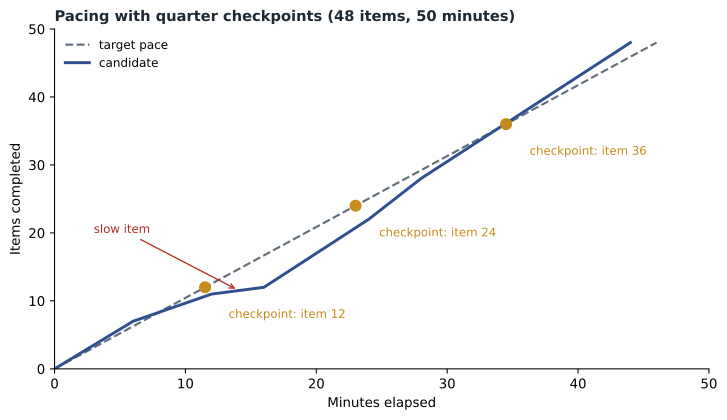
Looking at the timer after every item wastes attention and raises anxiety. A better approach is to set three or four checkpoints and glance at the timer only when you reach them. A common plan divides the exam into quarters. If the exam has 48 items, the checkpoints are items 12, 24 and 36, and the target times are roughly 12, 24 and 36 minutes, leaving a few minutes at the end. If you reach a checkpoint ahead of time, relax slightly and keep going. If you are behind, speed up by spending less time on items you cannot settle quickly, not by reading stems less carefully.
Write your checkpoints on the erasable board during the first minute of the exam, as soon as you see the item count. Jordan practises this until it takes him fifteen seconds: he writes the item count, divides by four, and writes three item numbers with target times beside them. It is a small ritual, and it also calms him down, because it turns the exam into a plan he has rehearsed.
What to do with a slow item
Every exam contains a few items that take longer than you expect. The decision you make about them is the most important timing decision of the exam. A practical rule is to set a personal limit, such as about two and a half times the average. With a one-minute average, that is about two and a half minutes. If you reach the limit without an answer you trust, eliminate what you can, choose the most likely remaining option and move on. A slow item is worth exactly the same as a quick one, and three easy items left unanswered at the end cost far more than one hard item answered by a reasoned guess.
Whether you can come back to an item later depends on the exam's navigation rules, which you learn from the instruction screens, as lesson 3 explained. If the exam lets you mark items for review and return, flag the slow item after making your best choice and revisit it if time remains. If the exam does not allow you to return, the decision is final, so make your best choice before moving on and do not carry the worry into the next item. In both cases, the habit is the same: never leave an item blank, and never let one item take the time of three.
| Item type | Typical time | Time-saving habit |
|---|---|---|
| Short recall question | 15 to 40 seconds | Answer in your head, confirm against the options, move on. |
| Scenario multiple choice | 45 to 90 seconds | Read the final sentence of the stem first to know what is asked. |
| Multiple answer | 60 to 90 seconds | Judge each option once as true or false; count your selections. |
| Drag and drop | 90 seconds to 3 minutes | Place the surest items first; anchor first and last steps. |
| Exhibit or calculation | 2 to 3 minutes | Read the question first; write working on the board. |
Reading fast without reading carelessly
Speed on an exam comes mostly from knowing the material, not from reading faster. When you know a topic well, you recognize what an item is asking in a sentence or two and answer with confidence. When you are unsure, you reread, second-guess and change answers. That is why the study plan in lesson 6 puts so much weight on practice and review: it is the most effective way to buy time on the exam.
Some reading habits do help. For long scenario stems, read the last sentence first, because that is usually where the actual question is, then read the scenario looking for the facts that matter. Skip over names and story details that do not affect the answer; whether the user is called Priya or Tomás rarely matters. Underline, mentally or on the board, the qualifying words: first, best, most likely, not. And resist the urge to reread an item you have already answered with confidence. A first answer based on knowledge is usually right; changing it should need a clear reason, such as noticing that you misread a word.
Building a time reserve
Aim to finish the last item with a few minutes to spare. That reserve covers the item that ran long and, if the exam allows review, lets you revisit flagged items. Keisha calls it the change window, after the maintenance windows Brightline schedules for client systems: a protected block of time for planned work. A reserve of three to five minutes on a 50-minute exam is realistic for a well-prepared candidate. If you reach the end with more than ten minutes left, you were probably not reading slowly enough, so use the time to check flagged items if you can, and slow down a little on your next practice set.
Rehearsing under time pressure
The only way to make timing automatic is to practise under the same conditions. In the last three or four weeks before the exam, take several timed practice sets of 40 to 50 items, in one sitting, with a 50-minute timer, no notes and no phone. Write your checkpoints at the start as you will on the day. Afterwards, compare your actual times at each checkpoint with your targets and note which items took longest. You will usually find a pattern: perhaps every subnetting item takes you three minutes, or you hesitate on every choose-two item. That pattern tells you what to study next.
Do not take timed sets every day. They are tiring, and their value comes from reviewing them carefully afterwards. Two or three a week in the final month is plenty for most people, with ordinary untimed study on the other days. Lila's teacher runs a timed set every Friday in the last month of the course, in the same lab where the class will sit the exam, so that both the room and the clock feel familiar.
Language, accommodations and timing
Cisco offers the CCST exams in several languages, and taking an exam in a second language takes longer. If English is not your first language and the exam is offered in yours, consider whether you will read faster and more accurately in it, keeping in mind that technical terms you learned in English may be translated. Candidates with an approved accommodation for extra time should plan their checkpoints on the extended time, not on the standard fifty minutes: with 75 minutes and 48 items, for example, each quarter checkpoint moves to roughly 19 minutes rather than 12. Rehearse your practice sets with the same timing you will have on the day, so that the pace feels normal.
Lila, who speaks Arabic at home and English at school, decides to take the exam in English because her Networking Academy course and all her notes are in English and switching languages for technical terms would slow her down more than reading in her second language. Her teacher agrees and suggests that she keep a short glossary of terms she finds tricky, such as gateway and broadcast, and review it the week before.
Worked problem
Recovering from a slow start
Jordan's exam shows 48 items. At his first checkpoint, item 12, the timer shows 16 minutes elapsed instead of his target of 12. How much time does he have left for the remaining items, and what is his new average?
Show solution
- Time remaining: 50 minus 16 is 34 minutes.
- Items remaining: 48 minus 12 is 36 items.
- New average: 34 minutes divided by 36 items is about 0.94 minutes, or roughly 57 seconds per item.
- That is only slightly faster than the original average of about 62 seconds. A four-minute deficit at the first checkpoint is recoverable.
- Action: keep reading carefully, but apply the slow-item limit strictly for the next quarter and check again at item 24.
Answer: About 34 minutes for 36 items, or roughly 57 seconds each. Noticing the deficit at a checkpoint, rather than at the end, is what makes it recoverable.
Common mistakes
MistakeWatching the timer after every item.
InsteadSet three checkpoints and look only when you reach them.
MistakeSpending as long as it takes on a hard item.
InsteadSet a personal limit, make a reasoned choice and move on.
MistakeLeaving items blank to come back to later.
InsteadAlways choose an answer before moving on, then flag it if review is allowed.
MistakeChanging confident answers without a reason.
InsteadChange only when you notice a clear misreading or recall a specific fact.
MistakePractising only untimed.
InsteadTake timed sets in the final weeks to build pacing habits.
Summary and key terms
- Cisco lists CCST exams at 50 minutes and does not publish the number of items.
- Average time per item is the minutes available divided by the number of items; it is a guide, not a rule for each item.
- Set checkpoints at each quarter of the items and check the timer only there.
- Give a slow item a personal limit, about two and a half times the average, then choose and move on.
- Whether you can revisit items depends on the exam's instructions; never leave an item blank.
- Aim for a reserve of a few minutes at the end.
- Rehearse with timed practice sets in the final weeks and review the timing pattern afterwards.
- Checkpoint
- A planned point in the exam where you compare elapsed time with your target.
- Average time per item
- Total minutes divided by the number of items.
- Time reserve
- Minutes left over at the end for slow or flagged items.
- Flag for review
- Marking an item to revisit later, where the exam allows it.
- Timed practice set
- A rehearsal under exam conditions with a strict time limit.
- Slow-item limit
- The longest you allow yourself on one item before choosing and moving on.
Practice problems
Work each problem on paper first, then reveal the answer to check.
With 50 minutes and 40 items, what is the average time per item?
Show answer
75 seconds, or one and a quarter minutes.
An exam has 44 items. Where are the three quarter checkpoints?
Show answer
Items 11, 22 and 33.
Why read the last sentence of a long stem first?
Show answer
It usually contains the actual question, so you know which facts in the scenario matter.
What should you do when you reach your slow-item limit?
Show answer
Eliminate what you can, choose the most likely answer, flag it if allowed and move on.
Why not take a timed practice set every day?
Show answer
They are tiring and their value comes from careful review; two or three a week in the final month is enough.
At item 24 of 48 you have 28 minutes left. Are you ahead or behind?
Show answer
Ahead: 24 items remain with 28 minutes, more than one minute each.
What does a large time reserve at the end often suggest?
Show answer
That you may be reading too quickly; slow down slightly in the next practice set.
Lesson quiz · 5 questions
Score 60% or more to complete this lesson.
Create a free account to save your progress, take quizzes and earn a certificate.