
CRE-499 · Lesson 9 of 12 · 30 min
The monetization pilot
By week 11 your channel has a publishing rhythm, a small community and evidence about what viewers value. Now you will test whether it can earn money, on a small scale and without damaging trust. The goal of the pilot is not to make a lot of money in three weeks. It is to choose one or two revenue streams that fit your audience, set them up properly and legally, measure the results honestly and learn what a larger version might earn. This lesson draws on the revenue mix and unit economics from CRE-302, the brand-deal skills from CRE-310, the disclosure rules from CRE-320 and the tax basics from CRE-330. The deliverable is a pilot report of two to three pages.
Monetizing too early, too aggressively or without disclosure is one of the fastest ways to lose a young audience. Choose streams that genuinely help viewers, such as recommending a tool you actually use, and be open about how you earn. Your sponsorship policy from lesson 3 already commits you to that.
Choosing pilot streams
CRE-302 described many revenue streams. For a capstone channel with a small audience, most are not yet available or not worth the effort. Platform ad revenue requires partner-program thresholds that most new channels will not reach in one term. At the time of writing (October 2026), YouTube's Partner Program opens fan-funding features at 500 subscribers with 3,000 public watch hours in a year or 3 million Shorts views in 90 days, and full ad revenue sharing at 1,000 subscribers with 4,000 watch hours or 10 million Shorts views. YouTube has announced that from 1 February 2027 new applicants for ad revenue sharing will need 8,000 watch hours in 365 days or 20 million Shorts views in 90 days, so check current requirements before planning around them.
Streams that suit a small, engaged audience include affiliate links to products you use and recommend, a small digital product such as a printable guide or template, a tip jar or simple fan-funding option, a small local sponsorship or product partnership, and services related to your expertise. Choose one or two, based on fit with your niche, audience trust and your capacity. A bike-repair channel might try affiliate links to the specific tools shown in videos and a $5 printable maintenance log.
| Stream | Fits a small audience? | Setup effort | Key compliance point |
|---|---|---|---|
| Platform ad revenue | Rarely within a term | Low once eligible | Partner-program rules and advertiser-friendly guidelines |
| Affiliate links | Yes, if recommendations are genuine | Low | Disclose the commission clearly near the link and in the video |
| Digital product | Yes, for a loyal niche | Medium | Accurate description, refund policy, sales tax rules |
| Fan funding or tips | Sometimes | Low | Platform eligibility; describe what support funds |
| Small sponsorship | Sometimes, often local | Medium | Contract terms and clear disclosure |
| Services | Yes, for expertise niches | Medium to high | Professional rules, liability and scope |
Affiliate links: projecting earnings
Affiliate programs pay a commission when someone buys through your link. CRE-302 introduced earnings per click (EPC), which combines conversion rate, average order value and commission rate into one useful number. Use it to set expectations before the pilot and to judge the result afterwards.
Worked problem
Projecting affiliate earnings
Jordan adds affiliate links for three tools shown in videos. Over the three-week pilot, links are expected to get 400 clicks. Assume 4 % of clicks lead to a purchase, the average order is $45 and the commission is 6 %. Calculate EPC and expected earnings.
Show solution
- EPC: \( 0.04 \times 45 \times 0.06 = \$0.108 \) per click.
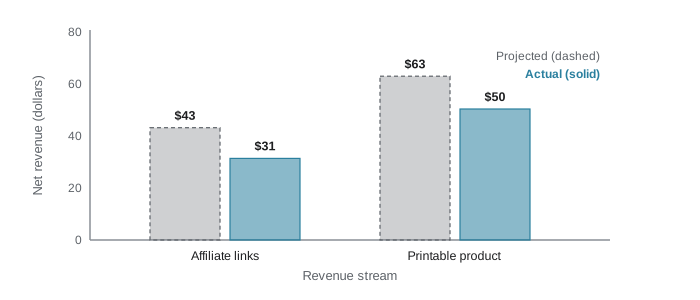
- Earnings: \( 400 \times 0.108 = \$43.20 \).
Answer: The pilot is expected to earn about $43. That is small, but it tests whether viewers act on recommendations. Doubling clicks through better placement, or choosing products with higher order values, would scale earnings proportionally, while conversion depends on trust and relevance.
A small digital product
A digital product, such as a printable checklist, a template or a short guide, can earn more per buyer than affiliate links and builds your own customer list. Keep the pilot product small and genuinely useful, priced modestly, and delivered through a platform that handles payment, delivery and taxes where possible. Describe it accurately and publish a simple refund policy. CRE-302 explained that platforms which act as merchant of record collect and remit sales taxes for you in many places, which greatly simplifies compliance for small sellers.
Worked problem
Break-even for a digital product
Jordan spends 6 hours making a $5 printable maintenance log and pays $15 for a design template. The sales platform keeps 10 % plus $0.30 per sale. How many sales are needed to cover the cash cost, and how many to also pay Jordan $15 an hour for the 6 hours?
Show solution
- Net per sale: \( 5 - (0.10 \times 5 + 0.30) = 5 - 0.80 = \$4.20 \).
- Cash break-even: \( 15 / 4.20 \approx 3.6 \), so 4 sales.
- Including time: \( 15 + 6 \times 15 = \$105 \); \( 105 / 4.20 = 25 \) sales.
Answer: Four sales cover the cash cost, but 25 are needed to pay for Jordan's time at $15 an hour. With about 100 email subscribers and a few thousand viewers, 25 sales in three weeks would be a strong result; even 10 would show real demand worth building on.
Small sponsorships
A small sponsorship, often from a local business or a brand that sends products, can be part of the pilot if it fits naturally. Use the process from CRE-310: check brand fit against your audience and values, agree deliverables, usage rights, timing, payment and approval in writing, and never agree to say anything you do not believe. A free product is still a material benefit that must be disclosed. If a sponsor asks you to hide the relationship or make claims you cannot support, decline; your sponsorship policy exists for exactly this moment.
Disclosure in practice
Every paid or material relationship in the pilot must be disclosed clearly, prominently and close to the endorsement, in words viewers understand, as CRE-320 explained in detail.
In Canada, the Competition Act prohibits false or misleading representations, including endorsements that hide a material connection, and Ad Standards' Influencer Marketing Disclosure Guidelines set out good practice: use clear labels such as #ad, #sponsored or 'paid partnership', say it in the video for video content, place it at the start of captions rather than hidden among hashtags, and disclose affiliate links near the link itself. The October 2025 update of the guidelines added labels such as #Gifted and #InvitedGuest and expectations for disclosing AI-generated or virtual influencer content. The Competition Bureau can seek administrative monetary penalties, and since June 2025 private parties can also bring some deceptive-marketing cases before the Competition Tribunal.
Worked problem
Checking a disclosure
Jordan's draft description reads: "Tools I use: [link] [link] [link] #bikes #repair #affiliate". The video does not mention commissions. Is this adequate, and how should it be fixed?
Show solution
- The disclosure is a single hashtag at the end, easy to miss and not in the video.
- The description links appear before any disclosure.
- A clear fix: say in the video "the tool links below are affiliate links, so I earn a small commission if you buy, at no extra cost to you," and start the description list with "Affiliate links (I earn a commission):".
Answer: The draft is not adequate. A clear spoken disclosure plus a plain-language label placed before the links meets regulators' expectations in both countries.
Tax and records
Even small earnings must be recorded and reported. Keep a simple ledger of every transaction in the pilot: date, source, gross amount, fees, net amount and currency, and save statements from each platform. CRE-330 covered the details.
In Canada, channel income is self-employment income reported on form T2125, and you can deduct reasonable expenses such as software and equipment, with capital cost allowance rules for larger items. You do not need to register for GST/HST until your worldwide taxable supplies exceed $30,000 in four consecutive calendar quarters. Platforms that act as marketplace operators may collect GST/HST on digital products sold to Canadian buyers. Payments from US platforms may have US tax withheld unless you submit a W-8BEN form, as CRE-460 explained.
Worked problem
Net pilot income
Over the pilot Jordan earns $31.40 in affiliate commissions and sells 12 printables at $5. The sales platform keeps 10 % plus $0.30 per sale. Template and software costs during the pilot were $15. What is the net profit, and what share came from each stream before costs?
Show solution
- Printable net: \( 12 \times 4.20 = \$50.40 \).
- Total net revenue: \( 31.40 + 50.40 = \$81.80 \).
- Profit after costs: \( 81.80 - 15 = \$66.80 \).
- Shares of net revenue: affiliate \( 31.40/81.80 \approx 38 \% \), printable \( \approx 62 \% \).
Answer: The pilot earned a profit of about $67, with the printable contributing almost two-thirds. The amount is small, but the result suggests that this audience prefers a practical product to tool recommendations, a useful finding for the business plan.
Writing the pilot report
Report the pilot the same way you reported your experiment: what you tried and why, what you expected (with the projection), what happened (with the ledger), what you learned and what you would do at a larger scale. Include audience reactions as well as numbers. Did anyone object to the affiliate links? Did buyers send thanks or questions? Did unsubscribes rise after the product announcement? Trust is a key result.
- Streams chosen and reasons, linked to audience and niche.
- Setup steps, disclosures used (with screenshots) and compliance checks.
- Projection compared with actual results, with a simple ledger.
- Audience response, including any negative reactions.
- Lessons and a recommendation for the business plan.
A pilot that earns $20 but is well designed, honestly disclosed and clearly reported scores better than one that earns $200 through hidden promotions or misleading claims. You are showing that you can build revenue responsibly, which is what future partners will want to see.
Watching for trust signals during the pilot
Monetization changes how some viewers see a channel, so watch for trust signals as closely as revenue. Compare unsubscribe and unfollow rates, comment tone and newsletter unsubscribes in the weeks before and during the pilot. A small rise in newsletter unsubscribes after a product announcement is normal; a sharp rise, or comments accusing you of selling out, suggests the offer or its framing does not fit the audience. Ask a few loyal viewers directly what they think of the product or recommendations. Viewers usually accept monetization that is relevant, honest and proportionate, such as a product that solves a problem the channel already discusses, and resent promotions that interrupt the content or push things the creator clearly does not use. Recording these signals turns the pilot into evidence about what your audience will support, which is more valuable for the business plan than the few dollars earned.
Common mistakes
MistakePlanning around partner-program ads a new channel cannot reach in a term.
InsteadPilot streams that suit a small audience, such as affiliates or a small digital product.
MistakeDisclosing affiliate links only with a hashtag at the end.
InsteadDisclose clearly in the video and in plain words before the links.
MistakeIgnoring the value of your own time.
InsteadCalculate break-even both for cash costs and including time.
MistakeKeeping no record of small earnings.
InsteadKeep a ledger of every transaction and save platform statements.
MistakeJudging the pilot only by money earned.
InsteadReport projections, results, audience trust and lessons for scaling.
Summary and key terms
- The pilot tests one or two revenue streams on a small scale without damaging trust.
- Partner-program thresholds are high for new channels; check current rules, including announced 2027 changes.
- Affiliate links, small digital products, tips, small sponsorships and services suit small audiences.
- EPC combines conversion, order value and commission to project affiliate earnings.
- Break-even should be calculated for cash costs and for the value of your time.
- Disclose every material connection clearly and close to the endorsement, under Canadian or US rules.
- Record all income and costs, know the tax thresholds and report the pilot honestly.
- Monetization pilot
- A small, time-limited test of revenue streams.
- Affiliate link
- A tracked link that pays a commission on resulting sales.
- Earnings per click (EPC)
- Average affiliate earnings for each click on a link.
- Digital product
- A downloadable or online product such as a guide or template.
- Merchant of record
- The party legally responsible for a sale, including collecting taxes.
- Material connection
- A relationship, such as payment or free products, that could affect how an endorsement is viewed.
- Break-even
- The point at which revenue covers costs.
- Ledger
- A record of financial transactions.
- Economic nexus
- A sales level that requires an out-of-state seller to collect a state's sales tax.
- Small supplier
- In Canada, a business below the $30,000 GST/HST registration threshold.
Practice problems
Work each problem on paper first, then reveal the answer to check.
Name two revenue streams suitable for a small audience.
Show answer
Affiliate links, a small digital product, tips, a small sponsorship, services (any two).
Conversion 3 %, order $60, commission 5 %. EPC?
Show answer
$0.09 per click.
With that EPC, earnings from 500 clicks?
Show answer
$45.
A $8 product, platform takes 10 % plus $0.30. Net per sale?
Show answer
$6.90.
Costs $69. Sales needed at that net?
Show answer
10 sales.
Is a free product a material connection?
Show answer
Yes, it must be disclosed.
Where should an affiliate disclosure appear?
Show answer
In the video and in plain words close to and before the links.
What must a pilot ledger record?
Show answer
Date, source, gross amount, fees, net amount and currency.
Name one Canadian and one US tax threshold from the lesson.
Show answer
GST/HST $30,000 small supplier; US self-employment tax from $400 net or 1099-NEC $2,000.
Why might a $20 pilot outscore a $200 one?
Show answer
If it is well designed, honestly disclosed and clearly reported while the other relied on hidden or misleading promotion.
Lesson quiz · 5 questions
Score 60% or more to complete this lesson.
Create a free account to save your progress, take quizzes and earn a certificate.