
CRE-499 · Lesson 2 of 12 · 28 min
Proposal and niche validation
Before you design a logo or film a single video, you need to know that the channel you are about to build has an audience, that you can serve that audience better than the alternatives, and that you can sustain it for a term and beyond. This lesson turns the niche-selection methods from CRE-420 and the research and experiment methods from CRE-440 into a proposal you can defend. The deliverable is a short validation report: at least three candidate niches, evidence of demand and competition for each, a weighted scorecard, a small test, and a recommendation.
Validation does not mean proving that a channel will succeed. Nobody can do that. It means reducing the biggest uncertainties cheaply before you commit fourteen weeks of effort. The cheapest time to discover that a topic has no searches, or that ten professional channels already cover it brilliantly, is week 2, not week 10.
Starting with candidate niches
List five to ten ideas, then narrow to at least three serious candidates. Good candidates sit where three circles overlap: what you know or can learn quickly, what a definable audience wants, and what can eventually earn money or other value. Consider your access too. A student who works in a bike shop has equipment, problems to solve and a supply of real questions from customers; a student who loves luxury travel but cannot afford it does not.
Write each candidate as a one-sentence positioning statement in the form 'For [audience] who [need], my channel offers [content] that [benefit], unlike [alternatives].' For example: 'For students and commuters with cheap bikes who cannot afford shop repairs, my channel offers short, clear fixes with basic tools that save money and keep them riding safely, unlike general repair channels that assume a full workshop.' Forcing yourself to name the audience, need and alternative exposes vague ideas quickly.
Gathering evidence of demand
Demand evidence comes from what people already search for, watch and ask. Use several sources so that no single noisy one misleads you.
- Search demand: autocomplete suggestions on YouTube and search engines, keyword tools and trend tools show what people type and whether interest is growing or seasonal.
- Existing content: search the topic and note the views, upload dates and comments on the top videos. Recent videos with strong views on small channels suggest unmet demand.
- Questions: forums, subreddits, comment sections and Q&A sites reveal the problems people struggle with and the words they use.
- Your own access: questions you hear at work, in class or in clubs are direct evidence from real people.
- Audience research: a short survey or five conversations with people in the target audience, using the methods and privacy rules from CRE-440.
Record your evidence in a table with sources and dates. Platform analytics and third-party tools estimate rather than measure, and numbers change quickly, so write down when you collected each figure. At the time of writing (October 2026), tools that estimate search volume or channel statistics should be treated as rough guides rather than precise counts.
Assessing competition
Competition is not automatically bad. A topic with no competitors may have no audience, while a topic with many competitors proves demand. What matters is whether there is a gap you can fill. Look at the top ten to twenty videos for your main search terms and ask what they have in common and what is missing. Perhaps every video assumes expensive tools, or none speaks to beginners, or all are long when viewers want quick answers, or none covers your region's conditions such as winter riding on salted roads.
CRE-440 introduced the outlier score: a video's views divided by the channel's median views. A video with an outlier score of 5 or more on a small channel signals a topic that the audience wanted badly, regardless of the creator's size. Collecting outliers in your candidate niches is one of the quickest ways to find proven topics.
Worked problem
Using outlier scores to find proven topics
In a budget bike-repair search, three videos from small channels stand out. Video A has 48,000 views on a channel whose median is 4,000. Video B has 22,000 views where the median is 11,000. Video C has 90,000 views where the median is 6,000. Which videos are outliers at a threshold of 5?
Show solution
- Video A: \( 48{,}000 / 4{,}000 = 12 \).
- Video B: \( 22{,}000 / 11{,}000 = 2 \).
- Video C: \( 90{,}000 / 6{,}000 = 15 \).
Answer: Videos A and C are outliers (12 and 15); B is ordinary for its channel. Their topics, perhaps a cheap brake fix and a winter chain-care routine, are strong candidates for early content.
The weighted scorecard
Bring the evidence together in a weighted scorecard. Choose five or six criteria, give each a weight that reflects your goals, score each niche from 1 to 10 on each criterion, multiply and add. The scorecard does not make the decision for you, but it makes your reasoning visible and forces you to consider every factor rather than only excitement.
| Criterion | Weight | Bike repair | Student cooking | Indie game reviews |
|---|---|---|---|---|
| Audience demand | 25 % | 8 | 9 | 7 |
| Gap in existing content | 20 % | 7 | 4 | 5 |
| Personal knowledge and access | 20 % | 9 | 6 | 7 |
| Production feasibility in 8 h a week | 15 % | 7 | 8 | 5 |
| Monetization potential | 10 % | 7 | 6 | 5 |
| Sustained interest after the term | 10 % | 8 | 6 | 8 |
Worked problem
Calculating weighted scores
Using the scorecard above, calculate each niche's weighted score out of 10.
Show solution
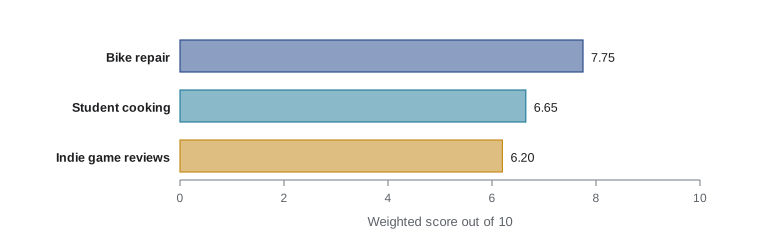
- Bike repair: \( 0.25(8) + 0.20(7) + 0.20(9) + 0.15(7) + 0.10(7) + 0.10(8) = 2.00 + 1.40 + 1.80 + 1.05 + 0.70 + 0.80 = 7.75 \).
- Student cooking: \( 0.25(9) + 0.20(4) + 0.20(6) + 0.15(8) + 0.10(6) + 0.10(6) = 2.25 + 0.80 + 1.20 + 1.20 + 0.60 + 0.60 = 6.65 \).
- Indie game reviews: \( 0.25(7) + 0.20(5) + 0.20(7) + 0.15(5) + 0.10(5) + 0.10(8) = 1.75 + 1.00 + 1.40 + 0.75 + 0.50 + 0.80 = 6.20 \).
Answer: Bike repair scores highest at 7.75. Student cooking has the most demand but the weakest gap; game reviews suffer on feasibility. Before deciding, check how sensitive the result is: if demand were weighted 40 %, would cooking win? Testing the weights shows whether the choice is robust.
Run a quick sensitivity check by changing the largest weight by ten percentage points and redistributing the difference. If the winner changes with every small adjustment, the niches are effectively tied and you should let a small test or your own interest decide. If the winner stays on top, you can choose with confidence.
Running a small validation test
Desk research tells you what people did in the past. A small test tells you how they respond to you. In week 2 or 3, before the full launch, publish two or three short pieces on your leading niche, or post in a relevant community, or share a simple landing page that invites people to join an email list for the upcoming channel. The goal is not views for their own sake but a signal: do strangers engage, ask questions, save, share or sign up?
Decide your decision rule before you look at the results, as CRE-440 taught. For example: 'If at least two of three test shorts reach 60 % average view percentage and receive comments asking for more, proceed with bike repair; otherwise reconsider student cooking.' Writing the rule first prevents you from interpreting any result as success. Keep tests small and honest; a test with tiny numbers can still reveal a strong qualitative signal, such as several people asking the same follow-up question.
Worked problem
Judging a landing-page test
Jordan shares a one-page sign-up form for the upcoming channel in two community groups. It is viewed 340 times and 41 people subscribe. Jordan's pre-set rule was to proceed if the sign-up rate was at least 8 %. Calculate the rate and an approximate 95 % confidence interval.
Show solution
- Sign-up rate: \( p = 41 / 340 \approx 0.121 \), or 12.1 %.
- Standard error: \( \sqrt{0.121 \times 0.879 / 340} \approx \sqrt{0.000313} \approx 0.0177 \).
- Margin: \( 1.96 \times 0.0177 \approx 0.035 \).
- Interval: about 8.6 % to 15.6 %.
Answer: The whole interval sits above the 8 % threshold, so the result supports proceeding. The sample is small, and people in a bike community are already interested, so the rate will fall when content reaches broader audiences; but the signal of demand is real.
Checking feasibility and risk
A niche can pass on demand and still fail on feasibility. Check that you can produce the content safely, legally and within your budget. A channel about extreme sports, risky chemistry or medical advice raises safety and liability issues that CRE-420 and CRE-450 explained. A channel built on film clips or music depends on fair dealing or fair use arguments that are fragile in practice. A channel that features your workplace, classmates or family needs permissions. Note these issues in the proposal and explain how you will handle them, or choose a different niche.
Also check platform fit. Some topics are restricted for advertisers or limited by platform policies, which affects reach and monetization. Firearms, gambling, adult themes, some health claims and some financial content attract extra rules. If your niche sits in a sensitive area, read the relevant platform policies and note how you will comply.
Writing the proposal
The proposal pulls everything together in two to four pages. A clear structure helps your instructor and later readers such as sponsors or collaborators.
- Summary: the chosen niche and positioning statement in two or three sentences.
- Audience: who they are, what they need and where they spend time online.
- Evidence: demand, competition and gap findings with sources and dates.
- Scorecard: the weighted comparison and sensitivity check.
- Test: what you tested, your decision rule and the result.
- Feasibility and risk: safety, legal, platform and capacity issues and responses.
- Recommendation: what you will build, why, and what would make you change course.
End the proposal with a short 'kill or pivot' rule: the evidence that would make you change niche or format by mid-term. For example, 'If by week 8 average view duration stays under 25 % and returning viewers are below 10 %, I will test a different format before changing topic.' Committing in advance to how you will react protects you from both quitting too soon and persisting with something that is clearly not working.
A note on authenticity
Validation can push you toward whatever seems most popular. Resist choosing a niche you do not care about just because the numbers look good. You will make dozens of pieces of content this term and, if things go well, hundreds after it. Audiences notice enthusiasm and expertise, and you will sustain effort much longer on a topic you enjoy. The best choice usually combines solid evidence of demand with genuine interest; the scorecard's 'sustained interest' criterion is there for a reason.
Common mistakes
MistakeChoosing a niche on excitement alone.
InsteadCompare at least three candidates with evidence and a weighted scorecard.
MistakeTreating competition as a reason to avoid a niche.
InsteadUse competition as proof of demand and look for a specific gap you can fill.
MistakeDeciding what counts as success after seeing test results.
InsteadWrite the decision rule before running the test.
MistakeIgnoring safety, legal and platform limits.
InsteadCheck feasibility and risk and record how you will comply, or pick another niche.
MistakeCopying the most popular topic without caring about it.
InsteadCombine evidence of demand with genuine interest you can sustain.
Summary and key terms
- Validation reduces the biggest uncertainties cheaply before committing a term of effort.
- Write each candidate as a positioning statement naming the audience, need, offer and alternatives.
- Gather demand evidence from search, existing content, questions, your own access and audience research.
- Competition proves demand; look for gaps and use outlier scores to find proven topics.
- A weighted scorecard and sensitivity check make the choice transparent and test its robustness.
- A small test with a pre-set decision rule shows how real people respond to you.
- The proposal covers audience, evidence, scorecard, test, risks, a recommendation and a pivot rule.
- Niche
- A focused topic and audience that a channel serves.
- Validation
- Testing the key assumptions behind a plan cheaply before committing to it.
- Positioning statement
- A sentence naming the audience, need, offer, benefit and alternatives.
- Outlier score
- A video's views divided by its channel's median views.
- Weighted scorecard
- A comparison that multiplies criterion scores by weights and adds them.
- Sensitivity check
- Testing whether a decision changes when assumptions or weights change.
- Decision rule
- A criterion set in advance for what result will lead to which action.
- Content gap
- An audience need that existing content does not meet well.
- Landing page
- A simple web page with one purpose, such as signing up for updates.
- Pivot
- A deliberate change of niche, format or strategy based on evidence.
Practice problems
Work each problem on paper first, then reveal the answer to check.
Write the template for a positioning statement.
Show answer
For [audience] who [need], my channel offers [content] that [benefit], unlike [alternatives].
Name three sources of demand evidence.
Show answer
Search suggestions and keyword tools, existing videos and comments, forums and Q&A sites, your own access, surveys or interviews.
A video has 30,000 views on a channel with a median of 3,000. What is its outlier score?
Show answer
10.
Scores 8, 6 and 7 with weights 50 %, 30 % and 20 %. Weighted score?
Show answer
4.0 + 1.8 + 1.4 = 7.2.
Why run a sensitivity check?
Show answer
To see whether the winner changes when weights change, showing how robust the choice is.
A sign-up page gets 500 views and 40 sign-ups. What is the rate?
Show answer
8 %.
Why set the decision rule before the test?
Show answer
To avoid interpreting any result as success after the fact.
Give two feasibility risks a niche might have.
Show answer
Safety, legal or copyright issues, permissions, platform restrictions, cost or time.
What is a pivot rule?
Show answer
A pre-set condition, such as low retention by week 8, that triggers a change of format or niche.
Why include sustained interest in the scorecard?
Show answer
Creators sustain effort and authenticity much longer on topics they genuinely care about.
Lesson quiz · 5 questions
Score 60% or more to complete this lesson.
Create a free account to save your progress, take quizzes and earn a certificate.