
CRE-440 · Lesson 8 of 12 · 29 min
Audience research: surveys, interviews and comments
Analytics show what viewers do; they rarely show why. A retention cliff tells you where people leave, not what bothered them. A drop in returning viewers tells you something changed, not whether the cause was your content, a competitor or viewers' changing lives. Audience research fills that gap by asking people directly and listening carefully to what they already say. Combined with analytics and experiments, it is one of the most powerful tools a creator has for generating good hypotheses and understanding results. This lesson covers surveys, interviews, comment analysis and community polls, how to avoid the common biases in each, and the privacy rules that apply when you collect information from your audience.
Qualitative and quantitative research
Audience research comes in two broad types. Quantitative research collects numbers from many people, such as survey ratings or poll results, and tells you how common something is. Qualitative research collects detailed words from fewer people, such as interviews or open-ended comments, and tells you why and how. The two work best together: interviews reveal ideas and language you would not think to ask about, and surveys then measure how widely those ideas are shared.
| Method | Type | Best for | Main risk |
|---|---|---|---|
| Survey | Quantitative, some open text | Measuring how common opinions are | Biased sample and leading questions |
| One-to-one interview | Qualitative | Understanding motivations and language | Small, unrepresentative sample |
| Comment analysis | Qualitative, can be counted | Finding recurring themes cheaply | Loud minority, not typical viewers |
| Community poll | Quantitative, very short | Quick choices between options | Self-selection and platform limits |
| Analytics | Quantitative, behavioural | What people actually do | Shows what, not why |
Surveys
A survey asks a set of standard questions to many people. Creators often run surveys through a link in a video description, community post, newsletter or membership platform. Good surveys are short, usually 5 to 12 questions, and focused on decisions you actually need to make.
Several principles improve survey quality.
- Ask about behaviour and specifics rather than hypotheticals. "How many of our videos did you watch last month?" is more reliable than "Would you watch more if we posted daily?"
- Avoid leading questions. "How much did you love the new series?" pushes toward a positive answer; "How would you rate the new series?" with a balanced scale does not.
- Ask one thing at a time. "Were the videos useful and entertaining?" combines two questions.
- Use balanced scales, such as 1 to 5 from very poor to very good, with a clear middle point.
- Include at least one open-ended question, such as "What is one thing we could do better?", to capture ideas you did not anticipate.
- Test the survey with two or three people first to catch confusing wording.
Who answers: sampling and bias
The biggest weakness of creator surveys is that respondents are not a random sample of the audience. People who answer are usually the most engaged fans, who watch more, like more and have stronger opinions than casual viewers. This is called self-selection bias. Survey results therefore describe your core audience well and your casual audience poorly. To reduce the problem, place the survey link where casual viewers will see it, such as in a popular video rather than only in a members' post, keep it short, and compare respondents' viewing habits with your analytics to see how representative they are.
Even with a biased sample, sample size matters for precision. For a yes-or-no question, an approximate 95 % margin of error is 1.96 times the square root of p(1 − p) divided by the number of respondents.
Worked problem
Margin of error for a creator survey
Of 400 survey respondents, 60 % say they would buy a paid course. What is the approximate 95 % margin of error, and what does it not cover?
Show solution
- Margin: \( 1.96 \times \sqrt{0.6 \times 0.4 \div 400} = 1.96 \times \sqrt{0.0006} \approx 1.96 \times 0.0245 \approx 0.048 \).
- The interval is about 60 % ± 4.8 points, or roughly 55 % to 65 %.
- The margin covers random sampling error only. It does not correct for self-selection, since respondents are likely your most engaged fans, or for the gap between saying and doing.
Answer: About ± 5 points. In practice, purchase intent in surveys usually overstates actual purchases, so treat 60 % as an upper bound and test with a pre-sale or waitlist before building the course.
Worked problem
From stated intent to a realistic estimate
A creator has 50,000 monthly viewers. Survey respondents, mostly engaged fans, said 60 % would buy a course. The creator assumes respondents represent about 10 % of the audience, that casual viewers are one-fifth as likely to buy, and that only one-quarter of stated intent becomes purchases. Estimate likely buyers.
Show solution
- Engaged viewers: 10 % × 50,000 = 5,000; stated intent 60 % gives 3,000; actual at one-quarter: 750.
- Casual viewers: 45,000; stated intent one-fifth of 60 % = 12 %, giving 5,400; actual at one-quarter: 1,350.
- Total estimate: 750 + 1,350 = 2,100 buyers, about 4.2 % of monthly viewers.
Answer: About 2,100 buyers, but every factor is an assumption. A waitlist or pre-sale is a much better test than survey intent, and can confirm or correct these guesses quickly.
Interviews
A short interview, 20 to 30 minutes on a video call, with five to ten audience members can reveal more about motivations than hundreds of survey answers. Interviews are especially useful early in strategy work, when you do not yet know which questions matter. Recruit a mix of people: long-time fans, newer viewers, and ideally a few people who used to watch and stopped. Ask open questions about their experiences, such as "Tell me about the last time you watched one of our videos. What were you doing? Why that video?", and listen more than you talk. Avoid pitching ideas and asking whether they like them; people tend to be polite to creators they admire.
After interviews, look for patterns: phrases that several people used, problems that came up repeatedly, and surprises. These become hypotheses for surveys and experiments.
Comment and message analysis
Comments, replies, messages and community discussions are free, continuous research. The challenge is that the people who comment are a small and unusual slice of viewers, and memorable comments, positive or negative, tend to dominate a creator's impression. Systematic analysis reduces that distortion.
- Sample comments in a consistent way, for example 200 comments from each of the last five videos, rather than reading only the top or the most emotional.
- Code each comment into themes, such as praise for pacing, request for a topic, confusion, criticism of audio, or off-topic.
- Count how often each theme appears and track it over time.
Worked problem
Coding comments into themes
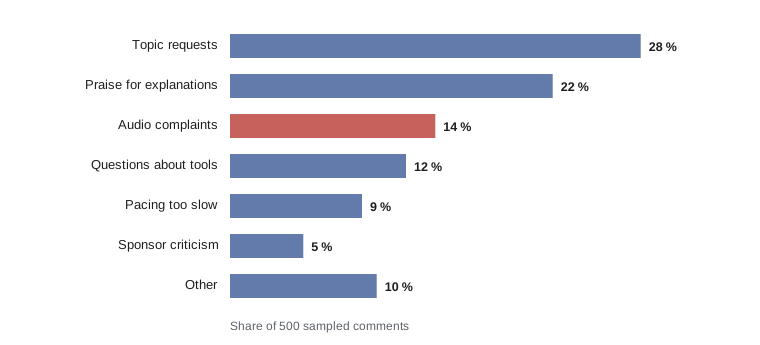
A creator codes 500 comments from recent videos and finds 70 complaints about audio quality, compared with 25 in a similar sample three months ago, also of 500 comments. What changed, and what should they check?
Show solution
- Current audio complaint rate: 70 ÷ 500 = 14 %.
- Earlier rate: 25 ÷ 500 = 5 %.
- The rate nearly tripled, a large change in a stable sampling method.
- Check what changed in the production chain, such as a new microphone, location or editing setting, and compare retention around sections with poor audio.
Answer: Audio complaints rose from 5 % to 14 % of comments. That is a clear signal worth fixing, even though most viewers never comment, because complaints in a consistent sample usually reflect a wider experience.
AI tools can help summarize and code large volumes of comments, as discussed in CRE-410, but spot-check their coding against your own reading, because summaries can miss sarcasm, context and minority views.
Community polls
Platform polls, such as YouTube community posts, Instagram stories and polls in livestream chats, are quick and engaging. They are useful for simple choices, such as which of two topics to cover next. Their limits are self-selection, a very small number of answer options, and the fact that people vote for what sounds appealing rather than what they will actually watch. Treat poll results as one input, and where possible check them against behaviour, for example by publishing both topics over time and comparing performance.
Privacy and consent
Collecting information from your audience, even through a simple survey, brings legal and ethical responsibilities. Collect only what you need, explain why you are collecting it and how it will be used, store it securely, and delete it when no longer needed. Avoid collecting sensitive information, such as health details, unless essential. Be especially careful with children.
In Canada, the Personal Information Protection and Electronic Documents Act (PIPEDA) generally applies to personal information collected in the course of commercial activity, which can include a creator business running surveys or mailing lists. It requires meaningful consent, limiting collection to what is needed for identified purposes, safeguarding data and giving people access to their information. Alberta and British Columbia have their own private-sector privacy acts that apply instead of PIPEDA for organizations within those provinces. Quebec's private-sector law, as amended by Law 25 with most changes in force by September 2023, adds requirements such as designating a person responsible for personal information (by default the person with the highest authority in the business), assessing privacy risks before transferring personal information outside Quebec, and obtaining express consent for sensitive information. Survey invitations sent by email or text can also be commercial electronic messages under Canada's Anti-Spam Legislation (CASL), which generally requires consent, identification and an unsubscribe option. Children's information calls for extra caution and, generally, parental consent.
| Practice | Why it matters in Canada |
|---|---|
| Explain purpose before collecting | Meaningful consent under PIPEDA and provincial laws |
| Collect only what you need | Limiting collection is a core privacy principle |
| Ask for express consent for sensitive data | Required under Quebec law and good practice everywhere |
| Get consent before emailing invitations | CASL generally requires consent for commercial messages |
| Avoid collecting from children without parental consent | Extra protection for minors under privacy guidance |
If you plan to collect detailed personal information, sell products to people who answer, or run research with children, get advice from a privacy professional.
Turning research into action
Research is valuable only if it changes decisions. After each research activity, write down three to five findings, the hypotheses they suggest, and how you will test them. For example: "Interviews suggest newer viewers find our jargon confusing. Hypothesis: adding a one-line definition the first time each technical term appears will raise retention among new viewers. Test: randomized holdout over eight videos, comparing retention for new viewers." This closes the loop between listening and experimenting.
Combining research with experiments
Research and experiments complement each other. Research suggests what to test and helps explain surprising results; experiments show whether the ideas from research actually change behaviour. When an experiment produces an unexpected result, a few follow-up interviews or a targeted look at comments often reveals why, and that understanding usually leads to a better next test.
Common mistakes
MistakeTreating survey respondents as representative of all viewers.
InsteadRecognize self-selection; compare respondents' habits with analytics and place surveys where casual viewers see them.
MistakeTrusting stated purchase intent.
InsteadTreat intent as an upper bound and test demand with a waitlist or pre-sale.
MistakeReading only the loudest comments.
InsteadSample comments consistently and code them into themes you can count.
MistakeAsking leading or double-barrelled questions.
InsteadUse neutral wording, balanced scales and one idea per question.
MistakeCollecting personal information without a clear purpose or consent.
InsteadCollect only what you need, explain why, store it securely and follow privacy law.
Summary and key terms
- Analytics show what viewers do; research shows why, and the two work best together.
- Surveys measure how common opinions are; interviews reveal motivations and language.
- Survey respondents are usually the most engaged fans, so results are self-selected.
- The margin of error for a proportion is about 1.96 √(p(1 − p)/n), but it does not fix bias.
- Stated intent overstates actual behaviour; test demand with waitlists or pre-sales.
- Systematic comment coding turns anecdotes into countable themes.
- Privacy law applies to audience research: consent, limited collection, security and extra care for children.
- Quantitative research
- Research that collects numerical data from many people.
- Qualitative research
- Research that collects detailed, non-numerical information from fewer people.
- Self-selection bias
- Bias that arises when participants choose themselves, such as engaged fans answering surveys.
- Leading question
- A question worded to push respondents toward a particular answer.
- Double-barrelled question
- A question that asks about two things at once.
- Margin of error
- The range around a survey result reflecting random sampling error.
- Stated intent
- What people say they will do, which often differs from what they actually do.
- Coding
- Assigning comments or answers to themes so they can be counted.
- Meaningful consent
- Consent given by someone who understands what is collected and why.
- Pre-sale
- Selling a product before it is built to test real demand.
Practice problems
Work each problem on paper first, then reveal the answer to check.
What can research tell you that analytics cannot?
Show answer
Why viewers behave as they do.
When are interviews most useful?
Show answer
Early on, when you do not yet know which questions matter.
Rewrite "How much did you love the series?" neutrally.
Show answer
"How would you rate the series?" with a balanced scale.
Why are survey respondents often unrepresentative?
Show answer
The most engaged fans are most likely to answer.
300 respondents; 50 % say yes. What is the 95 % margin?
Show answer
1.96 × √(0.25 ÷ 300) ≈ 5.7 points.
Why test demand with a pre-sale?
Show answer
Stated intent overstates real purchases.
40 of 400 sampled comments mention audio. What is the rate?
Show answer
10 %.
Name one limit of community polls.
Show answer
Self-selection, few options, or votes not matching viewing.
Name two privacy habits for surveys.
Show answer
Explain purpose, collect only what is needed, store securely, delete when done.
How do you close the loop after research?
Show answer
Turn findings into hypotheses and test them with experiments.
Lesson quiz · 5 questions
Score 60% or more to complete this lesson.
Create a free account to save your progress, take quizzes and earn a certificate.