
CRE-330 · Lesson 9 of 12 · 27 min
Income tax, CPP and instalments for Canadian creators
No employer withholds tax from a self-employed creator's income. Brands and platforms usually pay the full fee, and the creator is responsible for calculating, saving and paying income tax and Canada Pension Plan contributions. The most common financial crisis for new creators is a large tax bill in April that they have not saved for, followed by instalment demands for the next year. This lesson explains how creator income is taxed in Canada, how CPP works for the self-employed, how to estimate tax and set money aside, and how instalments and filing deadlines work. Figures are for 2026; confirm current amounts with the CRA or an accountant.
How creator income is taxed
A sole proprietor reports business income and expenses on Form T2125 and includes the net income on their T1 personal return, along with any employment, investment or other income. Net business income is added to other income, deductions are subtracted to get taxable income, and federal and provincial tax are calculated on taxable income using progressive brackets. Non-refundable tax credits, such as the basic personal amount, then reduce the tax. Business income from all sources, including platform revenue, brand fees, affiliate commissions and the fair market value of products received in exchange for content (lesson 10), is taxable whether or not you receive a slip.
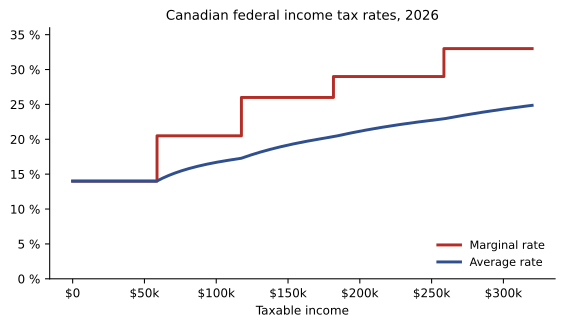
| 2026 federal taxable income | Federal rate |
|---|---|
| Up to $58,523 | 14 % |
| $58,523 to $117,045 | 20.5 % |
| $117,045 to $181,440 | 26 % |
| $181,440 to $258,482 | 29 % |
| Over $258,482 | 33 % |
Two rates matter. The marginal rate is the rate on the next dollar of income; it is what you use to evaluate a deduction or an extra deal. The average or effective rate is total tax divided by income; it is what you use to estimate how much of your profit to set aside. Because rates are progressive, the effective rate is always lower than the top marginal rate you reach.
CPP contributions for the self-employed
Employees and employers each pay half of CPP contributions. A self-employed person pays both halves. For 2026, the base and first additional contributions together are 11.9 % of net self-employment earnings between the basic exemption of $3,500 and the year's maximum pensionable earnings (YMPE) of $74,600, for a maximum of $8,460.90. The second additional contribution (CPP2) is 8 % of earnings between $74,600 and the year's additional maximum pensionable earnings (YAMPE) of $85,000, for a maximum of $832. Self-employed people in Quebec contribute to the Quebec Pension Plan instead, at slightly different rates. Part of the contributions, broadly the "employer" half and the enhanced portions, is deductible from income, and the rest earns a non-refundable tax credit.
CPP contributions are not lost money: they buy a pension and disability and survivor benefits, and the enhanced CPP introduced from 2019 will eventually raise retirement benefits. But they are a large cash cost, and creators must budget for them. Self-employed people can also opt in to Employment Insurance special benefits (maternity, parental, sickness, compassionate care and family caregiver benefits) by registering and paying premiums; regular EI for lost work is not available to the self-employed.
Deductions that reduce tax
Business expenses (lesson 7) reduce net business income and therefore both income tax and CPP. Personal deductions, such as RRSP contributions (lesson 12), reduce taxable income but not CPP. Credits such as the basic personal amount, tuition, medical expenses and charitable donations reduce tax directly. Business losses can offset other income in the same year and be carried back three years or forward twenty. Keeping good records is what makes all of this possible.
Worked problem
CPP on self-employment earnings
A creator's net self-employment income for 2026 is (a) $60,000 and (b) $90,000. What CPP contributions do they pay in each case?
Show solution
- (a) Earnings above the exemption: $60,000 − $3,500 = $56,500. CPP: 11.9 % × $56,500 = $6,723.50. No CPP2, because earnings are below the YMPE.
- (b) Base and first additional: earnings capped at the YMPE, so 11.9 % × ($74,600 − $3,500) = 11.9 % × $71,100 = $8,460.90.
- (b) CPP2: earnings above the YMPE up to the YAMPE: $85,000 − $74,600 = $10,400; 8 % × $10,400 = $832.
- (b) Total: $8,460.90 + $832 = $9,292.90, the maximum for 2026.
Answer: (a) $6,723.50 and (b) $9,292.90. CPP alone takes 11 % to 12 % of profit at these income levels, before any income tax.
Estimating your tax and setting money aside
The single most useful tax habit is to move a percentage of every payment into a separate savings account reserved for tax. The percentage should come from an estimate of your effective rate, including contributions, and be reviewed as the year progresses.
Worked problem
Estimating total tax and a set-aside rate
An Ontario creator expects 2026 net self-employment income of $70,000. CPP will be 11.9 % × ($70,000 − $3,500) = $7,913.50. Assume about $4,600 of CPP is deductible, so taxable income is about $65,400, and that Ontario tax and health premium will total about $3,800. Estimate federal tax, total tax and contributions, and a sensible set-aside percentage.
Show solution
- Federal tax on $65,400: 14 % × $58,523 = $8,193.22, plus 20.5 % × ($65,400 − $58,523) = 20.5 % × $6,877 = $1,409.79, total $9,603.01.
- Less the basic personal amount credit: 14 % × $16,452 = $2,303.28.
- Less the credit on the remaining CPP: about 14 % × $3,300 ≈ $462.
- Federal tax: $9,603.01 − $2,303.28 − $462 ≈ $6,838.
- Total: CPP $7,913.50 + federal $6,838 + Ontario $3,800 ≈ $18,552.
- Effective rate: $18,552 ÷ $70,000 ≈ 26.5 %.
Answer: About $18,550, or 26.5 % of profit. Setting aside about 30 % of each payment of profit, before any GST/HST, which is held separately, gives a margin for error and higher-than-expected income.
Notice that the set-aside percentage applies to profit, not gross revenue. A simple approach is to apply it to each payment after deducting the share that will go to expenses, or to apply a lower percentage to gross receipts if expenses are a stable share of revenue.
Instalments
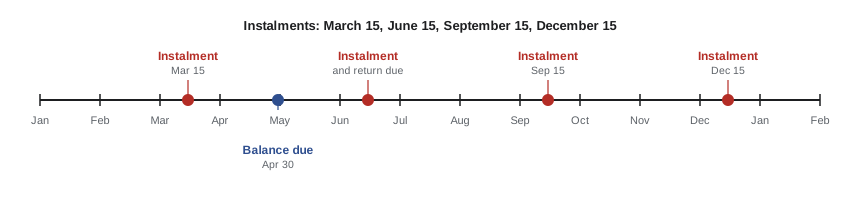
Because no tax is withheld, the CRA requires many self-employed people to pay instalments during the year. For 2026, you must pay instalments if your net tax owing is more than $3,000 in 2026 and in either 2025 or 2024 (for Quebec residents, the federal threshold is $1,800, and Revenu Québec has its own provincial instalment rules). Net tax owing includes federal and provincial income tax but not CPP; however, CPP contributions owed on self-employment earnings are included in the instalment amount. Instalments are due on March 15, June 15, September 15 and December 15.
There are three ways to calculate instalments. Under the no-calculation option, you pay the amounts on the reminders the CRA sends in February and August, based on earlier years. Under the prior-year option, you pay one-quarter of the previous year's net tax owing each quarter. Under the current-year option, you estimate this year's tax and pay one-quarter each time. If you pay according to the CRA's reminders, you will not be charged instalment interest even if the amounts turn out too low. If instalments are late or too low under the other options, the CRA charges interest at the prescribed rate plus 4 %, compounded daily, and may add a penalty for large shortfalls.
Worked problem
Instalments under the prior-year option
A creator's net tax owing, including CPP owed on self-employment income, was $9,600 for 2025, and they expect about $12,000 for 2026. They choose the prior-year option. What should they pay each quarter, and what will be due at the end of April 2027?
Show solution
- Instalments are required because net tax owing exceeds $3,000.
- Prior-year option: $9,600 ÷ 4 = $2,400 each quarter.
- Total paid in 2026: 4 × $2,400 = $9,600.
- Balance due by April 30, 2027: $12,000 − $9,600 = $2,400.
Answer: $2,400 on each of March 15, June 15, September 15 and December 15, with about $2,400 more due by April 30, 2027. The creator should save the extra $2,400 from 2026 income rather than spending it.
Filing deadlines
Self-employed individuals and their spouses or common-law partners have until June 15 to file their T1 return, but any balance owing must be paid by April 30 to avoid interest. Late filing with a balance owing triggers a penalty of 5 % of the balance plus 1 % per full month late, up to 12 months, with higher penalties for repeat late filers. Corporations file a T2 within six months of their year-end and generally pay tax within two or three months of year-end. Keep the CRA's My Account and, for a business, My Business Account up to date; most correspondence now arrives online.
Other taxes and situations to watch
- Provinces: provincial tax rates and credits differ substantially; a move between provinces changes your tax rate from the year you are resident on December 31.
- Quebec: residents file a separate provincial return with Revenu Québec and contribute to the QPP and the Quebec Parental Insurance Plan.
- Employees as well: if you have a job too, employer withholding covers only that income. Use instalments or ask your employer to withhold more (Form T1213 can reduce withholding; Form TD1 changes can increase it).
- Prizes, gifts and free trips received for content are usually income (lesson 10).
- Foreign income: Canadian residents are taxed on worldwide income, including US platform revenue, with credits for foreign tax withheld.
After you file
After you file, the CRA sends a notice of assessment confirming your income, tax and any balance or refund, and your RRSP deduction limit and instalment reminders for the next year. Read it carefully and compare it with your return. If you disagree, you generally have 90 days from the date of the notice, or one year from the filing due date if later, to file a formal objection. Keep your tax savings account in a high-interest savings account or short-term deposit, so the money earns interest while it waits; the interest is taxable, but it is better than leaving the money idle. Register for CRA My Account and choose online mail, which makes notices, slips and instalment reminders easier to track.
Common mistakes
MistakeSpending the whole payment and hoping to deal with tax in April.
InsteadMove a set percentage of each payment into a separate tax account.
MistakeForgetting that self-employed people pay both halves of CPP.
InsteadBudget about 11.9 % of earnings up to the YMPE, plus CPP2 above it.
MistakeUsing the top marginal rate to estimate total tax, or the average rate to evaluate a deduction.
InsteadUse the effective rate for saving and the marginal rate for decisions.
MistakeIgnoring instalment reminders.
InsteadPay the reminder amounts or the prior-year amount on time to avoid interest.
MistakeFiling late because you cannot pay.
InsteadFile on time to avoid large late-filing penalties, and arrange a payment plan.
Summary and key terms
- Sole proprietors report business income on the T2125 and pay tax at progressive federal and provincial rates.
- For 2026, federal rates run from 14 % to 33 %, and the basic personal amount is $16,452.
- The self-employed pay both halves of CPP: 11.9 % between $3,500 and $74,600, plus 8 % CPP2 up to $85,000.
- Use the effective rate to set aside money and the marginal rate to evaluate decisions.
- Setting aside roughly 25 % to 35 % of profit is common, depending on income and province.
- Instalments are due March 15, June 15, September 15 and December 15 when net tax owing exceeds $3,000.
- Self-employed returns are due June 15, but any balance must be paid by April 30.
- Taxable income
- Income after deductions, on which tax is calculated.
- Marginal rate
- The tax rate on the next dollar of income.
- Effective rate
- Total tax divided by income.
- Non-refundable credit
- A credit that reduces tax but not below zero.
- YMPE
- Year's maximum pensionable earnings: $74,600 for 2026.
- CPP2
- The second additional CPP contribution on earnings above the YMPE.
- YAMPE
- Year's additional maximum pensionable earnings: $85,000 for 2026.
- Net tax owing
- Tax payable after credits and withholding, used to test for instalments.
- Instalments
- Quarterly tax prepayments.
- Prescribed rate
- The CRA's quarterly interest rate, plus 4 % for instalment interest.
Practice problems
Work each problem on paper first, then reveal the answer to check.
CPP for 2026 net self-employment income of $40,000?
Show answer
11.9 % × 36,500 = $4,343.50.
Maximum 2026 CPP2 for a self-employed person?
Show answer
$832.
Federal tax on $50,000 of taxable income before credits?
Show answer
14 % × 50,000 = $7,000.
Value of the federal basic personal amount credit?
Show answer
14 % × 16,452 = $2,303.28.
Prior-year option with $8,000 net tax owing last year: quarterly instalment?
Show answer
$2,000.
When are self-employed returns due, and when must tax be paid?
Show answer
June 15; payment by April 30.
Total tax $15,000 on $60,000 of profit. Effective rate?
Show answer
25 %.
Name the four instalment dates.
Show answer
March 15, June 15, September 15, December 15.
Late-filing penalty on $2,000 owing, 3 months late?
Show answer
5 % + 3 × 1 % = 8 %, or $160.
Which EI benefits can the self-employed opt in to?
Show answer
Special benefits: maternity, parental, sickness, compassionate care, family caregiver.
Lesson quiz · 5 questions
Score 60% or more to complete this lesson.
Create a free account to save your progress, take quizzes and earn a certificate.