
CRE-330 · Lesson 2 of 12 · 26 min
Sole proprietorship or corporation in Canada
The legal structure of a business decides who owns it, who is responsible for its debts, how its profit is taxed and how much paperwork it needs. Many creators start without choosing anything, which by default makes them sole proprietors. That is often the right place to start. The question is when, and whether, a different structure begins to pay for itself.
In Canada the main choices are a sole proprietorship, a partnership and a corporation. Most creators choose between the first and the last. This lesson explains each option, how incorporation changes taxation, the costs and traps involved, and a method for deciding when to incorporate.
The sole proprietorship
A sole proprietorship is simply an individual carrying on business. There is no separate legal entity: the business's income is the owner's income, reported on Form T2125, Statement of Business or Professional Activities, with the personal T1 return. Profit is taxed at the owner's personal marginal rates, and the owner pays both the employee and employer shares of CPP contributions on self-employment earnings (or QPP in Quebec). Setup is cheap: you may need to register a business name with your province if you use a name other than your own, and you will need a GST/HST account once you pass the small supplier threshold (lesson 10).
The big disadvantage of a sole proprietorship is unlimited personal liability. If the business is sued or cannot pay its debts, creditors can pursue the owner's personal assets, such as savings, a car or a home. Insurance and careful contracts reduce this risk, but they do not remove it.
Partnerships
When two or more people carry on business together with a view to profit, they form a partnership, whether or not they sign anything. A general partnership is taxed like a group of sole proprietors: each partner reports their share of profit, and each is personally liable for the partnership's debts, including those created by the other partners. Creator duos and channels run by friends often become partnerships by accident. A written partnership agreement covering ownership of the channel and content, decision-making, money and what happens if someone leaves is essential. Limited partnerships and limited liability partnerships exist but are mostly used by investors and regulated professions.
A partnership must also consider GST/HST registration as a single business and file partnership information returns in some cases.
Incorporating a business
A corporation is a separate legal person. It owns its assets, signs its own contracts, pays its own tax and continues to exist if its owners change. You can incorporate federally under the Canada Business Corporations Act, which lets you use your name across Canada, or provincially, which is often slightly cheaper; either way, you must also register in each province where you carry on business. Government fees are a few hundred dollars, and many people also pay a lawyer or online service to prepare articles, bylaws and share registers. After incorporation, the corporation files an annual return with its incorporating jurisdiction, keeps a minute book and files a T2 corporate income tax return every year, usually prepared by an accountant for $2,000 to $5,000 or more.
A corporation that is a Canadian-controlled private corporation (CCPC) and earns active business income can claim the small business deduction. In 2026 the federal rate on the first $500,000 of active business income is 9 %, and provinces add their own small business rates. Ontario, for example, cut its small business rate from 3.2 % to 2.2 % effective July 1, 2026, and raised its provincial limit to $600,000, giving a combined rate of about 11.2 % after that date (about 11.7 % blended for a calendar 2026 year). Above the limit, the federal general rate of 15 % plus a provincial general rate applies. By comparison, an individual's combined top personal marginal rate is above 50 % in several provinces.
Deferral and integration
The low corporate rate is not a permanent saving. It is a deferral: tax is lower while profit stays in the corporation, but when the corporation pays that money to the owner as a dividend, the owner pays personal tax on the dividend. The tax system is designed for "integration," meaning that the total of corporate tax plus personal dividend tax should be roughly the same as if the owner had earned the income directly. Integration is not perfect and varies by province, but the main benefit of incorporation for most creators is the ability to leave profit they do not need to spend in the corporation, taxed at the low rate, and invest it until later.
Worked problem
Measuring the deferral
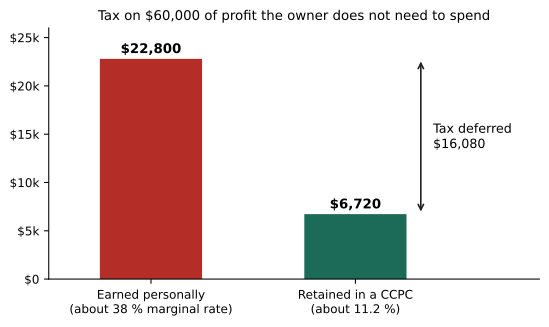
An Ontario creator expects $150,000 of profit in 2027 but needs only $90,000 a year to live on. If the extra $60,000 is earned personally, it would be taxed at a combined marginal rate of about 38 % on average. If it is retained in a CCPC, it is taxed at about 11.2 %. How much tax is deferred, and what happens when the money is later paid out?
Show solution
- Personal tax on $60,000: 38 % × $60,000 = $22,800.
- Corporate tax on $60,000: 11.2 % × $60,000 = $6,720.
- Tax deferred: $22,800 − $6,720 = $16,080, which stays invested in the corporation.
- When the corporation later pays the after-tax $53,280 as a dividend, the owner pays personal dividend tax, bringing total tax close to what it would have been without incorporation.
- If the dividend is paid in a year when the owner's income is lower, for example during a parental leave or in retirement, the total tax can end up lower.
Answer: About $16,000 of tax is deferred each year the $60,000 is retained. The real benefit comes from investing the deferred amount and from paying dividends in lower-income years, not from avoiding tax altogether.
Paying yourself: salary or dividends
An incorporated creator can pay themselves a salary, dividends or a mix. A salary is deductible to the corporation, is taxed as employment income, requires payroll remittances and T4 slips, creates RRSP contribution room and earns CPP pensionable service, with both employer and employee contributions. Dividends are paid from after-tax corporate profit, are taxed more lightly in the owner's hands because of the dividend tax credit, require a T5 slip, create no RRSP room and carry no CPP contributions. Many owners pay enough salary to maximize RRSP room and build CPP credits, and take the rest as dividends, but the right mix depends on income, family situation and future plans. Paying dividends to family members who do not work in the business is restricted by the tax on split income (TOSI) rules.
| Feature | Salary | Dividends |
|---|---|---|
| Deductible to the corporation | Yes | No; paid from after-tax profit |
| Personal tax | Employment income rates | Lower rates after the dividend tax credit |
| CPP contributions | Yes, employer and employee shares | None |
| RRSP room | Created (18 % of earned income) | None |
| Paperwork | Payroll remittances, T4 | Directors' resolution, T5 |
| Useful for | Retirement saving room, CPP benefits, childcare deduction | Flexibility and lower admin |
Liability: what a structure can and cannot do
A corporation protects shareholders from the corporation's debts, but the protection has limits. Lenders and landlords often require small-business owners to give personal guarantees. Directors can be personally liable for unremitted GST/HST and payroll deductions and, in some provinces, for unpaid wages. And everyone remains liable for their own wrongful acts: a creator who defames someone in a video can be sued personally even if a corporation published it. Insurance and good practices remain essential.
Traps to know about
- Personal services business: if the corporation's income comes from what would otherwise be an employment relationship with one client, the CRA can deny the small business deduction and apply a high tax rate. Creators with many brand clients are usually low risk, but a creator who works full-time for a single company through a corporation should get advice.
- Passive income: if a CCPC and its associated corporations earn more than $50,000 of passive investment income in a year, the small business limit is reduced the following year, reaching zero at $150,000.
- Tax on split income: paying dividends to a spouse or children who do not actively work in the business is often taxed at the top rate.
- Mixing funds: paying personal expenses from the business account, or business expenses personally without records, undermines both the liability shield and the tax filings.
- Moving assets: transferring an existing channel, equipment or trademarks into a new entity has tax and legal consequences and should be done with professional advice and proper documents.
Deciding when to change structure
A sensible decision process compares annual benefits with annual costs and considers non-tax factors:
- Estimate profit for the next two or three years, and how much of it you need to spend personally.
- Estimate the tax deferred each year on profit you can leave in a corporation.
- Subtract extra accounting, legal, payroll and government costs.
- Consider liability protection, how brands and platforms will pay the new entity, and the time needed to manage it.
- Ask a professional to check the estimate before acting, and revisit the decision every year.
A common rule of thumb is that incorporation becomes worth considering when a creator consistently earns more than they need to live on, typically when they could leave tens of thousands of dollars a year in the corporation. If all profit is needed for personal spending, the deferral advantage largely disappears.
Worked problem
A decision score
A creator rates a change of structure on four factors from 1 to 5, with weights: annual net financial benefit (40 %), liability protection (25 %), administrative burden where 5 means little burden (20 %), and fit with future plans (15 %). The scores are 4, 4, 2 and 5. Is the weighted score above their threshold of 3.5?
Show solution
- 0.40 × 4 = 1.60.
- 0.25 × 4 = 1.00.
- 0.20 × 2 = 0.40.
- 0.15 × 5 = 0.75.
- Total: 1.60 + 1.00 + 0.40 + 0.75 = 3.75.
Answer: The weighted score is 3.75, above 3.5, so the change is worth investigating with an accountant and a lawyer.
Making a change in practice
Changing structure is a project, not a single form. Before the change takes effect, plan the date, ideally the start of a month or year; open new bank accounts in the entity's name; update contracts, invoices and payment details with brands, platforms and agencies; transfer or license equipment, trademarks and the channel itself to the new entity with proper documents; set up payroll if needed; and tell your accountant early, because the first year after a change usually involves extra filings. Expect some clients to take a few weeks to update their vendor records, and keep the old account open until every payment has arrived.
Common mistakes
MistakeChanging structure because a friend did, without running the numbers.
InsteadCompare annual benefits with annual costs for your own profit and spending.
MistakeTreating the low corporate rate as a permanent tax saving.
InsteadUnderstand it as a deferral that pays off when profit is retained and invested.
MistakeAssuming a company protects you from your own defamation or negligence.
InsteadKeep insurance and careful practices; personal wrongdoing stays personal.
MistakeRunning personal spending through the business account.
InsteadKeep funds separate to protect the liability shield and the books.
MistakeRunning a channel with a friend without a written agreement.
InsteadAgree on ownership, money, decisions and exits in writing.
Summary and key terms
- A sole proprietorship is simple and cheap but gives no liability protection; profit goes on the T2125.
- Partnerships arise automatically when people carry on business together and need written agreements.
- A corporation is a separate legal person with limited liability, its own tax return and higher costs.
- CCPCs pay a low small business rate (9 % federal plus a provincial rate) on the first $500,000 of active income.
- The low rate mainly defers tax on profit retained in the corporation; integration evens out the total when paid out.
- Salary creates RRSP room and CPP credits; dividends are simpler and taxed more lightly but create neither.
- Incorporation is worth considering when you can consistently leave significant profit in the corporation.
- Sole proprietorship
- An individual carrying on business with no separate entity.
- T2125
- The form used to report self-employment income and expenses.
- Corporation
- A separate legal person owned by shareholders.
- CCPC
- Canadian-controlled private corporation.
- Small business deduction
- A reduced corporate tax rate on active business income up to a limit.
- Integration
- The principle that corporate plus personal tax should roughly equal direct personal tax.
- Tax deferral
- Postponing tax by retaining profit in a corporation.
- Dividend tax credit
- A credit that reduces personal tax on dividends.
- TOSI
- Tax on split income, limiting income splitting with family.
- Personal guarantee
- A personal promise to pay a business's debt.
Practice problems
Work each problem on paper first, then reveal the answer to check.
Retaining $40,000 with personal 40 % and corporate 12 % rates defers how much tax?
Show answer
$11,200.
What form reports a sole proprietor's business income?
Show answer
Form T2125.
What is the 2026 federal small business rate?
Show answer
9 % on the first $500,000 of active business income.
Name two benefits of paying salary rather than dividends.
Show answer
RRSP room and CPP pensionable earnings; deductibility to the corporation.
At what passive income level does the small business limit start to shrink?
Show answer
$50,000; it reaches zero at $150,000.
Can directors be liable for unremitted GST/HST?
Show answer
Yes.
Why is the corporate rate advantage called a deferral?
Show answer
Personal tax is paid later when profit is paid out as dividends.
What is a personal services business?
Show answer
A corporation earning what would otherwise be employment income from one client.
Weighted score: 0.5 × 4 + 0.3 × 3 + 0.2 × 5?
Show answer
3.9.
What document should creator partners sign?
Show answer
A partnership agreement.
Lesson quiz · 5 questions
Score 60% or more to complete this lesson.
Create a free account to save your progress, take quizzes and earn a certificate.