
CRE-330 · Lesson 3 of 12 · 29 min
Contract anatomy: scope, deliverables, payment and termination
Creators sign more contracts than most small businesses: brand agreements, management and agency agreements, network and platform terms, collaboration deals, licences for music and footage, and agreements with editors and other freelancers. CRE-310 introduced the main clauses of a brand agreement at an overview level. This lesson and the next two go deeper. Here we look at how contracts are formed and how a typical agreement is organized, clause by clause, focusing on the commercial terms: who does what, when, for how much and how the deal ends. Lesson 4 covers the rights clauses, and lesson 5 covers reviewing, redlining and negotiating.
For significant or unusual agreements, have a lawyer review the contract before you sign.
How a contract is formed
In the common-law provinces and territories, a binding contract generally needs an offer, an acceptance of that offer, consideration (something of value exchanged by each side) and an intention to create legal relations, with terms certain enough to enforce. In Quebec, the Civil Code of Québec governs contracts: a contract is formed by the exchange of consent between persons with capacity to contract, and it needs a cause and an object. In both systems, most commercial contracts do not have to be in writing, and electronic signatures and email acceptance are generally valid under provincial electronic commerce legislation and, in Quebec, the Act to establish a legal framework for information technology.
Two practical consequences follow. First, an exchange of emails or direct messages that agrees on the key terms can itself be a binding contract, even if you meant to "sign something later." Second, the written agreement usually contains an "entire agreement" clause saying it replaces everything discussed before, so promises made in calls or messages but left out of the document may be unenforceable. Get every important promise into the signed text.
The types of contract creators sign
- Brand or sponsorship agreements: content for a fee, often with a statement of work (SOW) for each campaign.
- Master services agreements (MSAs): umbrella terms for an ongoing relationship, with individual SOWs added over time.
- Management and agency agreements: representation in exchange for commission (lesson 11).
- Network or multi-channel network (MCN) agreements: services or revenue sharing tied to a channel.
- Platform terms of service and partner program terms: usually non-negotiable but legally binding.
- Licences: permission to use music, footage, fonts, images or a brand's trademarks.
- Collaboration agreements: ownership and revenue sharing for joint content or products.
- Freelancer and contractor agreements: work done for the creator by editors, designers or writers.
- Non-disclosure agreements (NDAs): confidentiality before or during a deal.
Each type has its own risks, but they share a common anatomy. Learning to recognize the parts lets you read any contract faster and spot what is missing.
The anatomy of an agreement
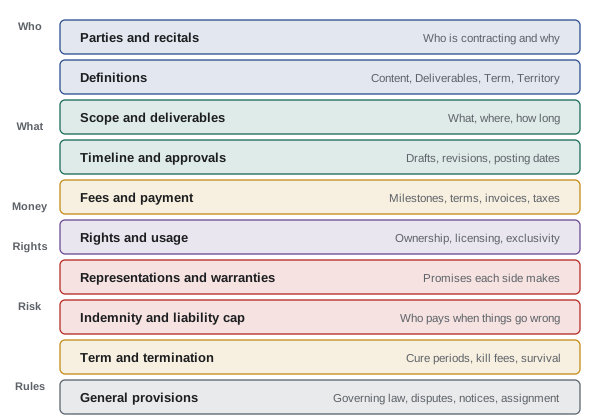
- Parties: the exact legal names of each party, including whether you are contracting personally or through your company. If you have incorporated or formed an entity, the contract should name it.
- Recitals: short background statements ("whereas") that explain the purpose but usually create no obligations.
- Definitions: capitalized terms such as "Content," "Deliverables," "Territory" and "Term." Definitions can quietly change the meaning of the whole agreement, so read them carefully.
- Scope of work and deliverables: exactly what you will create and publish.
- Timeline and approvals: drafts, review periods, revisions and posting dates.
- Compensation and payment: fees, milestones, expenses, invoicing, payment terms and taxes.
- Rights and licences: who owns the content and what the other party may do with it (lesson 4).
- Representations and warranties: statements of fact and promises each side makes.
- Indemnity and limitation of liability: who pays if something goes wrong.
- Term and termination: how long the agreement lasts and how either side can end it.
- General provisions, often called boilerplate: governing law, dispute resolution, assignment, notices, amendments, entire agreement, severability and signatures.
Scope of work and deliverables
Vague scope is the most common source of creator disputes. "Promote the product on social media" can mean one story frame or twenty videos. A good scope clause specifies, for each deliverable: the platform and format, length or duration, number of assets, key messages or required elements, mandatory disclosures, posting date or window, how long the content must stay live, and whether raw footage or extra cut-downs are included. It should also say what is not included, so that additional requests become paid change orders rather than unpaid favours.
| Element | Vague version | Clear version |
|---|---|---|
| Deliverable | Video about the product | One dedicated vertical video, 45 to 75 seconds, on TikTok |
| Timing | In the spring | Draft by April 10; live between April 20 and 25, 9 a.m. to 3 p.m. Eastern |
| Revisions | Brand approval required | Brand responds within 3 business days; up to 2 rounds of revisions |
| Live period | Keep it up | Remains public for at least 90 days |
| Extras | Brand may use content | No raw footage; organic reposting on brand channels for 30 days (see Rights) |
The approval process deserves its own attention. A clause that says the brand must "approve" content without limits can let a brand demand endless changes. Better clauses set a response deadline, deem content approved if the brand does not respond in time, cap the number of revision rounds and price extra rounds. They also distinguish factual corrections, which you should make, from changes to the creative concept after it has been approved, which are new work.
Compensation and payment terms
The money section should leave no doubt about how much, when and how you will be paid. Common structures include a flat fee, a fee split into milestones (for example, part on signing and the rest on posting), a fee plus performance bonuses tied to agreed metrics, revenue sharing, and affiliate commissions. Each needs clear definitions of what triggers payment.
- Payment terms: "net 30" means payment is due 30 days after a stated event, usually receipt of an invoice. Large brands often propose net 60 or net 90; shorter terms or a deposit protect your cash flow.
- Invoicing: what the invoice must contain, where to send it and whether the brand needs a purchase order (PO) number first.
- Expenses: whether travel, props or talent costs are reimbursed or included, and the approval process for them.
- Taxes: the fee should be stated as exclusive of GST/HST and QST, with sales tax added on the invoice if you are registered (lesson 10). Brands outside Canada may ask for tax forms such as Form W-8BEN if any US source income is involved.
- Late payment: interest or late fees on overdue amounts, and the right to suspend work or posting until paid.
In Canada, the federal Interest Act affects how late interest is written. If a contract states interest only as a rate per month or per day, without stating the equivalent annual rate, the maximum interest recoverable is 5 % a year. A clause that says "1.5 % per month (19.56 % per year)" avoids that problem. The Criminal Code also caps interest; since January 1, 2025, the criminal rate is an annual percentage rate above 35 %, far above typical late-payment terms.
Worked problem
A milestone schedule and late interest
A $9,000 campaign is paid 30 % on signing, 40 % on approval of the final cut and 30 % on posting, each on net 30 terms. The final payment arrives 45 days late. The contract charges interest of 1.5 % per month, stated as 19.56 % per year, calculated simply for the days late. How much is each payment, and how much interest is owed on the late one?
Show solution
- Signing payment: 30 % × $9,000 = $2,700.
- Approval payment: 40 % × $9,000 = $3,600.
- Posting payment: 30 % × $9,000 = $2,700.
- Daily interest equivalent: 19.56 % ÷ 365 ≈ 0.0536 % per day.
- Interest on the late payment: $2,700 × 0.000536 × 45 ≈ $65.
Answer: The payments are $2,700, $3,600 and $2,700. Interest of about $65 is owed on the late payment. The amount is small, but a clear interest clause encourages prompt payment and gives you leverage when chasing it.
Representations, warranties and indemnities
Representations are statements of fact, such as "the creator owns all rights in the content." Warranties are promises that something is or will be true, such as "the content will not infringe anyone's rights." If they turn out to be false, the other party may claim damages or terminate.
An indemnity is a promise to cover another party's losses, including legal costs, arising from specified events. Brand agreements typically ask the creator to indemnify the brand for claims caused by the creator's content, such as copyright infringement from unlicensed music or claims from people shown without permission. A fair agreement makes indemnities mutual: the brand should indemnify the creator for claims arising from the brand's product, its claims about the product and materials it supplied. Watch for one-sided indemnities, indemnities that cover claims "arising from the content" however caused, and obligations to pay the other party's legal fees with no cap.
A limitation of liability clause caps how much either party can recover, often at the fees paid under the contract, and excludes indirect losses such as lost profits. For creators, a cap equal to the fees received is a reasonable ask, because without one a single campaign could expose you to losses many times its value.
Worked problem
Measuring exposure under a cap
A creator signs a $4,000 agreement that caps each party's liability at the total fees paid, but excludes indemnities for intellectual property infringement from the cap. A claim alleges that a background song infringed copyright, and the brand's costs reach $15,000. A separate claim alleges a late post cost the brand $10,000 in lost sales. What can the brand recover from the creator under each claim, assuming both claims succeed?
Show solution
- The music claim falls under the intellectual property indemnity, which is excluded from the cap: the creator could owe the full $15,000.
- The late-post claim is a claim for lost profits. If the agreement excludes indirect and consequential losses, the brand may recover little or nothing; if not, recovery is capped at $4,000.
Answer: Up to $15,000 on the music claim and at most $4,000 on the late-post claim. The example shows why licensing music properly and reading the exclusions from the cap matter as much as the cap itself.
Term, termination and kill fees
The term is how long the agreement lasts. Termination clauses say how it can end early. Termination for cause lets a party end the agreement if the other breaches a material term and does not fix it within a cure period, such as 10 business days. Termination for convenience lets a party end it for any reason with notice. Brands often reserve a right to terminate for convenience; creators should ask for a matching right or, at minimum, a kill fee.
A kill fee compensates the creator if the brand cancels after work has started. A common approach is a percentage of the fee that rises as the project advances, for example 25 % after signing, 50 % after concept approval and 100 % after the final content is delivered. The agreement should also say what happens to content already produced, whether deposits are refundable, and which clauses survive termination, such as confidentiality, payment of amounts owed and licences already granted.
Morals clauses, which let a brand terminate if the creator's conduct damages its reputation, are covered in lesson 4 because they interact closely with rights and exclusivity.
General provisions that matter
- Governing law and jurisdiction: which province's law applies and where disputes are heard. A creator in British Columbia contracting with a Toronto agency may prefer British Columbia law and courts, or at least a neutral, convenient forum. Contracts with Quebec parties may be governed by the Civil Code of Québec.
- Dispute resolution: negotiation, then mediation, then arbitration or court. Arbitration is private and can be faster, but filing fees and arbitrator costs can exceed the value of a small dispute. A carve-out allowing small claims court for unpaid fees is useful.
- Small claims limits: provincial small claims courts handle claims up to limits that vary widely, for example $15,000 in Quebec and $100,000 in Alberta's Court of Justice civil claims process (limits change; check your province). In Quebec, lawyers generally cannot represent parties in small claims. For unpaid invoices, small claims is often the most practical remedy.
- Assignment: whether a party may transfer the contract to someone else. Brands often want the right to assign to affiliates or buyers; creators may want the right to assign to their own company.
- Notices: how formal notices must be sent. If notices must go to a physical address, an email may not count.
- Amendments: changes must usually be in writing and signed by both parties. Agree changes by email only if the contract allows it.
- Severability: if one clause is unenforceable, the rest survives.
- Counterparts and electronic signatures: the contract may be signed in separate copies and electronically.
Reading a contract efficiently
A practical reading order saves time. First, check the parties, fee, deliverables and dates against what was agreed. Second, read the definitions. Third, read the rights, exclusivity, indemnity and termination clauses closely, because they carry the most risk. Fourth, scan the boilerplate for governing law, dispute resolution and assignment. Finally, list what is missing, such as a late-payment clause, a kill fee or a revision cap. Lesson 5 turns this into a structured review and redlining process.
Common mistakes
MistakeAssuming nothing is binding until a formal document is signed.
InsteadTreat emails and messages agreeing on key terms as potentially binding.
MistakeAccepting vague deliverables such as "promote on social media."
InsteadSpecify platform, format, length, number, dates, live period and exclusions.
MistakeAgreeing to unlimited revisions and approvals.
InsteadSet response deadlines, deemed approval and a cap on revision rounds.
MistakeSigning one-sided, uncapped indemnities.
InsteadAsk for mutual indemnities and a liability cap tied to fees, and read the exclusions.
MistakeIgnoring governing law and dispute resolution.
InsteadChoose a convenient forum and keep small claims available for unpaid fees.
Summary and key terms
- A contract needs offer, acceptance, consideration and intention (or, in Quebec, consent, cause and object); emails can form contracts.
- Entire agreement clauses mean promises left out of the written contract may not count.
- Most agreements share an anatomy: parties, definitions, scope, timing, money, rights, warranties, indemnity, termination and boilerplate.
- Clear scope and approval clauses prevent unpaid extra work.
- Payment clauses should cover milestones, payment terms, invoicing, expenses, taxes and late interest.
- Indemnities should be mutual and liability capped, with exclusions read carefully.
- Termination clauses should include cure periods and kill fees, and governing law should be convenient.
- Consideration
- Something of value each party gives in a contract.
- Statement of work (SOW)
- A document describing the deliverables for a specific project.
- Master services agreement
- Umbrella terms for an ongoing relationship.
- Net 30
- Payment due 30 days after a stated event.
- Representation
- A statement of fact in a contract.
- Warranty
- A contractual promise that something is or will be true.
- Indemnity
- A promise to cover another party's losses from specified events.
- Limitation of liability
- A cap on what a party can recover.
- Kill fee
- Payment due if a project is cancelled after work begins.
- Entire agreement clause
- A clause making the written contract the complete agreement.
Practice problems
Work each problem on paper first, then reveal the answer to check.
A $6,000 fee is paid 50/25/25. What are the payments?
Show answer
$3,000, $1,500 and $1,500.
Simple interest on $2,000 at 18 % a year for 30 days?
Show answer
2,000 × 0.18 × 30 ÷ 365 ≈ $29.59.
Can an exchange of emails form a binding contract?
Show answer
Yes, if it agrees on the essential terms with intent to be bound.
Name five elements of a clear deliverable.
Show answer
Platform, format, length, number, dates, live period, required elements.
What does deemed approval do?
Show answer
Treats content as approved if the brand does not respond in time.
What is a reasonable liability cap for a creator?
Show answer
The fees paid under the contract.
Kill fee of 50 % after concept approval on a $5,000 deal?
Show answer
$2,500.
What is a cure period?
Show answer
Time allowed to fix a breach before termination.
Why include a small claims carve-out?
Show answer
To recover unpaid fees cheaply instead of through arbitration.
Which clauses should survive termination?
Show answer
Payment of amounts owed, confidentiality, granted licences, indemnities.
Lesson quiz · 5 questions
Score 60% or more to complete this lesson.
Create a free account to save your progress, take quizzes and earn a certificate.