
CRE-330 · Lesson 10 of 12 · 30 min
GST/HST, QST, gifted products and cross-border income
Income tax is not the only tax a creator business deals with. Once revenue passes a modest threshold, Canadian creators must register for the goods and services tax and harmonized sales tax (GST/HST), and in Quebec the Quebec sales tax (QST), charge it on many sales and remit it. Free products and trips received for content raise their own tax questions, and income from foreign platforms and brands brings withholding taxes and forms. CRE-302 introduced the $30,000 small supplier threshold; this lesson explains how registration, charging, input tax credits, filing and cross-border rules actually work.
How GST/HST works
GST/HST is a value-added tax. Registered businesses charge it on their taxable sales, called supplies, and claim back the GST/HST they pay on business purchases as input tax credits (ITCs). They remit the difference to the CRA. The tax is ultimately paid by consumers and unregistered buyers; for registered businesses it is largely a pass-through. The GST is 5 % across Canada. Five provinces have harmonized their sales taxes with the GST into a single HST: Ontario at 13 %, Nova Scotia at 14 % (reduced from 15 % on April 1, 2025), and New Brunswick, Newfoundland and Labrador and Prince Edward Island at 15 %. Quebec charges the 5 % GST plus the 9.975 % QST, administered by Revenu Québec. British Columbia, Saskatchewan and Manitoba charge separate provincial sales taxes that apply mainly to goods and certain services and have their own registration rules.
| Province or territory | Sales tax on most taxable supplies |
|---|---|
| Alberta, Yukon, Northwest Territories, Nunavut | 5 % GST |
| British Columbia | 5 % GST plus 7 % PST on many goods and some services |
| Saskatchewan | 5 % GST plus 6 % PST on many goods and some services |
| Manitoba | 5 % GST plus 7 % RST on many goods and some services |
| Quebec | 5 % GST plus 9.975 % QST |
| Ontario | 13 % HST |
| Nova Scotia | 14 % HST |
| New Brunswick, Newfoundland and Labrador, Prince Edward Island | 15 % HST |
When you must register
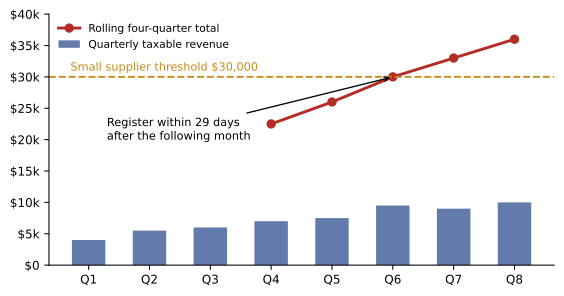
You must register for GST/HST once you are no longer a small supplier. You are a small supplier if your total revenue from worldwide taxable supplies, including zero-rated supplies and those of associated businesses, is $30,000 or less in a single calendar quarter and over the last four consecutive calendar quarters. If you exceed $30,000 in a single quarter, you become a registrant from the supply that took you over the threshold and must charge tax on it. If you exceed $30,000 over four consecutive quarters without exceeding it in one quarter, you stop being a small supplier at the end of the month after that quarter and must register within 29 days. Quebec's QST uses the same $30,000 test. You can also register voluntarily before reaching the threshold.
Worked problem
Testing the small supplier threshold
A creator's taxable revenue by calendar quarter was: Q1 $5,000, Q2 $7,000, Q3 $8,500, Q4 $11,000, and in the next year Q1 $6,000. When did they stop being a small supplier, and when must they register?
Show solution
- No single quarter exceeds $30,000.
- Four quarters ending Q4: $5,000 + $7,000 + $8,500 + $11,000 = $31,500, which exceeds $30,000.
- They cease to be a small supplier at the end of the month following that quarter, which is January 31.
- They must register within 29 days after that and charge GST/HST from the effective date of registration.
Answer: The threshold was crossed over the four quarters ending December 31, so the creator stops being a small supplier on January 31 and must register by the end of February. The next quarter's revenue does not change the result.
Charging GST/HST: place of supply and zero-rating
Once registered, you charge GST/HST at the rate of the province where the supply is made, determined by place of supply rules. For services such as sponsored content supplied to a business, the province is generally based on the recipient's business address. A creator in Alberta billing an Ontario brand therefore usually charges 13 % HST, not 5 % GST. Services supplied to non-residents who are not registered for GST/HST, such as most US brands and foreign platforms paying ad revenue share, are generally zero-rated exports: taxable at 0 %. Zero-rated sales count toward the $30,000 threshold, and you can still claim ITCs on expenses related to them. Some supplies are exempt, meaning no tax is charged and no ITCs can be claimed, but few creator activities fall into that category.
Worked problem
GST/HST on invoices across provinces
An Alberta creator registered for GST/HST invoices three clients for $5,000 each: a brand in Calgary, a brand in Toronto and a brand in Denver, Colorado that is not registered for GST/HST. During the quarter they paid $420 of GST on business expenses. What tax goes on each invoice, and what is the net amount remitted?
Show solution
- Calgary brand: 5 % GST × $5,000 = $250.
- Toronto brand: 13 % HST × $5,000 = $650.
- Denver brand: zero-rated export, $0.
- Tax collected: $250 + $650 + $0 = $900.
- Less ITCs: $900 − $420 = $480 remitted.
Answer: $250, $650 and $0, with a net remittance of $480. The $420 of ITCs includes tax on expenses related to the zero-rated Denver work.
Filing and the quick method
New registrants with annual taxable supplies of $1.5 million or less are usually assigned annual reporting periods, with the return due three months after the fiscal year-end (June 15 for individuals with a December year-end and business income, though payment is due April 30). You can choose to file quarterly or monthly, which spreads payments and can improve discipline. Small businesses with taxable supplies of up to $400,000 a year can elect the quick method: instead of tracking ITCs on most expenses, they remit a set percentage of their tax-included sales. For a service business in a non-participating province such as Alberta, the remittance rate is 3.6 % of GST-included sales; rates differ for HST provinces and for businesses that buy goods for resale. ITCs can still be claimed on capital purchases. The quick method often benefits creators with few taxable expenses, but compare both methods before electing.
Worked problem
Quick method or regular method?
An Alberta creator registered for GST has $80,000 of taxable sales, all to Canadian clients charged 5 % GST, so tax-included sales are $84,000. Taxable expenses are small: they paid $600 of GST on expenses during the year, none on capital property. Compare the GST remitted under the regular method and the quick method at 3.6 %.
Show solution
- Regular method: GST collected $4,000 − ITCs $600 = $3,400.
- Quick method: 3.6 % × $84,000 = $3,024.
- Difference: $3,400 − $3,024 = $376 in favour of the quick method.
- The $376 saving is business income for income tax purposes.
Answer: The quick method saves about $376 and simplifies bookkeeping. A creator with large taxable expenses, or many zero-rated sales on which no GST is collected, might do better under the regular method.
Forms and slips you may receive
Canadian clients do not issue tax slips for most self-employment income, so your own records are what count. Under the CRA's reporting rules for digital platform operators, which took effect for 2024, platforms that facilitate certain services or the rental of property may report sellers' income to the CRA, and the CRA receives information from other countries under similar rules. Assume the CRA can see much of your income and report everything.
Gifted products, trips and barter
The CRA has stated that influencers who receive products or services in exchange for promotion must include their fair market value in income. That includes free products, trips, event tickets, hotel stays and services given on the understanding that you will post about them. If you are a GST/HST registrant, a barter transaction can also be a taxable supply on which you owe GST/HST. Items received with no expectation of content and no obligation are harder to classify, but if the brand expects coverage, treat them as income. Items you must return, or that are used only to make the content and handed back, are not income. Keep a log recording each item, the date, its fair market value and what you posted.
Worked problem
The tax cost of free products
Over a year, a creator receives products worth $6,500 at retail in exchange for posts, plus a trip valued at $2,800. They keep all of it. Their combined marginal rate, including pension or self-employment contributions, is 40 %. What is the tax cost, and what should they consider?
Show solution
- Fair market value received: $6,500 + $2,800 = $9,300.
- Tax at 40 %: 0.40 × $9,300 = $3,720.
- If the creator would not have bought these items, the tax may feel like paying for things they did not want.
Answer: About $3,720 of tax on items that brought in no cash. Creators should decline gifts they do not need, negotiate cash fees instead of product-only deals, and set aside tax on barter income just as they do on cash.
Cross-border income
Canadian residents are taxed on worldwide income, so US and other foreign income must be reported, converted to Canadian dollars. Foreign platforms and brands may withhold tax at source. Google, for example, asks creators to submit US tax information through AdSense; non-US creators who do not submit it can face withholding of up to 24 % of total earnings, while a Canadian who submits Form W-8BEN claiming benefits under the Canada–US tax treaty pays withholding only at the treaty rate on earnings from US viewers, which for many creators is low or zero. Brands in other countries rarely withhold on fees for services performed in Canada, but some countries do. Foreign tax withheld can usually be claimed as a foreign tax credit on your Canadian return. If you perform services in the US, such as appearing at an event, US withholding can apply to that income unless a treaty exemption is claimed in advance.
Paying non-residents can create obligations too. If you pay a US editor for work done in the US, no Canadian withholding usually applies. If you pay a non-resident for services performed in Canada, Regulation 105 may require you to withhold 15 % and remit it to the CRA. Payments to non-residents for rights to use content, such as royalties, may require Part XIII withholding of 25 %, often reduced by treaty. Seek advice before making such payments.
Keep sales tax records with the same care as income tax records: copies of invoices showing tax charged, receipts showing tax paid for ITC claims, and working papers for each return.
Common mistakes
MistakeMissing the point at which revenue passes $30,000 over four quarters.
InsteadTrack the rolling four-quarter total and register on time.
MistakeCharging 5 % GST to clients in HST provinces.
InsteadApply place of supply rules: charge the rate of the client's province.
MistakeSpending sales tax collected as if it were income.
InsteadHold it in a separate account until it is remitted.
MistakeTreating free products and trips as tax-free.
InsteadRecord fair market value of items received for content and report it as income.
MistakeIgnoring US tax forms and losing a share of platform income to withholding.
InsteadSubmit Form W-8BEN with any treaty claim and claim foreign tax credits.
Summary and key terms
- GST/HST is a value-added tax: registrants charge it, claim ITCs and remit the difference.
- Registration is mandatory once taxable supplies exceed $30,000 in a quarter or over four consecutive quarters.
- Rates range from 5 % GST to 15 % HST; Quebec adds 9.975 % QST.
- Place of supply rules set the rate by the client's province; services to non-residents are usually zero-rated.
- The quick method can reduce remittances and bookkeeping for creators with few taxable expenses.
- Products and trips received in exchange for content are income at fair market value.
- Foreign income is taxable in Canada; W-8BEN and foreign tax credits limit double tax.
- GST/HST
- The federal goods and services tax and the harmonized sales tax.
- QST
- Quebec sales tax, 9.975 %.
- Small supplier
- A business with taxable supplies of $30,000 or less, not required to register.
- Input tax credit (ITC)
- A credit for GST/HST paid on business purchases.
- Place of supply
- Rules that decide which province's rate applies.
- Zero-rated supply
- A taxable supply taxed at 0 %, such as most exported services.
- Quick method
- A simplified way to calculate GST/HST remittances.
- Fair market value
- The price a willing buyer would pay a willing seller.
- Form W-8BEN
- A US form certifying foreign status and claiming treaty benefits.
- Regulation 105
- Canadian withholding of 15 % on fees to non-residents for services in Canada.
Practice problems
Work each problem on paper first, then reveal the answer to check.
Quarterly revenue of $9,000, $6,000, $8,000 and $8,500. Still a small supplier?
Show answer
No: $31,500 exceeds $30,000 over four quarters.
HST on a $4,000 invoice to a Nova Scotia business?
Show answer
14 % × 4,000 = $560.
GST and QST on a $2,000 invoice to a Montreal brand?
Show answer
$100 GST and $199.50 QST.
Tax on a $3,000 invoice to an unregistered UK brand?
Show answer
$0: a zero-rated export.
Collected $1,300, ITCs $350. Net remittance?
Show answer
$950.
Quick method at 3.6 % on $52,500 of GST-included sales?
Show answer
$1,890.
Tax on $4,000 of gifted products at a 35 % marginal rate?
Show answer
$1,400.
What form claims US treaty benefits for AdSense earnings?
Show answer
Form W-8BEN.
What withholding applies to fees paid to non-residents for services in Canada?
Show answer
15 % under Regulation 105.
Do zero-rated sales count toward the $30,000 threshold?
Show answer
Yes.
Lesson quiz · 5 questions
Score 60% or more to complete this lesson.
Create a free account to save your progress, take quizzes and earn a certificate.